
As an Amazon Associate I earn from qualifying purchases. This costs you nothing extra and helps us keep Buyiox free.
The One Cheap Habit That Kills Expensive Gear
A thunderstorm rolls through at 2 a.m. You wake up, check the windows, go back to sleep. The next morning the TV will not turn on, the desktop tower is dead, and the router lights are dark. Nothing was wrong with your house – just one power surge, a fraction of a second long, finding every expensive thing you own plugged straight into the wall.
Surges do not always announce themselves. Lightning is the dramatic one, but most damage comes from smaller, silent events: the power grid switching, a neighbor’s heavy appliance cycling, the utility restoring power after an outage. Each small spike wears down sensitive electronics a little more, until something expensive gives up quietly.
And here is the part most people get wrong: the white strip behind your TV with eight outlets is probably not protecting anything at all. A power strip and a surge protector are two different devices, and most strips sold as “power strips” have zero surge protection inside. They split one outlet into many – and call it a day.
We researched six real, currently available surge protectors – verified joule ratings, verified prices, real owner complaints included – with one rule guiding every pick: would this actually stop a surge from frying what you plug into it? Prices below are marked approximate because they shift constantly on Amazon.
The Lie on the Box: Power Strip vs Surge Protector
Before the list, you need this thirty-second lesson, because it is where most people lose money. A power strip gives you more outlets. A surge protector gives you more outlets plus protective components – usually metal oxide varistors, or MOVs – that detect dangerous voltage spikes and divert the excess energy safely away from your gear. The packaging often blurs the two on purpose.
How to tell what you are holding? Look for a joule rating. Real surge protectors print it: 1000 joules, 2100 joules, 4500 joules. If the box has no joule rating anywhere, treat it as a plain power strip, no matter what word the marketing copy uses. A “surge” LED that just lights up when the strip has power is not the same thing as surge protection either.
Joules are the whole game. A joule rating measures how much energy the protector can absorb before its components wear out and it becomes a plain strip. Think of it as a shield with a limited number of hits: every surge the protector eats, big or small, spends some of that budget. When it is spent, the outlets still deliver power – but the protection is gone. That is why the better picks below have indicator lights and warranties that mean something.
Quick Comparison: The 6 Best Surge Protectors
| Product | Best For | Approx. Price |
| — | — | — |
|---|---|---|
| Anker 351 Power Strip | Best overall | Around $29 |
| Tripp Lite by Eaton TLP1208SAT | Best for home office and media | Around $65 |
| Belkin 12-Outlet Surge Protector | Best maximum protection | Around $40 |
| SUPERDANNY 12-in-1 Flat Plug | Best compact | Around $20 |
| APC SurgeArrest Performance P11VNT3 | Best trusted brand | Around $70 |
| Amazon Basics 8-Outlet Surge Protector | Best budget | Around $18 |
Prices change often on Amazon, so treat these as rough guides. The links below take you to live Amazon search results where you can check the current price.
1. Anker 351 Power Strip – Best Overall
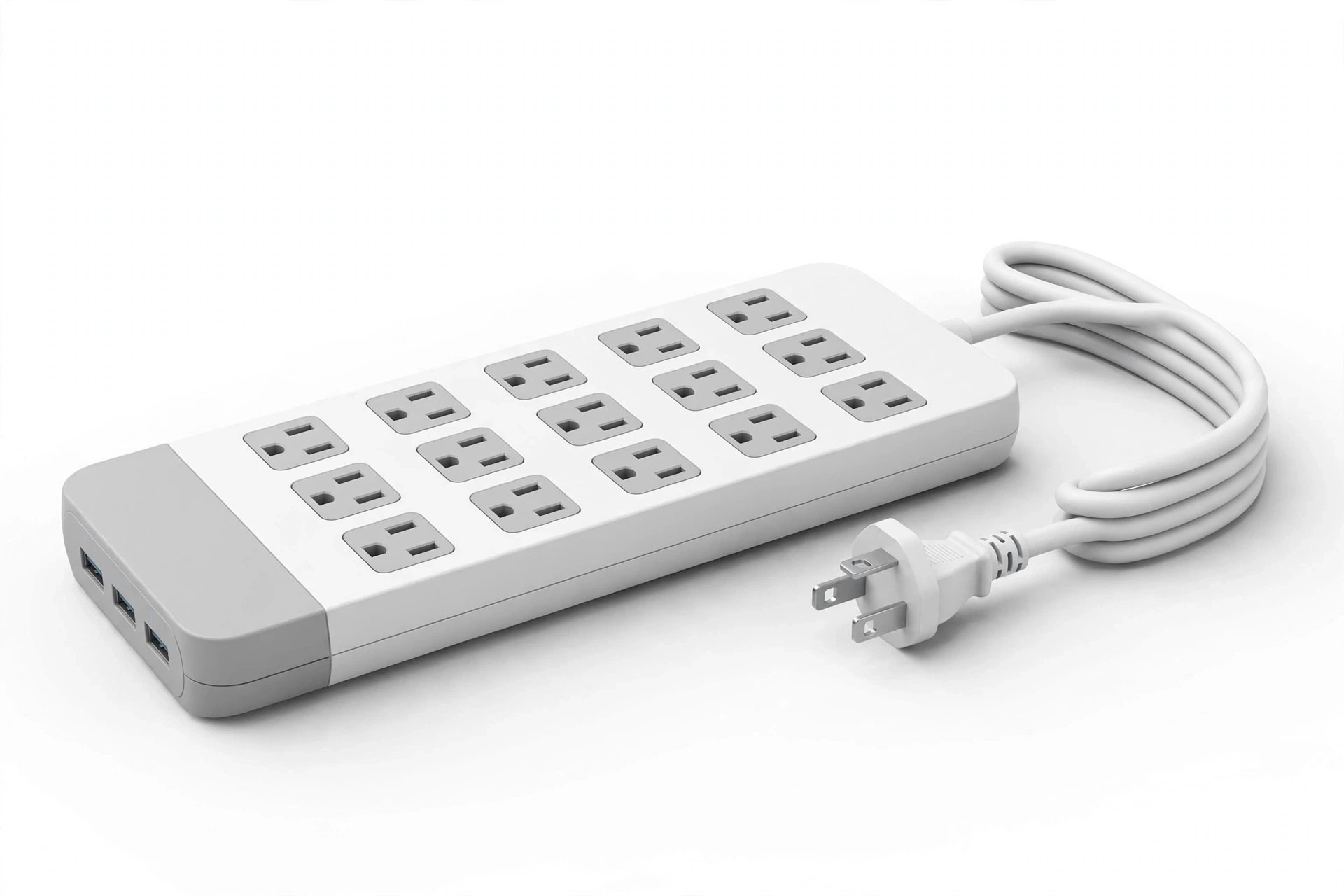
The Anker 351: 12 outlets plus 3 USB ports (20W USB-C), 2100 joules of surge protection, and a flat 5-foot cord.
The Anker 351 is the rare surge protector that nails both jobs: protecting your gear and organizing your cables. Twelve AC outlets give you room for a full desk – monitor, PC, printer, speakers, lamp, charger bricks – while one 20W USB-C and two USB-A ports handle phones and accessories without occupying a single outlet. Anker’s own product page confirms the model number A9192 and the USB breakdown: 20W USB-C plus 2.4A USB-A ports (https://www.anker.com/ca/products/a9192?ref=footer).
The protection is real but honest: 2100 joules with an 8-point safety system covering overload protection, fire resistance, and temperature control. That is solid for a home office or bedroom, though not the heaviest rating on this list. The layout is the standout – the outer outlets are spaced 1.5 inches apart, so fat power bricks stop swallowing neighboring sockets. The flat 5-foot plug sits nearly flush against the wall, and keyhole slots let you mount the whole thing under a desk.
The warranty is the real confidence builder: Anker backs it with a $200,000 connected equipment warranty for the lifetime of the product, meaning if a surge damages your properly connected gear, Anker covers the loss up to that limit. CNN’s hands-on testing picked it as the best overall surge protector, specifically praising the outlet layout that “required the least compromise” (https://www.cnn.com/cnn-underscored/reviews/best-surge-protectors?cid=external-feeds_iluminar_meta).
Pros:
- 12 outlets with extra spacing for bulky power bricks
- 20W USB-C fast charging plus 2 USB-A ports – no charger brick needed
- 2100 joules of verified surge protection with TUV safety certification
- $200,000 connected equipment warranty backs the protection claims
- Flat plug and wall-mount keyholes for clean desk setups
- Widely praised by hands-on testers, not just spec readers
Cons:
- 5-foot cord is shorter than most here – measure your desk-to-wall distance
- 20W USB-C speed drops when the USB-A ports are in use simultaneously
- 2100 joules is mid-range; home theaters get better from the Belkin or Amazon Basics
- No coax or phone-line protection for cable boxes
Best for: Home offices and desks where you want lots of outlets, USB charging built in, and a strip that does not eat the whole wall. The best surge protector overall.
Skip if: Your wall outlet is more than 5 feet from the desk, or you need to protect a full home theater – the Belkin below gives you double the joules.
2. Tripp Lite by Eaton TLP1208SAT – Best for Home Office and Media
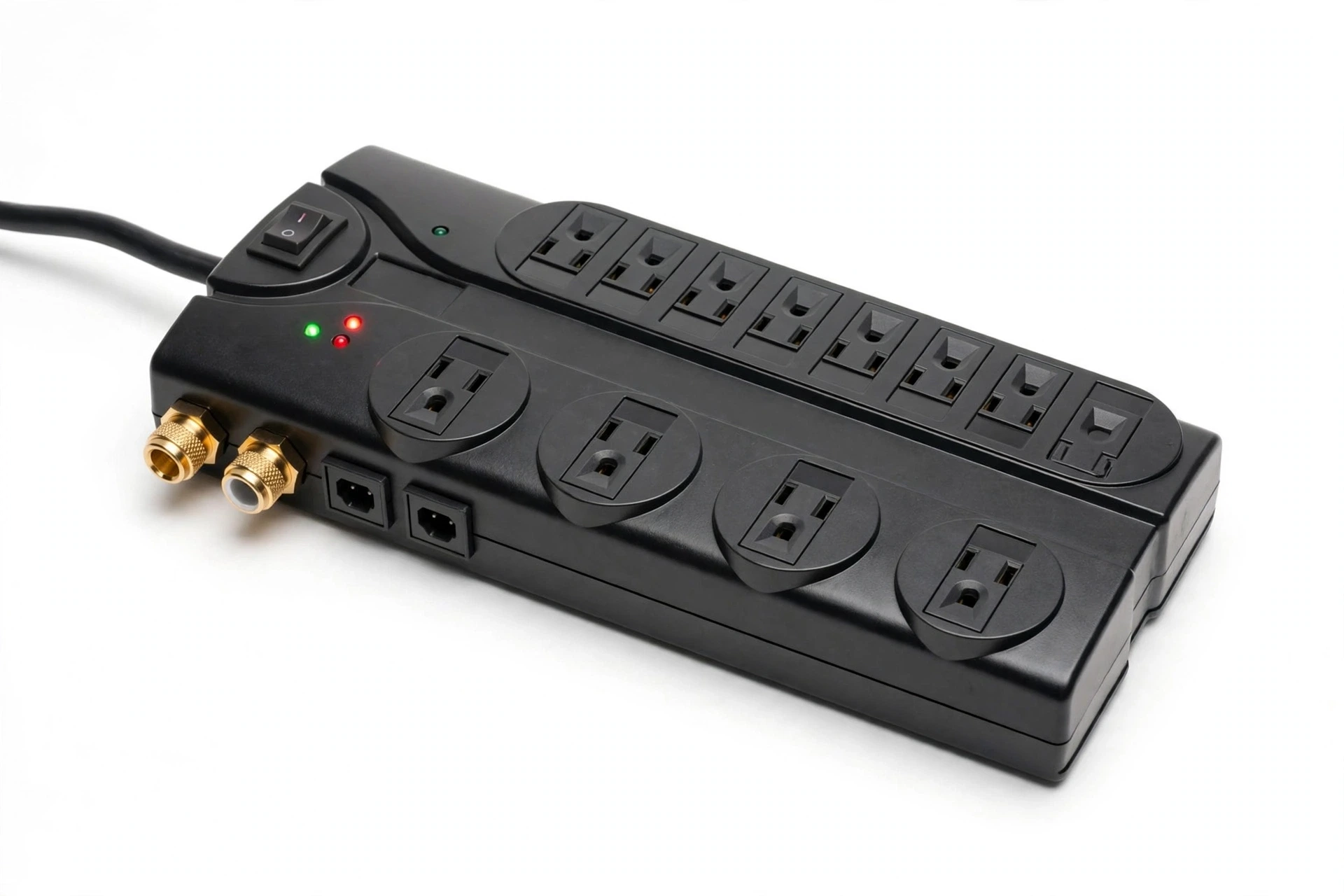
The Tripp Lite TLP1208SAT: 12 outlets, 2880 joules, and phone, ethernet, and coax line protection for your whole media setup.
The Tripp Lite TLP1208SAT is the pick when your setup has more than just plugs: a cable box, a router, a modem, a landline. Surges do not only arrive through power lines – they ride in on cable, phone, and ethernet lines too. This is the only pick under around $70 that protects all three, with built-in gold coax jacks rated for 2.2GHz broadband, RJ45 ethernet jacks, and 2-line RJ11 phone jacks. Eaton’s official spec sheet lists 2880 joules, the 8-foot cord, and UL 1449 listing (https://www.eaton.com/us/en-us/skuPage.TLP1208SAT.pdf).
The design is built for people who have actually wrestled with cables. Up to four transformer blocks fit without covering neighboring outlets, every outlet has an integrated child safety cover, and diagnostic LEDs show at a glance whether protection and grounding are present. The 8-foot cord ends in a space-saving right-angle plug. If the protection circuit takes a fatal hit, an audible alarm sounds and the unit shuts off power to the outlets automatically – so a dead protector can never masquerade as a live one.
That auto-shutoff is a bigger deal than it sounds. Cheaper strips keep passing power after their protection is gone, quietly leaving your gear unguarded. The TLP1208SAT refuses to do that. Behind it sits a $250,000 Ultimate Lifetime Insurance policy for connected equipment – one of the strongest guarantees in the category.
Pros:
- 2880 joules – the strongest protection here in a media-capable strip
- Protects power, coax, phone, and ethernet lines – surges have four doors, this closes all four
- Auto-shutoff plus audible alarm when protection is spent – never silently unguarded
- Diagnostic LEDs confirm protection and grounding at a glance
- Accommodates up to 4 transformer blocks without blocking outlets
- $250,000 connected equipment insurance and lifetime warranty
Cons:
- Clamping voltage of 150V (RMS spec) is less tight than the Belkin’s ratings
- Bulky 12-outlet housing – not a tuck-behind-furniture pick
- No USB ports at all
- Pricier than simpler strips with similar outlet counts
Best for: Home offices and media centers with cable boxes, modems, routers, and landlines – anywhere a surge could arrive through a data line, not just the wall. The best surge protector for home office and media.
Skip if: You just need USB charging and a compact strip – the Anker or SUPERDANNY fits that bill cheaper.
3. Belkin 12-Outlet Surge Protector – Best Maximum Protection
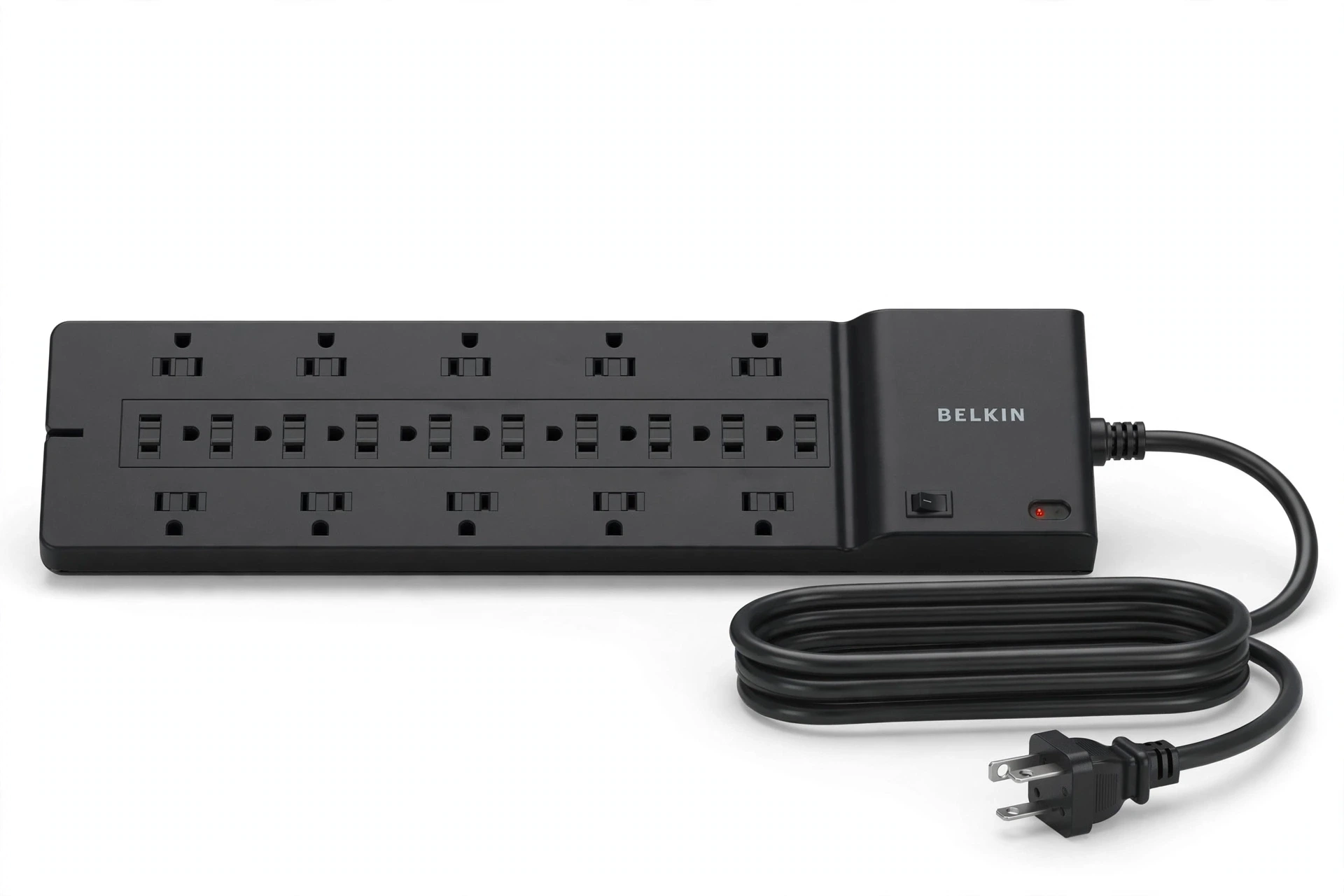
The Belkin 12-outlet: 3940 joules, phone, ethernet, and coax protection, and a $300,000 connected equipment warranty.
If joules are the shield’s hit points, the Belkin 12-outlet brings the biggest shield under around $50: 3940 joules of surge protection. That is nearly double the Anker’s rating and well above what most home theater setups need. Belkin’s official page pairs it with a lifetime product warranty and a $300,000 connected equipment warranty – if a surge damages your properly connected gear, Belkin repairs or replaces it up to that limit (https://www.belkin.com/p/12-outlet-home%2Foffice-surge-protector-w%2Fphone%2Fethernet%2Fcoax-protection/BE112234-10.html?bvstate=pg%3A2%2Fct%3Ar).
The physical design shows Belkin has been making these for decades. Six standard outlets plus six block-space outlets means fat power bricks actually fit. EMI and RFI noise filtering up to 75dB keeps interference out of audio and video gear – a small detail that matters when your receiver sits next to the strip. Phone, ethernet, and coax protection close the data-line doors, the 8-foot cord uses a space-saving angled plug, and every outlet has a sliding safety cover.
Belkin is also honest about one thing most brands bury: surge protectors wear out. Their guidance says to replace a surge protector every 3 years or immediately after any major over-voltage event like a thunderstorm or power outage, because the MOVs absorb spikes by sacrificing themselves. Treat the “protected” indicator light as the dashboard warning – when it goes out, the shield is spent even though the outlets still work.
Pros:
- 3940 joules – the highest protection rating of any pick under $50
- $300,000 connected equipment warranty plus lifetime product warranty
- Block-space outlet layout actually fits bulky adapters
- Phone, ethernet, and coax line protection included
- EMI/RFI noise filtering up to 75dB for cleaner AV performance
- 8-foot cord with angled plug fits tight spaces
Cons:
- No USB ports – plan for a separate charger for phones
- Long 13-inch housing needs real space behind a TV stand
- Like every protector, it degrades – expect replacement every few years
Best for: Home theaters, gaming setups, and anyone who wants the maximum joule rating and the strongest equipment warranty without paying premium prices. The best surge protector for maximum protection.
Skip if: You need USB charging on the strip itself – the Anker 351 covers that without losing much.
4. SUPERDANNY 12-in-1 Flat Plug Power Strip – Best Compact
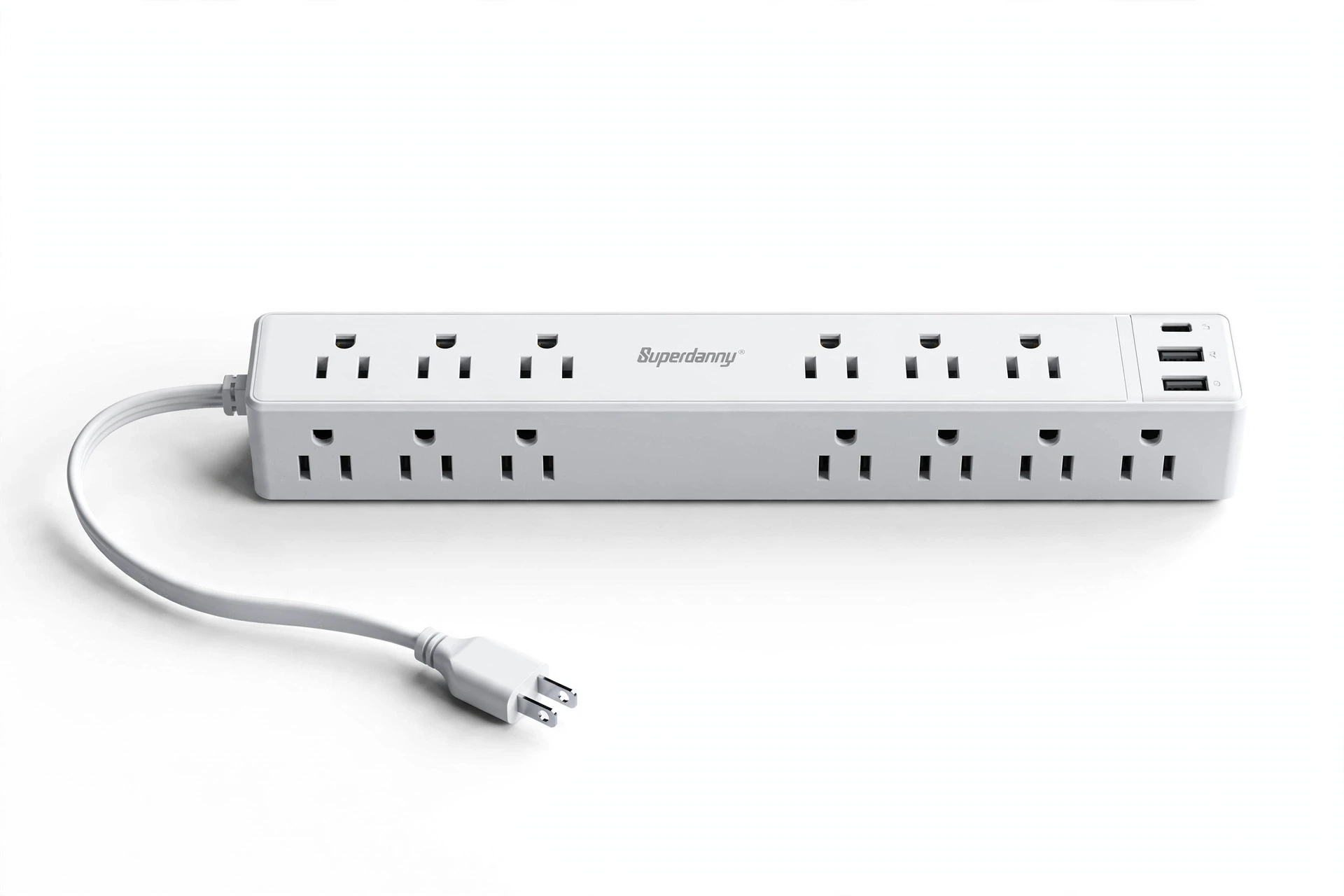
The SUPERDANNY 12-in-1: 8 AC outlets plus 4 USB ports in a compact flat-plug strip that hides behind furniture.
The SUPERDANNY 12-in-1 exists for one problem: the outlet is behind the couch. Its ultra-thin 0.3-inch flat plug slides behind furniture where no normal plug will go, and the flat 10-foot cord runs under rugs without a tripping bump. Eight AC outlets wrap around three sides of the compact housing with wide spacing, so nothing blocks nothing – plus four USB ports (two USB-A, two USB-C) for phones and tablets. Mounting holes let you screw it to a desk leg or wall.
The honest part: at 1050 joules, this is surge protection for small stuff, not for your OLED TV. It is a fair match for lamps, phone chargers, alarm clocks, and coffee machines – gear where you want some protection and lots of reach, not where you bet a $2,000 entertainment stack. The 1250W, 10A rating is lower than the full-size picks here, and the USB-C ports are standard 5V, not fast-charging – fine for overnight charging, not for a quick top-up.
That is not a criticism, just the trade-off of the compact category. For a dorm room, a bedside, a rental where the only outlet is trapped behind furniture, the SUPERDANNY solves the real problem better than any 12-outlet beast could. Just do not plug your home theater into it.
Pros:
- Ultra-thin 0.3-inch flat plug fits behind furniture – the whole point of the design
- 8 AC outlets plus 4 USB ports (2 USB-A, 2 USB-C) in a compact body
- 10-foot flat cord runs under carpets and reaches distant outlets
- Wide 3-sided outlet spacing – no plug blocks its neighbor
- Wall-mount holes for desks and dorm rooms
- Around $20 – the cheapest way to add real surge protection
Cons:
- 1050 joules – modest; not enough for TVs, PCs, or home theater gear
- 1250W/10A max load is lower than standard 1875W strips
- USB-C ports are not fast-charging
- Small brand with a smaller warranty story than Anker, Belkin, or APC
Best for: Dorms, bedside tables, rentals, and anywhere the outlet is trapped behind furniture. The best compact surge protector.
Skip if: You need to protect expensive electronics – put a 2000J+ protector like the Anker or Belkin between those and the wall.
Buying Guide: How to Choose a Surge Protector
The wrong surge protector is a false friend: a strip that keeps passing power long after its protection is gone. Six decisions keep you honest.
Joules: the one number that matters
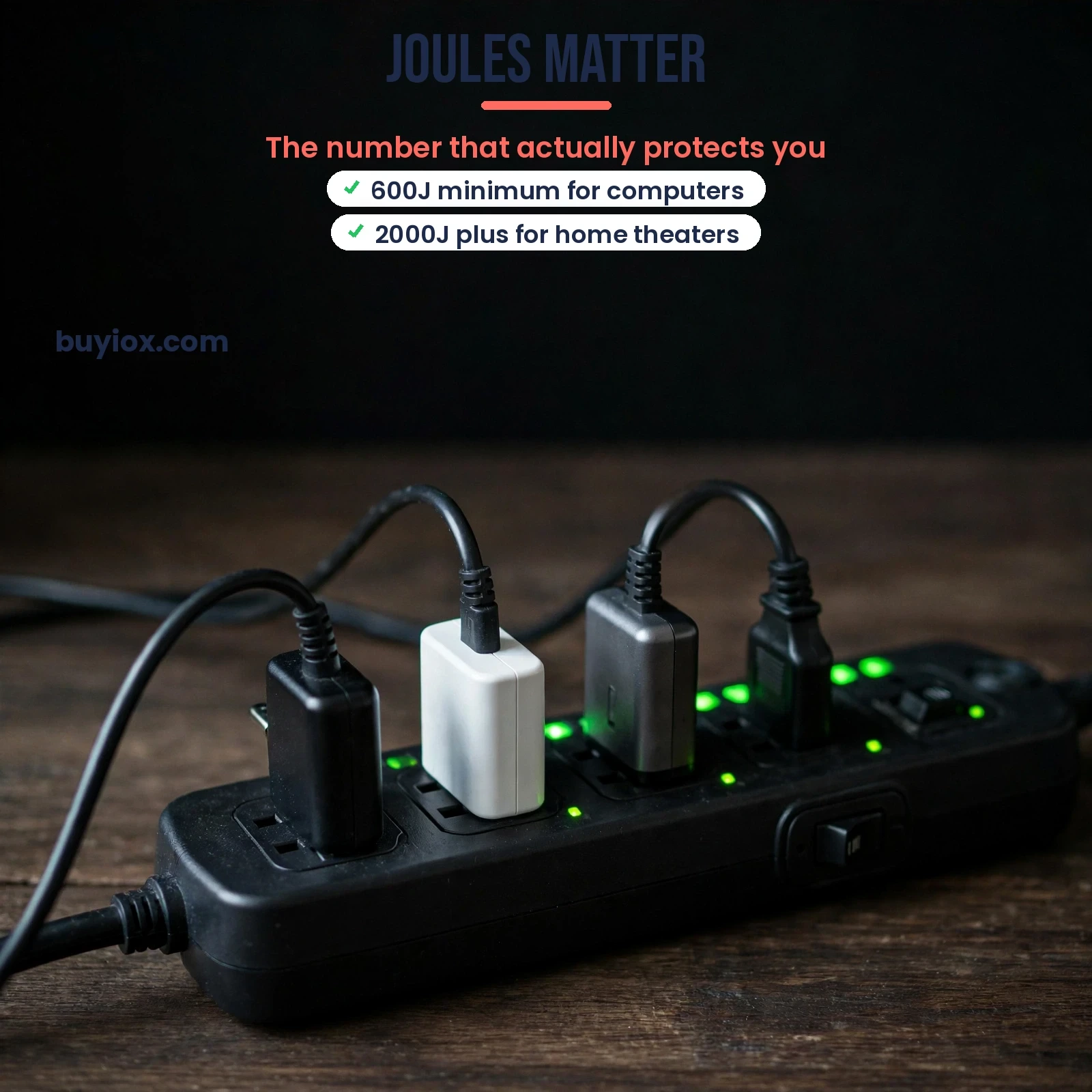
Joules measure how much surge energy the protector can absorb over its life. The practical minimums are simple: around 600 joules is the floor for protecting computers and desks, and 2000 joules or more is the right zone for home theaters and expensive electronics. Below 600 joules you are in lamp-and-charger territory. A strip that publishes no joule rating is almost certainly just a power strip – skip it for anything you care about.
Clamping voltage: how fast it reacts
Clamping voltage is the threshold where the protector starts diverting a spike. Lower is better: a 330V clamping rating (standard on good UL 1449 strips) means protection kicks in sooner for 120V household circuits than a looser 500V rating. When two strips have similar joule ratings, the one with the lower clamping voltage protects better.
Power strip vs surge protector: check before you buy
This deserves repeating because the packaging lies. If the box says “power strip” and lists no joule rating, it offers no surge protection – it just adds outlets. Many cheap “surge” strips have a light that simply shows the unit has power, not that surge components are inside. Real protectors list a joule rating, a UL 1449 or ETL listing, and usually a connected equipment warranty.
USB charging: convenience with a budget
Built-in USB ports (like the Anker 351’s 20W USB-C) eliminate charger bricks and free up outlets – a genuine quality-of-life upgrade for desks. But check the shared wattage: many strips advertise USB-C fast charging that only runs full speed when other USB ports are idle. For laptops you still want a real charger; for phones, earbuds, and tablets, strip USB is plenty. Pair a USB strip with a best portable charger and you are covered at the desk and on the road.
Cord length, flat plugs, and outlet spacing
Measure before you buy. The Anker’s 5-foot cord is great for a desk near a wall and useless if your outlet is across the room – the Belkin and Tripp Lite give you 8 feet, the SUPERDANNY gives you 10. Flat plugs (Anker, SUPERDANNY) let furniture sit flush against the wall. And count your actual wall warts: wide or block-space outlets (Belkin, Tripp Lite) keep fat adapters from eating neighboring sockets.
Data-line protection and connected equipment warranties
Surges travel through cable, phone, and ethernet lines, not just power outlets. If your setup includes a cable box, modem, or landline, protect those lines too – the Tripp Lite TLP1208SAT and Belkin both include them. And a connected equipment warranty ($100,000 to $300,000 on this list) is the brand putting money behind its claims. It is not a perfect insurance policy – terms apply – but its presence separates real protection from marketing.
What never to plug into a surge protector
Not everything belongs on one. Space heaters and hair dryers draw 1,500 watts or more and can overheat even heavy-duty strips. Refrigerators cycle high-power compressors that wear protectors out fast. Medical equipment like CPAP machines belongs on a UPS with battery backup, not a strip that may cut power. And never daisy-chain one surge protector into another – that is a fire hazard. Plug those directly into the wall.
5. APC SurgeArrest Performance P11VNT3 – Best Trusted Brand
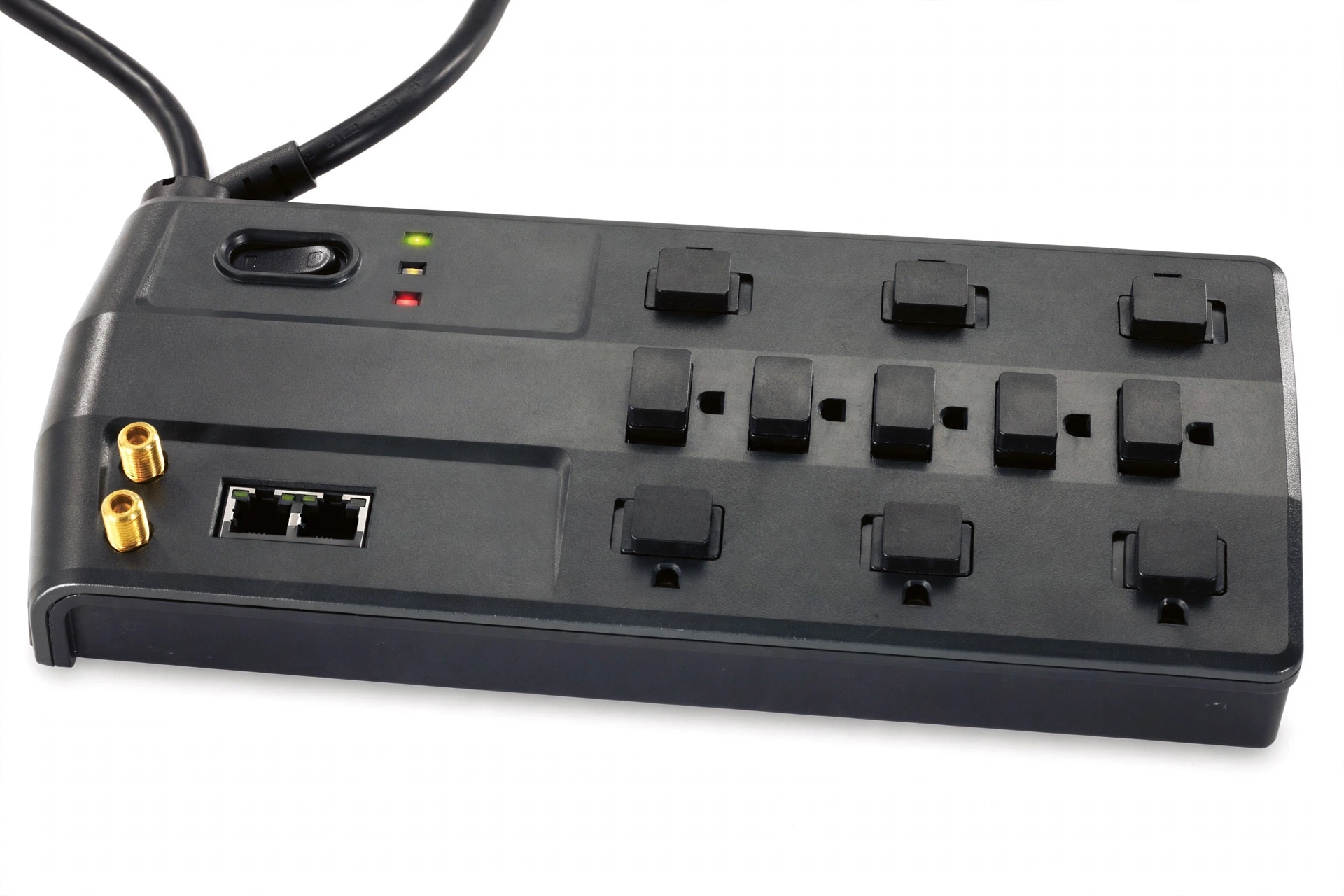
The APC P11VNT3: 11 outlets, 3020 joules, and coax plus phone plus ethernet protection from the most trusted name in power.
APC is the brand that runs the battery backups in corporate server rooms. The SurgeArrest Performance P11VNT3 brings that pedigree to a home strip: 11 outlets, 3020 joules of surge protection, and data-line protection for phone (with a 2-way splitter), cable modem/video coax, and ethernet. When it is time to trust a brand with your $3,000 PC, “the company that protects data centers” is a reasonable argument.
The build is purposeful rather than pretty. Safety covers guard unused outlets, LED indicators report protection and wiring status, a built-in circuit breaker guards against overloads, and EMI/RFI noise filtering rated at 70dB keeps interference away from sensitive gear. APC backs it with a $100,000 equipment protection policy and their reputation for honoring it.
The honest trade-offs: it is the priciest pick here at around $70, and it offers no USB ports – APC expects you to bring your own chargers. The clamping voltage of 500V is also on the looser side compared to tighter 330V strips. You are paying for the brand, the 3020 joules, and the data-line coverage in one package.
Pros:
- 3020 joules – serious protection from the most trusted power brand
- Phone, coax, and ethernet data-line protection in one strip
- Built-in circuit breaker plus safety covers on every outlet
- 70dB EMI/RFI noise filtering for sensitive electronics
- Diagnostic LEDs for protection and wiring status
- $100,000 equipment protection policy
Cons:
- Around $70 – the priciest pick on this list
- No USB ports at this price
- 500V clamping voltage is looser than 330V alternatives
- Bulky form factor for a desk
Best for: Anyone who wants the APC name between their gear and the grid – especially PC and workstation setups where the brand’s data-center reputation matters. The best surge protector from a trusted brand.
Skip if: You want USB charging or the tightest value per dollar – the Anker gives you both cheaper.
6. Amazon Basics 8-Outlet Surge Protector – Best Budget
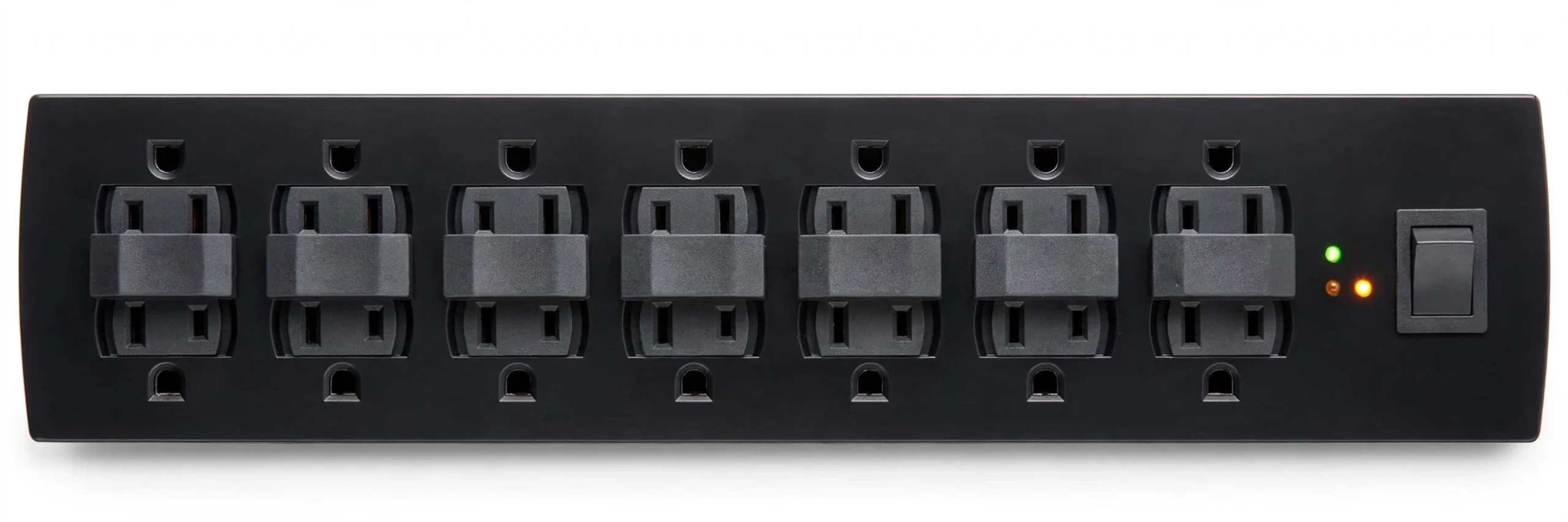
The Amazon Basics 8-outlet: 4500 joules, a 6-foot cord, and the cheapest real surge protection on this list.
Here is the surprise of the list: the cheapest pick has the highest joule rating. The Amazon Basics 8-outlet surge protector packs 4500 joules – more than the Belkin, more than double the Anker – into a plain black strip that usually sells for around $18. Eight outlets with sliding safety covers, a 6-foot cord, an LED indicator, and a resettable 15A overload circuit breaker cover the essentials without any fuss.
What do you give up? Plenty of convenience: no USB ports, no data-line protection for coax or phone lines, no connected equipment warranty (Amazon Basics covers the unit itself with a 1-year warranty, not your gear), and a basic plastic housing with none of the design polish of the Anker or Belkin. The outlets are reasonably spaced but not block-space wide, so a couple of fat bricks will still eat neighbors.
But if the job is “put real surge protection between my stuff and the wall for the least money,” nothing else here touches it. 4500 joules at around $18 is an absurd ratio – and the LED indicator plus resettable breaker mean you are not flying blind. This is the one to buy when you need several: one for the living room, one for the bedroom, one for the garage. The manual confirms the 4500-joule protection rating and 6-foot cord (https://manuals.plus/amazon-basics/b07gfrkrzg-4500-joule-8-outlet-surge-protector-manual.pdf).
Pros:
- 4500 joules – the highest rating on this list, at the lowest price
- Around $18 – less than half the price of most picks
- Resettable 15A overload circuit breaker built into the power switch
- Sliding safety covers on every outlet, keyhole mounts on the back
- LED indicator shows protection status
- Fire-resistant housing materials
Cons:
- No connected equipment warranty – only a 1-year product warranty
- No USB ports and no coax/phone/ethernet line protection
- Basic build and tight-ish outlet spacing for big adapters
- Amazon Basics branding will not win design awards
Best for: Anyone who needs solid surge protection on a budget – or needs to protect three rooms for the price of one premium strip. The best budget surge protector.
Skip if: You want the warranty safety net behind your gear, or you need USB charging – the Anker is the upgrade.
Frequently Asked Questions
What is the difference between a power strip and a surge protector?
A power strip only adds outlets – it splits one wall socket into many and does nothing about voltage spikes. A surge protector adds outlets plus protective components (usually MOVs) that detect dangerous spikes and divert the excess energy away from your gear. The quickest test: if the product lists a joule rating, it is a surge protector. No joule rating means no meaningful surge protection, regardless of what the packaging claims.
How many joules should a surge protector have?
It depends on what you are protecting. Around 600 joules is a reasonable minimum for computers and desk electronics, and 2000 joules or more is the right range for home theaters and other expensive gear. For basic items like lamps and phone chargers, 1000 joules is plenty. More joules means the protector can absorb more surges over its life before wearing out – it is the size of the shield, not a guarantee against a direct lightning strike.
What does clamping voltage mean on a surge protector?
Clamping voltage is the threshold at which the protector starts diverting a voltage spike away from your devices. Lower is better: a 330V clamping rating reacts sooner for standard 120V household circuits than a looser 500V rating. When comparing two protectors with similar joule ratings, the one with the lower clamping voltage gives you tighter protection. Look for UL 1449 listed strips, which publish verified ratings.
Do surge protectors wear out? How often should I replace mine?
Yes – and this is the fact most people miss. The protective components absorb surges by sacrificing themselves, so every spike the protector eats spends some of its joule budget. Belkin advises replacing a surge protector every 3 years or immediately after any major over-voltage event such as a thunderstorm or power outage. Watch the “protected” indicator light: when it goes dark, the outlets still pass power but the surge protection is gone, and you are running unguarded.
Can a surge protector protect against lightning?
Only against indirect lightning – surges that enter through the power lines during a storm. No plug-in strip can stop a direct lightning strike to your house; that energy level dwarfs any consumer device. For the best defense, layer your protection: a plug-in surge protector at the outlet for your most valuable gear, plus a whole-home surge protection device installed at your breaker panel by an electrician for major events.
What should I never plug into a surge protector?
Keep high-draw and critical equipment off your strip. Space heaters, hair dryers, and similar tools draw 1,500 watts or more and can overheat even heavy-duty strips. Refrigerators and freezers cycle power-hungry compressors that wear protectors out prematurely. Medical equipment like CPAP machines should run on a UPS with battery backup, which keeps power on during outages instead of cutting it. And never daisy-chain one surge protector into another – plug a second unit directly into a separate wall outlet.
Does a surge protector protect against power outages?
No. A surge protector guards against voltage spikes, not against power going away – when the power cuts, it cuts through the strip too. If you need your computer or router to stay on during a blackout, you want a UPS (uninterruptible power supply), which includes a battery and usually surge protection built in. Think of it this way: a surge protector saves your gear from bad power, a UPS saves your gear from no power.
Final Verdict: Which Surge Protector Should You Buy?
If you want our single top recommendation, it is the Anker 351 Power Strip. Twelve outlets, 20W USB-C charging, 2100 joules of protection, a $200,000 connected equipment warranty, and a layout that real testers praise – it is the best surge protector for the way most people actually use one: a desk full of gear that needs power, protection, and charging in one strip.
For maximum protection, the Belkin 12-Outlet gives you 3940 joules and a $300,000 warranty for around $40 – the strongest shield per dollar here. If your setup has cable boxes and modems, the Tripp Lite TLP1208SAT protects the data lines too. The APC P11VNT3 is the pick when the brand name itself is the reassurance. On a tight budget, the Amazon Basics puts 4500 joules between your gear and the grid for around $18. And for dorms and tight spaces, the SUPERDANNY flat-plug strip goes where nothing else fits.
Whatever you choose, protect the rest of your setup the same way. Your home theater stack benefits from a best mini projector fed through a real protector rather than the wall, ambient gear like the best digital photo frames deserves better than a bare outlet, and if you travel with chargers worth protecting, the best Bluetooth key finders roundup keeps track of the gear your strip keeps alive. Plug in smart.