
Affiliate Disclosure: As an Amazon Associate, Buyiox earns from qualifying purchases. This means if you buy through our links, we may earn a small commission at no extra cost to you. We only recommend products we would buy for our own bedrooms.
Why Your Phone Alarm Is Ruining Your Mornings
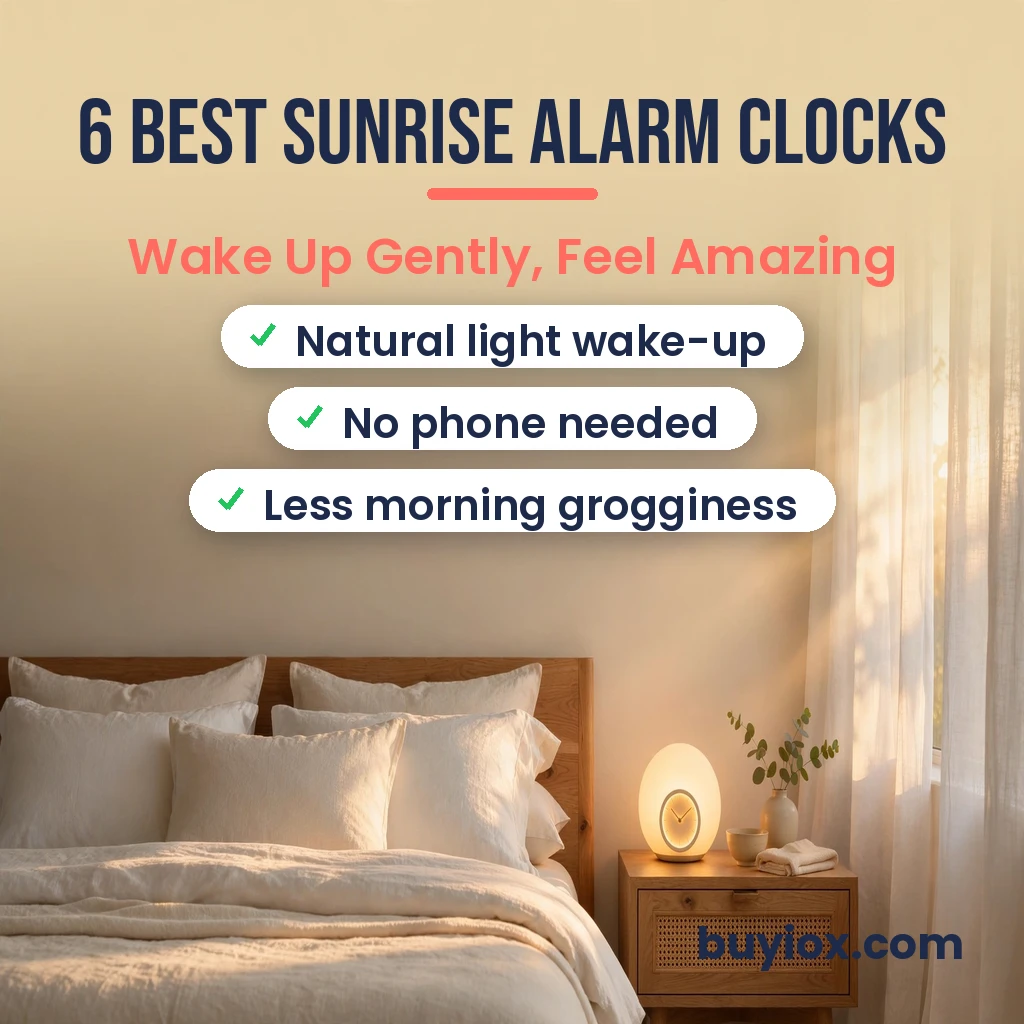
Does your phone alarm feel like a fire drill going off inside your skull? You jolt awake, heart pounding, already reaching for your phone – and before your feet hit the floor you have doomscrolled through twenty minutes of bad news. If that is your morning, you are not broken. You are just waking up the wrong way.
A sunrise alarm clock flips the script. Instead of a blaring tone, a lamp on your nightstand starts glowing softly 20 to 60 minutes before your alarm, shifting from deep red through warm orange to bright yellow – just like a real dawn. Light seeps through your closed eyelids, gently pulls your body out of deep sleep, and by the time the sound kicks in (soft, melodic, nothing like a siren) you are already half awake. The Sleep Foundation notes that dawn simulators can improve alertness and cognitive function after waking, and that a harsh mid-sleep-phase alarm is what causes that groggy “sleep inertia” feeling.
There is real science behind this. Morning light is the strongest signal your body clock listens to – Cleveland Clinic sleep experts call sunlight a “clock setter” that regulates your sleep-wake cycle. When winter steals your mornings and it is pitch black at 7 AM, a sunrise clock is the next best thing to actual dawn.
We dug through the research, the reviews, and the spec sheets to find the six sunrise alarm clocks actually worth your money – from the $35 budget hero to the premium light-therapy lamp. Every pick below has its honest downsides listed too, because a review that hides the subscription trap is not a review you can trust.
Quick Picks: The 6 Best Sunrise Alarm Clocks at a Glance
- Best Overall: Philips SmartSleep Wake-Up Light HF3520 – 300 LUX, 5 wake sounds, no app or subscription, just works
- Best Sleep Routine: Hatch Restore 3 – gorgeous design, 80+ sleep sounds, full bedtime routine system (watch the Hatch+ subscription)
- Smoothest Sunrise: Lumie Bodyclock Shine 300 – 320 LUX, adjustable 15 to 90 minute sunrise ramp, FM radio
- Best Design: Dreamegg Sunrise 1+ – Hatch-style fabric look, 34 sounds, app control optional
- Best Budget: JALL Wake Up Light – dual alarms, 7 sounds, around $35, the cheapest way to try the concept
- Brightest / Premium: Philips SmartSleep Somneo HF3650 – 310 LUX, RelaxBreathe wind-down, the flagship Philips
The 6 Best Sunrise Alarm Clocks Reviewed
1. Philips SmartSleep Wake-Up Light HF3520 – Best Overall
The HF3520 is the sunrise clock that made the category famous, and it is still the one most sleep experts recommend first. Philips built it with clinical sleep researchers, and it shows: the sunrise color ramp moves through soft red, warm orange, and bright yellow over a fixed 30 minutes, ending at 300 LUX of light. That is the brightest, most convincing artificial dawn in this price range.
It also does everything a bedside clock should. You get 5 natural wake-up sounds (birds, sea waves, and the like), an FM radio you can wake to, a sunset simulation that fades the light down to ease you to sleep, a reading lamp with 20 brightness levels, tap-to-snooze, and 2 alarms. With over 14,000 Amazon reviews and a 4.5-star average, it is the most battle-tested pick on this list. Prices move around – we have seen it between around $76 and $106.
Here is the honest part. There is no app and no WiFi. Everything runs through physical buttons, which is a feature for anyone who wants a phone-free bedroom, but a dealbreaker if you like tweaking routines from your couch. The sunrise ramp is fixed at 30 minutes – you cannot stretch it to 60 like you can on the Hatch or Lumie. And some light-sensitive users note a faint flicker at the very lowest brightness settings, worth knowing if that bothers you.

Philips SmartSleep Wake-Up Light HF3520 – best overall, around $76 to $106
Pros:
- Clinically developed sunrise simulation with the most natural color ramp
- 300 LUX peak brightness – strong enough for genuinely heavy sleepers
- Sunset simulation, FM radio, reading lamp, and 2 alarms in one device
- No app, no WiFi, no subscription – it just works every morning
- Over 14,000 reviews averaging 4.5 stars
Cons:
- No app or WiFi control – physical buttons only
- Sunrise ramp fixed at 30 minutes, not adjustable
- Slight flicker reported at the lowest brightness levels
Best for: Almost everyone. Deep sleepers who want the most reliable, no-fuss wake-up. People who want their bedroom phone-free.
Skip if: You want app control, adjustable sunrise duration, or a full sleep-content library.
2. Hatch Restore 3 – Best Sleep Routine / Smart Pick
The Hatch Restore 3 is not just an alarm clock – it is a whole sleep system. The half-dome device in soft putty fabric looks like a design object, not a gadget. It runs a full routine: a sunset wind-down at night with 80+ science-backed sleep sounds, meditations, and white noise, then a gentle sunrise in the morning over 10 to 60 minutes, fully customizable through the Hatch Sleep app.
The experience is genuinely lovely. One big button starts your routine, adjusts volume, and handles snooze without you ever touching your phone. The sound library is the best in this roundup by a mile, and reviewers consistently call the sunrise the most natural-feeling of any clock they have tested. At $169.99 it is premium but fair for what it does.
Now the catch you need to know before buying. The Hatch+ subscription costs $4.99 a month or $49.99 a year after the included 30-day trial, and it gates most of the content library – the meditations, sleep stories, and much of the sound collection. The core features (sunrise alarm, basic sounds, custom routines) work fine without paying, but the device clearly nudges you toward the subscription. It also needs the app and WiFi for setup, and there is no battery backup – a power cut means a dead alarm.

Hatch Restore 3 – best sleep routine pick, around $170 (plus optional Hatch+ subscription)
Pros:
- Beautiful design that actually belongs on a nightstand
- 80+ sleep sounds, meditations, and white noise – the richest audio library here
- Fully customizable 10 to 60 minute sunrise and sunset routines
- One-button control – genuinely usable half asleep
- Core sunrise and sounds work without the subscription
Cons:
- Hatch+ subscription ($4.99/month or $49.99/year) gates most of the content
- App and WiFi required for setup and full features
- No battery backup
- Premium price at around $170
Best for: People who want a full bedtime routine, not just an alarm. Sound-machine lovers. Anyone building a phone-free bedroom.
Skip if: You hate subscriptions, or you want a simple device with physical buttons only.
3. Lumie Bodyclock Shine 300 – Smoothest Sunrise
Lumie is the British company that has been making wake-up lights since before most people had heard of them, and the Bodyclock Shine 300 is their sweet spot. It puts out 320 LUX – the highest peak brightness on this list – and lets you stretch the sunrise ramp anywhere from 15 to 90 minutes. That long, slow ramp is what makes its wake-up feel the most like a real dawn.
It is also a proper bedside hub: 15 sleep and wake sounds, an FM radio with 5 presets, a 7-day alarm you can program differently for weekdays and weekends, tap-to-snooze, an auto-dimming display, and a dimmable bedside lamp mode. The grey fabric base looks smart, and Lumie backs it with a 3-year warranty plus a 45-day home trial. Street price is around $159.
The honest downside is the interface. Everything is set through button combinations on the device – no app – and reviewers consistently call the menus fiddly until you learn them. If your wake time changes often, reprogramming it is a small chore. And while the light is excellent, the maximum alarm volume is not the loudest here, so extremely heavy sleepers should lean on the long sunrise ramp rather than the sound.

Lumie Bodyclock Shine 300 – smoothest sunrise, around $159
Pros:
- 320 LUX – the brightest lamp in this roundup
- Sunrise ramp adjustable from 15 to 90 minutes
- 15 sounds plus FM radio with presets, 7-day programmable alarm
- 3-year warranty and 45-day home trial
- Sunset wind-down mode included
Cons:
- Button-only menus are fiddly until you learn them
- No app control
- Alarm volume not the loudest for very heavy sleepers
Best for: Light-sensitive wakers who want the longest, smoothest sunrise. Radio lovers. Anyone who wants maximum brightness without a subscription.
Skip if: You want app control or frequently change your alarm time.
4. Dreamegg Sunrise 1+ – Best Design
If you love the Hatch Restore’s look but not its price, the Dreamegg Sunrise 1+ is the clock to look at. It has the same modern round shape wrapped in cotton-linen fabric, and at around $75 on the Dreamegg site (around $120 on Amazon, so check both) it costs far less than the Hatch.
The feature list punches above its price. You get 34 soothing sounds, 24 alarm tones, 5 light modes, a sunset wind-down mode, and 6 customizable sleep and wake routines. Control works two ways: physical buttons on the device or an optional app – the app is genuinely optional, which is the best of both worlds. The sound is noticeably better than tinny phone speakers, though reviewers note it does not match the Hatch’s audio quality.
Two honest caveats. First, the price swings a lot between the Dreamegg site and Amazon – buy wherever it is cheaper. Second, this is a lifestyle sunrise clock, not a clinical light-therapy device; its peak brightness is modest compared to the Philips and Lumie lamps, so very heavy sleepers should treat it as a gentle option rather than a guaranteed wake-up.

Dreamegg Sunrise 1+ – best design, around $75 to $120
Pros:
- Gorgeous fabric design that looks far more expensive than it is
- 34 sounds, 24 alarm tones, 6 custom routines
- App control is optional – physical buttons work fully on their own
- Sunset wind-down mode included
- Great value versus the Hatch
Cons:
- Sound quality not on the Hatch’s level
- Peak brightness is modest – gentle rather than powerful
- Price varies a lot between the brand site and Amazon
Best for: Design lovers on a budget. Anyone who wants the Hatch aesthetic without the Hatch subscription.
Skip if: You are a very heavy sleeper who needs maximum brightness, or you want the richest sound library.
5. JALL Wake Up Light Sunrise Alarm Clock – Budget Pick
The JALL is the Amazon bestseller that proves you do not need to spend much to try the sunrise concept. For around $35 you get a round wake-up light with a sunrise simulation that ramps from 10% to full brightness over 10, 20, or 30 minutes, 7 natural sounds, an FM radio, 7 color mood-light options with 20 brightness levels, dual alarms, snooze, and even a USB port to charge your phone. Over 25,000 reviewers rate it 4.3 stars.
Is it as refined as the Philips? No. The sunrise ramp is shorter and simpler, the plastic build feels like a $35 device, and the light quality is not as smooth as the Lumie or Philips. But as a first sunrise clock – or a gift for someone skeptical – it is unbeatable value. Many buyers start here and upgrade later, which tells you everything about how well the concept works even at this price.

JALL Wake Up Light – budget pick, around $35
Pros:
- Around $35 – by far the cheapest way to try a sunrise alarm
- Dual alarms, 7 sounds, FM radio, 7 color mood lights
- 10/20/30 minute sunrise ramp options
- USB charging port for your phone
- Over 25,000 Amazon reviews
Cons:
- Shorter, simpler sunrise ramp than the premium picks
- Plastic build feels budget
- Light quality less smooth than Philips or Lumie
Best for: First-timers, tight budgets, kids rooms, gifts. Anyone who wants to test the concept before investing.
Skip if: You are a very heavy sleeper – consider the brighter Philips or Lumie instead.
6. Philips SmartSleep Somneo HF3650 – Brightest / Premium
The Somneo HF3650 is the flagship of the Philips line – everything the HF3520 does, turned up. Peak brightness is 310 LUX with 25 brightness levels, the sunrise adds an amber tone to the red-orange-yellow ramp, and the sunrise duration adjusts from 20 to 40 minutes. You get 7 wake-up sounds plus white noise, an FM radio, a USB port to charge your phone, a power backup so a blip in the night does not kill your alarm, and 2 alarm settings for weekday/weekend routines.
Its signature extra is RelaxBreathe: a light-guided breathing rhythm that plays during the sunset wind-down to help you relax into sleep. It is a genuinely nice touch if you lie awake with a racing mind. At around $170 it sits at the top of the Philips range.
So who should buy this over the HF3520 at half the price? Honestly, only two groups: heavy sleepers who want the absolute brightest Philips lamp with adjustable ramp, and anyone who specifically wants the RelaxBreathe wind-down and power backup. For most people, the HF3520 delivers 90% of the experience for much less – which is exactly why it is our best overall and this one is the premium alternative.

Philips SmartSleep Somneo HF3650 – brightest premium pick, around $170
Pros:
- 310 LUX with 25 brightness levels – the brightest Philips sunrise here
- Adjustable 20 to 40 minute sunrise ramp
- RelaxBreathe light-guided wind-down for falling asleep
- Power backup, USB phone charging, 2 alarm settings
- FM radio, AUX input, 7 sounds plus white noise
Cons:
- Around $170 – roughly double the HF3520 for incremental gains
- Much of its feature set overlaps the cheaper HF3520
- Bulkier design takes more nightstand space
Best for: Heavy sleepers who want the maximum Philips brightness. Fans of guided wind-down routines.
Skip if: The HF3520 covers your needs – it does, for most people – and you would rather keep the difference.
Comparison Table: All 6 Sunrise Alarm Clocks Side by Side
| Clock | Best For | Peak Brightness | Sunrise Ramp | Wake Sounds | App | Approx. Price |
| — | — | — | — | — | — | — |
|---|---|---|---|---|---|---|
| Philips HF3520 | Overall value | 300 LUX | 30 min fixed | 5 + FM radio | No | around $76-106 |
| Hatch Restore 3 | Sleep routines | Not published | 10-60 min | 80+ sounds | Yes | around $170 |
| Lumie Shine 300 | Smoothest sunrise | 320 LUX | 15-90 min | 15 + FM radio | No | around $159 |
| Dreamegg Sunrise 1+ | Design on a budget | Modest | Adjustable | 34 sounds | Optional | around $75-120 |
| JALL Wake Up Light | Budget | Modest | 10/20/30 min | 7 + FM radio | No | around $35 |
| Philips Somneo HF3650 | Max Philips brightness | 310 LUX | 20-40 min | 7 + white noise + FM | No | around $170 |
Buying Guide: How to Choose the Right Sunrise Alarm Clock
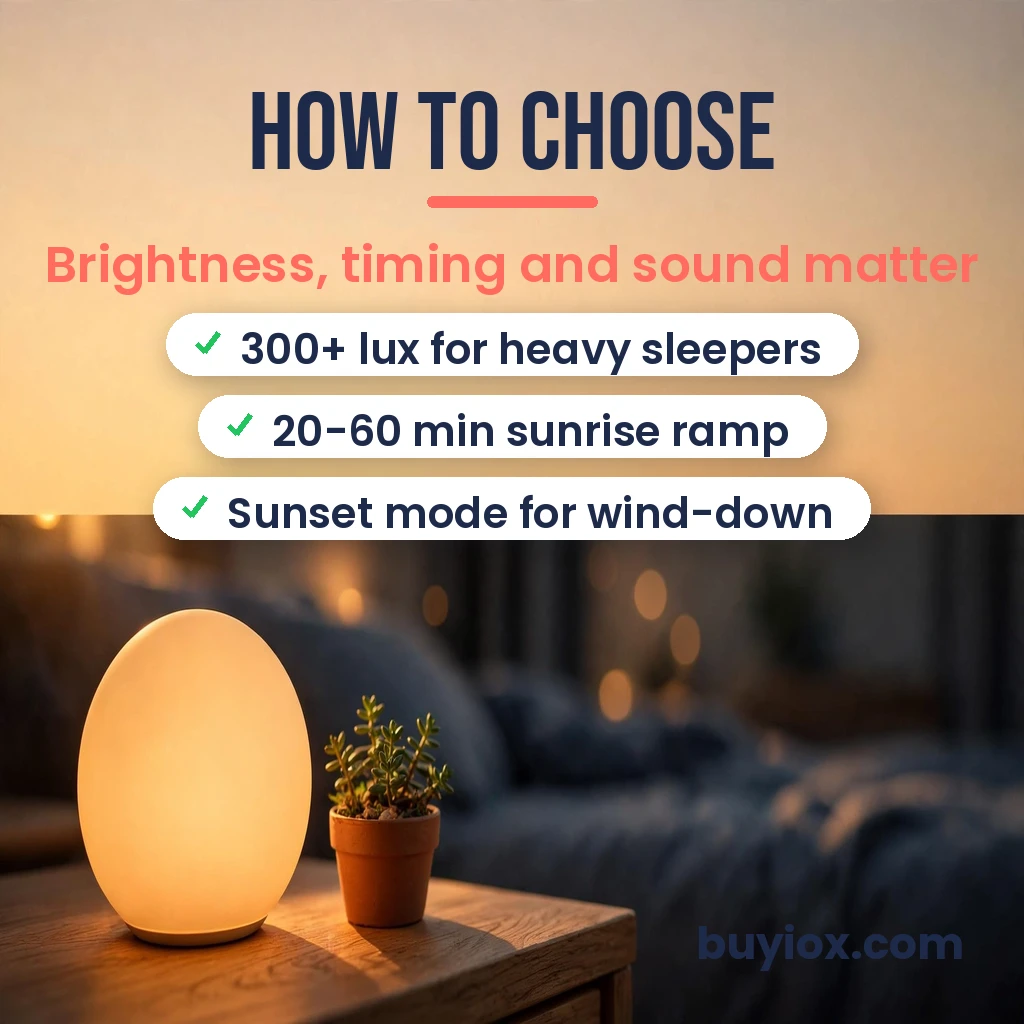
Look at the lux rating first. Lux measures how bright the lamp gets at its peak. The Philips HF3520 (300 LUX), Somneo HF3650 (310 LUX), and Lumie Shine 300 (320 LUX) are the heavy hitters here – that brightness is what actually pulls a deep sleeper toward waking. Budget models like the JALL do not publish lux figures and are noticeably dimmer. If you sleep through everything, brightness is the spec that matters most.
Match the sunrise duration to your sleep depth. A longer ramp gives your body more time to climb out of deep sleep gently. The Lumie stretches to 90 minutes and the Hatch to 60, while the Philips HF3520 is fixed at 30. Light sleepers do fine with 20 to 30 minutes; self-described deep sleepers should look for 30 minutes or more.
Decide how you want to control it. There are three philosophies on this list. The Hatch Restore 3 is app-first – powerful, but you need your phone for setup. The Dreamegg lets you use the app or the buttons. The Philips, Lumie, and JALL models are button-only: no accounts, no WiFi, nothing to update. If your goal is a phone-free bedroom, button-only is a feature, not a limitation.
Watch out for subscription traps. This is the big one. The Hatch Restore 3 works fine without paying, but its best content – meditations, sleep stories, most of the sound library – sits behind Hatch+ at $4.99 a month or $49.99 a year. None of the other five clocks on this list have any subscription. Factor the ongoing cost into your decision honestly: two years of Hatch+ costs more than the clock itself.
Think about sound, not just light. Light does the gentle part, but deep sleepers still need a sound backup. Check what you are waking to: the Philips models offer natural sounds plus FM radio, the Lumie adds radio presets, the Hatch has the deepest library, and the JALL covers the basics. Melodic, gradually increasing sounds beat a sudden beep – research cited by the Sleep Foundation finds melodic alarms make sleep inertia easier to shake off.
Place it right. A sunrise clock works through your eyelids, so put it on the nightstand close to your pillow, not across the room. Keep a consistent wake time – your body clock learns the pattern within a week or two, and the light works best as part of a steady routine.
Dark Winter Mornings Are Exactly When These Shine
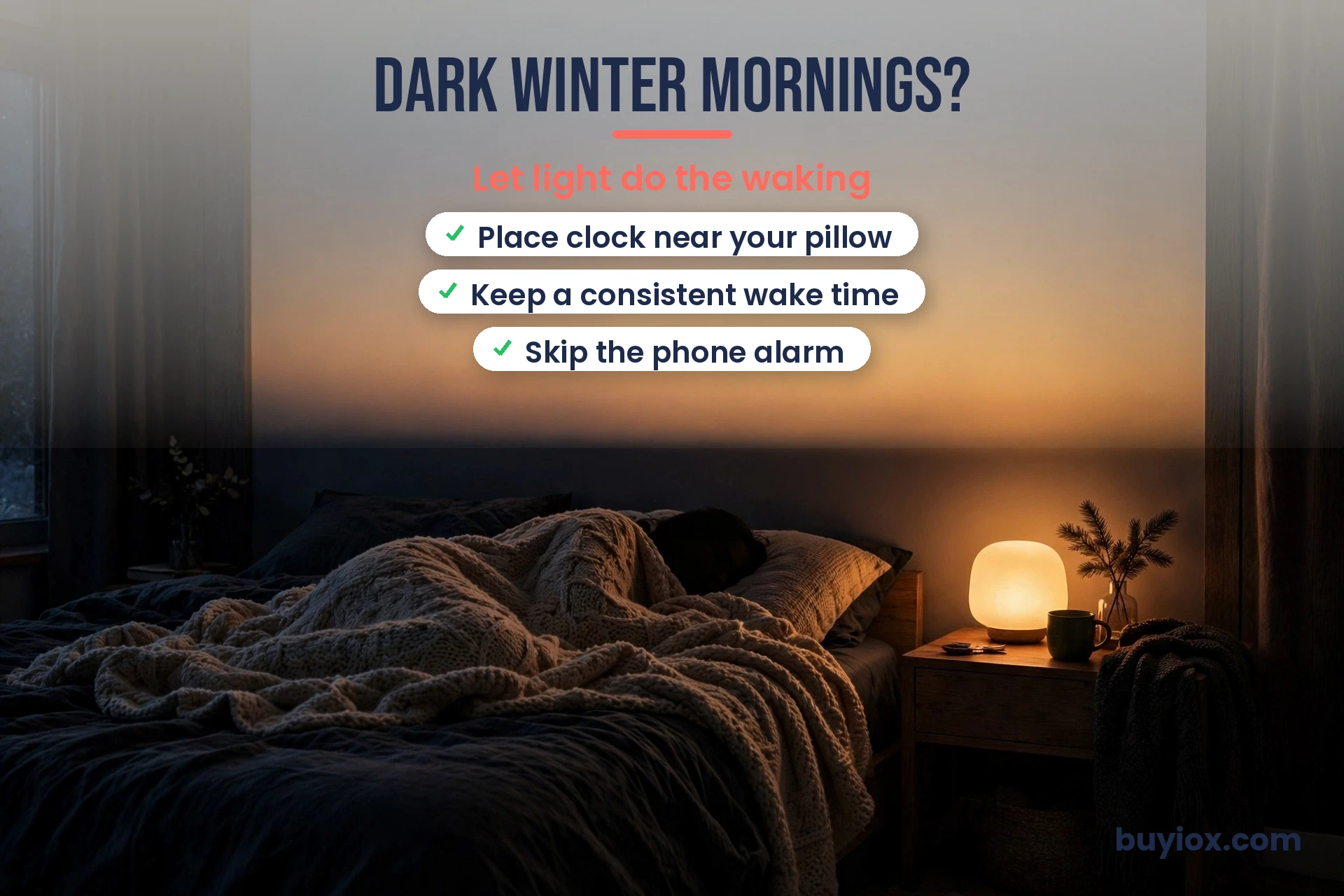
October through February is sunrise-clock season. When the sun does not rise until after your alarm, your body gets no dawn signal at all – you are asking your brain to wake up in what feels like the middle of the night. That is why searches for wake-up lights spike every autumn, and why buying now means you get the full benefit through the darkest months.
A few habits multiply what the clock can do. Keep the same wake time on weekends – big swings confuse your body clock. Get real daylight within an hour of waking when you can; the clock starts the process, actual sunlight finishes it. And charge your phone outside the bedroom. The whole point of a sunrise clock is breaking the alarm-then-doomscroll loop, and that only works if the phone is not under your pillow.
One honest boundary: a wake-up light is not a medical light-therapy lamp. Clinical light therapy for seasonal mood issues typically uses 10,000-lux lamps and specific timing protocols – a different device with different evidence. A sunrise clock makes dark mornings easier and supports your rhythm; it is not a treatment. If low winter mood is the real problem, talk to your doctor.
Frequently Asked Questions
Do sunrise alarm clocks really work?
Yes, within what they claim to do. They do not magically fix poor sleep, but gradual dawn simulation is well supported as a gentler way to wake. The Sleep Foundation cites a study finding dawn simulators improved alertness and cognitive function after waking, and notes that being yanked out of a sleep phase by a harsh alarm is what causes groggy sleep inertia. Thousands of reviewers across the clocks on this list report the same subjective experience: waking before the sound even plays.
Will a sunrise alarm clock wake me if I am a very heavy sleeper?
It helps, but be realistic. Light is a gentler signal than sound, so the heaviest sleepers should choose a bright model (300+ LUX – the Philips HF3520, Somneo HF3650, or Lumie Shine 300), place it close to the pillow, use the longest sunrise ramp available, and keep a sound alarm as backup for the first couple of weeks. Many heavy sleepers find the light starts waking them before the sound within a week or two of consistent use.
Do I need a subscription for the Hatch Restore 3?
No – but it depends what you want from it. The sunrise alarm, sunset wind-down, a basic set of sleep sounds, and custom routines all work without paying anything. The Hatch+ subscription ($4.99 a month or $49.99 a year after a 30-day trial) unlocks the full content library: meditations, sleep stories, and most of the 80+ sounds. If you only want a great sunrise alarm, skip the subscription. If you want the full routine experience, budget for it.
How many lux should a wake-up light have?
For a wake-up light, 300 LUX or more is the sweet spot – that is what the Philips HF3520 (300), Somneo HF3650 (310), and Lumie Shine 300 (320) deliver. Do not confuse this with clinical light-therapy lamps, which use around 10,000 lux for treating seasonal mood symptoms; those are a different category of device used while awake, not a dawn simulator.
Are sunrise alarm clocks better than phone alarms?
For how you feel on waking, usually yes. A phone alarm is a sudden loud noise that can interrupt deep sleep mid-cycle, causing sleep inertia – that heavy groggy feeling. A sunrise clock eases you toward wakefulness with light first, then adds a gradually increasing melodic sound. The bigger win is behavioral: a dedicated clock lets you charge your phone outside the bedroom, breaking the alarm-then-doomscroll habit that ruins so many mornings.
Can a sunrise alarm clock help with winter blues?
It can make dark winter mornings noticeably easier, which helps mood indirectly – morning light exposure supports a healthy circadian rhythm, something Cleveland Clinic sleep experts emphasize. But be honest with yourself about the goal: if you are dealing with seasonal affective disorder, a wake-up light is not a substitute for proper light therapy or medical care. Use the sunrise clock for better mornings, and talk to your doctor about the bigger picture.
Final Verdict: Our Top Recommendation
If you buy just one sunrise alarm clock, get the Philips SmartSleep Wake-Up Light HF3520. It has the most natural sunrise ramp, 300 LUX of brightness that genuinely works for deep sleepers, and zero app, WiFi, or subscription nonsense – it just wakes you up well, every morning, for around a hundred dollars or less.
If you want a whole bedtime routine and love beautiful design, the Hatch Restore 3 is the best experience on this list – just go in with eyes open about the Hatch+ subscription. If maximum brightness is the priority, the Lumie Bodyclock Shine 300 at 320 LUX with its 90-minute ramp is the smoothest sunrise you can buy. On a budget? The JALL at around $35 lets you test the whole concept for the price of a pizza night.
Whichever you choose, give it two weeks of consistent wake times. Your body clock learns the pattern – and dark winter mornings will never feel quite so brutal again.