Affiliate Disclosure: As an Amazon Associate, Buyiox earns from qualifying purchases. This means if you buy through our links, we may earn a small commission at no extra cost to you. We only recommend products we would use with our own dogs.
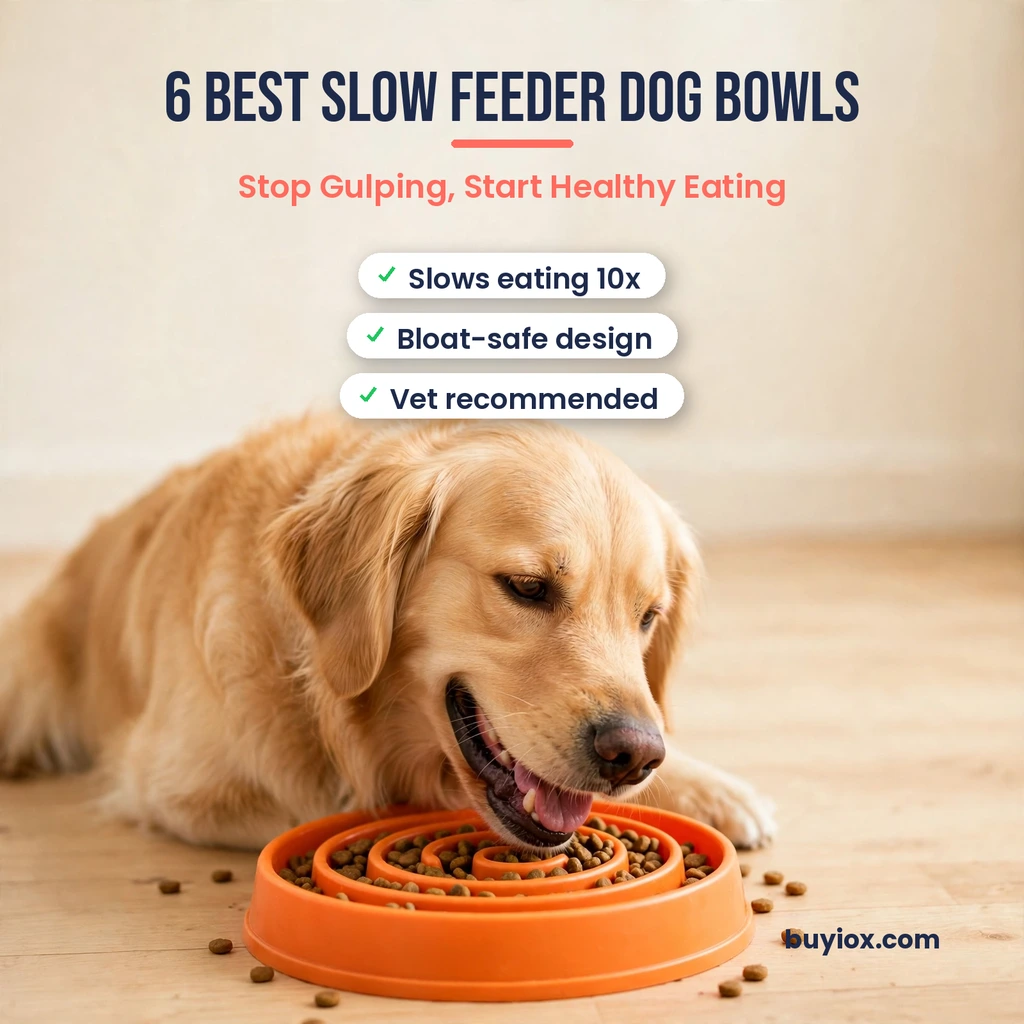
Why Your Fast-Eating Dog Needs a Slow Feeder Bowl
Picture this: you set the bowl down, turn around to wash your hands, and by the time you look back, dinner is gone. Thirty seconds, maybe less. Then comes the worrying part – the retching, the vomit on the rug, the bloated belly that makes you wonder if this is the time you need the emergency vet.
If that sounds like your house, you are not alone. Dogs that inhale their food swallow huge gulps of air along with the kibble, and that leads to choking, regurgitation, gassiness, and in the worst cases, bloat (gastric dilatation-volvulus or GDV) – a life-threatening emergency where the stomach fills with gas and can twist. The AKC confirms that fast eaters face five times the bloat risk of slow eaters, and recommends slow feeder bowls with fingers or center posts as a proven way to slow dogs down physically.
A slow feeder dog bowl fixes this with a beautifully simple idea: raised ridges, mazes, and channels that force your dog to work for each bite. Instead of vacuuming up a meal in 30 seconds, your dog spends 5 to 15 minutes foraging. Less air swallowed, better digestion, calmer stomach, and a mentally tired dog at the end.
We researched the six most loved slow feeder bowls on Amazon – checking materials, maze difficulty, dishwasher safety, sizing, and what thousands of real dog owners actually say. Here is the honest breakdown, with a real photo of every single bowl.
Quick Picks: The 6 Best Slow Feeder Dog Bowls at a Glance
- Best Overall: Outward Hound Fun Feeder – the legendary maze, up to 10x slower eating, three difficulty levels
- Premium / USA-Made Pick: SodaPup Honeycomb eBowl – deep honeycomb maze, made in the USA, freezer and microwave safe
- Best Ceramic (Non-Plastic): Le Tauci Ceramic Slow Feeder – heavy hygienic ceramic, gorgeous on the counter
- Best for Flat-Faced Breeds: AIPERRO Stainless Steel Slow Feeder – shallow gentle ridges built for Pugs and Bulldogs
- Maximum Challenge: Jasgood Slow Feeder Bowl – spiral maze with the highest ratings in the category
- Best Budget: MateeyLife Slow Feeder 2-Pack – two maze bowls for the price of one
The 6 Best Slow Feeder Dog Bowls Reviewed
1. Outward Hound Fun Feeder Slow Feed Interactive Dog Bowl – Best Overall
The Outward Hound Fun Feeder is the bowl that made slow feeding mainstream, and after more than a decade on the market, it is still the one every other bowl gets compared to. With over 135,000 Amazon reviews and a 4.6-star average, it has more real-world feedback than any competitor by a mile.
The design is a swirling maze of raised ridges that turns mealtime into a foraging puzzle. Outward Hound claims it slows eating up to 10 times, and owner reports consistently back that up – Labs that cleared a bowl in 15 seconds now take four or five minutes. It comes in three difficulty levels (Slow, Slower, and Slowest), so you can match the challenge to your dog instead of buying a whole new bowl when your pup cracks the first pattern.
Sizing is generous: the Large holds up to 4 cups of kibble (great for medium and large dogs), the Medium/Mini holds 2 cups, and the Small/Tiny holds 3/4 cup. The base is wider than the bowl with a non-slip bottom, so it stays put on hard floors. The plastic is BPA, PVC, and phthalate free, and the whole thing is top-rack dishwasher safe.
Pros:
- Proven by 135,000+ reviews over more than a decade
- Slows eating up to 10x according to the manufacturer
- Three difficulty levels grow with your dog
- Three sizes: 4-cup, 2-cup, and 3/4-cup options
- Top-rack dishwasher safe, BPA/PVC/phthalate free
- Excellent value, usually around $8 to $15 depending on size
Cons:
- Plastic develops micro-scratches over time (replace every 6-12 months per vet advice)
- Deep grooves can trap wet food and need a brush to clean
- Determined chewers can damage it – not a chew toy
Best for: Almost every fast eater – puppies to large breeds, kibble or wet food.
Skip if: Your dog chews bowls (go stainless steel) or you want to avoid plastic entirely.

Outward Hound Fun Feeder Slo Bowl – the legendary maze slow feeder, usually around $8 to $15.
2. SodaPup Honeycomb eBowl Slow Feeder – Premium / USA-Made Pick
SodaPup is the premium brand in the enrichment world, and the Honeycomb eBowl is its flagship slow feeder. Every bowl is made in the USA from FDA-compliant, food-safe material that is free of BPA, PVC, and phthalates – and the build quality genuinely feels a step above the budget options.
The honeycomb pattern is the clever part: hexagonal chambers of varying depth force your dog to work food out of each cell. The chambers are deeper in the center and shallower at the edges, so the difficulty ramps naturally through the meal. It measures about 8 by 8 inches, 2 inches deep, and holds roughly 4 cups – ideal for medium to large dogs and deep-chested breeds at higher bloat risk.
It is also the most versatile bowl here: top-rack dishwasher safe, freezer safe (fill it with wet food or broth and freeze overnight for a 30-minute enrichment session), and microwave safe. Two colors, yellow and blue, and a price around $22.
Pros:
- Made in the USA from FDA-compliant food-safe material
- Deep honeycomb maze is genuinely challenging without being frustrating
- Dishwasher, freezer, and microwave safe
- Doubles as a frozen enrichment bowl for wet or raw food
- Excellent build quality and fun design
Cons:
- The 2-inch depth is not ideal for small or flat-faced breeds
- Pricier than basic plastic maze bowls
- Deep honeycomb cells need soaking for wet-food cleanup
Best for: Medium and large fast eaters, raw and wet feeders, owners who want USA-made quality.
Skip if: You have a Pug, Frenchie, or small breed – the depth will frustrate a short snout.

SodaPup Honeycomb eBowl – made in the USA, around $22.
3. Le Tauci Ceramic Slow Feeder Dog Bowl – Best Ceramic (Non-Plastic)
Plastic bowls scratch, and scratched plastic harbors bacteria – it is the number one reason vets and trainers recommend ceramic. The Le Tauci is the best ceramic slow feeder we have found, and it is a genuinely beautiful object: glossy glazed ceramic in rich colors with a curved maze pattern that looks intentional on your kitchen floor, not like a science experiment.
The weight is the secret weapon. At roughly a kilogram, this bowl does not slide, tip, or travel across the room when your dog eats. Non-skid rubber pads on the bottom help too. The maze ridges are smooth and rounded, so they slow eating effectively (owners report meals stretching from seconds to minutes) without frustrating the dog.
It comes in sizes from 0.6 cups (small) up to 1.5 cups and larger, measures about 8 inches square, and is both dishwasher and microwave safe. Warm your dog’s food or add warm water to kibble right in the bowl – try that with plastic.
Pros:
- Ceramic: hygienic, no micro-scratches, no chemical leaching worries
- Heavy enough to stay put – no sliding or tipping
- Dishwasher and microwave safe
- Beautiful design in multiple colors
- Multiple sizes for small to medium breeds
Cons:
- Can break if dropped on a hard floor
- Heavier and pricier than plastic alternatives
- Maze ridges need a brush for thorough cleaning
Best for: Owners avoiding plastic, dogs with plastic sensitivities, anyone who wants a bowl that looks good in the kitchen.
Skip if: You have a giant breed needing 4+ cups per meal, or a dog that throws bowls.

Le Tauci ceramic slow feeder – heavy, hygienic, and beautiful on the counter.
4. AIPERRO Stainless Steel Slow Feeder Dog Bowl – Best for Flat-Faced Breeds
Here is the problem most roundups ignore: deep maze bowls are miserable for Pugs, French Bulldogs, English Bulldogs, and Boston Terriers. A flat face physically cannot reach into deep channels, so the dog face-plants, gets frustrated, and gives up – or worse, swallows even more air trying.
The AIPERRO was designed with brachycephalic anatomy in mind. Instead of deep trenches, it uses shallow, wide-set ridges at about half the height of a typical maze. Your flat-faced dog can actually maneuver a short muzzle around the barriers while still eating meaningfully slower – think 12 seconds stretched to two minutes, without the stress.
It is made from 304 food-grade stainless steel – the same grade used in commercial kitchen equipment – in a one-piece mold with no seams where food can hide. That makes it the most hygienic option for raw feeders and the safest for chewers. The non-slip base is part of the construction, it is dishwasher safe, rust and stain resistant, and backed by a 1-year warranty. Available in 2-cup (1.6 inch deep) and 4-cup (2 inch deep) sizes.
Pros:
- Specifically designed for flat-faced breeds – shallow gentle ridges
- 304 food-grade stainless steel, the most hygienic material
- One-piece mold: no seams, effortless cleaning, chew-proof
- Non-slip base that cannot peel off or degrade
- Dishwasher safe, rust and stain resistant
Cons:
- Shallow grooves may not slow down extreme gulpers enough
- Costs more than basic plastic bowls for the 2-cup size
- Stainless steel is noisy on hard floors
Best for: Pugs, French Bulldogs, English Bulldogs, Boston Terriers, Shih Tzus – any flat-faced fast eater.
Skip if: Your dog is an extreme gulper with a normal snout – get the Jasgood spiral instead.

AIPERRO stainless steel slow feeder – shallow ridges designed for flat-faced breeds.
5. Jasgood Slow Feeder Dog Bowl – Maximum Challenge (Spiral Design)
Some dogs are not just fast eaters – they are escape artists who memorize a maze pattern in a week and go right back to inhaling. The Jasgood is built for those dogs. Its spiral maze narrows progressively toward the center, so each section of the bowl demands a different tongue angle. There is no single trick that unlocks the whole meal.
It holds the highest rating in this roundup at 4.7 stars, and independent testing clocked a 70-pound German Shepherd at over 6 minutes to clear it – the longest eating time among comparable bowls. The spiral is an independently developed mold, not a copy of existing patterns, which matters because dogs genuinely do memorize layouts over time.
The base is widened to resist tipping, with six anti-slip mats underneath, and the bowl is dishwasher safe and made from BPA and PVC free materials. The large size holds about 1 to 1.5 cups. One honest caveat from owner reviews: the rubber feet can loosen over time, so check them periodically – a dab of pet-safe glue fixes it permanently.
Pros:
- Highest-rated spiral design in the category (4.7 stars)
- Progressive spiral difficulty defeats pattern-memorizing gulpers
- Longest eating times in independent testing
- Widened anti-tip base with six anti-slip mats
- Dishwasher safe, BPA and PVC free
Cons:
- Rubber feet can loosen over time (check them monthly)
- Runs large – measure your feeding area first
- Can be too deep for very small dogs
Best for: Extreme gulpers, smart dogs that outsmart simpler mazes, large breeds.
Skip if: Your dog is a gentle eater or a tiny breed – this level of challenge will frustrate them.

Jasgood spiral slow feeder – maximum challenge for extreme gulpers.
6. MateeyLife Slow Feeder Dog Bowls 2-Pack – Best Budget
Two slow feeder bowls for around nine dollars. The MateeyLife 2-pack is the best value in slow feeding, full stop – and it is not junk, either. It sits at number 3 in Amazon’s Dog Slow Feeders best-seller ranking, which tells you everything about how many owners trust it.
Each bowl holds 2 cups and measures about 7.9 inches square, sized for small to medium breeds. The maze pattern uses concentric ridges that reliably stretch a 30-second meal into 4 or 5 minutes – owners consistently report the end of post-meal vomiting. The food-safe PP polypropylene is dishwasher safe, and the non-slip base keeps the bowl steady.
The two-pack format is genuinely practical: keep one in the dishwasher and one in service, feed two dogs at the same pace (a big deal in multi-dog homes with food competition), or stash one in your travel bag. At this price, there is no reason not to try slow feeding.
Pros:
- Unbeatable value: two bowls for around $9
- Number 3 best-seller in Dog Slow Feeders on Amazon
- Dishwasher safe, food-safe PP material
- Works with dry, wet, and raw food
- Perfect for multi-dog households and travel
Cons:
- 2-cup capacity is small for large breeds (a 4-cup version exists separately)
- Simpler maze – extreme gulpers may master it
- Lightweight, so very pushy eaters can scoot it
Best for: Budget buyers, multi-dog homes, first-time slow feeder experimenters, travel.
Skip if: You have a large breed eating 3+ cups per meal – look at the Outward Hound Large instead.

MateeyLife slow feeder 2-pack – two maze bowls for around $9.
Comparison Table: All 6 Slow Feeder Bowls Side by Side
| Bowl | Best For | Material | Capacity | Dishwasher Safe | Approx. Price |
| — | — | — | — | — | — |
|---|---|---|---|---|---|
| Outward Hound Fun Feeder | Overall, most dogs | BPA-free plastic | 4 / 2 / 0.75 cups | Yes (top rack) | around $8-15 |
| SodaPup Honeycomb eBowl | Premium, USA-made | FDA-compliant polypropylene | 4 cups | Yes (top rack) | around $22 |
| Le Tauci Ceramic | Non-plastic pick | Ceramic | 0.6-1.5+ cups | Yes | mid-range |
| AIPERRO Stainless | Flat-faced breeds | 304 stainless steel | 2 / 4 cups | Yes | mid-range |
| Jasgood Spiral | Maximum challenge | BPA-free plastic | 1-1.5 cups | Yes | budget-friendly |
| MateeyLife 2-Pack | Budget, multi-dog | Food-safe PP | 2 cups each | Yes | around $9 |
Buying Guide: How to Choose the Right Slow Feeder Bowl
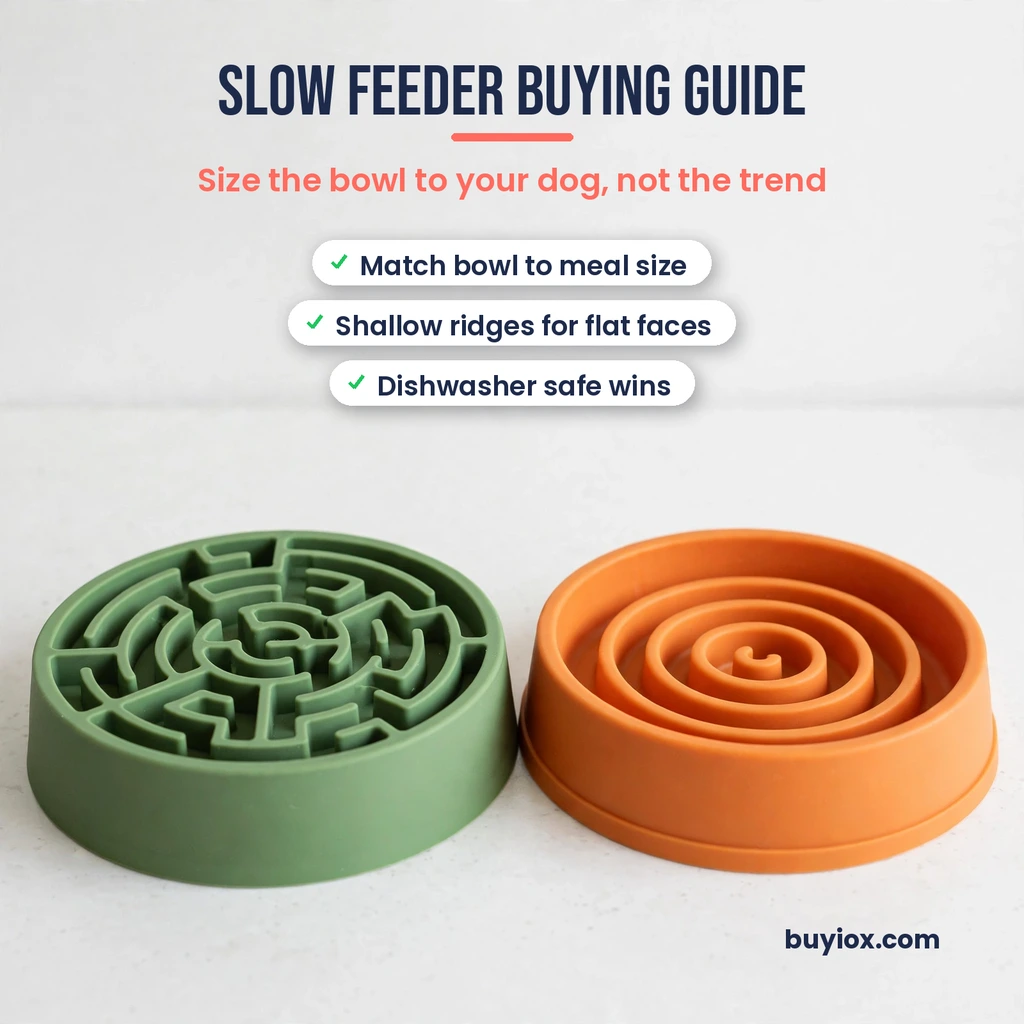
Match the material to your priorities. Plastic bowls (Outward Hound, Jasgood, MateeyLife) offer the deepest, most challenging maze designs at the lowest prices – but plastic develops micro-scratches that trap bacteria, so vets generally recommend replacing plastic bowls every 6 to 12 months. Stainless steel (AIPERRO) is the most hygienic and the only safe choice for bowl chewers – it cannot be chewed through and does not hold odors. Ceramic (Le Tauci) splits the difference beautifully: hygienic, heavy, stable, and gorgeous, but it breaks if dropped.
Size the bowl to the meal, not the dog. A good rule: the bowl should hold about one and a half times your dog’s typical meal, and never fill it more than two-thirds full – overcrowding defeats the maze pattern. Small breeds under 20 pounds do well with 1 to 2 cup bowls. Medium dogs need 2 to 4 cups. Large dogs over 60 pounds need 4 cups or more, and giant breeds may need two feedings (which is good bloat prevention anyway).
Consider dishwasher safety seriously. Wet food and raw diets turn deep maze grooves into a cleaning project. If you feed anything other than dry kibble, dishwasher-safe is non-negotiable – and even then, a bottle brush for the grooves will save your sanity. All six bowls in this guide are dishwasher safe.
Flat-faced breeds need shallow designs. Pugs, French Bulldogs, English Bulldogs, Boston Terriers, and Shih Tzus physically cannot use deep maze bowls – their short muzzles cannot reach the food. For these breeds, choose shallow wide-set ridges like the AIPERRO, or a wide low bowl. Deep-chested breeds (Great Danes, German Shepherds, Standard Poodles) face the highest bloat risk and deserve the deepest maze you can find.
Plan for the chewer. If your dog chews bowls, skip plastic entirely and go stainless steel. PetMD lists slow feeders among its recommended enrichment toys, but supervise all slow feeder use with puppies and power chewers, whatever the material. Ingested plastic shards are a genuine vet emergency risk. Supervise all slow feeder use with puppies and power chewers, whatever the material.
Feeding Tips: Flat-Faced Dogs and Reluctant Eaters
Some dogs take to a slow feeder instantly. Others stare at it like you have insulted them personally. Here is how to win them over:
Introduce it gradually. For the first 2 to 3 days, place food on top of the ridges without filling the channels, so your dog eats at normal speed from the new bowl. Over the next week, push food progressively deeper into the maze. By day 10, fill it normally. This works for the vast majority of reluctant dogs.
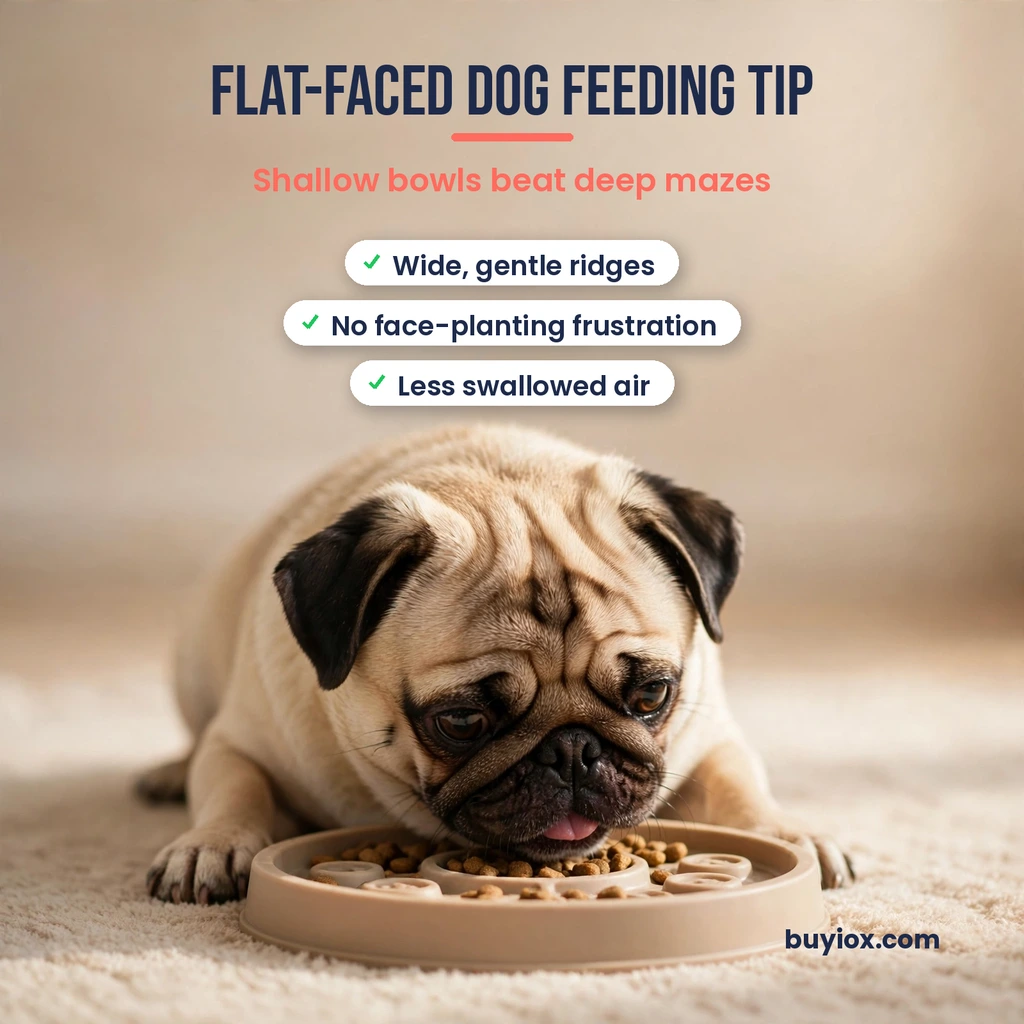
For flat-faced breeds, go shallow. The single biggest mistake Pug and Bulldog owners make is buying the deepest, most impressive maze. A flat face in a deep maze means frustration, face-planting, and more swallowed air – the opposite of what you want. Shallow gentle ridges (like the AIPERRO above) slow the meal without the struggle.
Rotate designs for smart dogs. Dogs memorize maze patterns – it is a documented pain point. If your dog’s eating time creeps back down after a few weeks, rotate between two or three different bowl designs to keep mealtime challenging.
Add a topper for motivation. A spoonful of wet food, plain pumpkin puree, or a splash of low-sodium bone broth on top of the kibble gives hesitant dogs a reason to engage with the pattern.
Separate multi-dog feedings. The AKC notes that feeding anxiety around other dogs is itself a bloat risk factor. Feed competitive eaters in separate rooms or crates so nobody is rushing to finish first.
For more ways to turn mealtime into enrichment, see our guides to the best dog enrichment toys and the best snuffle mats for dogs – both pair perfectly with a slow feeder routine.
Frequently Asked Questions
Do slow feeder bowls help prevent bloat?
They help reduce a major risk factor. The AKC reports that fast eaters have five times the bloat risk of slow eaters, and specifically recommends slow feeder bowls with fingers or center posts to physically slow dogs down. No bowl can guarantee prevention – bloat (GDV) is a complex emergency – but slowing the meal is one of the few evidence-backed steps you can take at home.
Can puppies use slow feeder bowls?
Yes, puppies 12 weeks and older can safely use slow feeder bowls. Start with a shallow ridge pattern like the MateeyLife or AIPERRO – deep maze designs can frustrate very young puppies. Increase the complexity as your puppy grows, and always supervise mealtimes with any new bowl.
Do vets recommend slow feeder bowls?
Most veterinarians recommend slow feeder bowls for fast-eating dogs, especially deep-chested breeds like Great Danes, German Shepherds, and Standard Poodles that face higher bloat risk. They are considered a low-cost preventive measure against gulping-related problems including vomiting, choking, and obesity from overeating.
What is the best material for a slow feeder dog bowl?
Stainless steel is the most hygienic and durable – ideal for chewers and raw-fed dogs. Ceramic offers excellent stability and hygiene but can break if dropped. Plastic allows the deepest maze designs and is the most affordable, but develops bacteria-trapping micro-scratches and should be replaced every 6 to 12 months. Choose based on whether your dog chews, what you feed, and how much stability you need.
Are there any downsides to slow feeder bowls?
A few honest ones: some dogs memorize the pattern and eat fast again (rotate designs to fix this), deep grooves trap wet food and are harder to clean, plastic bowls can crack and harbor bacteria over time, and some picky dogs refuse to eat from them at first (introduce gradually). None of these outweigh the benefits for a true gulper.
Can flat-faced dogs use slow feeder bowls?
Yes, but they need the right design. Pugs, Bulldogs, Frenchies, and similar breeds cannot reach into deep maze channels with their short muzzles. Choose a bowl with shallow, wide-set ridges like the AIPERRO stainless steel feeder – it slows the meal without the face-planting frustration that deep mazes cause.
How long should it take a dog to eat from a slow feeder?
A healthy target is 5 to 15 minutes for a full meal, versus 30 seconds from a regular bowl. If your dog clears the slow feeder in under 2 minutes, step up to a more challenging design like the Jasgood spiral. If it takes more than 20 minutes and your dog seems stressed, the bowl is too hard – go shallower.
Final Verdict: Our Top Recommendation
If you buy just one slow feeder bowl, get the Outward Hound Fun Feeder. A decade of dominance, 135,000+ reviews, three difficulty levels, and a price that makes it a no-brainer – it is the safest recommendation for the widest range of dogs. If your dog chews or you want to ditch plastic, the Le Tauci ceramic is the most beautiful upgrade you can buy. Flat-faced breed owners should go straight to the AIPERRO stainless steel feeder, and extreme gulpers who outsmart everything need the Jasgood spiral.
Whichever you choose, your rug will thank you – and so will your dog’s stomach.