
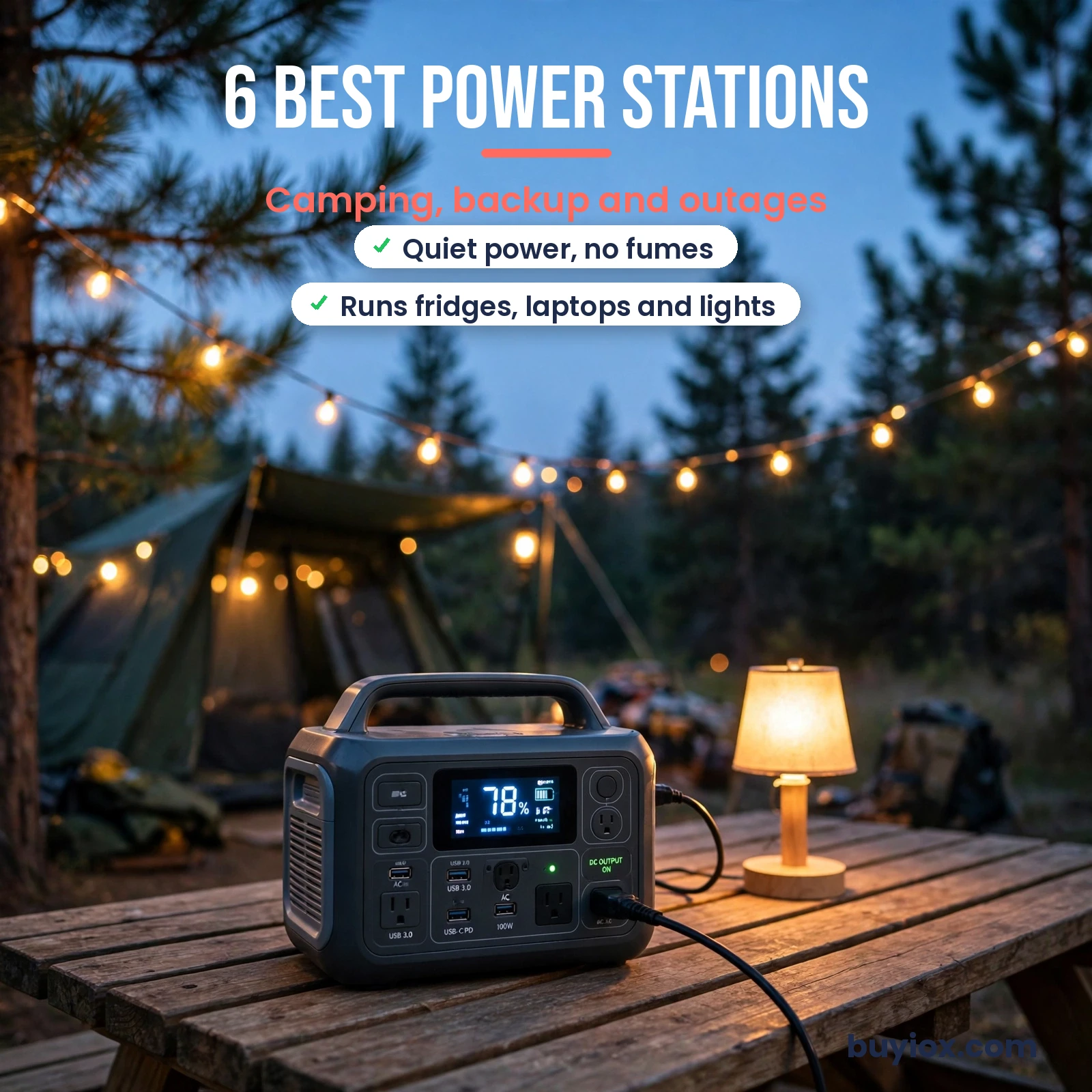
Affiliate Disclosure: This article contains affiliate links. If you buy through them, we may earn a commission at no extra cost to you. It helps us keep testing and publishing honest reviews.
https://buyiox.com/wp-content/uploads/2026/11/pps-featured.webp
6 Best Portable Power Stations for Camping, Home Backup and Emergencies
The lights go out, the WiFi dies, and your phone is at 12 percent. Or you are miles from the nearest outlet at a campsite and the laptop you need for work is about to die. A portable power station solves both problems with the same box: a big rechargeable battery, an inverter, and a row of outlets that let you plug in a fridge, a laptop, a CPAP machine, or a string of lights, with no gas, no fumes, and almost no noise.
But the power station aisle is confusing in a different way than most tech. Two numbers that sound similar mean completely different things. Watt-hours tell you how much energy the battery holds. Watts tell you how much power it can deliver at once. A 256Wh station can charge phones all weekend, but it cannot run a 1,200W microwave no matter how full it is. A 1,000Wh station with a weak inverter cannot run a fridge either. Buy the wrong one and you own an expensive brick that cannot do the one job you bought it for.
We researched the most recommended portable power stations across expert roundups, manufacturer specs, and price trackers to find six that are worth your money, from a $199 pocket-size unit that weighs less than 8 pounds to a 1,070Wh workhorse that can keep home essentials running through an outage. Every pick here uses long-life LiFePO4 battery chemistry, which is the single most important quality marker in this category right now. If you only need to keep small devices alive on the go, our best portable chargers guide covers the pocket-size side.
Our Top Picks at a Glance
- Best overall: Jackery Explorer 1000 v2 – 1,070Wh, 1,500W, and the lightest 1kWh station here
- Best for home backup: EcoFlow Delta 2 – 1,024Wh, 1,800W, and the fastest recharge on this list
- Best mid-size value: EcoFlow River 2 Max – 512Wh and a 1-hour full recharge for around $269 on sale
- Best build quality: Anker 535 PowerHouse – 512Wh with a 5-year warranty and 9 ports
- Best compact power: BLUETTI EB3A – 600W of output from a 268Wh box that weighs 10 pounds
- Best budget: EcoFlow River 2 – 256Wh, 7.7 pounds, and a 1-hour recharge for around $199
Comparison Table
| Power Station | Best For | Capacity | Output | Weight | Around Price |
|---|---|---|---|---|---|
| Jackery Explorer 1000 v2 | Overall, camping + backup | 1,070Wh | 1,500W | 23.8 lb | Around $499 |
| EcoFlow Delta 2 | Home backup | 1,024Wh | 1,800W | 27 lb | Around $599 |
| EcoFlow River 2 Max | Mid-size value | 512Wh | 500W | 13.4 lb | Around $269 on sale |
| Anker 535 PowerHouse | Build quality, warranty | 512Wh | 500W | 16.75 lb | Around $300 |
| BLUETTI EB3A | Compact power | 268Wh | 600W | 10.1 lb | Around $229 |
| EcoFlow River 2 | Budget, ultralight | 256Wh | 300W | 7.7 lb | Around $199 |
https://buyiox.com/wp-content/uploads/2026/11/pps-in1.webp
The 6 Best Portable Power Stations
1. Jackery Explorer 1000 v2 – Best Overall Portable Power Station
If you buy one portable power station and want it to handle camping, road trips, and a power outage without a second thought, this is the one. The Jackery Explorer 1000 v2 packs 1,070Wh of LiFePO4 battery and a 1,500W pure sine wave inverter into a 23.8-pound box, which makes it the lightest 1kWh-class station on this list. It runs a full-size fridge, a coffee maker, a microwave on low settings, and power tools that would choke every smaller pick here.
https://buyiox.com/wp-content/uploads/2026/11/pps-prod-1.jpg
The Jackery Explorer 1000 v2 – our best overall portable power station.
The headline numbers hold up in practice. The 1,500W continuous output with a 3,000W surge peak means the station can start motors, like a fridge compressor, that briefly draw far more than their running wattage. The LiFePO4 battery is rated for 4,000 cycles to 70 percent capacity, so even if you cycled it every other day it would last for years. With emergency charging turned on in the Jackery app, it refills from a wall outlet in about 1 hour; the standard charge takes about 1.7 hours. Three AC outlets, two USB-C ports (one at 100W), a USB-A port, and a car port cover nearly everything you would plug in, and it pairs with Jackery SolarSaga panels for off-grid recharging.
Runtime is where the 1,070Wh capacity earns its keep. After inverter losses, you get roughly 900Wh of usable energy. That is about 9 hours for a 100W laptop, a full night for a 40W CPAP machine, or several hours of a fridge that cycles on and off. It is the only pick here that can genuinely back up home essentials rather than just phones and lights.
- Capacity: 1,070Wh LiFePO4, 4,000 cycles to 70% capacity
- Output: 1,500W continuous, 3,000W surge, pure sine wave
- Ports: 3x AC, 2x USB-C (100W and 30W), 1x USB-A, 1x car port
- Recharge: About 1 hour with emergency charging via the app, about 1.7 hours standard
- Weight: 23.8 lb with a foldable handle
- Warranty: 5 years
- Price: Around $499
Pros:
- The best capacity-to-weight ratio here: a full 1,070Wh at under 24 pounds
- 1,500W output runs real appliances, including fridges and power tools
- LiFePO4 chemistry rated for 4,000 cycles, the longest on this list
- One-hour emergency recharge is genuinely useful when a storm is coming
Cons:
- Capacity is sealed at 1,070Wh, with no expansion battery option
- At nearly 24 pounds it is not a backpack unit, it is a carry-with-two-hands unit
- Emergency fast charging needs the app, and it is harder on the battery over time
- No built-in light, unlike the Anker and BLUETTI picks
Best for: Anyone who wants one station for camping and home backup, and anyone running a fridge, a CPAP machine, or power tools off grid.
Skip it if: You only need phone and laptop charging, or you need to carry power in a backpack. Buy the EcoFlow River 2 instead and save about $300.
2. EcoFlow Delta 2 – Best Portable Power Station for Home Backup
The EcoFlow Delta 2 is the pick for people whose main fear is the power going out at home. It pairs 1,024Wh of LiFePO4 capacity with an 1,800W inverter, the strongest continuous output on this list, and it recharges faster than anything else here: 80 percent in 50 minutes and a full charge in about 80 minutes from a wall outlet. When the outage ends and the next storm is already on the forecast, that recharge speed matters.
https://buyiox.com/wp-content/uploads/2026/11/pps-prod-2.jpg
The EcoFlow Delta 2 – the best portable power station for home backup.
The Delta 2 is the most expandable pick here. Add one extra battery and capacity grows to 2,048Wh; add two and it reaches 3,072Wh, which is enough to keep a fridge, a router, lights, and phones running for more than a day. Its X-Boost mode lets it run appliances rated up to 2,200W, so devices that would overload a 1,500W inverter keep working. With 15 outlets, including 6 AC outlets, two 100W USB-C ports, and a car port, it is the only station here that can power a whole work-from-home desk at once. Keep your internet alive through the outage too with our best mesh WiFi system guide, and the router plus the Delta 2 make a solid pair.
For the full specs, see the official EcoFlow Delta 2 page. The trade-offs are weight and price. At 27 pounds it is the heaviest pick here, and at around $599 it costs more than the Jackery, though it regularly drops to around $429 on sale. If your use is mostly camping, the lighter Jackery is the better buy. If your use is mostly home backup, the Delta 2 wins on output, recharge speed, and expansion.
- Capacity: 1,024Wh LiFePO4, 3,000+ cycles to 80% capacity, expandable to 3,072Wh
- Output: 1,800W continuous, 2,700W surge, X-Boost up to 2,200W
- Ports: 15 outlets, including 6x AC, 2x USB-C 100W, 2x USB-A fast charge, car port
- Recharge: 80% in 50 minutes, 100% in about 80 minutes from AC; up to 500W solar input
- Weight: 27 lb
- Warranty: 5 years
- Price: Around $599, often on sale near $429
Pros:
- The fastest recharge here, and the strongest continuous output at 1,800W
- Expandable to over 3,000Wh, so it grows from a backup box into a home system
- 15 outlets, the most on this list, with 6 AC outlets for a full desk setup
- X-Boost runs high-draw appliances that overload other 1kWh stations
Cons:
- 27 pounds makes it the heaviest pick, and it is awkward to carry far
- Costs more than the Jackery at list price, though sale prices are close
- The cooling fan is audible under heavy load, so it is not silent in a quiet room
- Overkill if you only camp and charge phones and laptops
Best for: Home backup, storm preparation, and anyone who wants to expand capacity later instead of buying a second station.
Skip it if: You carry your station to a campsite on foot, or your budget tops out near $500. The Jackery 1000 v2 is lighter and cheaper.
3. EcoFlow River 2 Max – Best Mid-Size Portable Power Station
The EcoFlow River 2 Max is the sweet spot of this list. It doubles the capacity of the budget picks to 512Wh, keeps the weight at a carry-friendly 13.4 pounds, and still recharges from empty to full in about 1 hour. At around $269 on sale, it costs barely more than the small units while doing far more work.
https://buyiox.com/wp-content/uploads/2026/11/pps-prod-3.jpg
The EcoFlow River 2 Max – the best mid-size portable power station for the money.
With 500W of continuous output and a 1,000W surge, the River 2 Max runs a mini fridge, a TV, a laptop, a fan, and a CPAP machine, and its 11 outlets mean you rarely have to choose which device to unplug. The LiFePO4 battery is rated for 3,000 cycles to 80 percent, and the 220W solar input refills it in a few hours of good sun. For a weekend camping trip, it is the right size: big enough for a portable fridge and lights all weekend with a solar top-up, small enough to carry in one hand.
The honest limit is the 500W ceiling. It will not run a microwave, a hair dryer, or a full-size fridge, and it will not back up a home for a day the way the 1kWh picks can. That is the trade for the price and the weight. For everything under 500W, it is the best value on this list.
- Capacity: 512Wh LiFePO4, 3,000 cycles to 80% capacity
- Output: 500W continuous, 1,000W surge with X-Boost
- Ports: 11 outlets, including 4x AC, USB-C 100W, USB-A, car port
- Recharge: 0 to 100% in about 1 hour from AC; up to 220W solar input
- Weight: 13.4 lb
- Warranty: 5 years
- Price: Around $269 on sale, list price $469
Pros:
- The best value per watt-hour here, especially on sale
- One-hour full recharge from a wall outlet, the fastest in its size class
- Light enough to carry with one hand at 13.4 pounds
- 11 outlets cover a full campsite setup without a power strip
Cons:
- 500W output rules out microwaves, hair dryers, and full-size fridges
- 512Wh is a weekend of camping, not a day of home backup
- No built-in light, and the display is small
- Sale prices move around, so the price you see may be higher than $269
Best for: Weekend campers, RV trips, and first-time buyers who want real capacity without paying for a 1kWh station.
Skip it if: You need to run a full-size fridge or a microwave. Step up to the Jackery 1000 v2 or the EcoFlow Delta 2.
4. Anker 535 PowerHouse – Best-Built Mid-Size Power Station
Anker built its name on chargers that last, and the 535 PowerHouse carries that reputation into power stations. It matches the River 2 Max on capacity at 512Wh and output at 500W, but it adds the longest warranty on this list at 5 years, a rugged impact-resistant body, and a built-in LED light bar that turns it into a campsite lantern after dark. If you want the station that feels the most solid in your hands, this is it.
https://buyiox.com/wp-content/uploads/2026/11/pps-prod-4.jpg
The Anker 535 PowerHouse – the best-built mid-size power station, with a 5-year warranty.
The 535 uses LiFePO4 cells rated for 3,000 cycles, and Anker rates its design life at 10 years with everyday use. Its 9 ports include 4 AC outlets, 3 USB-A ports, a 60W USB-C port, and a car outlet, and the front display shows remaining charge at a glance. The light bar is a real feature, not a gimmick: on a dark campsite it lights the whole table. For full specs, see the official Anker 535 page.
The trade-offs are weight and recharge speed. At 16.75 pounds it is about 3 pounds heavier than the River 2 Max for the same capacity, and it takes about 3.4 hours to fully recharge from a wall outlet, against the River 2 Max at about 1 hour. It also costs a little more, at around $300, and stock varies: Anker’s own store shows it sold out at the time of writing, so check Amazon for availability. If you value build quality and warranty over recharge speed, the Anker wins. If you want the fastest recharge, buy the River 2 Max.
- Capacity: 512Wh LiFePO4, 3,000+ cycles, 10-year design life
- Output: 500W continuous, 1,000W surge, pure sine wave
- Ports: 9 ports, including 4x AC, 3x USB-A, 1x USB-C 60W, car outlet, LED light bar
- Recharge: 80% in about 2.5 hours, 100% in about 3.4 hours; up to 120W solar input
- Weight: 16.75 lb
- Warranty: 5 years
- Price: Around $300
Pros:
- The toughest build here, with impact-resistant design and a 5-year warranty
- Built-in LED light bar doubles as a campsite lantern
- 4 AC outlets, the most in the mid-size class
- Clear, easy-to-read display and simple one-button operation
Cons:
- Slow recharge: 3.4 hours to full, against about 1 hour for the River 2 Max
- Heavier than the River 2 Max for the same 512Wh capacity
- 60W USB-C is slower than the 100W USB-C on the EcoFlow picks
- Stock is inconsistent, so you may need to check a few sellers
Best for: Campers and RV owners who want the toughest station with the longest warranty, and anyone who likes the built-in light.
Skip it if: You need a fast recharge between uses, or you count every pound. The River 2 Max is lighter and faster.
5. BLUETTI EB3A – Best Compact Portable Power Station
The BLUETTI EB3A is the most surprising pick on this list. It holds only 268Wh, barely more than the budget River 2, yet its inverter delivers 600W continuous and 1,200W surge, which is double the River 2 and more than the 512Wh Anker. That makes it the small station that can run things the other small stations cannot, like a small blender, a mini fridge, or a 500W tool, as long as you only need it for a short while.
https://buyiox.com/wp-content/uploads/2026/11/pps-prod-5.jpg
The BLUETTI EB3A – the best compact portable power station, with 600W in a 10-pound box.
The EB3A is also the most versatile small station here. It has 9 outlets, a 100W USB-C port, a 15W wireless charging pad on top, and a built-in LED light. It recharges from 0 to 80 percent in about 30 minutes with AC and solar combined, and its 200W solar input is generous for its size. The LiFePO4 battery is rated for 2,500 cycles. At 10.1 pounds it is light enough to carry anywhere, and at around $229 it is the cheapest way to get a 600W inverter.
The catch is runtime, and it is a hard one. With 268Wh, a 100W laptop gets about 2 hours, and a 60W fan gets about 3 to 4 hours. The EB3A is a sprinter, not a marathon runner. Buy it for short, high-power jobs and for keeping phones and laptops alive on a day trip. Do not buy it expecting it to run a fridge overnight.
- Capacity: 268Wh LiFePO4, 2,500+ cycles to 80% capacity
- Output: 600W continuous, 1,200W surge, pure sine wave
- Ports: 9 outlets, including 2x AC, 100W USB-C, 15W wireless charging pad, LED light
- Recharge: 0 to 80% in about 30 minutes with AC plus solar; up to 200W solar input
- Weight: 10.1 lb
- Warranty: 2 years
- Price: Around $229
Pros:
- 600W output from a 268Wh box is unmatched in this size class
- Wireless charging pad and 100W USB-C cover phones and laptops with no cables
- Very fast recharge and strong 200W solar input
- Light and compact at 10.1 pounds, with a built-in light
Cons:
- 268Wh runs out fast under a real load, so runtime is short
- Only a 2-year warranty, against 5 years for the Jackery, EcoFlow, and Anker picks
- Noisy fan under heavy load for a small unit
- The app is basic compared with EcoFlow and Jackery
Best for: Day trips, short camping stops, and anyone who needs a burst of 600W power in a small box.
Skip it if: You need all-day runtime. The River 2 Max costs only a little more and holds almost twice the energy.
6. EcoFlow River 2 – Best Budget Portable Power Station
The EcoFlow River 2 is the cheapest way into a proper portable power station, and it does not feel cheap. At 256Wh and 7.7 pounds, it is the lightest pick here by a clear margin, it recharges from empty to full in about 1 hour, and its LiFePO4 battery is rated for 3,000 cycles. For phones, laptops, lights, a WiFi router, and a CPAP machine for a night, it is all most people need.
https://buyiox.com/wp-content/uploads/2026/11/pps-prod-6.jpg
The EcoFlow River 2 – the best budget portable power station and the lightest pick here.
The numbers are modest but honest. The 300W inverter with a 600W surge runs a laptop, a 100W light, a small fan, and a 40W CPAP machine for around 5 hours. Its 6 outlets include 2 AC outlets, a 100W USB-C port, and a car port, and the 110W solar input refills it in a few hours of sun. For full specs, see the official EcoFlow River 2 page. It is also the pick that fits in a car emergency kit next to our best portable jump starters guide, so a dead battery and a dead phone never happen on the same trip.
The limits are obvious and worth stating plainly. It will not run a fridge, a microwave, or any heating appliance, and 256Wh is one evening of use, not a weekend. But at around $199, it is the station you can buy without thinking twice, keep in a closet for outages, and grab for every camping trip. For many buyers, it is the right first power station.
- Capacity: 256Wh LiFePO4, 3,000 cycles to 80% capacity
- Output: 300W continuous, 600W surge, pure sine wave
- Ports: 6 outlets, including 2x AC, USB-C 100W, 2x USB-A, car port
- Recharge: 0 to 100% in about 1 hour from AC; up to 110W solar input
- Weight: 7.7 lb with a built-in handle
- Warranty: 5 years
- Price: Around $199
Pros:
- The lightest pick here at 7.7 pounds, and the cheapest at around $199
- One-hour full recharge, the fastest in its class
- LiFePO4 battery rated for 3,000 cycles, so it lasts for years of regular use
- Perfect size for a car emergency kit or a first power station
Cons:
- 256Wh is a single evening of use, not a weekend of backup
- 300W output rules out fridges, microwaves, and heating appliances
- Only 2 AC outlets, so you may need a power strip
- No built-in light and no wireless charging
Best for: First-time buyers, car emergency kits, and anyone who mainly charges phones, laptops, and lights.
Skip it if: You need to run a fridge or power a campsite for a weekend. The River 2 Max is the next step up.
https://buyiox.com/wp-content/uploads/2026/11/pps-in2.webp
Portable Power Station Buying Guide: How to Choose the Right One
Buying a power station is simpler than the spec sheets make it look. Here is what actually matters, in the order that matters.
Capacity first: watt-hours decide how long things run
Capacity, measured in watt-hours, decides runtime. A rough rule that works well: multiply the watt-hours by 0.85 to allow for inverter losses, then divide by the watts your device draws. A 1,070Wh station gives you about 900Wh of usable energy, so a 100W laptop runs for about 9 hours, and a 40W CPAP machine runs for about 20 hours. A 256Wh station gives you about 215Wh, so the same laptop runs for about 2 hours. Pick your capacity by the hungriest device you need to run and how long it must run, not by the number of phones you own.
Output second: watts decide what you can run at all
Output, measured in watts, decides whether a device turns on. A 300W station cannot run a 1,200W microwave no matter how full its battery is, and a fridge compressor can briefly draw double its running watts when it starts, which is why surge ratings matter. Check the running watts of your biggest device, add a margin for startup surge, and buy an inverter that clears it. For most homes, 500W covers lights, laptops, routers, and fans. A fridge needs 1,000W or more of inverter headroom, which is why the 1kWh picks exist.
Battery chemistry: LiFePO4 is worth paying for
Every pick on this list uses LiFePO4 (lithium iron phosphate) cells, and that is not an accident. LiFePO4 batteries last 2,500 to 4,000 charge cycles before dropping to 70 or 80 percent capacity, against about 500 cycles for older lithium-ion NMC batteries. They also handle heat better and are far more stable, which matters for a device you may store indoors and charge unattended. A station you cycle weekly will wear out an NMC battery in a few years while a LiFePO4 battery is barely started. If a station does not say LiFePO4, treat it as a short-life product.
Weight and size: be honest about carrying it
A 27-pound station is fine if it lives in a closet and rolls out to the kitchen during an outage. It is a bad buy if you carry it half a mile to a campsite. Under 10 pounds is backpack-friendly. Around 13 pounds is a comfortable one-hand carry. Over 20 pounds is a two-hand carry that stays near the car. Match the weight to how far you will actually carry it, not to how strong you feel in the store.
Recharge options: wall, solar, and car
Every station here recharges from a wall outlet, and the fast ones do it in about an hour. Solar input matters if you camp for more than a weekend: a 200W panel refills a 500Wh station in a few hours of good sun, while a 110W panel takes most of a day. Car charging works in a pinch, but it is slow, usually 100W or less, so it is a top-up method, not a recharge method. If you plan to live off grid, buy the solar panel with the station and size the panel to the station, not the other way around.
Outlets and extras: count them before you buy
Count the AC outlets first, because that is the number that runs out first at a campsite. Then check USB-C wattage: 100W USB-C charges a laptop at full speed, while 60W charges it slowly and 30W barely keeps up. A built-in light, a wireless charging pad, and an app with remote monitoring are nice extras, but none of them replaces capacity or output. And protect the gear you plug in: our best surge protectors guide covers the other half of keeping electronics safe.
UPS mode: a bonus, not a promise
Several stations here offer a pass-through or UPS mode that switches to battery power in under 30 milliseconds when the grid drops. That is fast enough for a router, a laptop, or a CPAP machine. It is not a medical-grade UPS, and you should never rely on a portable station for life-support equipment without a proper backup plan. Treat UPS mode as a convenience for electronics, not as a safety system.
Getting the Most Out of Your Power Station
A power station lasts longest when you treat it like a battery, not like a wall outlet. A few habits make a real difference:
- Keep it between 20 and 80 percent for storage: LiFePO4 cells are happiest in the middle of their range. Store the station half charged and top it up every few months.
- Charge it before the storm, not during it: The fastest recharge on this list is about an hour, but that hour needs grid power. Charge the day the forecast turns bad.
- Run the big stuff first: A fridge cools down fastest when the battery is full. Plug in the heavy loads early and save phones and lights for later.
- Use solar in the morning: Panels produce the most power before noon. Point them at the sun early and let the station refill while you use it.
- Keep it dry and ventilated: These stations are not waterproof. Keep them out of rain, out of direct sun on a hot day, and clear of the vents so the fan can cool them.
- Test it before you need it: Plug in your fridge, your CPAP machine, and your router once, when the power is on, and time how long they run. You do not want the first test to be a real outage.
Frequently Asked Questions
What size portable power station do I need?
List the devices you need to run and add up their watts, then work out how long each must run. Phones, laptops, lights, and a router need 256Wh to 512Wh. A portable fridge, a CPAP machine, or a TV for a night needs 512Wh to 1,024Wh. A full-size fridge or several home essentials through an outage needs 1,024Wh or more. When in doubt, buy one size bigger than your math says: capacity is the one spec you cannot add later, unless you buy an expandable station like the EcoFlow Delta 2.
How long does a portable power station last on one charge?
It depends on the load. Multiply the capacity in watt-hours by 0.85 to allow for inverter losses, then divide by the watts your device draws. A 1,070Wh station gives about 900Wh of usable energy, so a 100W laptop runs for about 9 hours and a 10W LED light runs for about 90 hours. A 256Wh station gives about 215Wh, so the same laptop runs for about 2 hours. Fridges cycle on and off, so a fridge rated at 100W while running may last far longer than 9 hours on a 1kWh station.
Can a portable power station run a refrigerator?
Yes, if it is big enough. A modern full-size fridge draws around 100W to 200W while running, but its compressor can briefly draw 1,000W or more when it starts. You need a station with at least 1,000Wh of capacity and at least 1,500W of output, which means the Jackery Explorer 1000 v2 or the EcoFlow Delta 2 on this list. A portable 12V camping fridge draws far less, around 40W, and runs happily on a 512Wh station like the River 2 Max for a whole day.
What is the difference between LiFePO4 and lithium-ion batteries?
LiFePO4 (lithium iron phosphate) is a type of lithium battery built for long life and safety. It lasts 2,500 to 4,000 charge cycles before dropping to 70 or 80 percent capacity, handles heat better, and is far more stable than older lithium-ion NMC batteries, which typically last about 500 cycles. LiFePO4 cells are heavier for the same capacity, so a LiFePO4 station weighs a little more. Every station on this list uses LiFePO4, which is why they cost more than no-name stations with NMC cells and last far longer.
Can I use a portable power station while it is charging?
Yes, most modern stations support pass-through charging, which means you can plug devices into the station while the station itself charges from a wall outlet or a solar panel. The charge will be slower while you draw power, and the station may get warm, but it is safe. A few stations, like the EcoFlow Delta 2, also offer a UPS mode that switches to battery power in under 30 milliseconds if the grid drops, so a router or a computer stays on through a brief outage.
How long does it take to recharge a portable power station?
It varies a lot by model. The EcoFlow River 2, River 2 Max, and Delta 2 recharge from empty to full in about 1 hour from a wall outlet, and the Delta 2 reaches 80 percent in 50 minutes. The Jackery Explorer 1000 v2 takes about 1 hour with emergency charging turned on, or about 1.7 hours on standard charging. The Anker 535 is the slowest here at about 3.4 hours to full. Solar recharging depends on panel size and sunlight: a 200W panel refills a 500Wh station in a few hours of good sun.
Can I take a portable power station on a plane?
Almost certainly not. Airlines and aviation regulators cap lithium batteries in carry-on luggage at 100Wh, with some airlines allowing up to 160Wh with prior approval. Every station on this list is 256Wh or larger, so none of them can fly. Ship it by ground, or buy a small power bank under 100Wh for air travel and keep the power station for road trips and home backup.
Final Verdict: Which Portable Power Station Should You Buy?
For most people, the answer depends on the job. If you want the best portable power station, full stop, buy the Jackery Explorer 1000 v2. It is the lightest 1kWh station here, it runs real appliances with 1,500W of output, its LiFePO4 battery is rated for 4,000 cycles, and at around $499 it is the best all-rounder for camping and home backup in one box.
If home backup is the job, the EcoFlow Delta 2 is the smarter buy. It charges faster than anything else here, its 1,800W output runs more appliances, and it expands past 3,000Wh if your needs grow. Campers on a budget should grab the EcoFlow River 2 Max at around $269 on sale, which is the best value on this list. If build quality and warranty matter most, the Anker 535 PowerHouse and its 5-year warranty are hard to beat. The BLUETTI EB3A is the pick for short, high-power jobs in a 10-pound box, and the EcoFlow River 2 at around $199 is the best first power station you can buy without thinking twice.
Whatever you choose, size it honestly. Add up the watts of what you need to run, multiply by the hours you need it, and buy the capacity that covers it with room to spare. A station that is too small is a disappointment on the first night. A station that fits your real loads will keep the lights on, the fridge cold, and the phones charged, and you will wonder how you ever camped or waited out a storm without one.