As an Amazon Associate I earn from qualifying purchases. This costs you nothing extra and helps us keep Buyiox free.
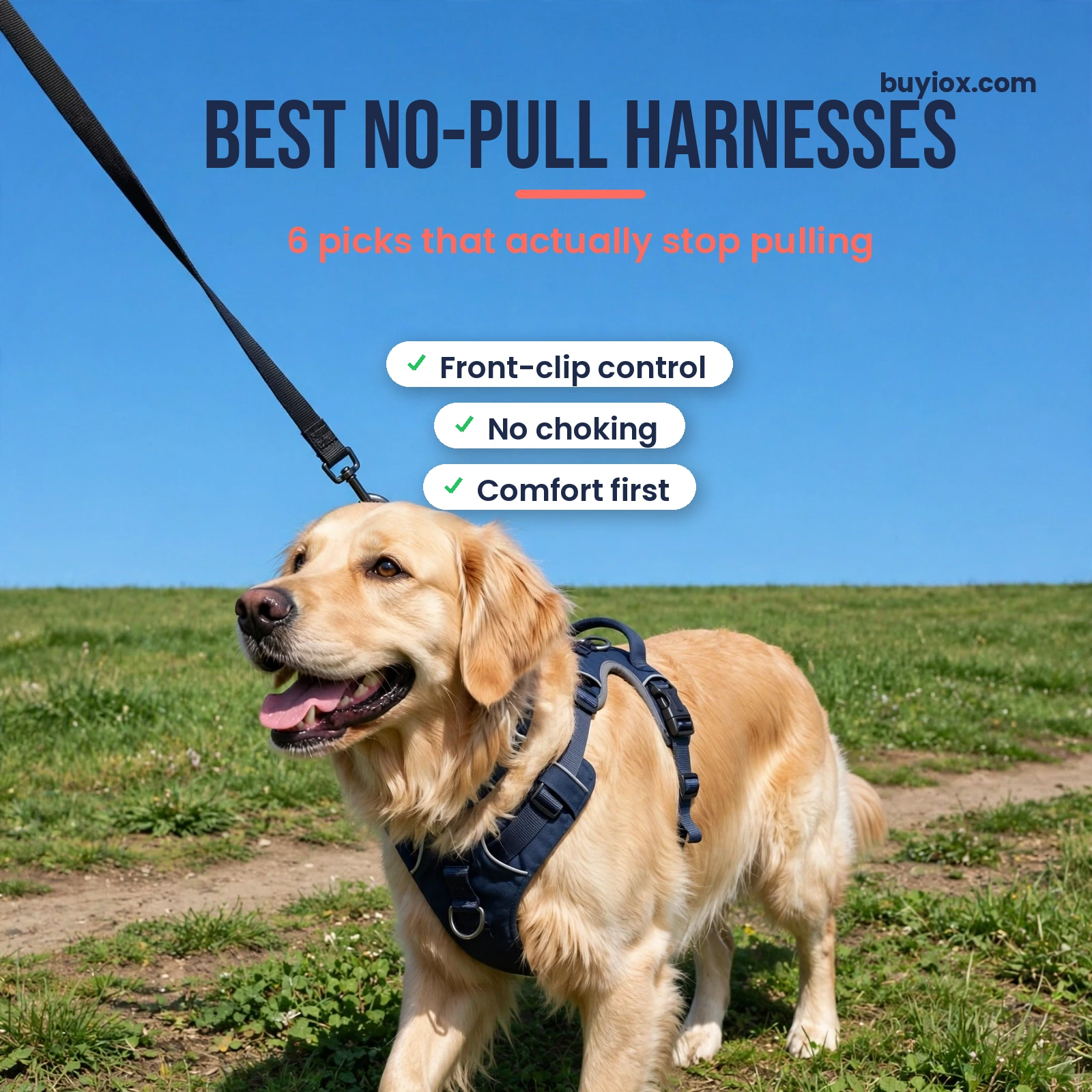
Your Shoulder Is Not a Leash Shock Absorber
You know the walk. You clip the leash to your dog’s collar, take three steps, and suddenly you are water-skiing behind 60 pounds of pure enthusiasm. Your shoulder aches, your dog is half-choking, and the squirrel two blocks away is the most interesting thing in the universe.
A collar makes this worse. Every lunge puts pressure straight on your dog’s throat, which is exactly why so many pullers cough and gag their way through walks. A no-pull harness changes the physics: the leash clips to the front of the chest, so when your dog surges forward, their own momentum gently turns them back toward you instead of dragging you along.
But not all no-pull harnesses are equal. Some chafe under the legs, some are impossible to fit, and some restrict shoulder movement so much that your dog develops an odd gait. That is why “fit and honest design” is the number one thing we looked for when picking these six.
We dug through real product specs, official brand pages, sizing charts, and thousands of owner experiences to find the best no-pull dog harnesses on the market right now. Every product below is a real, currently available product with verified features. No invented specs, no fake testing claims, no guesses.
Quick Comparison: The 6 Best No-Pull Dog Harnesses
| Product | Best For | Approx. Price |
| — | — | — |
|---|---|---|
| rabbitgoo No Pull Dog Harness | Best overall value | Around $20 |
| PetSafe Easy Walk Harness | Classic vet-designed minimalist pick | Around $23 |
| 2 Hounds Design Freedom No-Pull Harness | Strong pullers, trainer favorite | Around $33 |
| Blue-9 Balance Harness | Hard-to-fit dogs, fully adjustable | Around $40 |
| Kurgo Enhanced Strength Tru-Fit Smart Harness | Car travel, crash-tested | Around $40 |
| Embark Adventure No-Pull Harness | Padded comfort on a budget | Around $35 |
Prices change often on Amazon, so treat these as rough guides. The links below take you to live Amazon search results where you can check the current price.
1. rabbitgoo No Pull Dog Harness – Best Overall
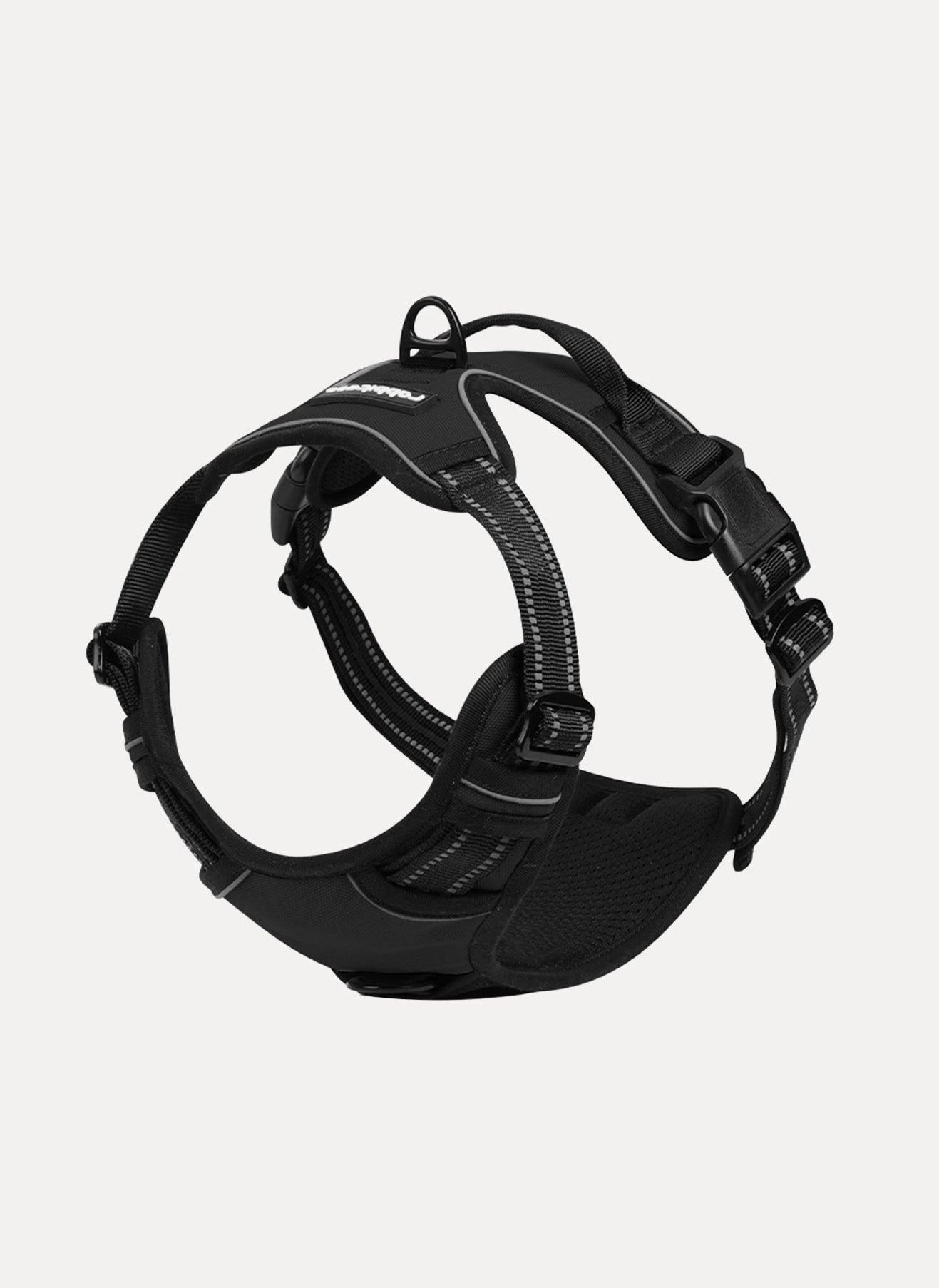
The rabbitgoo Classic: padded vest-style harness with front and back leash clips, top handle, and reflective trim.
If you ask ten dog owners which no-pull harness they bought first, a lot of them will say this one. The rabbitgoo No Pull Dog Harness (Classic Fit, part of the brand’s ControlPro series) is one of the best-selling dog harnesses on Amazon for a reason: it packs the two features that matter most – a front chest clip for no-pull training and a back clip for casual walks – into one affordable, padded package.
The design is a padded vest style. You get two metal D-rings: clip the leash to the chest ring when you are actively training against pulling, and switch to the back ring for relaxed walks and jogs once your dog’s manners improve. Four adjustable straps (two at the neck, two at the chest) let you dial in the fit, and two fast-release buckles mean the whole thing goes on and off in seconds once you know the routine.
Comfort-wise it is well thought out for the price. The outer is 600D polyester Oxford, the lining is breathable air mesh, and there is soft padding at the pressure points so the straps do not dig in. A top handle gives you a grab point for crossings and car loading, and reflective strips help drivers see your dog after dark. Sizes run from XS to XL, covering chest girths from 11 to 38 inches across the range.
Honest caveats, because this harness is popular enough to have real feedback. The fit can run tight behind the front legs on deep-chested breeds, so if your dog is between sizes, most owners recommend sizing up. Some owners report mild chafing in warm weather when the fit is not quite right, and the fabric can show wear after a couple of months of heavy daily use.
Pros:
- Front AND back leash clips in one affordable harness
- Padded, breathable vest design is comfortable for daily walks
- Top handle plus reflective strips included at a budget price
- Four adjustment points for a customizable fit
- Easy on/off with two fast-release buckles
Cons:
- Can fit tight behind the front legs on deep-chested dogs – measure carefully
- Some owners report mild chafing in warm weather
- Fabric shows wear faster than premium harnesses under heavy daily use
Best for: First-time no-pull buyers and budget-conscious owners who want the classic dual-clip design. The best no-pull dog harness for the money.
Skip if: Your dog is a very heavy puller over 70 lbs or reactive – consider the sturdier Freedom or Kurgo picks below.
2. PetSafe Easy Walk Harness – The Classic Vet-Designed Pick
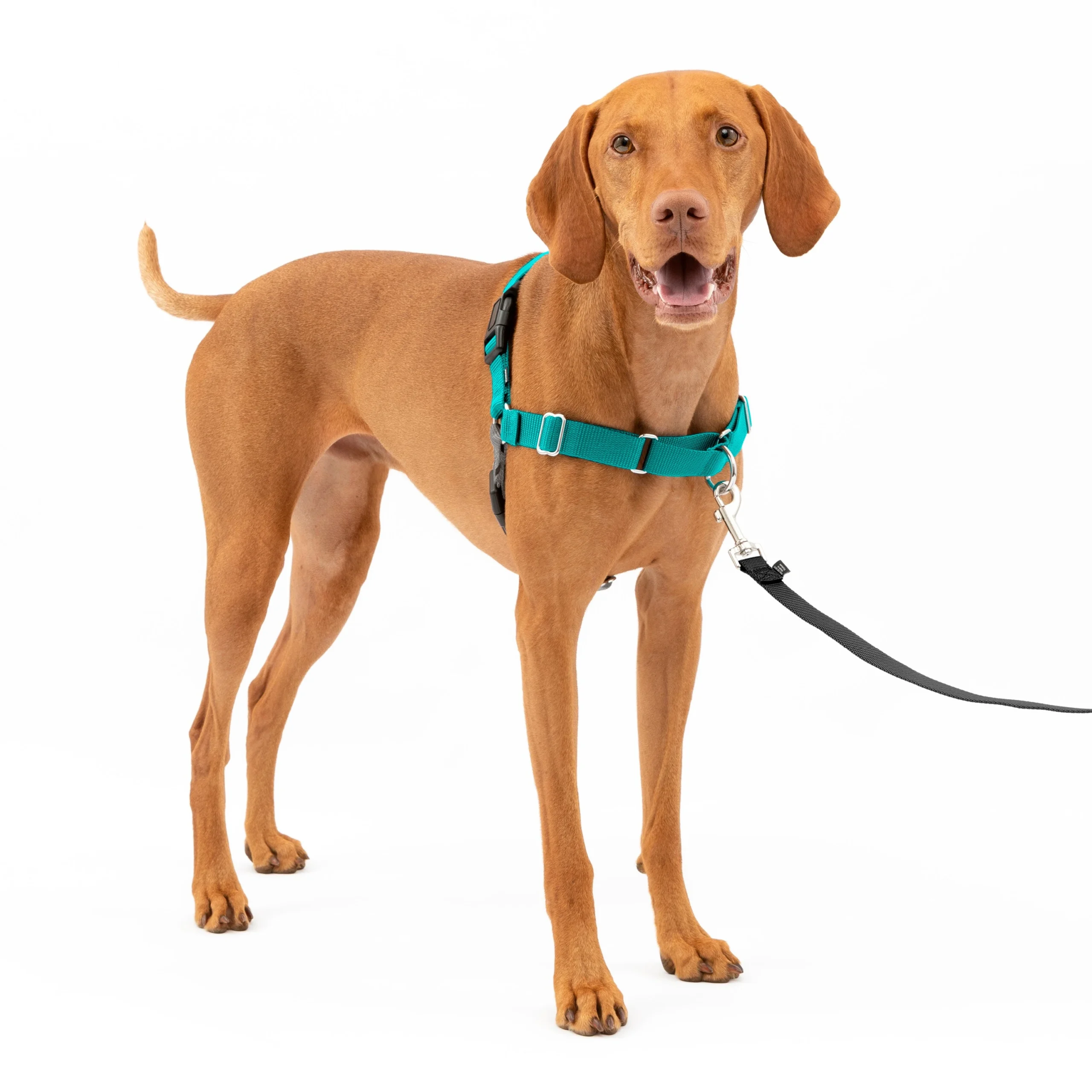
The PetSafe Easy Walk: minimalist front-clip strap harness designed by a veterinary behaviorist.
The PetSafe Easy Walk Harness is the granddaddy of no-pull harnesses. Originally designed by a veterinary behaviorist and on the market since 2004, it is the harness many professional trainers recommend first – and its design philosophy is the opposite of the rabbitgoo: instead of padding and bulk, it uses a minimalist strap layout with a patented martingale loop across the chest.
Here is how it works. The leash attaches to a single D-ring on the front of the chest – note that there is NO back clip on this harness, which is deliberate. When your dog pulls, the martingale loop tightens gradually across the shoulders, applying gentle, even pressure that redirects their attention back to you. Because the harness rests across the chest rather than the throat, there is no gagging or choking like you get with a collar.
The minimalist build is genuinely practical. Four adjustment points with quick-snap shoulder and belly straps, and the belly strap is a different color from the rest of the harness so you always know which side is which – putting it on correctly becomes foolproof. The lightweight, breathable design with minimal coverage keeps dogs cool, which is a real advantage in warm climates. Eight sizes cover dogs from under 10 lbs (Petite) all the way to 90+ lbs (XL).
The trade-offs are real too. Fit is easy to get wrong: when misfitted, the straps can sit in the armpits and cause chafing, or the chest strap can hang loose and let a determined dog wriggle free. The thin webbing has minimal padding compared to vest-style harnesses, and the brand does not recommend it for running or jogging because of chafing risk. And if you want a back-clip option for casual walks, it simply does not have one.
Pros:
- Designed by a veterinary behaviorist, trusted by trainers since 2004
- Minimalist, breathable, lightweight – great for warm climates
- Color-coded belly strap makes correct fitting foolproof
- Chest-resting design eliminates throat pressure and gagging
- Eight sizes from Petite to XL
Cons:
- No back leash clip – front-only attachment
- Easy to misfit; misfitted straps cause armpit chafing or let dogs wriggle out
- Thin webbing with minimal padding compared to vest-style harnesses
- Not recommended for running or jogging
Best for: Owners who want the proven, vet-designed classic and a cool, lightweight harness for everyday training walks.
Skip if: You want a back clip, padding, or a harness for jogging – look at the rabbitgoo or Embark instead.
3. 2 Hounds Design Freedom No-Pull Harness – Best for Strong Pullers
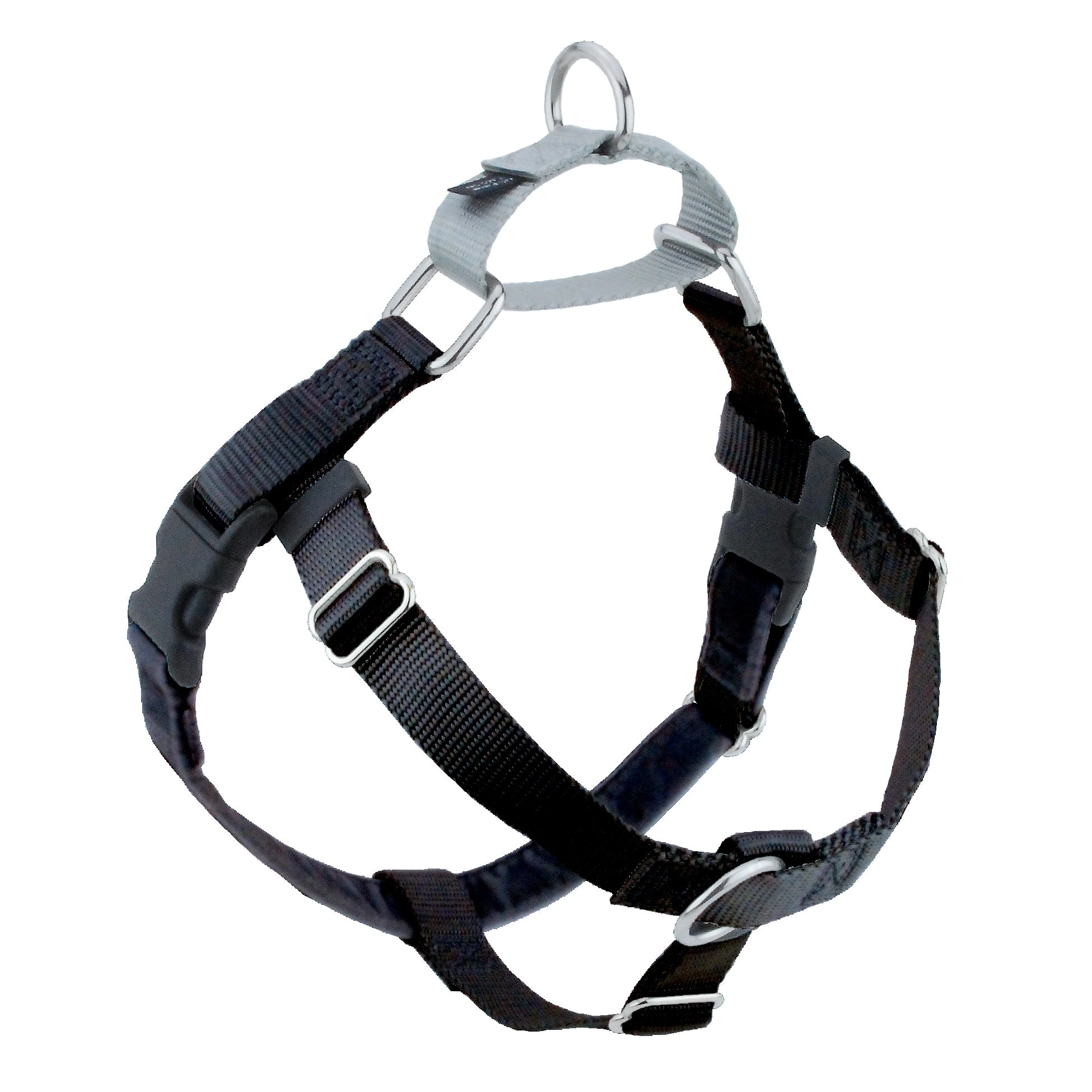
The Freedom harness: dual front and back connection points with a patented martingale loop and Swiss velvet-lined chest strap.
If your dog is a serious puller – the kind that has snapped a leash clip or pulled you off your feet – this is the harness trainers reach for. The 2 Hounds Design Freedom No-Pull Harness is a trainer and veterinarian favorite, made by a small company in North Carolina that has been building dog gear since 2003.
The Freedom’s secret is its patented martingale control loop at the back, paired with a structural connection ring on the chest. You can clip the leash to the front ring, the back loop, or both at once using a double-ended leash (the brand sells an optional Training Leash and Euro Leash for exactly this). When the dog pulls, the martingale loop tightens gently around the chest, applying a soft, even compression the brand compares to a calming hug – no choking, no pinching.
It is built like serious equipment. The chest strap is lined with Swiss velvet to prevent the rubbing and chafing that bare webbing causes behind the front legs. The hardware is non-rusting stainless steel, and the webbing is heavy-duty nylon rated to 3,800 lb test strength. Four adjustment points help you get the fit right, and the size range is enormous: from a 3/8-inch XXS Mini (13-16 inch chest, roughly 6-15 lbs) all the way to a 1-inch XXL (36-44 inch chest), designed to fit dogs from 14 lbs to over 250 lbs. Dogs under 40 lbs get 5/8-inch webbing, dogs over 40 lbs get the full 1-inch width.
Two honest warnings. First, the initial fitting has a learning curve – take your time measuring, choose the smallest size that fits the chest measurement, and follow the brand’s fitting guidance, because several owners ordered wrong despite measuring. Second, it is not chew-proof, and a few owners of very short-coated dogs report it can still rub the armpits on long walks.
Pros:
- Trainer and veterinarian recommended for strong, determined pullers
- Dual front + back connection gives maximum control and redirection
- Swiss velvet-lined chest strap genuinely reduces chafing
- Stainless steel hardware and 3,800 lb test webbing – built to last
- Huge size range fits dogs from 14 lbs to 250+ lbs; made in the USA
Cons:
- Initial fitting takes patience – measure carefully and follow the fitting guide
- Not chew-proof; determined chewers can damage the straps
- Can still rub the armpits of very short-coated dogs on long walks
Best for: Strong pullers, large breeds, and owners who want the trainer-recommended martingale design with dual-clip versatility.
Skip if: You want a simple, padded, put-it-on-and-go vest – the rabbitgoo is easier for beginners.
4. Blue-9 Balance Harness – Best Adjustable Fit
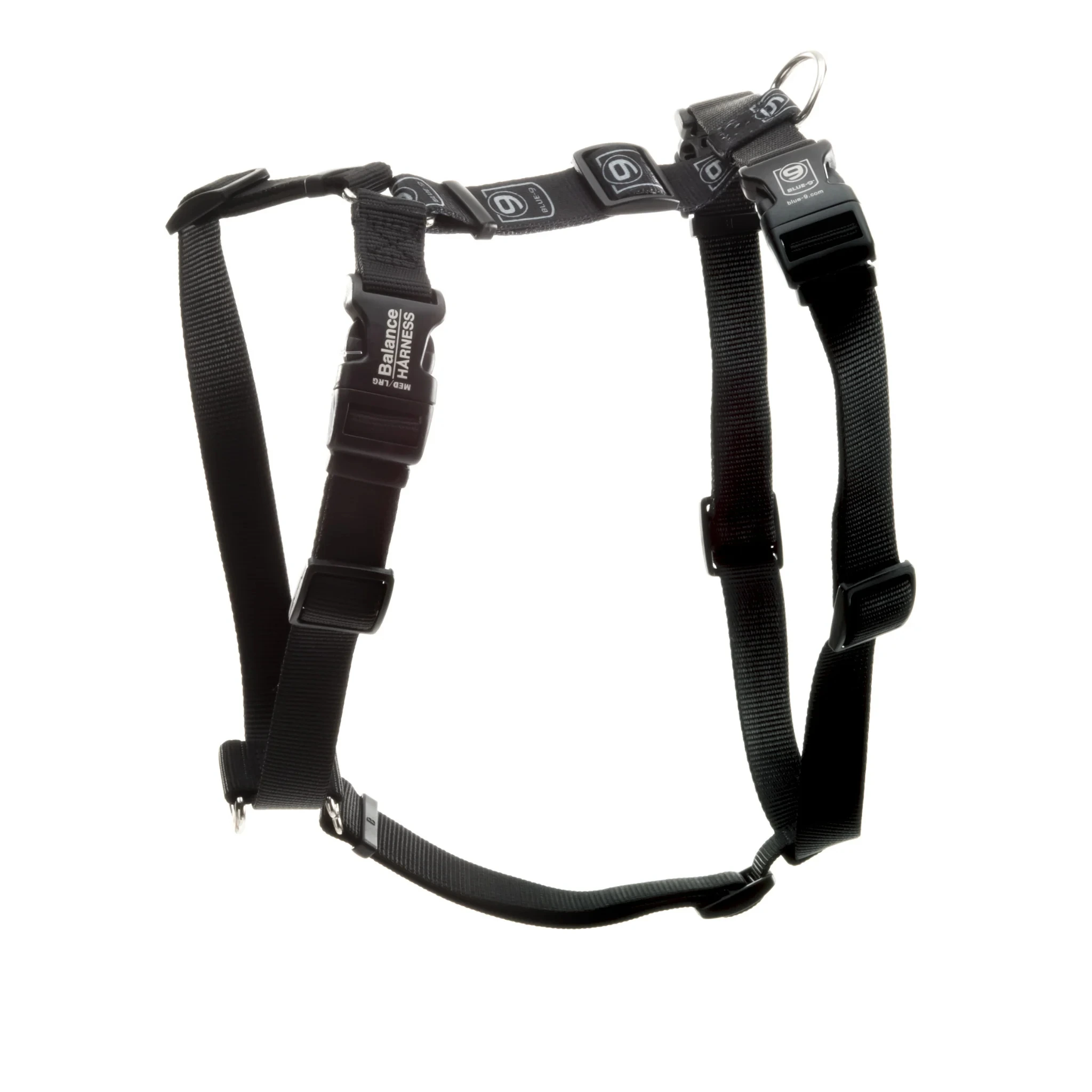
The Blue-9 Balance: six-point adjustment with a Y-front design that keeps shoulders free for natural movement.
Some dogs are just hard to fit. Deep-chested greyhounds, barrel-chested bulldogs, long narrow whippets – standard harnesses either strangle their shoulders or slide sideways. The Blue-9 Balance Harness was designed for exactly these dogs, and its headline feature is six points of adjustment for a genuinely customized fit.
The design thinking shows everywhere. The front is Y-shaped rather than a straight horizontal strap, so it does not press on the shoulders or restrict leg extension – your dog keeps a natural gait. The neck loop has a buckle, so dogs that hate having gear slipped over their heads can step in instead. You get both a front chest ring and a back ring, usable separately or together (the brand suggests pairing it with a double-ended training leash). The material is washable soft-touch nylon, comfortable against the skin, and it comes in nine colors including Black, Blue, Camo, Hot Pink, Hunter Green, Orange, Purple, Red, and Sky Blue. Sizes run XS through Large, and there is a reflective version for night walks at a slightly higher price.
Now the honest part: this harness is fiddly. Multiple owners describe putting it on as “like a puzzle” at first – the straps can tangle, it can slide side-to-side, or cinch up behind the armpits until you learn the routine. Several owners needed the brand’s fitting video or a trainer’s help to get it right, and one reviewer joked their elderly parents could never figure out the buckles. The soft nylon that makes it comfortable is also chewable – it is not escape-proof and not chew-proof. And sizing can run large on some builds, so check the official sizing chart and consider sizing down if your dog is between sizes.
Pros:
- Six-point adjustment gives a truly custom fit for hard-to-fit body shapes
- Y-front design keeps shoulders free for natural movement
- Buckle neck loop – no over-the-head struggle for sensitive dogs
- Front + back rings for versatile leash setups
- Soft, washable nylon in nine colors
Cons:
- Fiddly to put on at first – straps tangle and the routine takes practice
- Not escape-proof and not chew-proof
- Sizing can run large on some builds
Best for: Deep-chested, barrel-chested, or otherwise hard-to-fit dogs, and owners willing to learn the fitting routine for a custom fit.
Skip if: You want the simplest possible harness, or your dog chews gear – the rabbitgoo is more forgiving.
Buying Guide: How to Choose the Right No-Pull Dog Harness
Picking a no-pull harness comes down to four decisions. Get these right and the harness practically disappears into the walk.
Front clip, back clip, or dual clip
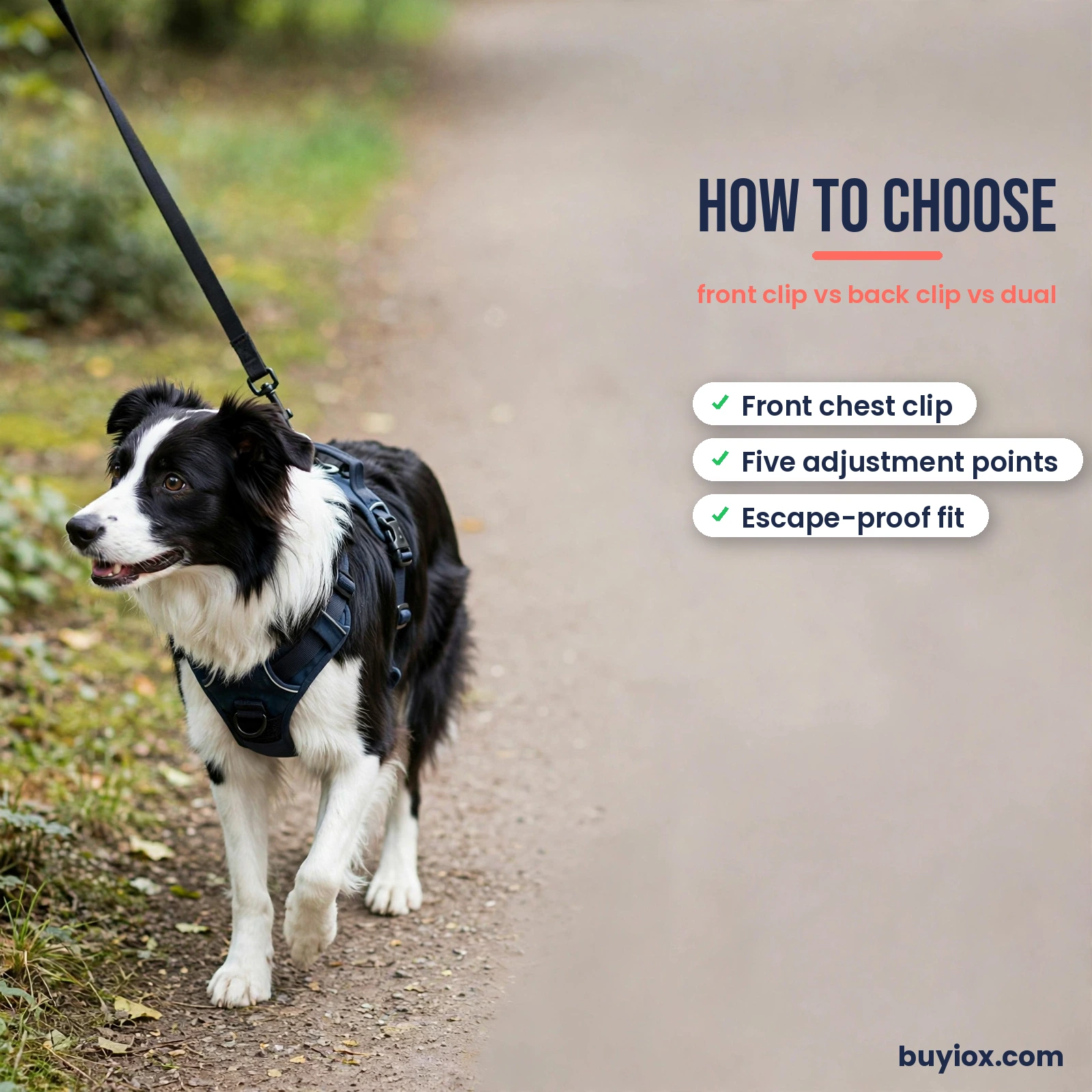
This is the most important choice. A front-clip (chest) attachment is what makes a harness “no-pull”: when the dog surges forward, the leash redirects their momentum sideways and back toward you, breaking the pulling motion. Use it for training walks and for dogs with a real pulling habit. A back-clip attachment is the standard setup for casual walks, jogging, and hiking – comfortable, tangle-free, but it does nothing to discourage pulling (it can even encourage it, since dogs naturally pull against pressure from behind). Dual-clip harnesses (rabbitgoo, Freedom, Balance, Kurgo, Embark) give you both: train on the front, relax on the back.
Fit: measure, don’t guess
No-pull harness sizing varies wildly by manufacturer, so never assume your Labrador is a Large. Measure your dog’s girth – the circumference of the widest part of the rib cage, right behind the front legs – with a soft tape measure, then check the brand’s sizing chart. PetMD’s fitting guide (https://www.petmd.com/dog/training/how-choose-and-fit-no-pull-dog-harness) walks through exactly which measurements matter for no-pull designs.
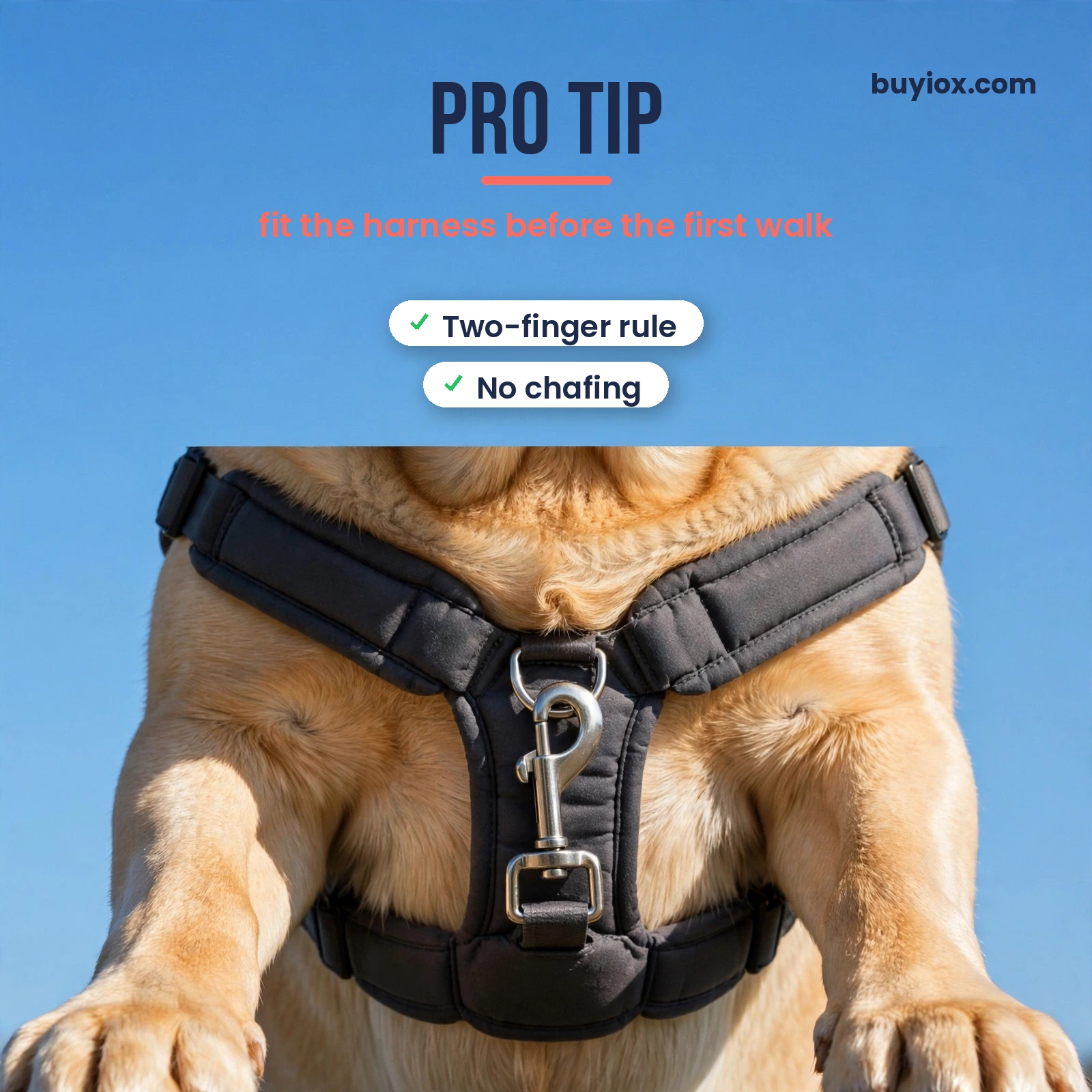
The golden rule once it is on: you should be able to slip two fingers snugly between the harness and your dog, but no more. Too loose and a determined dog can back out of it – PetMD notes that some no-pull designs have a flaw where the chest piece slips down when the leash is taut, letting pullers slip free (https://www.petmd.com/dog/care/surprising-dog-harness-dangers-avoid). Too tight and you get chafing, especially in the armpit area. If your dog is between sizes, most brands advise sizing up for vest-style harnesses and checking the brand’s own guidance for strap-style ones.
Why a proper fit matters more than the brand
This is worth emphasizing, because a poorly fitting harness is not just annoying – it can genuinely harm your dog. The AKC’s guide to well-fitting harnesses (https://www.akc.org/expert-advice/lifestyle/the-importance-of-a-well-fitting-harness/) quotes canine sports medicine veterinarian Dr. Chris Zink, who warns that a bad fit can cause soft tissue injuries from abnormal pressure and compensatory muscle overuse as the dog alters its gait. Signs of a bad fit: fur rubbed raw, odd movement patterns, the dog refusing to wear the harness, or skin bunching around the neck and shoulders. If you see any of these, stop using that harness and refit or replace it.
Padding vs. minimalist straps
Padded vest-style harnesses (rabbitgoo, Embark, Kurgo) distribute pressure over a wider area and are more comfortable for long walks, but they run warmer and take longer to dry. Minimalist strap harnesses (Easy Walk, Freedom, Balance) are cooler, lighter, and easier to wash, but the straps concentrate pressure on smaller areas – which is exactly why the Freedom’s velvet lining and the Balance’s Y-front design exist. For hot climates or short-coated dogs, lean minimalist or well-padded; for heavy pullers, padding plus a martingale or dual-clip design is the safer bet.
The harness is a training aid, not a cure
The honest truth no product page will tell you: no harness teaches loose-leash walking by itself. The front clip makes pulling unrewarding and gives you control while you train, but the actual skill comes from consistent, reward-based training – rewarding the dog for walking beside you, stopping when they pull, and practicing in low-distraction areas first. Think of the harness as training wheels: it keeps everyone safe and comfortable while the real learning happens.
5. Kurgo Enhanced Strength Tru-Fit Smart Harness – Best for Car Travel
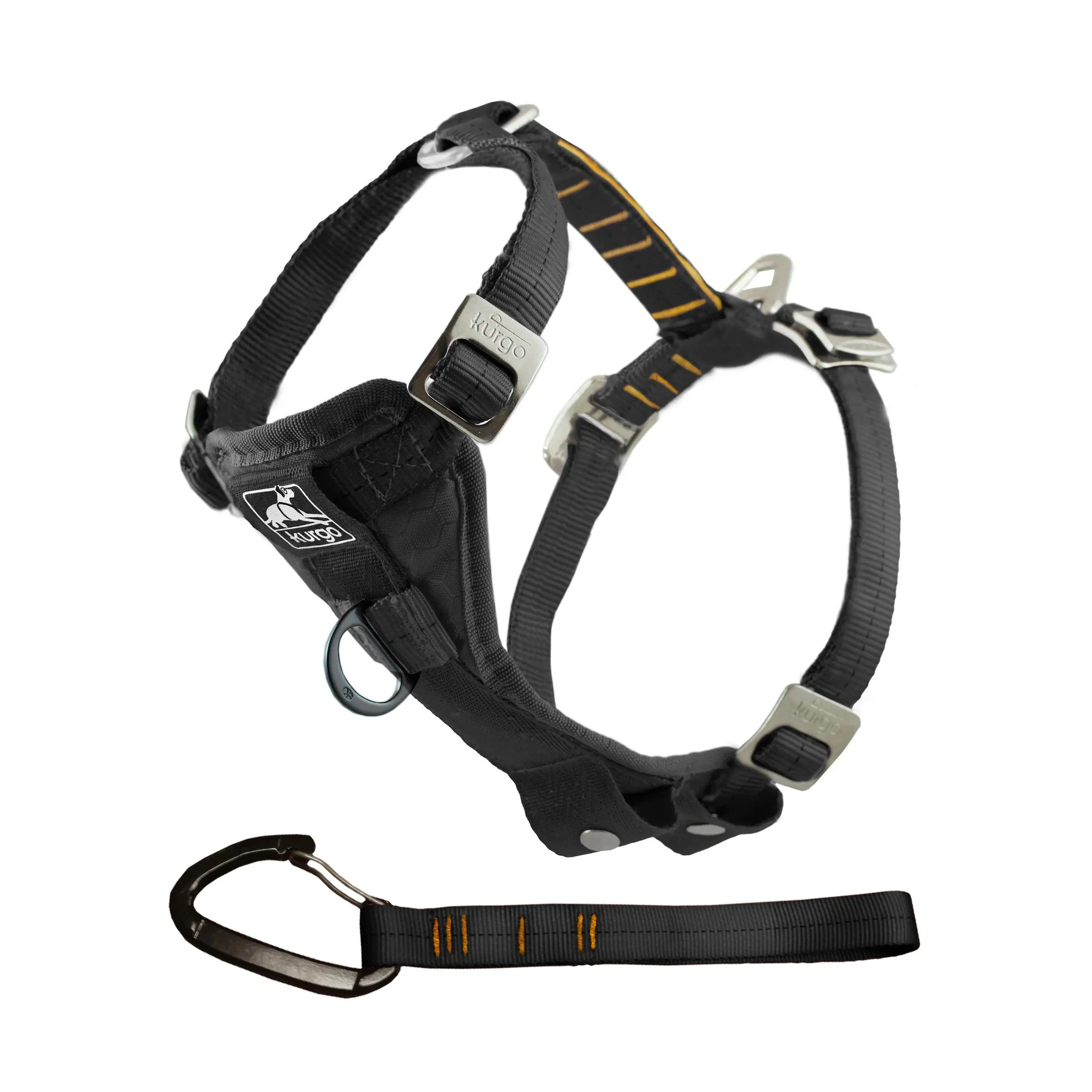
The Kurgo Enhanced Strength Tru-Fit: crash-tested no-pull harness with all-steel buckles and an included seat belt tether.
Here is something most no-pull roundups get wrong: Kurgo makes two different Tru-Fit harnesses, and only one is crash-tested. The standard Tru-Fit Smart Dog Walking Harness is a fine everyday harness, but Kurgo’s own product page states clearly that it is not crash tested. The Enhanced Strength Tru-Fit Smart Harness is the crash-tested version – tested for dogs up to 75 lbs at a university facility using crash-test standards adapted for dogs – and that is the one we recommend here.
It earns its place as the best no-pull harness for car travel. The all-steel nesting buckle system is engineered like rock-climbing hardware for serious security, and it includes a 10-inch seat belt tether with a steel carabiner that clips straight into your car’s seat belt buckle – so your dog rides restrained instead of roaming the car. For walks, you get both a front chest attachment (the halt ring on the padded chest plate corrects pulling) and a back attachment, five adjustment points for a near-custom fit, a padded chest plate that reduces stress on the trachea and sternum, and reflective trim for low-light visibility. It comes in multiple sizes with a detailed sizing chart on the official site.
The trade-offs: all that steel makes it heavier and bulkier than minimalist strap harnesses, and it is an over-the-head design, so head-shy dogs may object. It also costs more than the standard version – you are paying for the crash engineering. But if your dog rides in the car regularly, it is the only pick on this list that doubles as genuine crash protection.
Pros:
- Genuinely crash-tested (up to 75 lbs) – the real deal for car travel
- All-steel nesting buckles engineered like climbing hardware
- Front + back leash attachments with five adjustment points
- Padded chest plate protects trachea and sternum
- Includes 10-inch seat belt tether with steel carabiner
Cons:
- Heavier and bulkier than minimalist strap harnesses
- Over-the-head put-on – not ideal for head-shy dogs
- Pricier than the standard (non-crash-tested) Tru-Fit version
- Make sure you buy the Enhanced Strength version, not the standard one
Best for: Dogs who ride in the car regularly – the only crash-tested no-pull pick here, and a solid walking harness too.
Skip if: Your dog never rides in the car – the standard Tru-Fit or the rabbitgoo gives you the walking features for less.
6. Embark Adventure No-Pull Harness – Best Padded Pick
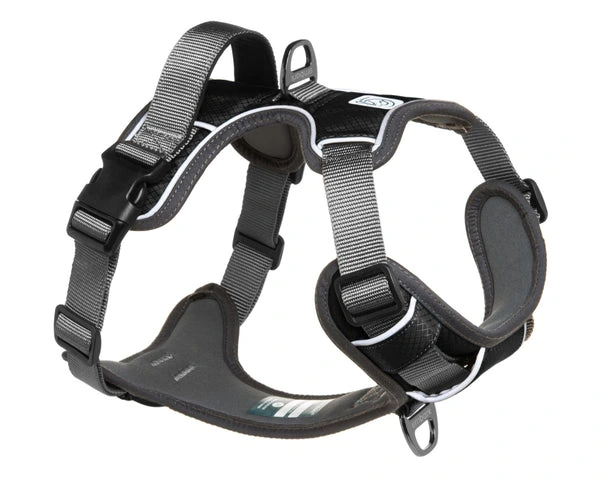
The Embark Adventure: padded no-pull harness with front and back metal rings, gel-lined handle, and reflective trim.
The Embark Adventure No-Pull Harness comes from Embark Pets, a small Tampa-based company that built its reputation on this single flagship product – and it shows in the details. This is the pick for owners who want the comfort of a padded vest harness with a bit more personality than the big-brand options.
The spec sheet is strong for the price (around $33-35). Two metal leash rings – front chest clip for no-pull training, back ring for everyday walks. Two quick-release buckles that the brand says get the harness on and off in seconds. Military-grade nylon with four layers of cushioning, breathable mesh, and bright reflective trim for night visibility. A gel-lined top handle gives you close control in traffic or at the vet – note it is designed for control, not for lifting your dog. Sizes run S through XL, and the color range is genuinely fun, from classic Black to patterns like Baja, Maverick, and Aurora. The company backs it with a lifetime warranty against manufacturing defects.
The number one owner complaint is sizing. Some dogs find it runs large with excess straps dangling; others fall between sizes and get a shifting, loose-necked fit – narrow-necked, broad-headed dogs like pit mixes seem most affected. The brand advises choosing the larger size if you are between sizes, so measure carefully. Also worth knowing: it is not crash-tested or certified for car safety, and a few owners report the straps can loosen under very hard pulling, so check the fit periodically.
Pros:
- Padded, comfortable vest design with breathable mesh and reflective trim
- Dual metal leash rings (front no-pull + back) plus a gel-lined control handle
- Fun color and pattern range beyond the usual black and grey
- Quick on/off with two buckles; lifetime warranty from a small US business
- Good value around $35
Cons:
- Sizing is the top complaint – can run large or shift on narrow-necked dogs
- Not crash-tested or certified for car safety
- Straps can loosen under very hard pulling; check fit periodically
- Gel handle is for control, not for lifting the dog
Best for: Owners who want a comfortable, padded, good-looking no-pull harness from a small business, at a fair price.
Skip if: Your dog is between sizes and hard to fit (try the Blue-9 Balance instead), or you need crash protection (the Kurgo is the pick).
Frequently Asked Questions
Do no-pull dog harnesses actually work?
Yes, with the right expectations. A front-clip no-pull harness works by redirecting your dog’s forward momentum: when the dog pulls, the chest attachment turns them gently back toward you instead of letting them drag you forward. This makes pulling unrewarding and gives you control. What it does not do is teach loose-leash walking on its own – that still takes consistent, reward-based training. Think of the harness as a management tool that keeps walks safe and pleasant while the training does the real work, as PetMD explains in their no-pull harness guide (https://www.petmd.com/dog/training/how-choose-and-fit-no-pull-dog-harness).
Are front-clip harnesses bad for dogs’ shoulders?
They can be if they fit poorly. Research on walking equipment has found that all harnesses affect a dog’s gait to some degree, and a horizontal chest strap that sits across the shoulder joints can restrict natural leg movement – which is exactly why designs like the Blue-9 Balance use a Y-shaped front that keeps the shoulders free. Canine sports medicine veterinarians warn that a badly fitted harness can cause soft tissue injuries from abnormal pressure (https://www.akc.org/expert-advice/lifestyle/the-importance-of-a-well-fitting-harness/). The fix is simple: choose a design that clears the shoulders and fit it correctly using the two-finger rule.
What is the difference between a front-clip and a back-clip harness?
A front-clip (chest) harness attaches the leash at the dog’s chest and is designed to discourage pulling by redirecting forward momentum – it is the training configuration. A back-clip harness attaches at the top of the back like a traditional harness: comfortable and tangle-free for casual walks, jogging, and hiking, but it does nothing to reduce pulling. Many of the best no-pull dog harnesses (rabbitgoo, Freedom, Balance, Kurgo, Embark) include both clips so you can train on the front and relax on the back.
How should a no-pull harness fit?
Measure your dog’s girth (the widest part of the rib cage, right behind the front legs) and check the brand’s sizing chart – never guess the size. Once it is on, you should be able to slide two fingers snugly under every strap. The chest strap should sit right behind the front legs, not in the armpits, and the harness should not rotate or slide when your dog moves. Check the fit again after the first few walks, since straps settle, and re-check regularly for growing puppies.
Can a dog escape from a no-pull harness?
A determined dog can escape from almost any harness if the fit is wrong – usually by backing out of it. The biggest escape risk comes from a harness that is too loose: the dog plants its feet, reverses, and the harness slides right off. This is why the two-finger rule matters, and why you should test the fit before the first real walk by gently pulling backward on the harness while a helper holds the leash. Martingale-style designs like the Freedom and Easy Walk add a small margin of safety here, since the loop tightens slightly when the dog pulls back.
Should I use a harness or a collar for a dog that pulls?
A harness, in most cases. A collar concentrates all the force of a lunge on the dog’s neck and trachea, which is why pullers on collars so often cough and gag. A well-fitted no-pull harness distributes pressure across the chest and shoulders instead. The one exception some trainers note: for initial leash training with very small puppies, a lightweight collar or harness both work – but once pulling starts, a front-clip harness is the kinder, more effective tool.
Will a no-pull harness stop my dog pulling on its own?
No – and any product that promises this is overselling. The harness removes the reward of pulling (the dog no longer gets to drag you toward the interesting thing) and gives you humane control, which makes training dramatically easier. But the pulling habit itself is unlearned through training: rewarding calm walking, stopping or changing direction when the leash tightens, and practicing in low-distraction environments first. Most owners see real improvement within a few weeks of combining the right harness with consistent training.
Final Verdict: Which No-Pull Dog Harness Should You Buy?
If you want our single top recommendation, it is the rabbitgoo No Pull Dog Harness. The dual front-and-back clips, padded breathable design, top handle, and reflective trim at around $20 make it the best no-pull dog harness for most owners. It is the one we would buy first.
For a proven classic, the PetSafe Easy Walk Harness remains the vet-designed minimalist pick that trainers have recommended since 2004 – just remember it is front-clip only. For strong, determined pullers, the 2 Hounds Design Freedom is the trainer favorite with its dual-connection martingale design. Hard-to-fit dog? The Blue-9 Balance and its six-point adjustment were made for exactly that problem.
If your dog rides in the car, the Kurgo Enhanced Strength Tru-Fit is in a class of its own as the only genuinely crash-tested pick here – just make sure you buy the Enhanced Strength version, not the standard Tru-Fit. And for padded comfort with personality, the Embark Adventure delivers a lot of harness for around $35.
Whichever you choose, remember the two rules that matter more than the brand: fit it properly with the two-finger rule, and pair it with consistent training. Do that, and the water-skiing days are over.
If your dog pulls partly out of anxiety, our guide to the best calming chews for dogs can help take the edge off stressful walks. For dogs who ride along in the car, pair your new harness with one of the best dog car seat covers to protect your seats. And for the muddy-paw aftermath of every adventure, check out the best dog paw washers – the perfect end to a calm, pull-free walk.