

Affiliate Disclosure: Buyiox is reader-supported. When you buy through links on this page, we may earn a small commission at no extra cost to you. We only recommend products we would use in our own homes.
You open the fridge at midnight and the milk is warm. The ice cream you bought yesterday has turned to soup. Your dorm room has no kitchen, your bedroom is three rooms from the fridge, and your office lunch keeps going soft by noon. That is the exact problem a mini fridge solves. It puts cold drinks, snacks, and a few days of food within arm’s reach, in a box small enough to fit beside a desk, under a lofted bed, or in the corner of a bedroom.
A mini fridge sounds simple, and that is why most buyers get it wrong. The box on the listing photo looks like a small version of a full fridge, but most single-door mini fridges do not have a real freezer at all. They have a small chiller box inside the same door, and that chiller box will not keep ice cream frozen or store frozen meals safely for long. Only a two-door model, with a separate freezer door of its own, gives you a freezer that actually freezes. That one distinction decides whether you end up happy or disappointed, and most roundups never spell it out.
There are other honest truths in this category too. A thermoelectric cooler, the tiny 4 liter kind sold for skincare and desks, cools relative to room temperature, not to a fixed safe temperature, so it cannot keep milk safe. Noise matters more than the spec sheet admits when the fridge sits two feet from your pillow. Here are the six best mini fridges we found, with the freezer truth, the noise, and the limits of each one stated plainly.
Our Top 6 Mini Fridges at a Glance
- Midea WHD-113FSS1 – Best overall, the only one here with a true separate freezer
- Upstreman BR321 – Best quiet pick for bedrooms, just 38 dB
- BLACK+DECKER BCRK32B – Best value, trusted brand with a 2-year compressor warranty
- Insignia NS-CF33BK6 – Best budget, the cheapest proper compressor fridge here
- Frigidaire Retro EFR372 – Best retro style, the one that looks good in the room
- Cooluli Classic 4L – Best portable, a desk and car cooler for drinks and skincare
1. Midea WHD-113FSS1 3.1 Cu. Ft. Double Door Mini Fridge – Best Overall

Midea WHD-113FSS1 Double Door Mini Fridge (product-style image)
The Midea WHD-113FSS1 is the best mini fridge for most buyers for one clear reason. It is the only fridge on this list with a true separate freezer behind its own door. The 3.1 cubic feet split into a 2.16 cubic foot fridge and a 0.92 cubic foot full-width freezer, and that freezer runs from minus 11.2 to 5 degrees Fahrenheit, cold enough to keep ice cream firm and frozen meals frozen. Every other full-size pick here has a chiller box inside a single door. If you plan to store anything frozen for more than a day or two, this is the fridge to buy, and there is no close second.
The rest of the package is just as solid. It is Energy Star certified and uses about 270 kWh per year, which is roughly 25 percent under the federal standard for its size, so it barely registers on your power bill. The fridge section holds 32 to 50 degrees Fahrenheit on its adjustable thermostat, with two adjustable removable glass shelves, a crisper drawer for produce, and a door rack with a built-in can dispenser. At about 19.4 inches wide, 18.5 inches deep, and 33 inches tall, it fits under most counters and inside most dorm size limits, though you should check your housing rules first, because some dorms cap fridges at 3.1 cubic feet and this one sits exactly on that line.
The honest trade-off is the price and one quirk in testing. At around $220 to $280 depending on the seller and the color, it is the most expensive full-size fridge here, and the black version is usually cheaper than the stainless steel one. Independent testing also found that the default thermostat setting runs slightly warm, close to the 40 degree food safety threshold rather than the ideal 37 degrees, so you should turn the dial one notch colder after setup and check it with a cheap fridge thermometer in the first week. For a dorm, a bedroom, or a small apartment, it is the best mini fridge you can buy.
Why we like it
- True separate freezer (0.92 cu ft) that actually freezes, the only one here
- Energy Star certified at about 270 kWh per year, roughly 25 percent under the federal standard
- Adjustable glass shelves, crisper drawer, and a built-in can dispenser
- Reversible doors and recessed handles, fits under most counters
- 5,700+ Amazon ratings at 4.5 stars, the longest track record here
Pros
- Best mini fridge for anyone who needs frozen food, not just cold drinks
- Low running costs and a trusted brand with wide parts availability
- Well-organized interior for a 3.1 cubic foot box
Cons
- Around $220 to $280, the priciest full-size fridge on this list
- Default thermostat runs slightly warm, needs a one-time adjustment
- At 33 inches tall it may not fit under a low lofted bed, and it sits exactly on some dorm size caps
Price: around $220 to $280 on Amazon depending on color and seller
Best for: dorms, bedrooms, and small apartments where you want a real freezer, and anyone who stores frozen meals or ice cream.
Who should skip it: buyers on a tight budget, where the Insignia costs far less, and anyone who only needs cold drinks, where the Upstreman or the Cooluli does the job for less.
2. Upstreman BR321 3.2 Cu. Ft. Mini Fridge – Best Quiet Pick for Bedrooms

Upstreman BR321 Mini Fridge (product-style image)
If your mini fridge will sit in a bedroom, noise is the feature that matters most, and the Upstreman BR321 is the quietest full-size fridge on this list. It runs at 38 dB, which is quieter than a library whisper, and in testing it was barely audible from a top bunk. It is a 3.2 cubic foot single-door fridge with a small 0.3 cubic foot freezer compartment, an adjustable thermostat, a crisper drawer, and a reversible door. It is Energy Star certified, uses the eco-friendly R600a refrigerant, and comes in black, white, and silver, so it fits most rooms without standing out.
The value is hard to argue with. At around $150 to $170, it costs far less than the Midea while giving you the same usable fridge space for drinks, lunches, leftovers, and snacks. The layout is simple and practical: adjustable shelves, a door rack, and a crisper drawer that keeps fruit and vegetables fresh for a few days. At about 18.7 inches wide, 17.4 inches deep, and 33.1 inches tall, it fits beside a desk or a bed in a dorm or a small bedroom, and the reversible door means you can put it on either side of the room without blocking the door swing.
The honest trade-off is the freezer, and the maker is upfront about it. The 0.3 cubic foot compartment is a chiller box, not a real freezer, and the maker says it is not suitable for storing ice cream and ice cubes long term. Treat it as a place to chill a couple of drinks fast or keep an ice pack cold, and you will be happy. Expect it to hold a bag of frozen peas for a week and you will be disappointed. That is true of every single-door fridge here, and the Upstreman is at least honest about it. For a bedroom or a dorm where quiet matters and frozen food does not, it is the best mini fridge for the money.
Why we like it
- Just 38 dB, the quietest full-size mini fridge on this list
- Energy Star certified with R600a refrigerant
- Adjustable thermostat, crisper drawer, and reversible door
- Three colors, black, white, and silver, to match your room
- Around $150 to $170, strong value for a 3.2 cubic foot fridge
Pros
- Best mini fridge for bedrooms and light sleepers
- Same fridge space as the Midea for far less money
- Simple, reliable, and easy to live with
Cons
- Freezer is only 0.3 cubic feet and will not keep ice cream frozen
- No separate freezer door, so frozen food is not an option here
- Fewer color and finish options than the Frigidaire retro line
Price: around $150 to $170 on Amazon depending on color
Best for: bedrooms, dorms, and offices where quiet matters, and buyers who want cold drinks and fresh food without paying for a real freezer.
Who should skip it: anyone who needs to store frozen food, where the Midea two-door is the honest pick, and buyers who want the cheapest fridge possible, where the Insignia costs less.
3. BLACK+DECKER BCRK32B 3.2 Cu. Ft. Compact Refrigerator – Best Value

BLACK+DECKER BCRK32B Compact Refrigerator (product-style image)
The BLACK+DECKER BCRK32B is the best value mini fridge on this list, and the reason is the combination of a trusted brand, a fair price, and a warranty that actually covers the part most likely to fail. It is a 3.2 cubic foot single-door fridge with a full-width freezer compartment and an ice cube tray, two adjustable glass shelves, three full-width door shelves, and a can dispenser that holds six 12 ounce cans. It is Energy Star certified, uses about 219 kWh per year, runs on the eco-friendly R600a refrigerant, and carries a 1-year parts and labor warranty plus a 2-year compressor warranty, which is the longest compressor cover of any fridge here.
The interior layout is the best of the single-door fridges. The two slide-out glass shelves adjust to fit tall bottles, the door shelves are wide enough for a gallon of milk, and the can dispenser keeps six cans cold and easy to grab. At about 17.7 inches wide, 19.3 inches deep, and 32.7 inches tall, it is one of the narrower fridges here, which helps in tight dorm rooms and small offices where every inch of floor space counts.
Two honest points before you buy. First, the freezer is the same chiller-box design as the other single-door fridges, with only about 0.2 cubic feet of space, so it chills and makes a little ice but it will not store frozen food for long. Second, stock on Amazon has been inconsistent: one roundup found no buyable Amazon offer at its check, while price trackers show it at around $210 at Amazon and Best Buy. If it is out of stock when you look, the Midea is the better buy anyway. At around $210, with a trusted brand and a 2-year compressor warranty behind it, the BCRK32B is the best value mini fridge for buyers who want a known name without paying the Midea price. The official BLACK+DECKER product page confirms the shelf layout, the can dispenser, and the R600a refrigerant.
Why we like it
- Full-width freezer compartment with an ice cube tray
- Two adjustable glass shelves and three door shelves, including one that fits a gallon of milk
- Can dispenser for six 12 ounce cans
- Energy Star certified at about 219 kWh per year
- 2-year compressor warranty, the longest cover on this list
Pros
- Best value mini fridge from a trusted brand
- Best interior layout of the single-door fridges here
- Narrow 17.7 inch width fits tight rooms
Cons
- Freezer is only about 0.2 cubic feet, a chiller box, not a real freezer
- Amazon stock has been inconsistent, so you may need to check Best Buy
- Fixed-hinge door, unlike the reversible doors on the Midea and Upstreman
Price: around $210 on Amazon
Best for: dorms, offices, and bedrooms where you want a trusted brand, a good layout, and a solid warranty at a fair price.
Who should skip it: buyers who need a real freezer, where the Midea is the only honest pick, and buyers who need a reversible door for a tight corner, where the Upstreman fits better.
4. Insignia NS-CF33BK6 3.3 Cu. Ft. Mini Fridge – Best Budget
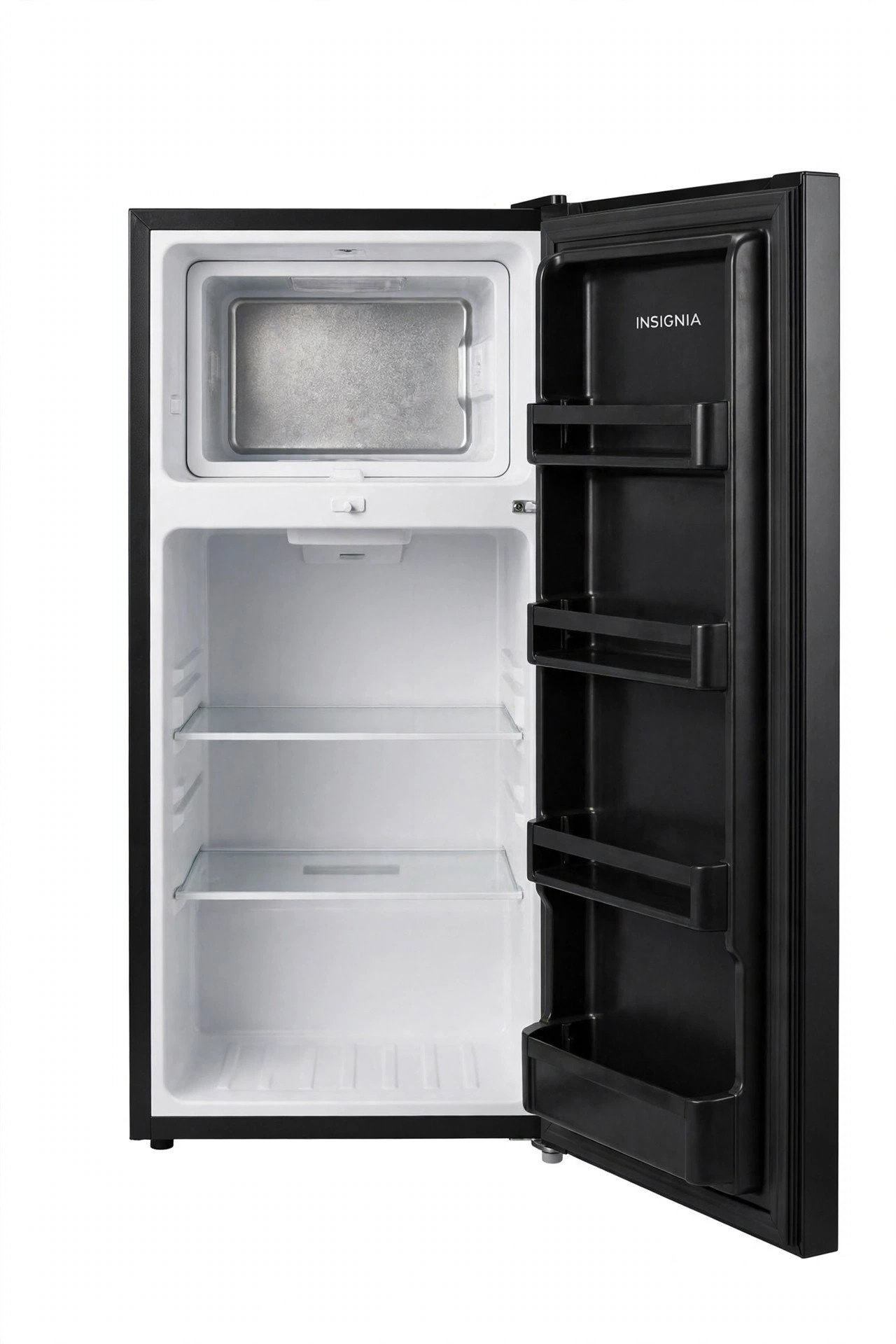
Insignia NS-CF33BK6 Mini Fridge (product-style image)
The Insignia NS-CF33BK6 is the cheapest proper compressor mini fridge on this list, and it is the best budget pick by a clear margin. It is a 3.3 cubic foot single-door fridge, the largest capacity here, with glass shelves, a bottom drawer, three removable door bins, and a reversible door. It is Energy Star certified at 260 kWh per year, runs at 40 dB, which is quiet enough for a bedroom, and uses R600a refrigerant. At about 34 inches tall, 18.6 inches wide, and 17.6 inches deep, and just 45 pounds, it is also one of the lightest full-size fridges here, which makes it easy to move into a dorm or up a flight of stairs.
The price is the story. At around $125 on sale at Best Buy, with a comparable value of $179.99, it costs roughly half the Midea and far less than the BLACK+DECKER, while giving you the same 3.2 to 3.3 cubic foot class of storage. The interior is roomy and simple: three glass shelves, a bottom drawer, and door bins that hold up to 18 cans, though owners report fitting about 15 in practice. The Energy Star certified listing confirms the 3.3 cubic foot capacity and the 260 kWh per year energy use.
The honest trade-offs are the freezer and the defrost. The frozen storage is a small internal compartment that needs manual defrosting whenever ice builds past a quarter inch, and there is no separate freezer door, so frozen food is not a realistic use. The unit is freestanding only, with generous clearance needs, and the maker says it should not be used in a garage or anywhere the temperature drops below 50 or rises above 110 degrees Fahrenheit. For a dorm room, a bedroom, or an office, where you want cold drinks and fresh food for the least money, it is the best budget mini fridge you can buy, and the money you save buys a lot of groceries.
Why we like it
- Around $125 on sale, the cheapest proper compressor fridge here
- Largest capacity on this list at 3.3 cubic feet
- 40 dB, quiet enough for a bedroom
- Energy Star certified at 260 kWh per year
- Light at 45 pounds, easy to carry up stairs
Pros
- Best budget mini fridge for dorms and first apartments
- Roomy interior with glass shelves, a bottom drawer, and three door bins
- Reversible door and a simple, reliable design
Cons
- Small freezer compartment needs manual defrosting
- No separate freezer door, so no real frozen storage
- Not for garages or rooms outside 50 to 110 degrees Fahrenheit
Price: around $125 to $180 depending on sale and retailer
Best for: students, first apartments, and anyone who wants a proper fridge for the least money.
Who should skip it: buyers who need a real freezer, where the Midea is the only pick, and buyers who hate defrosting, where the Midea’s partial automatic defrost is easier to live with.
5. Frigidaire Retro EFR372 3.2 Cu. Ft. Compact Refrigerator – Best Retro Style
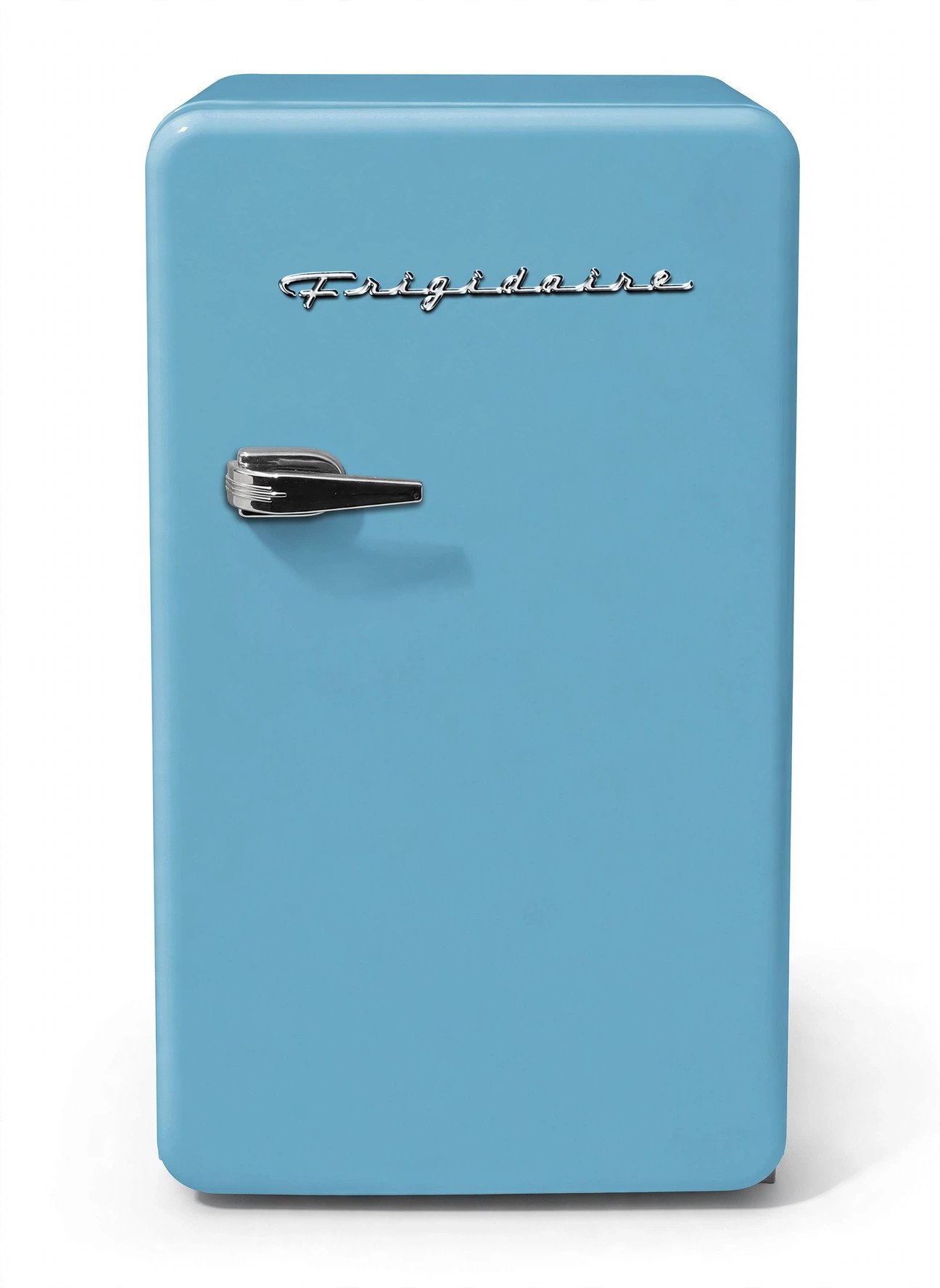
Frigidaire Retro EFR372 Compact Refrigerator (product-style image)
Most mini fridges look like small white boxes. The Frigidaire Retro EFR372 does not. It is a 3.2 cubic foot retro fridge with rounded corners, a chrome handle, and a choice of colors including blue, black, red, pink, and a soft cream called Moonbeam. It has a built-in bottle opener on the side, a chiller compartment with an ice tray, two glass shelves, a 2 liter door basket, and a can dispenser. The Moonbeam version is Energy Star certified. For a bedroom, a home office, or a home bar where the fridge is part of the room, it is the best-looking mini fridge on this list by a wide margin.
The practical side is solid too. At about 20 inches wide, 18.5 inches deep, and 31.5 inches tall, it is shorter than the other full-size fridges here, which helps it fit under a desk or a low shelf. The shelves are removable for cleaning. For drinks, snacks, and a few days of fresh food, it does the same job as the other single-door fridges, and it does it while looking like a piece of furniture rather than an appliance.
Three honest points before you buy. First, the chiller compartment is small, about 0.2 to 0.25 cubic feet, so frozen food is not a realistic use. Second, the price varies widely by color and retailer, from around $150 on a good deal to around $325 at full price, so check the color you actually want before you compare prices, because the cheapest listing is rarely the color you want. Third, a safety note: the U.S. Consumer Product Safety Commission recalled Frigidaire-brand personal minifridges made by Curtis International for fire and burn hazards in 2025, with the recall expanded in 2026. That recall covers small personal minifridges, not this larger 3.2 cubic foot EFR372 model, but it is a good reminder to buy the real Frigidaire model from a reputable seller and to check the exact model number at checkout, because lookalike listings exist.
Why we like it
- Retro rounded-corner design with a chrome handle, the best-looking fridge here
- Built-in bottle opener, a genuinely useful touch for a drinks fridge
- Five colors, including blue, red, pink, black, and cream
- Shorter 31.5 inch height fits under desks and low shelves
- Chiller compartment with an ice tray, plus a can dispenser
Pros
- Best retro mini fridge for bedrooms, offices, and home bars
- Trusted Frigidaire brand with wide availability
- Good drinks storage with the 2 liter door basket and can dispenser
Cons
- Price varies widely by color, around $150 to $325
- Small chiller compartment, no real frozen storage
- Specs vary between color variants, so check the exact model number
Price: around $150 to $325 depending on color and retailer
Best for: bedrooms, home offices, and home bars where looks matter, and buyers who want a fridge that suits the room.
Who should skip it: buyers who need a real freezer, where the Midea is the pick, and budget buyers, where the Insignia gives the same storage for far less.
6. Cooluli Classic 4L Mini Fridge – Best Portable and Skincare Pick

Cooluli Classic 4L Mini Fridge (product-style image)
The Cooluli Classic 4L is a different kind of mini fridge, and it earns its place on this list because it does a job none of the others can. It is a 4 liter thermoelectric cooler and warmer, about 7.25 inches wide, 10.25 inches deep, and 10.75 inches tall, weighing just 4 pounds, with a molded handle on top. It holds six 12 ounce cans, runs on AC power at home, DC power in a car, and even USB power from a power bank in eco mode. It is the original skincare fridge, with more than 18,000 Amazon reviews at 4.4 stars, and it is the best mini fridge for a desk, a nightstand, a car, or a vanity.
The versatility is the point. It cools 35 to 40 degrees Fahrenheit below room temperature, and with one switch it warms up to 149 degrees Fahrenheit, so it works for cold drinks, skincare serums, medications, breast milk, and even warm towels. There is no compressor, no refrigerant, and no vibration, which is why skincare fans love it: serums and creams stay cool without the shaking a compressor fridge gives them.
Now the honest limit, and it matters. A thermoelectric cooler does not hold a fixed temperature. It cools relative to the room, so on a hot day in a warm room it may only reach 50 degrees Fahrenheit inside, which is above the 40 degree safety line for milk and perishable food. Never use it to store milk, meat, or leftovers for more than a few hours, and never treat it as a replacement for a real fridge. For drinks, skincare, and medications that need cool rather than cold storage, it is brilliant. At around $50 to $60, it is also the cheapest pick here and the only one you can carry in one hand. Pair it with our guide to the best insulated water bottles for drinks on the go, and with our guide to the best portable ice makers if you want real ice for those drinks.
Why we like it
- Just 4 pounds with a carry handle, truly portable
- AC, DC, and USB power, works at home, in a car, or from a power bank
- Cools and warms with one switch, up to 149 degrees Fahrenheit on warm mode
- No compressor, no vibration, nearly silent at 30 to 35 dB
- 18,000+ Amazon reviews at 4.4 stars
Pros
- Best portable mini fridge for desks, cars, and vanities
- Best skincare fridge, keeps serums cool without vibration
- Cheapest pick here at around $50 to $60
Cons
- Thermoelectric cooling cannot keep milk or perishable food safe
- Only 4 liters, holds six cans and little else
- Cooling power drops on hot days because it cools relative to room temperature
Price: around $50 to $60 on Amazon
Best for: desks, nightstands, cars, and vanities, and anyone who wants cold drinks or cool skincare within arm’s reach.
Who should skip it: anyone who needs to store food or milk, where a compressor fridge like the Upstreman is the honest pick, and anyone who needs more than six cans of space.
Mini Fridge Comparison Table
| Mini Fridge | Best For | Capacity | Freezer | Noise | Energy Use | Around Price |
|---|---|---|---|---|---|---|
| Midea WHD-113FSS1 | Most buyers, best overall | 3.1 cu ft | True separate freezer, 0.92 cu ft | 45 dB | 270 kWh/year | ~$220-280 |
| Upstreman BR321 | Quiet bedrooms | 3.2 cu ft | Chiller box, 0.3 cu ft | 38 dB | Energy Star | ~$150-170 |
| BLACK+DECKER BCRK32B | Best value | 3.2 cu ft | Chiller box, 0.2 cu ft | Not published | 219 kWh/year | ~$210 |
| Insignia NS-CF33BK6 | Best budget | 3.3 cu ft | Small compartment, manual defrost | 40 dB | 260 kWh/year | ~$125-180 |
| Frigidaire Retro EFR372 | Retro style | 3.2 cu ft | Chiller box, 0.2-0.25 cu ft | Not published | Energy Star (Moonbeam) | ~$150-325 |
| Cooluli Classic 4L | Portable and skincare | 4 liters | None, thermoelectric | 30-35 dB | About 40 W | ~$50-60 |
Buying Guide: How to Choose the Right Mini Fridge
A mini fridge looks simple, but the wrong one is too big for your room, too loud for your bedroom, or has a freezer that cannot freeze. Match the fridge to your room and your food first, then to your budget, and be honest with yourself about whether you need frozen storage, because that one answer decides almost everything else.
1. Decide first: do you need a real freezer?
This is the single most important question, and it is the one most buyers skip. A real freezer lives behind its own door, with its own temperature control, and it holds 0 degrees Fahrenheit or lower. Only the Midea on this list has one. Every other full-size fridge here has a chiller box inside the same door, a small compartment that gets cold enough to chill drinks and make a little ice, but not cold enough to keep ice cream firm or store frozen meals safely for more than a day or two. If you only need cold drinks, snacks, and a few days of fresh food, a single-door fridge is cheaper, quieter, and simpler, and the chiller box is a bonus, not a broken promise.
2. Measure your space, then measure it again
Mini fridges are sold by capacity in cubic feet, but capacity does not tell you whether the box fits your room. Measure the width, depth, and height of your spot, then add clearance: most makers recommend 4 to 6 inches behind and on the sides for ventilation, because a fridge works by moving heat out of the box, and if that heat has nowhere to go, the compressor works harder, uses more power, and dies sooner. Check the door swing too, because a fridge with a fixed-hinge door, like the BLACK+DECKER, only opens one way, while a reversible door, like the Midea, Upstreman, and Insignia, can be flipped to suit your room. And check your dorm rules: many dorms cap fridges at 3.1 to 4.5 cubic feet, and some cap them at 3.1, which puts the Midea exactly on the line and the Insignia over it. A tape measure now saves a return later.

3. Noise matters more than you think
A mini fridge in a kitchen is background noise. A mini fridge two feet from your pillow is a roommate. Compressor fridges cycle on and off all day, and the difference between 38 dB and 45 dB is the difference between sleeping through it and waking up every time it kicks in. The Upstreman at 38 dB is the quietest full-size fridge here, and it is the pick for light sleepers. The Insignia at 40 dB is close behind. The Midea at 45 dB is fine in a dorm or an office, but think twice before putting it beside a bed. If you are a light sleeper, buy for noise first and capacity second.
4. Energy use: small fridge, small bill, but check the label
Mini fridges use far less power than full-size fridges, typically 100 to 300 kWh per year, which works out to roughly $20 to $55 a year at average US electricity rates. Energy Star certified models use about 9 to 10 percent less energy than the federal minimum standard, so the certification is worth looking for, especially if the fridge runs 24 hours a day in a dorm where you pay for power. The Danby compact refrigerator FAQs explain the temperature and maintenance basics that keep energy use low.
5. Compressor or thermoelectric: two different machines
Most mini fridges use a compressor, the same technology as a full-size fridge, with refrigerant and a pump that holds a fixed temperature. Compressor fridges keep food safe, freeze ice, and work in warm rooms. Thermoelectric coolers, like the Cooluli, use a semiconductor chip with no moving parts. They are silent, light, and cheap, but they cool relative to room temperature, typically 35 to 40 degrees below ambient, so they cannot hold milk or perishable food at a safe temperature on a warm day.
6. Set the temperature right, then leave it alone
Keep your fridge between 37 and 40 degrees Fahrenheit and your freezer at 0 degrees or lower. That range keeps food fresh without overworking the compressor, and it is the range every maker and food safety guide agrees on. The catch is that the dial on a mini fridge is rarely accurate, and the Midea in particular has been found to run slightly warm on its default setting. Buy a cheap fridge thermometer, put it on the middle shelf, and check it after 24 hours. Turn the dial one notch colder if it reads above 40, and one notch warmer if it reads below 34, because food that freezes in the fridge section is a sign the dial is too cold. Once it is right, leave it alone: opening the door often and stuffing the fridge full both force the compressor to run longer, which uses more power and shortens the fridge’s life.
7. Maintenance: the 10-minute routine that adds years
A well-maintained mini fridge lasts 10 to 15 years. A neglected one can die in three. The routine is simple. Clean the interior and exterior every 3 to 4 months with warm soapy water, and dry it before you close the door. Defrost the freezer compartment whenever ice builds past a quarter inch, because thick ice makes the compressor work harder and uses more energy. Vacuum the coils at the back once or twice a year, because dust on the coils traps heat and forces the compressor to run longer. Check the door seal by closing the door on a piece of paper: if the paper slides out easily, the seal is loose and cold air is leaking out. Ten minutes every few months is the difference between a fridge that lasts a decade and one that gives up in year three.
Why a Mini Fridge Is Worth It
A mini fridge pays for itself in small ways that add up fast. Cold water at your desk means fewer trips to the kitchen and fewer vending machine drinks. A dorm fridge means you can keep milk, yogurt, and leftovers without sharing a crowded communal fridge. A bedroom fridge means a cold drink at midnight without waking the house. And a portable cooler like the Cooluli means your skincare stays cool and your road trip drinks stay cold without a bag of ice.
The math is friendly too. A mini fridge costs roughly $20 to $55 a year to run, which is less than a dollar a week for most models here. A single vending machine drink a day costs more than that in a month. If you buy one coffee or one cold drink a day from a shop, a mini fridge stocked from the supermarket pays for itself within a few months, and it keeps paying for years. Pair it with our guide to the best portable ice makers for real ice on demand, and with our guide to the best dehumidifiers and our guide to the best air purifiers if you want the whole bedroom to feel as fresh as the fridge.
Three honest rules for living with a mini fridge:
- Buy for the freezer you actually need, not the one the listing photo implies.
- Give it room to breathe, 4 to 6 inches behind and on the sides, and keep it out of hot garages.
- Check the temperature with a thermometer in the first week, then leave the dial alone.
Mini fridges are at their best when they disappear into your routine: the cold drink is just there, the leftovers are still good on day three, and you never think about the box in the corner. That is what a good one does, quietly, for a decade or more.
Frequently Asked Questions
What is the best mini fridge?
For most buyers, the Midea WHD-113FSS1 is the best mini fridge, because it is the only one here with a true separate freezer that actually keeps frozen food frozen, it is Energy Star certified, and it has the longest settled review record with more than 5,700 Amazon ratings at 4.5 stars. If you sleep lightly, the Upstreman BR321 at 38 dB is the best quiet pick. If you are on a budget, the Insignia NS-CF33BK6 at around $125 on sale is the best value. The right answer depends on whether you need frozen storage, how quiet the fridge must be, and how much you want to spend.
What size mini fridge should I get for a dorm room?
For most single dorm rooms, a 3.1 to 3.3 cubic foot fridge fits under a lofted bed or beside a desk while holding a few days of food and drinks. Check your housing contract first, because many dorms cap fridges at 3.1 to 4.5 cubic feet, and some cap them at exactly 3.1, which puts the Midea on the line and the Insignia over it.
Do mini fridges use a lot of electricity?
No. Most mini fridges use about 100 to 300 kWh per year, which works out to roughly $20 to $55 a year at average US electricity rates. Energy Star certified models use about 9 to 10 percent less than the federal minimum standard. A mini fridge costs less than a dollar a week to run for most models here.
What temperature should a mini fridge be set to?
Keep the fridge section between 37 and 40 degrees Fahrenheit and the freezer at 0 degrees or lower. That range keeps food safe without overworking the compressor. Use a cheap fridge thermometer on the middle shelf to check, because the dial on a mini fridge is rarely accurate, and the Midea in particular has been found to run slightly warm on its default setting. Turn the dial one notch colder if it reads above 40 degrees, and do not set it colder than needed, because that just makes the compressor run longer for no benefit.
How long do mini fridges last?
A well-maintained mini fridge lasts about 10 to 15 years, depending on the brand, the quality, and how you treat it. Compressor fridges with good build quality last the longest, while thermoelectric coolers typically last 8 to 10 years. Clean the interior every 3 to 4 months, defrost the freezer when ice builds past a quarter inch, keep the coils clean, and keep the fridge in a room between 50 and 110 degrees Fahrenheit.
Can a mini fridge keep ice cream frozen?
Only if it has a true separate freezer. The Midea WHD-113FSS1, with its own freezer door and a freezer range down to minus 11.2 degrees Fahrenheit, keeps ice cream firm. The single-door fridges on this list, the Upstreman, BLACK+DECKER, Insignia, and Frigidaire, have a small chiller box instead, and their makers say plainly that it is not suitable for storing ice cream and ice cubes long term. If ice cream matters to you, buy the two-door Midea and do not compromise.
Can I put a mini fridge in a garage?
Usually not, and this is a common mistake. Most mini fridges are designed for rooms between 50 and 110 degrees Fahrenheit, and the Insignia maker guidance says so explicitly. In a cold garage, the compressor may not run enough to keep food cold, and in a hot garage it runs constantly and wears out fast. Keep your mini fridge indoors, in a ventilated spot with 4 to 6 inches of clearance behind and on the sides.
Our Verdict: Which Mini Fridge Should You Buy?
If you want one mini fridge that does the most for the most people, get the Midea WHD-113FSS1 in the 3.1 cubic foot size. It is the only fridge here with a real freezer, it is Energy Star certified, and at around $220 to $280 it is a fair price for a fridge that will last from your first dorm room to your first apartment. If you sleep lightly, get the Upstreman BR321 at around $150 to $170, because at 38 dB it is the quietest full-size fridge here and it costs far less. If your budget is tight, get the Insignia NS-CF33BK6 at around $125 on sale, because it gives you the same class of storage for half the price.
For a trusted brand with the best warranty, the BLACK+DECKER BCRK32B at around $210 is the value pick, with a 2-year compressor warranty and the best interior layout of the single-door fridges. If you want a fridge that looks good in the room, the Frigidaire Retro EFR372 is the only honest answer, and for a desk, a car, or a vanity, the Cooluli Classic 4L at around $50 to $60 is the portable pick that no full-size fridge can replace. Whatever you choose, remember the simple rule: buy for the freezer you actually need, measure your space before you order, and check the temperature with a thermometer in the first week. Do that, and your mini fridge will quietly do its job for a decade or more.
Was this guide helpful? Share it with a friend who is setting up a dorm room or a first apartment before they buy the wrong fridge. And if you try one of these mini fridges, come back and tell us how it worked out – your experience helps other buyers choose with confidence.