
Affiliate Disclosure: Buyiox is reader-supported. When you buy through links on this page, we may earn a small commission at no extra cost to you.
6 Best Immersion Blenders for Smooth Soups, Sauces and More
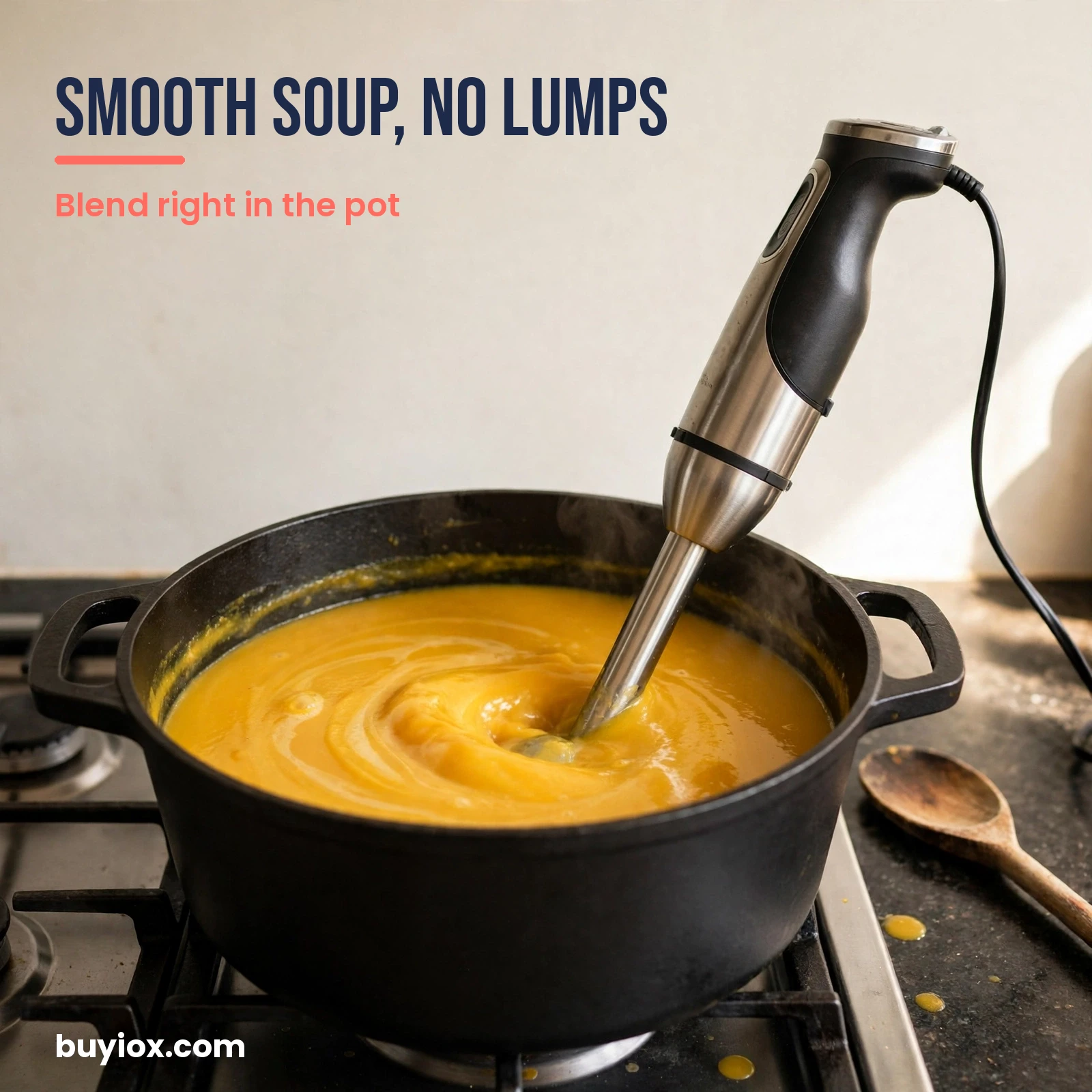
You know the soup is almost perfect. The vegetables are soft, the seasoning is right, and then you face the worst part of the job. You ladle steaming hot soup into a countertop blender in batches, you hold the lid down with a towel, you pray it does not explode across the kitchen, and then you wash a heavy glass jar, a lid, and a blade assembly. By the time the soup is smooth, it is lukewarm and your sink is full. There is a better way, and it costs less than a dinner out.
An immersion blender, also called a hand blender or stick blender, goes straight into the pot. You lower it into the soup, press a button, and move it slowly through the pot until the soup turns silky. No pouring, no batches, no hot splashes on your hands. Then you rinse the shaft under the tap and you are done. The same tool makes smoothies in a jar, whips cream, blends salad dressing in its own bottle, makes mayonnaise in sixty seconds, and purees baby food without a second appliance. If your kitchen has room for exactly one small gadget, this is the one that earns its drawer space every single week.
That simplicity is also why immersion blenders can be confusing to buy. The six blenders on this list range from around $40 to around $150, and they all look like the same stick with a button. The honest truth is that the blending mechanism is the same in every one of them: a motor in the handle spins a small blade inside a bell-shaped guard at the bottom of a shaft. What changes with price is the power, the fineness of the speed control, the splash protection, the quality of the attachments, and how the blender feels in your hand during a long blend. This guide explains each of those differences in plain language, with real specs, real prices, and honest pros and cons, so you can buy the right stick the first time.
We checked current Amazon prices, read thousands of buyer reviews, and compared the test results from independent cooking publications before choosing these six. Every price below is marked as approximate, because Amazon prices move with sales and stock, and you should always check the live price before you buy. Every wattage figure is the maker’s listed rating, not a measured lab result, and we flag where that matters. Nothing here is sponsored, and no maker paid for a place on this list.
Our Top Picks at a Glance
If you are short on time, here is the whole guide in one paragraph. The Vitamix 5-Speed is the most powerful blender here, with a 625 watt motor that powers through thick hummus and frozen fruit, and it is our pick for cooks who blend heavy mixtures often. The Breville Control Grip is the most precise blender here, with 15 speeds and the best splash control we found, and it is our pick for cooks who want the smoothest soups with the least mess. The Braun MultiQuick 7 is the test-kitchen favorite, with a 500 watt motor and a pressure-sensitive speed control that purees fibrous vegetables faster than anything else in its price range. The KitchenAid KHBV53 is the easiest blender to live with, light in the hand, gentle on your pots, and priced around $50. The Mueller Austria Ultra-Stick is the best value here, with a 500 watt motor and a full attachment kit for around $40. And the Cuisinart CSB-179 is the sensible middle pick, with a quiet 300 watt motor and a chopper, whisk, and measuring cup for around $55.
| Blender | Best for | Power | Speeds | Attachments | Price |
|---|---|---|---|---|---|
| Vitamix 5-Speed | Most powerful, thick blends | 625 W | 5 | 32 oz container, bundle adds chopper, whisk, jar, case | around $145 |
| Breville Control Grip BSB510XL | Precision and splash control | 280 W | 15 | 42 oz jug, 25 oz chopping bowl, whisk | around $150 |
| Braun MultiQuick 7 MQ7035 | Smoothest purees, test-kitchen favorite | 500 W | SmartSpeed pressure control | 2-cup chopper, whisk, beaker | around $80 |
| KitchenAid KHBV53 | Easiest to use, lightest | 180 W | Variable trigger | 3-cup blending jar with lid, pan guard | around $50 |
| Mueller Austria Ultra-Stick | Best value, full kit | 500 W | 9 plus turbo | Whisk, milk frother, beaker | around $40 |
| Cuisinart CSB-179 | Quiet mid-range all-rounder | 300 W | Variable slide | Chopper, whisk, measuring cup | around $55 |
Before the reviews, one honest note about wattage. Wattage is the number every listing shouts about, and it is also the number that matters least on its own. A 280 watt Breville beats many 500 watt sticks in soup tests, because its blade shape, bell design, and speed control matter more than raw motor size. A 1,000 watt budget stick can still stall on frozen fruit if its blade is dull and its bell traps food. Use wattage as a rough guide to power, then judge the blender on its speed control, its splash guard, its attachments, and what real buyers say after months of use. The buying guide near the end of this article explains exactly how to weigh each factor, and our guide to the best blender for smoothies covers the countertop side of the same question, because a good immersion blender and a good countertop blender solve different problems in the same kitchen.
1. Vitamix 5-Speed Immersion Blender: Most Powerful
The Vitamix 5-Speed is the strongest immersion blender on this list, and it is not close. Its 625 watt motor is the highest rated motor among the premium brands here, and it shows the moment you blend something thick. Where lighter sticks bog down and whine on frozen fruit, thick hummus, or a pot of dense root vegetables, the Vitamix keeps its speed and powers through. The blade is a four-pronged stainless steel design, and the wand pairs it with five clear speed settings and a bell guard that protects coated cookware from scratches. If you already own a Vitamix countertop blender, this stick feels like the same engineering in a smaller package, and it carries a 3-year warranty that backs that feeling up.
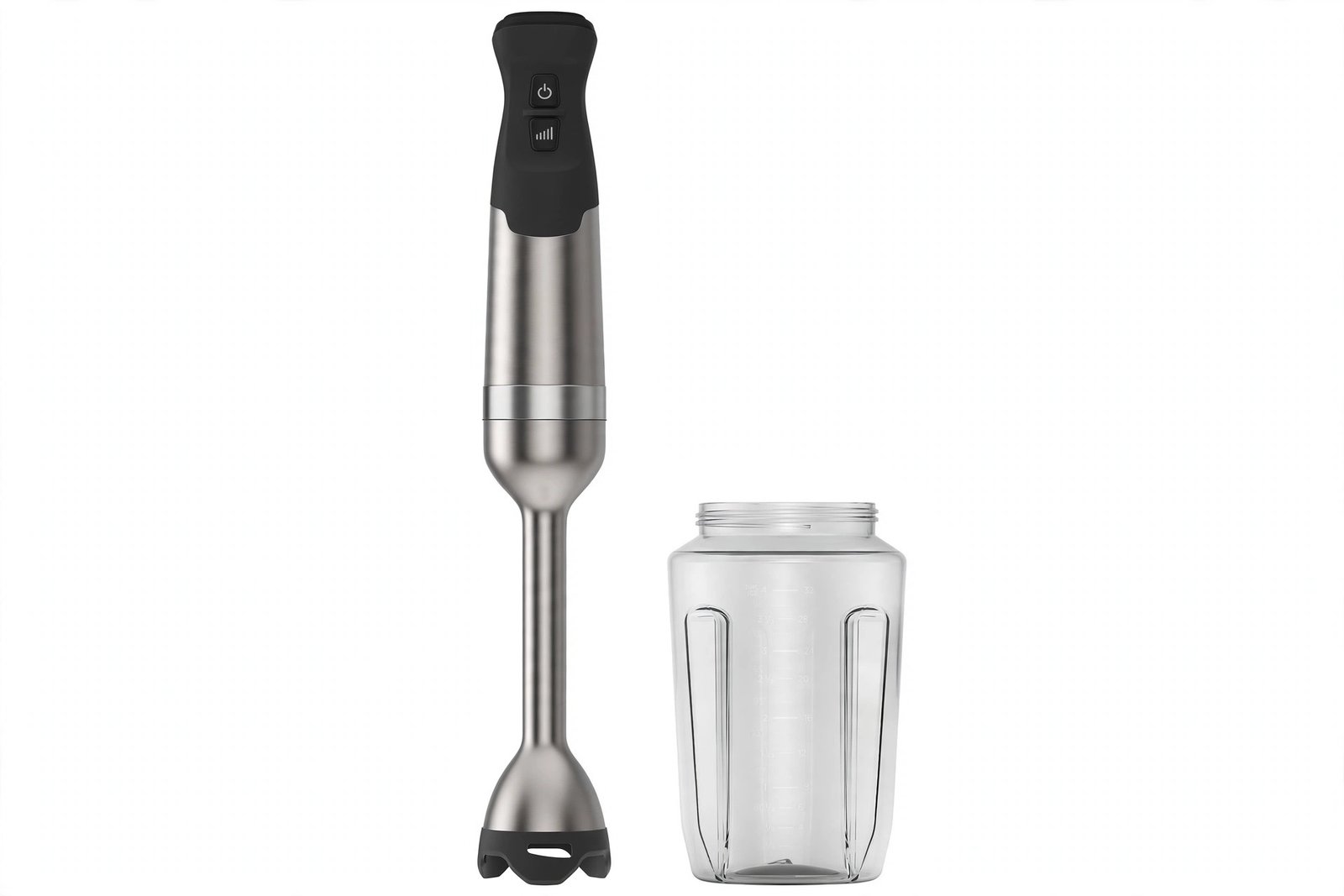
Vitamix 5-Speed Immersion Blender (product-style image)
The build quality is the first thing you notice when you pick it up. The motor body feels solid and balanced, the stainless steel shaft is long enough to reach the bottom of a deep stockpot, and the 5 foot cord gives you room to move around the stove without dragging the pot. The blending jar that comes in the box is 32 ounces, which is the right size for smoothies, dressings, and small batches of sauce. The optional 5-piece bundle adds a mini-chopper, a second jar, a whisk, and a storage case, and it turns the stick into a small food prep system. That bundle costs more, around $200 at recent checks, so decide before you buy whether you need the attachments or just the wand.
In everyday use, the Vitamix is the blender for the cook who blends heavy things. It makes the smoothest hummus of any stick here, it crushes frozen berries for smoothies without stopping, and it purees a pot of potato leek soup in about a minute. The five speeds are well spaced, so speed one is gentle enough for a vinaigrette and speed five is fast enough for a frozen smoothie. The bell guard does a good job of keeping splashes down, though it is not quite as splash-proof as the Breville below. Cleanup is simple: the shaft twists off the motor body, and you rinse it under the tap or run it in soapy water for twenty seconds.
Pros:
- 625 watt motor, the strongest premium motor on this list
- Powers through thick hummus, frozen fruit, and dense vegetables without stalling
- Four-pronged stainless steel blade and bell guard that protects coated pots
- Long stainless shaft reaches deep stockpots, 5 foot cord gives room to move
- 3-year warranty and Vitamix build quality
- Optional bundle adds mini-chopper, whisk, jar, and storage case
Cons:
- Around $145 for the wand alone, and the full bundle costs around $200
- Heavier than the KitchenAid and Mueller picks, which matters in long blends
- Only 5 speeds, so less fine control than the 15-speed Breville
- Splash control is good but not the best here
- Attachments like the whisk and chopper cost extra unless you buy the bundle
Best for: cooks who blend thick mixtures often, including hummus, nut butter, frozen smoothies, and dense vegetable soups, and anyone who already trusts Vitamix build quality and wants the strongest motor available in a stick blender.
Who should avoid it: cooks who mostly blend thin soups and sauces, because a $40 to $80 blender does that job just as well, and anyone with wrist trouble, because this is one of the heavier sticks here and the extra weight adds up over a long blend.
2. Breville Control Grip BSB510XL: Best for Precision and Splash Control
The Breville Control Grip is the blender the test kitchens keep recommending, and the reason is not power. At 280 watts, it has the lowest listed wattage of any premium pick on this list. The reason it wins anyway is control. The Control Grip has 15 speeds, more than any other blender here, and a trigger grip that lets you squeeze harder for more power, so you can start a hot soup at a gentle stir and finish it at full speed without ever lifting the stick out of the pot. The bell-shaped base has internal ribbing that reduces suction, so the blender does not stick to the bottom of the pot or drag food around in a vortex. In soup tests, it produced zero splashes on a six-cup pot of butternut squash soup where other sticks splashed three times or more.
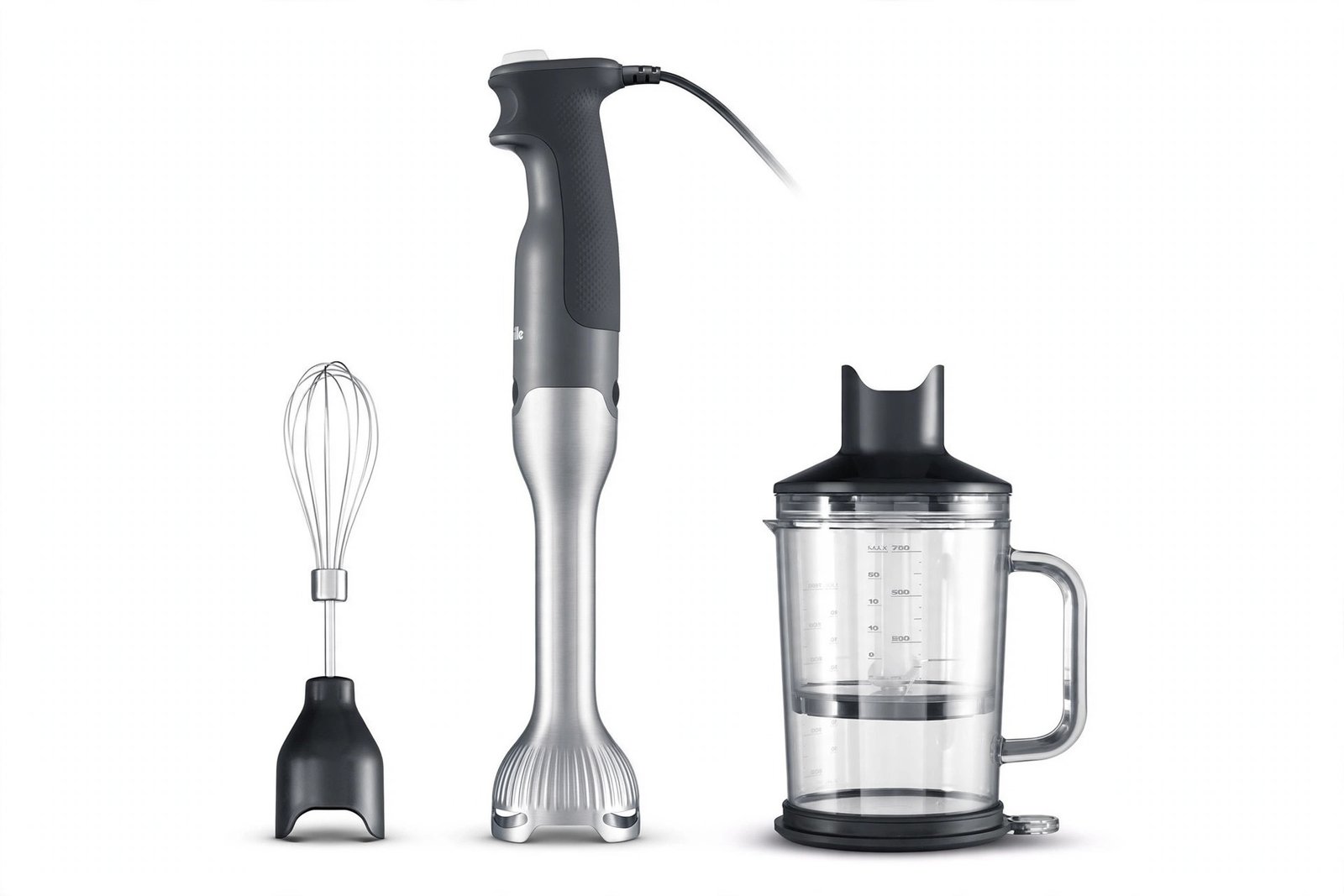
Breville Control Grip Immersion Blender BSB510XL (product-style image)
The box is the fullest on this list. You get the blender, a 42 ounce jug with a lid, a 25 ounce chopping bowl, and a whisk attachment, so the Breville is a soup maker, a small food chopper, and a cream whipper in one box. The 8 inch stainless steel shaft is heat rated for boiling liquids, it twists off for cleaning, and the non-scratch base protects your pots. The pistol-grip trigger feels natural in the hand, and the speed dial sits at the top of the body where your thumb can reach it. At around $150 at recent checks, with prices seen as low as around $110 on sale, it is one of the most expensive sticks here, but it is also the one that feels most like a professional tool.
In everyday use, the Breville is the blender for the cook who cares about texture. Fifteen speeds sounds like overkill until you try to make a chunky salsa, a silky vinaigrette, and a smooth soup in the same week. The low speeds leave texture in place, the middle speeds blend a soup smooth without turning it to glue, and the high speeds handle a smoothie. The anti-suction bell is the feature you notice most, because it lets you hold the stick at any angle without the blade getting stuck against the pot, and it keeps hot soup where it belongs. The whisk attachment whips cream in about a minute, and the chopping bowl handles onions, herbs, and nuts in small batches.
The honest flag is the wattage. At 280 watts, this is the weakest motor among the premium picks, and it shows on the hardest jobs. It will not power through frozen fruit or raw carrots the way the 500 watt and 625 watt picks do, and it works noticeably slower than the Vitamix on ice or frozen berries. For soups, sauces, smoothies made with soft fruit, and everyday blending, the blade geometry and the speed control more than compensate. For frozen smoothies and thick hummus, buy the Vitamix or the Braun instead.
Pros:
- 15 speeds, the finest control of any blender on this list
- Best splash control here, thanks to the anti-suction bell with internal ribbing
- Fullest box: 42 oz jug, 25 oz chopping bowl, and whisk included
- Ergonomic trigger grip, natural one-handed control
- 8 inch stainless shaft, heat rated for boiling liquids, non-scratch base
- Blade geometry beats higher-wattage sticks on soup texture
Cons:
- 280 watts, the weakest premium motor here, slow on frozen fruit and raw carrots
- Around $150, one of the most expensive picks on this list
- No turbo button, so top speed is the only way to power through a tough spot
- Heavier than the budget picks at around 4 lb with accessories
Best for: cooks who make soup most weeks and want the smoothest result with the least mess, anyone who values precise texture control, and cooks who want a whisk and chopper in the same box without buying attachments separately.
Who should avoid it: cooks who blend frozen smoothies daily or make thick hummus often, because the 280 watt motor will feel slow on those jobs, and strict budget buyers, because the Braun below gives you more power for about half the price.
3. Braun MultiQuick 7 MQ7035: Best for Smooth Purees
The Braun MultiQuick 7 is the test-kitchen favorite, and it earned that title the hard way. In independent testing, it pureed fibrous soups and frozen smoothies faster and more thoroughly than anything else in its price range. The secret is a combination of a 500 watt motor and a technology Braun calls Easy SmartSpeed: there are no fixed speed buttons, and instead you press harder on the top button for more power and lighter for less. That sounds like a small detail until you use it, because it means your thumb controls the speed in real time, without looking down at a dial, while the other hand steadies the pot.
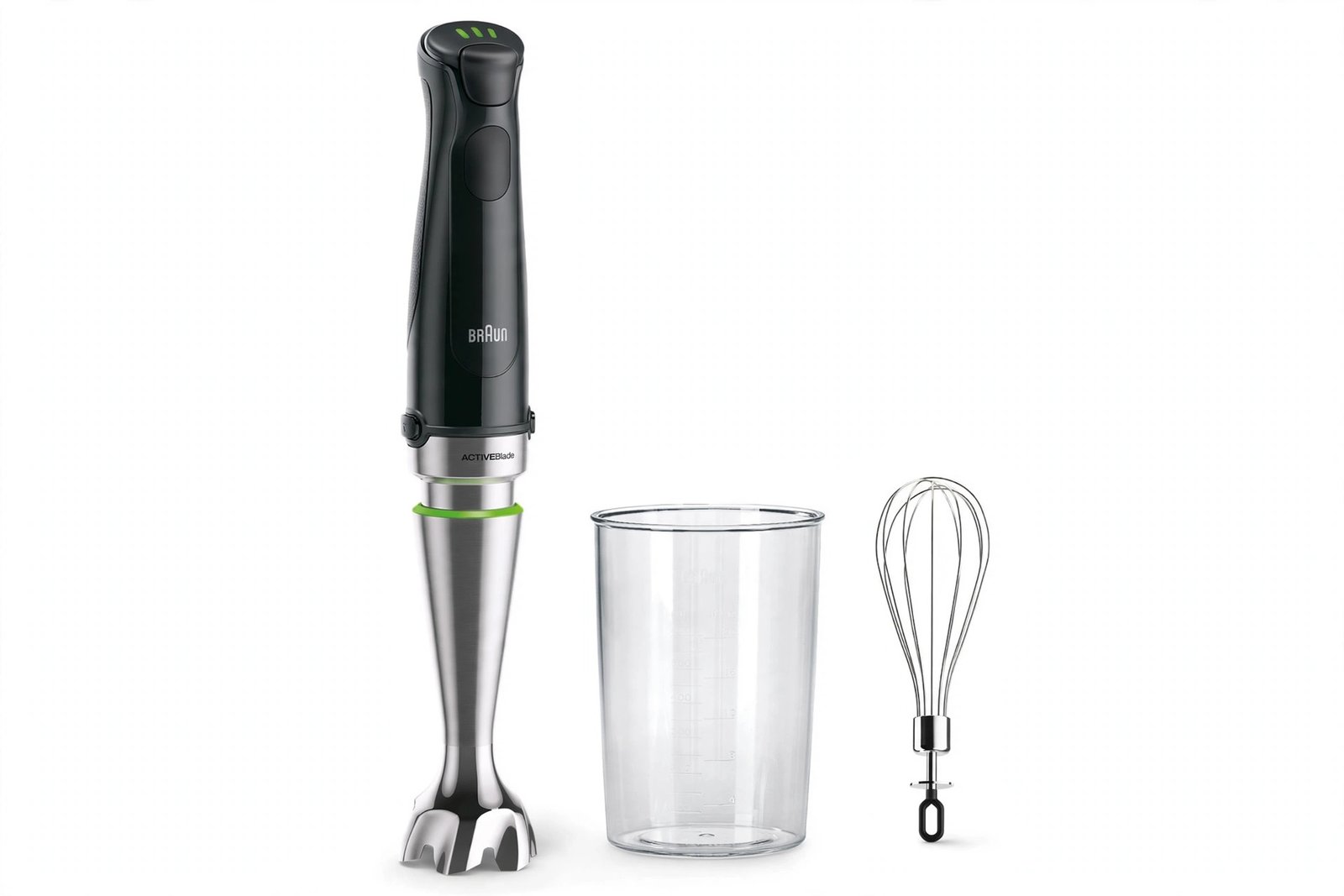
Braun MultiQuick 7 MQ7035 Immersion Blender (product-style image)
The MultiQuick 7 is a 3-in-1 kit. The box holds the blending shaft, a whisk, a 2-cup food processor bowl, and a beaker, so it covers soups, whipped cream, chopped herbs, and small batches of salsa without a second appliance. The shaft is stainless steel, the motor body has an ergonomic handle that fits most hands, and the whole unit weighs around 2.2 lb, which makes it one of the lighter premium sticks here. Braun calls itself the number one hand blender brand, and the MultiQuick 7 is the model that built that claim: it holds around 4.5 stars across more than 3,700 Amazon ratings, and it sits in the top five hand blenders on Amazon by sales rank.
In everyday use, the Braun is the blender for the cook who wants the smoothest soup with the least thinking. The SmartSpeed control feels strange for about thirty seconds, and then it feels obvious, because you never have to choose a speed number. You press gently to stir a sauce, you press harder to puree a soup, and you press all the way down for a frozen smoothie. The 500 watt motor handles fibrous vegetables like celery and raw carrot better than the Breville, and it keeps up with the Vitamix on most soups. The splash guard works well, the attachments click on and off easily, and the beaker is the right size for salad dressing and mayonnaise. At around $80 on sale at recent checks, down from a list price of around $110, it is the best value among the premium picks, and it is the one we would buy first if we could only buy one blender from this list for general cooking.
The honest flags are small. The pressure-sensitive control means there are no set speeds to return to, so if you like to know you are always on speed three, you will miss the dial. The 2-cup chopper is smaller than the Breville chopping bowl, so it suits herbs and small batches rather than a full onion. And the Braun has a newer sibling model, the MQ7027, which adds a masher, so check which model is on sale when you buy, because the older MQ7035 is often the better deal.
Pros:
- 500 watt motor purees fibrous vegetables faster than most sticks in its price range
- Easy SmartSpeed pressure control, intuitive speed in real time with no dial
- 3-in-1 kit: whisk, 2-cup food processor, and beaker included
- Light at around 2.2 lb, comfortable for long blends
- Around $80 on sale, the best value among the premium picks
- 4.5 stars across more than 3,700 Amazon ratings
Cons:
- No fixed speeds, so you cannot return to an exact setting
- 2-cup chopper is small for big batches
- List price around $110 when not on sale, so check the live price
- Newer sibling model can confuse buyers about which version they are getting
Best for: cooks who make soup weekly and want the smoothest puree for the least money, anyone who likes intuitive controls without a speed dial, and first-time immersion blender buyers who want one tool that does almost everything well.
Who should avoid it: cooks who want exact repeatable speed settings for recipes, because the pressure control has no numbers, and cooks who need a large chopper bowl, because the 2-cup bowl is built for small batches.
4. KitchenAid Variable Speed Corded Hand Blender KHBV53: Easiest to Use
The KitchenAid KHBV53 is the simplest blender on this list, and that is its greatest strength. It has no chopper, no whisk, and no extra attachments to store. It is a blending wand and a jar, and it does that one job beautifully. The variable-speed trigger works like the Breville: squeeze gently for a slow stir, squeeze harder for full power, so you control the texture with your hand instead of a dial. The removable 8 inch blending arm has a four-point stainless steel blade, and the arm comes off the motor body with a click for washing. The blending arm is dishwasher safe, which is a small detail that matters a lot on a busy night.
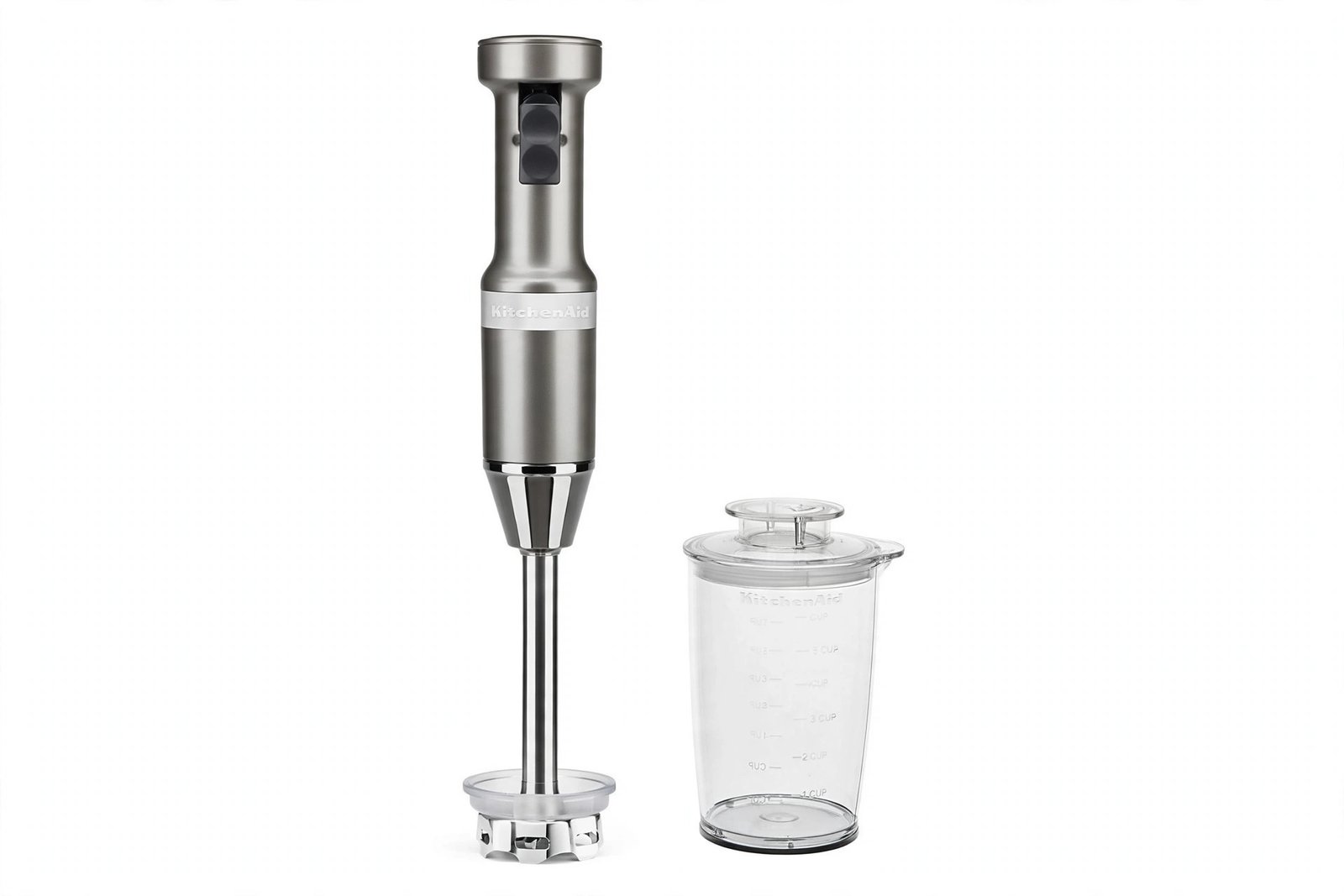
KitchenAid Variable Speed Corded Hand Blender KHBV53 (product-style image)
Two features make the KitchenAid the easiest blender here to live with. The first is the patented removable pan guard, a plastic ring around the blade that keeps the blade off the bottom of your pot, so you can blend in a nonstick pot or an enameled Dutch oven without scratching the coating. The second is the weight. At around 2 lb or less in the hand, it is the lightest of the good blenders here, and the difference shows up when you blend a big pot of soup for two minutes straight. The 3-cup BPA-free blending jar comes with a lid, so you can blend a smoothie, put the lid on, and take it with you. The motor is rated at 180 watts on the maker sheet, which is modest, and a few listings quote 225 watts, but the difference is minor and the real-world result is the same: this blender is built for soups, sauces, smoothies, and dressings, not for frozen fruit or thick nut butter.
In everyday use, the KitchenAid is the blender you reach for without thinking. It is the one we would hand to a new cook, to a cook with wrist trouble, or to anyone who wants a blender that lives in a drawer and comes out three times a week. It purees a pot of tomato soup in about a minute, it blends a smoothie in a jar without a second container to wash, and it makes mayonnaise and salad dressing in the jar it comes with. It sold more than 3,000 times in a single recent month on Amazon, the most of any pick here, and it holds around 4.7 stars across more than 18,000 ratings, which tells you how many kitchens rely on it daily. At around $50 at recent checks, down from a list price of around $70, it is the cheapest premium-brand blender on this list, and it comes in a dozen colors, so it can match your kitchen instead of hiding in a drawer.
The honest flag is the power. At 180 watts, this is the weakest motor on this list, and it will stall on frozen fruit, raw carrots, and thick hummus. If you blend those things often, buy the Braun or the Vitamix instead. The other flag is the attachments: there are none. No whisk, no chopper, no frother. If you want those, you buy them separately or you buy the Mueller or Cuisinart below. But for the cook who wants a simple, light, reliable soup and smoothie stick from a brand they trust, the KitchenAid is the easiest yes on this list.
Pros:
- Lightest premium blender here, easy on the wrist during long blends
- Patented removable pan guard protects nonstick and enameled pots
- Variable-speed trigger, intuitive control with no dial to learn
- Removable 8 inch arm is dishwasher safe, easy cleanup
- 3-cup blending jar with lid included, great for smoothies and dressings
- Around $50, the cheapest premium-brand pick here, in many colors
- 4.7 stars across more than 18,000 Amazon ratings
Cons:
- 180 watts, the weakest motor here, stalls on frozen fruit and thick blends
- No whisk, chopper, or frother in the box
- Not the pick for hummus, nut butter, or frozen smoothies
Best for: first-time buyers, cooks with wrist trouble or small hands, anyone who mostly blends soups, sauces, smoothies, and dressings, and cooks who want a light, simple, reliable stick from a trusted brand.
Who should avoid it: cooks who blend frozen fruit, raw vegetables, or thick hummus regularly, because the 180 watt motor will struggle, and anyone who wants a whisk or chopper in the box, because this blender ships as a wand and a jar only.
5. Mueller Austria Ultra-Stick MU-HB-02: Best Value
The Mueller Austria Ultra-Stick is the best-selling immersion blender on Amazon, and the numbers explain why. It holds around 4.4 stars across more than 52,000 ratings, more than any other blender on this list by a wide margin, and it sells more than 500 units a month. The reason is simple: it gives you a 500 watt motor, nine speeds plus a turbo button, and a full attachment kit, for around $40. That is the same motor power as the Braun, at half the price, with more speeds and more attachments in the box.
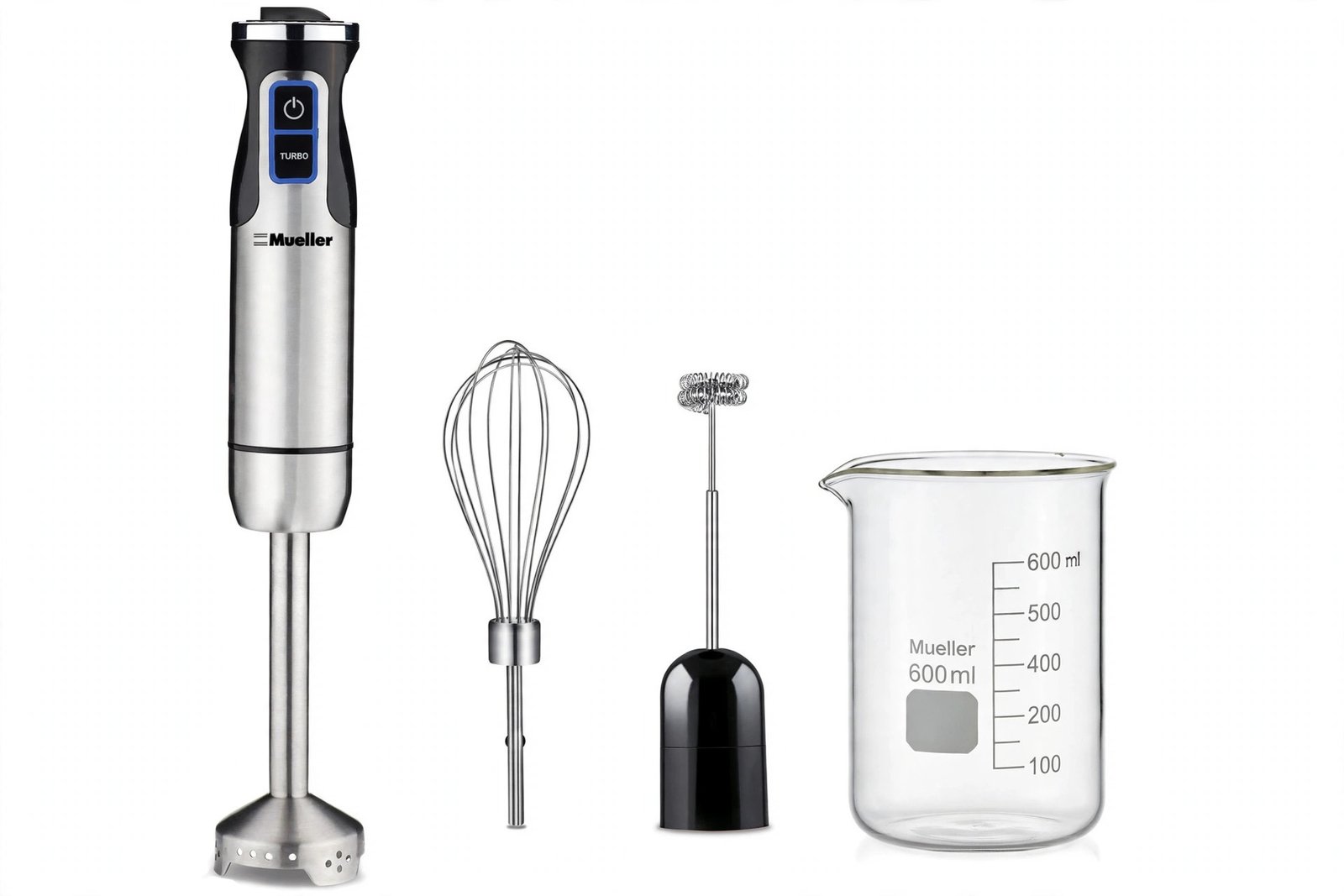
Mueller Austria Ultra-Stick Immersion Blender (product-style image)
The Ultra-Stick is a 5-in-1 kit. The box holds the blending wand, a whisk attachment, a milk frother, and a beaker, so it covers soups, whipped cream, frothed milk for coffee, and small batches of sauce without a second appliance. The motor is listed at 500 watts, the blades are titanium-coated stainless steel, and the shaft is stainless steel with a bell guard. The nine speeds plus turbo give you more control than the price suggests, and the turbo button is genuinely useful when you hit a stubborn lump of potato or a pocket of unblended soup at the bottom of the pot.
In everyday use, the Mueller is the blender for the cook who wants the most for the least money. It purees soup well, it makes smoothies from soft fruit without fuss, it froths milk for a latte, and it whips cream for dessert. The 500 watt motor keeps up with the Braun on most soups, and the turbo button gives it a burst of power the KitchenAid and Cuisinart cannot match. The build is lighter in feel than the premium brands, and the plastic parts do not feel as solid as the Breville or Vitamix, but at around $40, that is a fair trade, and the sheer number of happy buyers suggests the trade holds up in real kitchens.
The honest flags matter here, so read them carefully. First, wattage on budget brands is a maker claim, not a measured fact, and one buyer review of a Mueller sibling model found the label showing a lower wattage than the listing claimed. Treat the 500 watt figure as approximate, and judge the blender on what it does, not on the number. Second, stock can be patchy: one recent crawl found no featured offer for the Mueller Multistick sibling, so check the live offer before you order, and buy the exact MU-HB-02 model linked below rather than a lookalike. Third, the splash control is only fair. This is not the blender for a very full pot of hot soup, because it splashes more than the Breville or the Braun. Blend in a deep pot, keep the bell fully submerged, and start on the lowest speed, and the splashing stays manageable.
Pros:
- Around $40, the cheapest blender on this list by a clear margin
- 500 watt motor with 9 speeds plus a turbo button
- Full kit: whisk, milk frother, and beaker included
- More than 52,000 Amazon ratings, the most reviewed blender here
- Titanium-coated stainless steel blades
- Milk frother is a feature none of the premium picks include
Cons:
- Splash control is only fair, so blend in a deep pot and start slow
- Wattage is a maker claim and may be overstated, judge it on performance
- Build feels lighter and less solid than the premium brands
- Stock can be patchy, so check the live offer before ordering
- No chopper attachment in the box
Best for: budget buyers who want the most power and the most attachments for the least money, coffee lovers who want a milk frother in the box, and cooks buying their first immersion blender who are not sure how often they will use it.
Who should avoid it: cooks who blend very full pots of hot soup often, because the splash control is weaker than the Breville or Braun, and anyone who wants a chopper attachment, because this kit does not include one.
6. Cuisinart CSB-179 Smart Stick: Best Mid-Range All-Rounder
The Cuisinart CSB-179 Smart Stick is the sensible middle pick, and it has been the sensible middle pick for years. It has been on sale for years, it holds around 4.4 stars across more than 3,900 reviews, and it does the everyday jobs without fuss and without drama. The motor is a 300 watt DC motor, which Cuisinart designed to deliver strong blending with noticeably low noise, and it works: this is the quietest blender on this list, which matters if you blend early in the morning or late at night while the house sleeps.
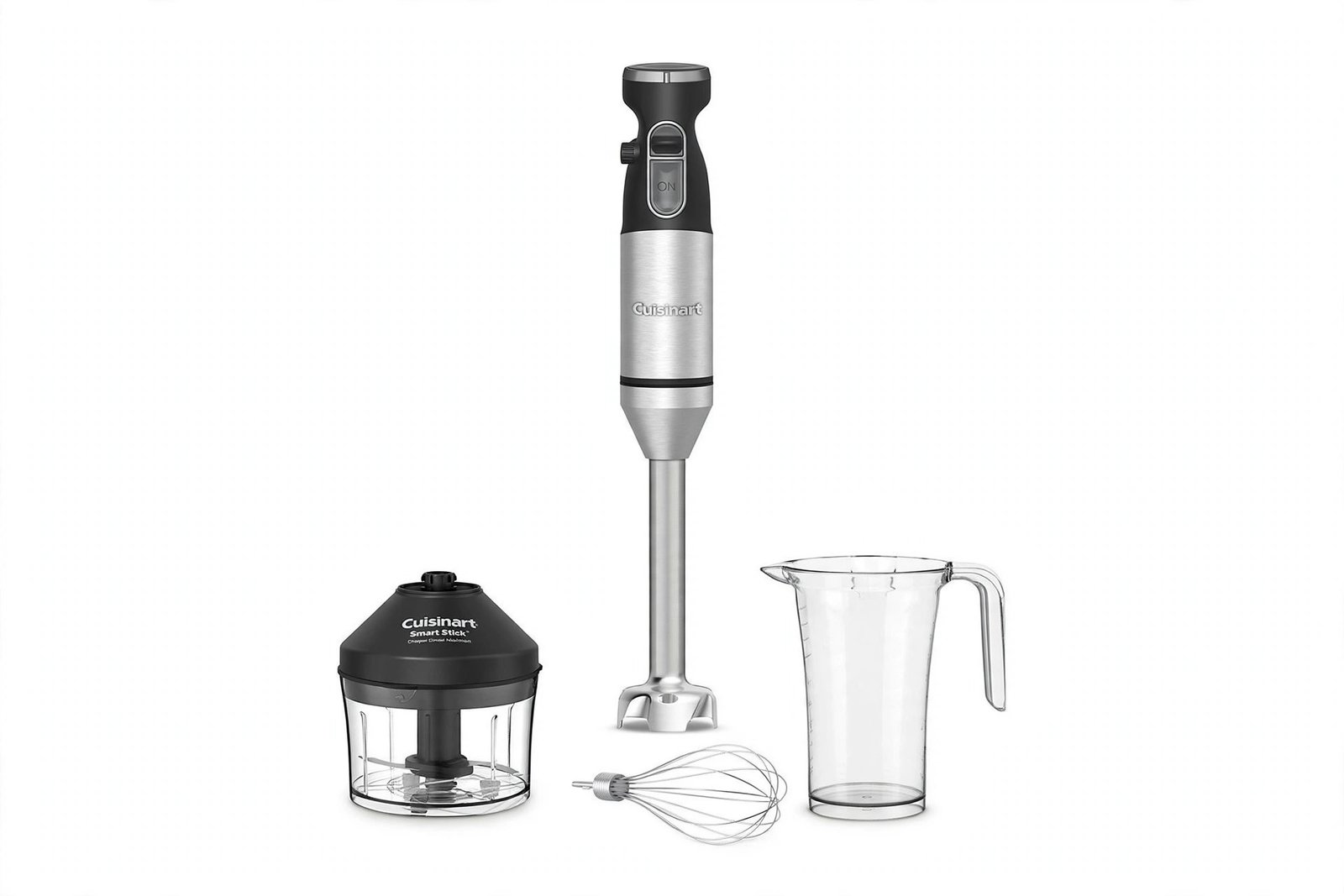
Cuisinart CSB-179 Smart Stick Hand Blender (product-style image)
The CSB-179 is a complete kit at a middle price. The box holds the blender, a chopper and grinder attachment, a chef’s whisk attachment, and a deluxe mixing and measuring cup, so it covers soups, chopped herbs, whipped cream, and dressings without extra purchases. The 8 inch stainless steel blending shaft reaches deep into pots, pitchers, and bowls, the comfort-grip handle fits most hands, and the variable-speed slide control lets you dial the speed up or down with your thumb. Push-button control gives you continuous or pulse action, and a lock and unlock button keeps the blender from starting by accident in a drawer. The whole unit carries a limited 3-year warranty, which matches the Vitamix and beats the budget picks.
In everyday use, the Cuisinart is the blender for the cook who wants a complete kit without paying premium prices. It purees soup smoothly, it blends smoothies from soft fruit, it chops herbs and nuts in small batches, and it whips cream without a second appliance. The quiet motor is the feature you notice most, because it blends at a lower hum than the Mueller or the Vitamix, and the slide speed control is easy to learn. At around $55 to $60 at recent checks, down from a list price of around $80, it sits between the $40 Mueller and the $80 Braun, and it gives you the chopper the Mueller lacks and the quiet motor the Braun lacks.
The honest flag is the power. At 300 watts, this blender will not crush ice or frozen fruit, and it will struggle with thick hummus and raw carrots. If you blend frozen smoothies often, buy the Braun or the Vitamix instead. There is also no milk frother in the box, so coffee lovers should buy the Mueller. But for the everyday jobs that most cooks actually do, soups, sauces, smoothies from soft fruit, dressings, and whipped cream, the Cuisinart does them quietly, reliably, and for a fair price, and it has been doing them for years.
Pros:
- Quiet 300 watt DC motor, the quietest blender on this list
- Complete kit: chopper, whisk, and measuring cup included
- 8 inch stainless steel shaft reaches deep pots
- Variable-speed slide control with pulse action and safety lock
- Limited 3-year warranty
- Around $55 to $60, a fair middle price for a full kit
Cons:
- 300 watts, so no ice crushing and no frozen fruit
- No milk frother in the box
- Heavier than the KitchenAid at around 3.3 lb
- Will struggle with thick hummus and raw vegetables
Best for: cooks who want a complete, quiet, reliable kit at a middle price, anyone who blends early or late and values a low-noise motor, and buyers who want a chopper and whisk without paying premium prices.
Who should avoid it: cooks who blend frozen smoothies or crush ice often, because the 300 watt motor will not do it, and coffee lovers who want a milk frother, because this kit does not include one.
Immersion Blender vs Countertop Blender vs Food Processor: Which One Do You Need?
Three tools, three jobs, and the confusion between them costs buyers money every year. An immersion blender blends in the container the food is already in. A countertop blender blends in its own jar, and it is stronger, faster, and better at crushing ice and frozen fruit. A food processor chops, slices, shreds, and mixes, and it is better at dry and semi-dry work like pie dough, chopped vegetables, and shredded cheese. Most kitchens need two of the three, and the immersion blender is the one to buy first, because it is the cheapest, the smallest, and the easiest to clean.
Buy an immersion blender first if you make soup, sauces, dressings, mayonnaise, whipped cream, baby food, or smoothies in a jar. Buy a countertop blender as well if you make frozen smoothies daily, crush ice, or blend large batches for a family, because a countertop blender does those jobs faster and smoother. Our guide to the best blender for smoothies covers the countertop side in detail. Buy a food processor as well if you chop large amounts of vegetables, make pie dough, shred cheese, or slice vegetables in bulk, because a food processor does dry work an immersion blender cannot. Our guide to the best food processor covers that side. And if you bake often, a stand mixer is the third tool in the set, because it kneads dough and whips egg whites in a way no blender can. Our guide to the best stand mixer covers that one too.
The practical rule is simple. If you can only buy one tool this month, buy the immersion blender, because it handles the most everyday jobs for the least money and the least counter space. If you already own a countertop blender and you still ladle hot soup into it in batches, buy the immersion blender next, because it will save you time and burns every single week. And if you already own an immersion blender and you want to chop vegetables faster, buy the food processor, because that is the job the stick blender cannot do.
Side-by-Side Comparison: All 6 Immersion Blenders
| Blender | Power | Speeds | Shaft | Attachments | Weight | Warranty | Price |
|---|---|---|---|---|---|---|---|
| Vitamix 5-Speed | 625 W | 5 | Stainless steel, deep reach | 32 oz container, bundle adds chopper, whisk, jar, case | Heavier | 3-year | around $145 |
| Breville Control Grip BSB510XL | 280 W | 15 | 8 in stainless, heat rated | 42 oz jug, 25 oz chopping bowl, whisk | around 4.1 lb with accessories | 1-year limited | around $150 |
| Braun MultiQuick 7 MQ7035 | 500 W | SmartSpeed pressure | Stainless steel | 2-cup chopper, whisk, beaker | around 2.2 lb | 2-year | around $80 |
| KitchenAid KHBV53 | 180 W | Variable trigger | 8 in removable, dishwasher safe | 3-cup jar with lid, pan guard | Lightest | 1-year | around $50 |
| Mueller Austria Ultra-Stick | 500 W | 9 plus turbo | Stainless steel | Whisk, milk frother, beaker | Light | 1-year | around $40 |
| Cuisinart CSB-179 | 300 W | Variable slide | 8 in stainless steel | Chopper, whisk, measuring cup | around 3.3 lb | 3-year limited | around $55 |
Read the table from left to right and the pattern becomes clear. Power and price do not move together. The strongest motor here is the Vitamix at 625 watts, the second strongest are the Braun and Mueller at 500 watts, and the weakest are the KitchenAid at 180 watts and the Breville at 280 watts. Yet the Breville, with the second weakest motor, wins most test-kitchen roundups, because its blade shape and speed control matter more than watts. The Mueller, with a 500 watt motor, costs around $40, while the Vitamix, with a 625 watt motor, costs around $145. The difference between them is not the blending, it is the build quality, the warranty, the splash control, and the feel in the hand. That is why the buying guide below spends more time on control, attachments, and weight than on wattage.
Buying Guide: How to Choose the Best Immersion Blender
An immersion blender looks simple on the shelf, but the wrong power, control, or shaft length turns a handy tool into a drawer ornament. Match the blender to the jobs you actually do, then check the speed control, then check the attachments, because those answers decide everything else.
1. Match the power to the jobs you actually do
Power is the first decision, and it is the one most buyers get wrong, because they buy on the biggest wattage number instead of on their own cooking. If you mostly blend soups, sauces, dressings, and smoothies from soft fruit, any blender on this list will do the job, including the 180 watt KitchenAid and the 280 watt Breville. If you blend frozen fruit, raw carrots, or thick hummus often, you need 500 watts or more, which means the Vitamix, the Braun, or the Mueller. If you blend baby food, you need gentle low speeds more than raw power, because you want a smooth puree without over-blending. And if you blend once a week or less, do not pay for power you will never use. The $40 Mueller gives you 500 watts for the price of a takeaway dinner, and the $50 KitchenAid gives you the easiest daily blending for the price of a pizza.
2. Judge the speed control, not just the speed count
Speed control is the second decision, and it matters more than the number of speeds. A blender with 15 speeds and a good trigger, like the Breville, gives you finer texture control than a blender with 9 speeds and a button, like the Mueller. A variable trigger, like the KitchenAid and Breville, lets you change speed in real time without looking down. A pressure control, like the Braun SmartSpeed, does the same thing with your thumb. A slide control, like the Cuisinart, is simple and reliable. A fixed-speed button, like the Vitamix five speeds, is clear and repeatable. The right choice depends on how you cook. If you make dressings and sauces where texture matters, buy the Breville with 15 speeds. If you make soup and want to set a speed and forget it, buy the Vitamix with five clear speeds. If you want the simplest control possible, buy the KitchenAid trigger or the Braun pressure button, because both feel natural within thirty seconds.
3. Check the splash guard before you buy, not after
Splash control is the feature buyers forget to check, and it is the feature they complain about most. Hot soup on your hand is no joke, and a blender that splashes turns a quick job into a cleanup. The Breville has the best splash control here, thanks to its anti-suction bell with internal ribbing, and it produced zero splashes in soup tests where other sticks splashed three times or more. The Braun and Vitamix have good bell guards that keep most splashes down. The Mueller has only fair splash control, so it needs a deep pot and a slow start. Whatever blender you buy, use this technique every time: lower the bell fully below the surface before you press the button, start on the lowest speed, keep the blender angled slightly, and never lift the blades above the surface while it is running. That technique, from the Vitamix official tips page, prevents almost all splashing on any blender. A detailed guide to splash-free blending is available at Vitamix tips and tricks, which covers immersion blending technique in plain language.
4. Decide which attachments you will actually use
Attachments are the fourth decision, and they are where buyers waste the most money. A whisk is worth having if you whip cream, beat egg whites, or make meringue, because it does those jobs faster than a hand whisk and cleaner than a stand mixer for small batches. A chopper is worth having if you chop herbs, onions, nuts, or garlic in small batches, because it saves you washing a full food processor. A milk frother is worth having if you make lattes at home, because it is the only attachment here that no premium brand includes. A beaker or jar is worth having if you make dressings, mayonnaise, or smoothies, because it is the right size and shape for the job. But an attachment you never use is just clutter in a drawer. The Breville box is the fullest here, with a jug, a chopping bowl, and a whisk. The Braun box is the most practical, with a chopper, a whisk, and a beaker. The Mueller box is the best value, with a whisk, a frother, and a beaker for around $40. The KitchenAid box is the simplest, with a wand and a jar only, and that is a feature, not a flaw, if you know you will never use a whisk or a chopper.
5. Check the shaft length and the pot protection
Shaft length is the fifth decision, and it matters more than most buyers expect, because a short shaft cannot reach the bottom of a deep stockpot. The Breville, KitchenAid, and Cuisinart all have 8 inch shafts, which reach the bottom of most pots. The Vitamix shaft is long enough for a deep stockpot too. Check the depth of your largest pot before you buy, and make sure the shaft reaches the bottom with the motor body clear of the rim. Pot protection is the other half of this decision. The KitchenAid pan guard is the best protection here, because it keeps the blade off the bottom of a nonstick or enameled pot. The Breville non-scratch base does the same job. The Vitamix bell guard protects coated cookware too. If you cook in nonstick pots or an enameled Dutch oven, treat pot protection as a must-have, not a nice-to-have, because a scratched pot is a ruined pot. Our guide to the best Dutch oven explains why enameled cookware deserves that protection.
6. Weigh the blender in your hand, not just on the page
Weight is the sixth decision, and it matters more than most buyers expect, because you hold an immersion blender in the air for a minute or two at a time. The KitchenAid is the lightest premium blender here, and the Braun is light too at around 2.2 lb. The Mueller is light as well. The Vitamix and Breville are heavier, and the Breville runs around 4.1 lb with its accessories. Try this test before you buy: hold the blender at arm’s length for thirty seconds, then blend a pot of water for a minute. If your wrist complains, buy lighter. Cooks with arthritis, wrist trouble, or a small frame should treat weight as the first filter, not an afterthought. A blender you cannot hold comfortably is a blender you will not use, no matter how powerful it is.
7. Think about cleaning before you buy, not after
Cleaning is the seventh decision, and it is the reason most immersion blenders get used three times a week while most countertop blenders gather dust. Every blender on this list cleans the same basic way: twist off the shaft, rinse it under the tap, and dry it. The KitchenAid arm is dishwasher safe, which is a small win. The Vitamix and Breville shafts twist off easily too. The fastest method, from the Vitamix tips page, is to add warm water and a drop of dish soap to the blending jar or a bowl, run the blender for twenty seconds, then rinse and dry, with no scrubbing at all. Avoid two mistakes: never submerge the motor body in water, because it is electric and it will die, and never put a hot shaft straight into cold water, because thermal shock can damage the seal. A blender that cleans in twenty seconds gets used. A blender that needs scrubbing does not.
8. Set a budget that matches the job, not the badge
The price spread in this guide is wide on purpose, because it shows what money does and does not buy. Around $40 buys the same soup as a $150 blender. Around $50 buys the lightest, easiest blender here. Around $55 buys the quietest blender and a full kit. Around $80 buys the test-kitchen favorite and the smoothest purees. Around $145 buys the strongest motor and the best build quality. Around $150 buys the finest speed control and the best splash protection. None of those higher prices buys a smoother soup. They buy comfort, durability, control, and build quality. That is a fair trade if you blend several times a week and you value it, and it is a waste if you blend twice a month and a $40 Mueller would do. Our guide to the best electric kettles makes the same point for a different tool, because the best buy is the one that fits how you actually cook, not the one with the highest price tag.
Frequently Asked Questions
What is the best immersion blender for soup?
For soup, the best immersion blender is the Braun MultiQuick 7 MQ7035, because its 500 watt motor and SmartSpeed pressure control puree fibrous vegetables faster and more thoroughly than anything else near its price, and it costs around $80 on sale. The Breville Control Grip is the best soup blender if you hate splashing, because its anti-suction bell produced zero splashes in soup tests where other sticks splashed three times or more. The Vitamix 5-Speed is the best soup blender if you make very thick soups with root vegetables, because its 625 watt motor powers through dense mixtures without stalling. For most cooks making soup once or twice a week, any of these three will do the job well, and the Braun is the best balance of price, power, and smoothness. Start on the lowest speed, keep the bell fully submerged, and move the blender slowly through the pot for the smoothest result.
Can an immersion blender replace a regular blender?
Yes, for most everyday jobs, and no, for the hardest jobs. An immersion blender replaces a countertop blender for soups, sauces, dressings, mayonnaise, whipped cream, baby food, and smoothies made in a jar from soft fruit. It does those jobs faster, with less washing up, and without pouring hot liquid anywhere. It does not replace a countertop blender for frozen smoothies, crushed ice, large batches, or thick nut butter, because a countertop blender has a bigger motor, a bigger jar, and a blade designed for ice. If you make frozen smoothies daily, keep a countertop blender. If you make soup and sauces most weeks and a smoothie now and then, an immersion blender alone is enough. An independent comparison of the best immersion blenders is available at Kitchen Explorers best immersion blenders guide, which ranks the category by verified Amazon purchase data and review counts.
How many watts does an immersion blender need?
For soups, sauces, and dressings, 180 to 300 watts is enough, which is why the 180 watt KitchenAid and the 280 watt Breville both blend soup beautifully. For smoothies from soft fruit and general everyday cooking, 300 to 500 watts is the sweet spot, which is where the Cuisinart and Braun sit. For frozen fruit, raw carrots, thick hummus, and nut butter, you need 500 watts or more, which means the Braun, the Mueller, or the 625 watt Vitamix. But wattage alone does not decide the result. Blade shape, bell design, and speed control matter just as much, and a well-designed 280 watt Breville beats a poorly designed 500 watt stick on soup texture. Do not buy on watts alone. Buy on the jobs you do, then check the wattage as a rough guide to power.
Can you use an immersion blender in a hot pot on the stove?
Yes, and that is the whole point of the tool. Every blender on this list is designed to go straight into a hot pot on the stove, and the stainless steel shafts are heat rated for boiling liquids. The Breville shaft is heat rated for boiling liquids, the Vitamix shaft handles hot soup without trouble, and the KitchenAid arm is built for hot pots too. Two safety rules apply. First, keep the bell fully submerged before you press the button, and start on the lowest speed, because a blade that breaks the surface of hot soup will splash. Second, use the pan guard or the non-scratch base if you cook in a nonstick or enameled pot, because a bare blade can scratch the coating. Never use an immersion blender in a pot over direct high flame with the motor body touching the heat, and never leave the blender running unattended in a hot pot.
How do you clean an immersion blender?
Cleaning takes about twenty seconds. Twist the shaft off the motor body, rinse it under warm running water, and dry it. For stuck food, fill a jar or a bowl with warm water and a drop of dish soap, run the blender in it for twenty seconds, then rinse and dry, with no scrubbing needed. The KitchenAid blending arm is dishwasher safe, and the other shafts can be hand washed the same way. Never submerge the motor body in water, because it is electric and it will stop working. Never put a hot shaft straight into cold water. And never leave food to dry on the blade, because dried soup is much harder to clean than fresh soup. Rinse it the moment you finish blending, and it will stay clean for years.
What is the difference between an immersion blender and a hand mixer?
An immersion blender blends, purees, and emulsifies wet food in a pot, a jar, or a bowl. A hand mixer beats, whips, and mixes batter, egg whites, and cream in a bowl. They look similar, they both have a motor in a handle, but they do different jobs. An immersion blender makes soup smooth, makes mayonnaise, blends a smoothie, and purees baby food. A hand mixer makes cake batter, whips cream, beats egg whites, and mixes cookie dough. You cannot puree soup with a hand mixer, and you cannot cream butter and sugar with an immersion blender. If you bake often, you need a hand mixer or a stand mixer. If you cook soups and sauces often, you need an immersion blender. Many kitchens own both, because they solve different problems. Our guide to the best stand mixer covers the baking side in detail.
Is a cheap immersion blender worth it?
Yes, for most cooks, and the Mueller Austria Ultra-Stick is the proof. At around $40, it gives you a 500 watt motor, nine speeds plus turbo, a whisk, a milk frother, and a beaker, and it holds around 4.4 stars across more than 52,000 Amazon ratings. For soups, sauces, smoothies from soft fruit, whipped cream, and frothed milk, it does the job as well as blenders costing three times as much. A cheap blender is not worth it if you blend frozen fruit daily, if you need the best splash control, or if you want a chopper attachment, because the budget picks are weaker on those jobs. But if you blend a few times a week and you want the most for the least money, a cheap immersion blender is one of the best value buys in the whole kitchen. Spend the money you save on better ingredients.
Our Verdict: Which Immersion Blender Should You Buy?
If you want one immersion blender that does the most for the most cooks, get the Braun MultiQuick 7 MQ7035. It is the test-kitchen favorite for a reason: it purees fibrous soups faster and smoother than anything else near its price, it is light in the hand, it comes with a whisk, a chopper, and a beaker, and at around $80 on sale it costs about half what the premium picks cost. For most cooks, for most kitchens, and for most meals, it is the honest first buy.
If you want the most powerful immersion blender, get the Vitamix 5-Speed Immersion Blender, because its 625 watt motor powers through thick hummus, frozen fruit, and dense vegetables without stalling, for around $145. If you want the most precise blender with the least mess, get the Breville Control Grip BSB510XL, with its 15 speeds and its anti-suction bell that produced zero splashes in soup tests, for around $150. If you want the easiest blender to live with, get the KitchenAid Variable Speed Corded Hand Blender KHBV53, the lightest premium stick here with a pan guard that protects your pots, for around $50. If you want the best value, get the Mueller Austria Ultra-Stick, with a 500 watt motor and a full kit including a milk frother, for around $40. And if you want the quietest blender with a complete kit at a middle price, get the Cuisinart CSB-179 Smart Stick, with its quiet 300 watt motor and its chopper, whisk, and measuring cup, for around $55.
Whatever you choose, remember the simple rule: keep the bell below the surface, start slow, and rinse the shaft the moment you finish, because an immersion blender earns its place by being used, not by sitting in a drawer. And if you are still deciding, start with the Braun. It is the blender the test kitchens keep coming back to, it is one of the cheapest premium picks on this list, and it is the one you are least likely to regret. A good immersion blender is quiet, boring, and over in one purchase. Start today, and your next soup might be the first one that is smooth without a sink full of washing up.
Was this guide helpful? Share it with a fellow cook whose soup is still lumpy and whose sink is still full of blender parts. And if you try one of these immersion blenders, come back and tell us how your first soup went, your experience helps other cooks choose with confidence.