As an Amazon Associate, Buyiox earns from qualifying purchases made through links on this page, at no extra cost to you. This helps us keep testing pet products and publishing honest guides.
6 Best Dog Training Treats That Actually Motivate Your Dog
Your dog knows “sit” perfectly in the kitchen. Then you step outside, a squirrel runs past, and suddenly your dog has never heard the word “sit” in his life. Sound familiar? The problem usually is not your dog, and it is not your technique. It is the paycheck.
Here is the truth most treat roundups skip: not all training treats do the same job. A low-calorie nibble is perfect for drilling “sit” fifty times in your living room, but it will not cut through the chaos of a busy park. For that, you need a high-value reward your dog would cross a parking lot for. And for a tiny puppy or a toy breed, the treat has to be small enough to swallow in one second flat, or your whole training rhythm falls apart.
So instead of ranking six bags by popularity, we matched six proven treats to the six training jobs dog owners actually face: everyday reps, high-value recall work, puppies, small dogs, calorie control, and bulk value. Every product below is a real, widely sold training treat with verified calories per treat and a verified price. Prices are approximate and change often, so check the live price on Amazon before you buy.
One rule runs through this whole guide: treats should stay within about 10% of your dog’s daily calories. The American Kennel Club confirms that treats, including training rewards, should make up no more than 10% of daily calories. That is exactly why calorie counts matter so much here, and why the lowest-calorie pick on this list can be the smartest one for heavy training days.

The 6 best dog training treats, matched to the training job.
The 6 Best Dog Training Treats at a Glance
- Zuke’s Mini Naturals Chicken Recipe – best overall for everyday training
- Pet Botanics Training Reward Bacon Flavor – best value in bulk
- Stewart Pro-Treat Beef Liver – best high-value reward for distractions
- Blue Buffalo Blue Bits Beef Recipe – best for puppies
- Pupford Train Freeze-Dried Beef Liver – best low-calorie training treat
- Bil-Jac Little Jacs – best for small dogs
Our Top Picks, Reviewed
1. Zuke’s Mini Naturals Chicken Recipe – Best Overall
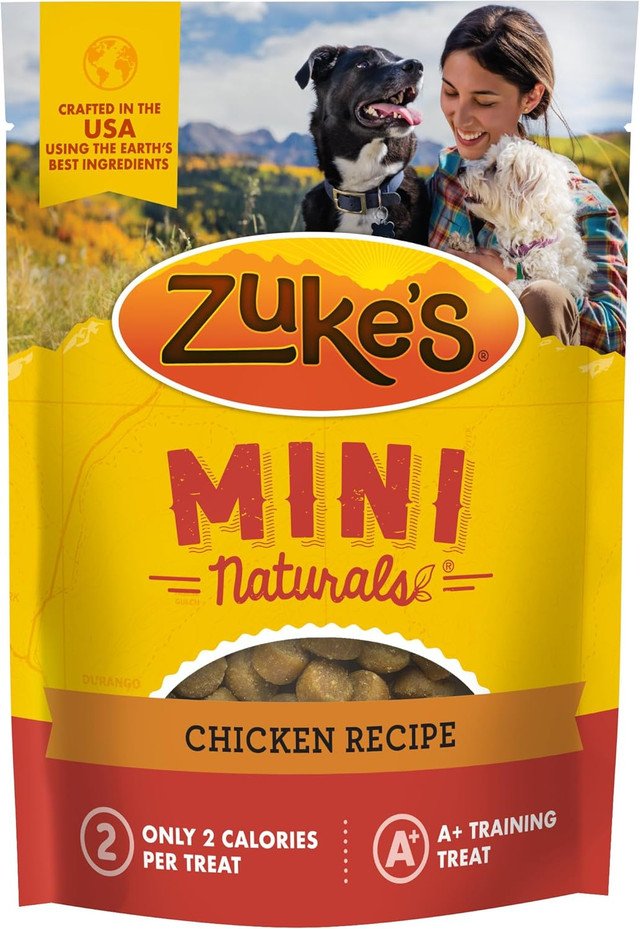
Zukes Mini Naturals Chicken Recipe dog training treats
If you buy just one bag of training treats, make it this one. Zuke’s Mini Naturals are the default treat in trainers’ pockets for a reason: they are soft, tiny, smelly enough to hold a dog’s attention, and they cost almost nothing per reward. Each treat is just 2 calories, printed right on the pouch, so you can run through dozens of reps without blowing your dog’s daily calorie budget.
The Chicken Recipe leads with real chicken as the first ingredient, plus wholefood extras like cherries, and it contains no corn, wheat or soy. The soft, chewy texture matters more than it sounds: your dog swallows in about a second, which keeps the training session flowing instead of stopping every rep for a long chew. The resealable pouch fits a jacket pocket or a treat bag, and the treats stay soft instead of drying into crumbs.
At around $6 for the 6 oz pouch, this is also one of the cheapest ways to start training properly. The 16 oz pouch costs around $15 and is the better buy if you train daily. The honest downside is that chicken is a common allergen, so dogs with chicken sensitivities need a different recipe from the same line, like the peanut butter or salmon versions.
Pros:
- Only 2 calories per treat, ideal for high-rep sessions
- Real chicken first ingredient, no corn, wheat or soy
- Soft and chewy, swallowed in about a second
- Resealable pocket-friendly pouch
- Around $6 for the 6 oz pouch
Cons:
- Chicken recipe is not suitable for dogs with chicken allergies
- Small pouch runs out fast in multi-dog households
- Soft texture can stick together in heat
Best for: Everyday obedience training, puppy classes, and owners who want one reliable bag for everything.
Who should avoid it: Dogs with chicken sensitivities should pick a different Zuke’s recipe or a single-protein treat instead.
2. Pet Botanics Training Reward Bacon Flavor – Best Value
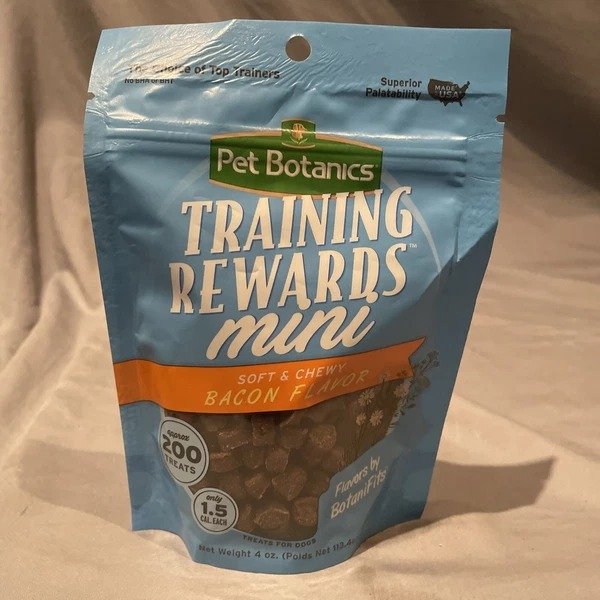
Pet Botanics Training Rewards Mini Bacon Flavor dog treats
Heavy trainers burn through treats fast, and that is where Pet Botanics wins. The 20 oz bag holds roughly 500 treats and costs around $17, which works out to about 3 cents per reward. That is the cheapest cost per rep on this list, and it is why so many professional trainers and doggy daycares keep this bag on the shelf.
Each treat is about 3 calories in the regular size, and the mini size shown here is just 1.5 calories with 200 treats in the 4 oz bag. The flavor comes from pork liver and real bacon, plus added botanicals, and the treats contain no artificial flavors, colors or preservatives. They are soft and chewy, pea-sized, and they do not crumble in your pocket, which matters when you are rewarding every few seconds.
The bacon smell is strong, which is a feature for your dog and a minor downside for your jacket. The resealable bag is generous, but once it is open for a few weeks the treats at the bottom can dry out slightly, so decanting into a smaller pouch for daily walks keeps them fresh.
Pros:
- Roughly 500 treats per 20 oz bag at around $17, about 3 cents per treat
- Pork liver and real bacon flavor dogs go crazy for
- Soft, pea-sized, no crumbling in pockets
- No artificial flavors, colors or preservatives
- Made in the USA
Cons:
- Strong bacon smell lingers on hands and pouches
- Large bag can dry out if left open for weeks
- Pork liver flavor is not ideal for dogs on limited-ingredient diets
Best for: Owners who train daily, multi-dog households, and classes where you burn through a bag a month.
Who should avoid it: Owners who want a single-protein or limited-ingredient treat should look at the Stewart liver treats instead.
3. Stewart Pro-Treat Beef Liver – Best High-Value Reward
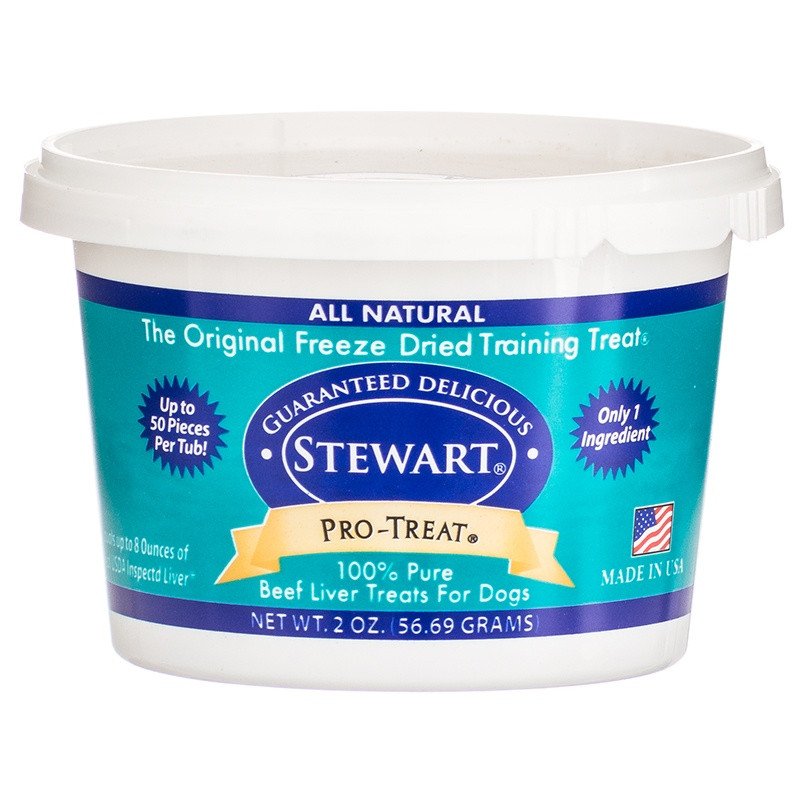
Stewart Pro-Treat Beef Liver freeze dried dog treats
Every trainer has a secret weapon for the hard stuff: recall at the dog park, loose-leash walking past other dogs, and any behavior your dog only does when he feels like it. For a huge number of trainers, that weapon is freeze-dried beef liver, and Stewart has been making it since 1973. It was even recognized by CNN Underscored as a top dog treat in December 2024.
The ingredient list is exactly one item long: 100% pure beef liver. Nothing else. The freeze-drying locks in the raw liver smell that dogs find irresistible, and the pieces break easily into smaller bits for training. At 4 kcal per gram, these are richer than the soft treats on this list, so they are best used as jackpot rewards for the hardest behaviors, not as your all-day drilling treat.
Because liver is so rich, a little goes a long way, and too much can loosen stools in sensitive dogs. The tubs are also pricier per ounce than soft treats: around $22 for the 17.5 oz tub. But for the moments when your dog’s attention is worth more than gold, this is the treat most likely to buy it back.
Pros:
- Single ingredient: 100% pure beef liver, nothing else
- Freeze-dried to lock in the smell dogs love
- Trusted by professional trainers since 1973
- Breaks easily into smaller training-sized pieces
- Great for dogs with food sensitivities and limited diets
Cons:
- Richer than soft treats at 4 kcal per gram, so use sparingly
- Too much liver can loosen stools in sensitive dogs
- Pricier per ounce than soft training treats
- Crumbly bits collect at the bottom of the tub
Best for: Recall training, distraction work, and jackpot rewards for breakthrough moments.
Who should avoid it: Owners who need an all-day, low-calorie drilling treat should pick Zuke’s or Pupford instead.
4. Blue Buffalo Blue Bits Beef Recipe – Best for Puppies
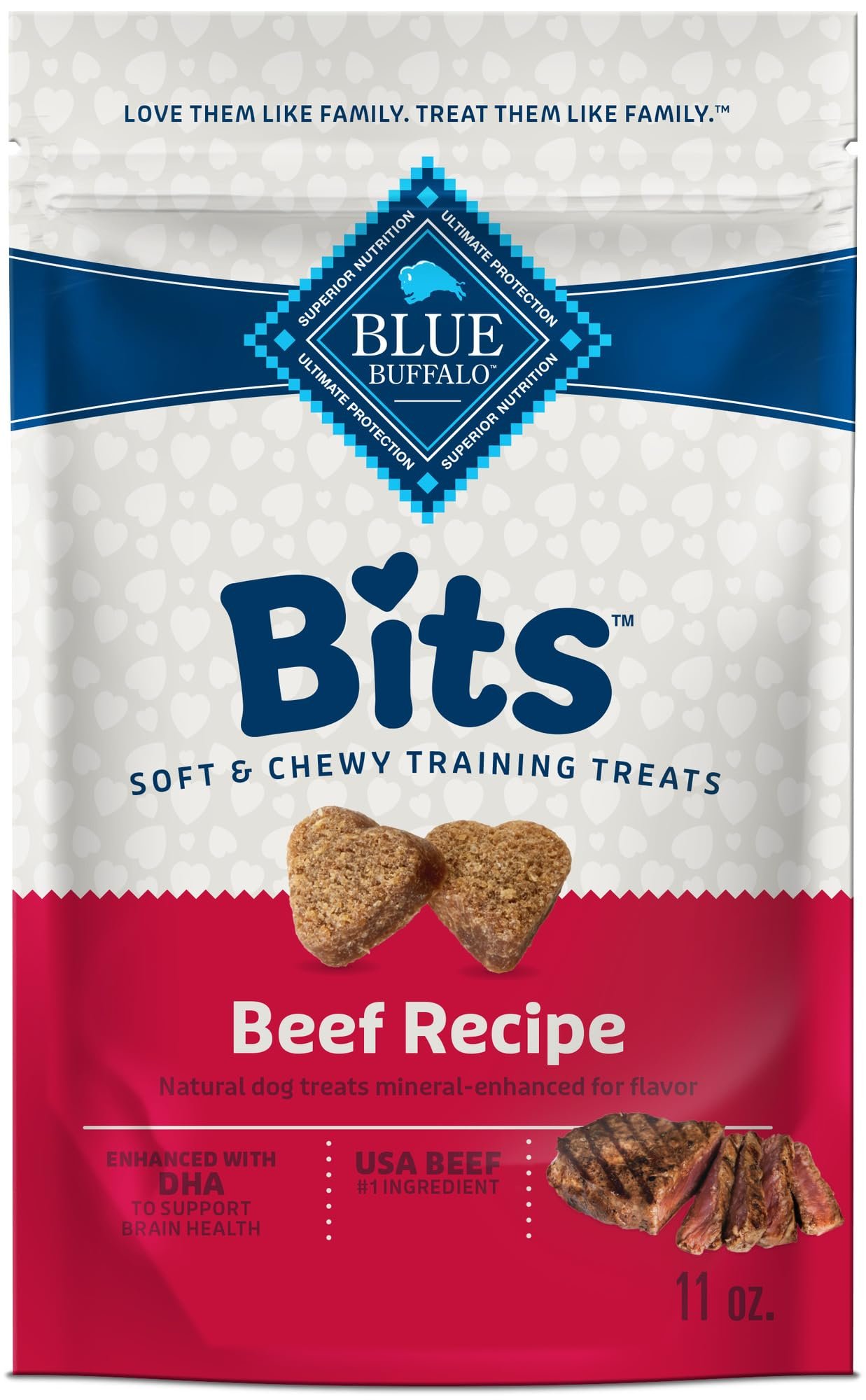
Blue Buffalo Blue Bits Beef Recipe training treats
Puppies are a special training case: they need dozens of rewards a day, their stomachs are sensitive, and their attention span is about four seconds long. Blue Buffalo Blue Bits are built for exactly that window. The heart-shaped morsels are tiny, soft and moist, so a puppy can swallow one instantly and stay in the game instead of wandering off mid-chew.
Each bit is just 4 calories, and the Beef Recipe leads with real beef as the first ingredient, plus DHA from fish oil to support cognitive development. That DHA angle is genuinely useful for puppies in their socialization window, and it is something most training treats do not offer. The recipe contains no corn, wheat, soy or poultry by-product meals, which keeps it gentle on young stomachs.
The two-pack of 4 oz pouches costs around $10, which is fair for a puppy-stage treat, but heavy trainers will go through it quickly. The bits can also stick together in humidity, so keep the pouch sealed between sessions. For older dogs, the pieces are small enough that a large breed may swallow them without tasting, so this pick shines brightest for puppies and small adults.
Pros:
- Just 4 calories per treat, perfect for frequent puppy rewards
- Real beef first ingredient plus DHA for cognitive support
- Tiny, soft, heart-shaped morsels puppies swallow instantly
- No corn, wheat, soy or poultry by-product meals
- Around $10 for the two-pack of 4 oz pouches
Cons:
- Small pouches run out fast for daily trainers
- Bits can stick together in humid weather
- Too small for large breeds to savor as a reward
Best for: New puppies, puppy classes, and early socialization training.
Who should avoid it: Owners of large adult dogs who want a more substantial reward should pick Zuke’s or Pet Botanics instead.
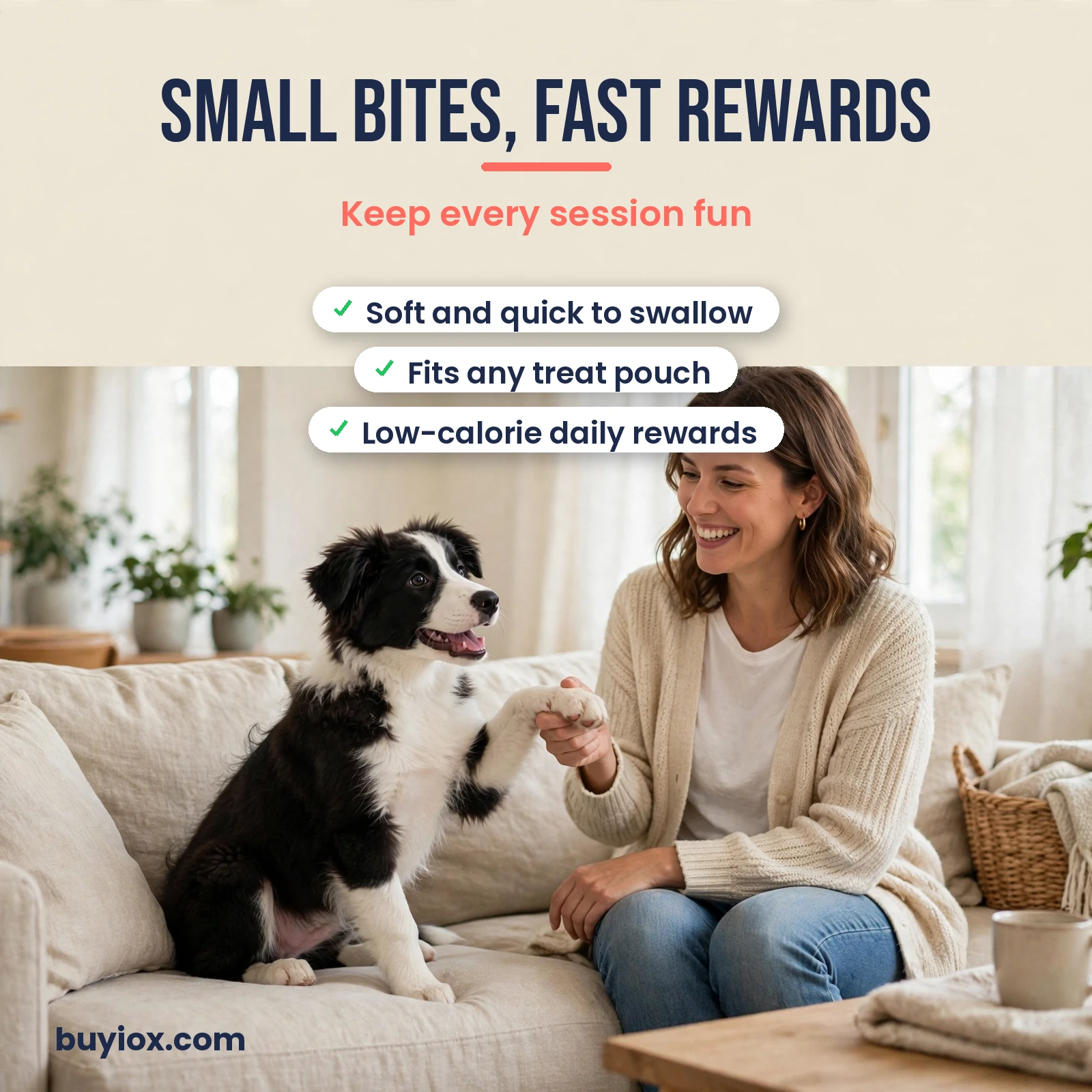
Small, soft treats keep training sessions fun and fast.
5. Pupford Train Freeze-Dried Beef Liver – Best Low-Calorie Treat

Pupford Train Freeze Dried Beef Liver training treats
If your dog is on a weight-management plan, or you simply train a lot, Pupford is the pick that solves the calorie problem completely. Each tiny nugget contains less than 1 calorie, and the 4 oz bag holds approximately 475 of them. Do the math on a 40-calorie treat budget: that is 40 rewards before you even approach the limit, which is freedom no other treat on this list offers.
The ingredient list is short and clean: beef liver, beef heart, and mixed tocopherols as a natural preservative. That is it. The treats are grain-free, freeze-dried in the USA, and they leave no greasy residue on your fingers or your treat pouch, which anyone who has trained with liver treats before will appreciate. The tiny size, about the size of a pinky nail, means no breaking, no crumbs, and no pauses.
The tradeoff is price and richness. At around $17 for a 4 oz bag, this is the priciest treat per ounce here, even though the per-treat cost is only about 3 to 4 cents. And because the formula is liver-rich with a crude fat level around 35%, it is not the best choice for dogs on a strict low-fat diet or with pancreatitis history. For healthy dogs in heavy training, though, it is hard to beat.
Pros:
- Less than 1 calorie per treat, approximately 475 treats per bag
- Only 3 ingredients: beef liver, beef heart, mixed tocopherols
- Grain-free and freeze-dried in the USA
- No greasy residue on hands or pouches
- Tiny size needs no breaking or cutting
Cons:
- Around $17 for a 4 oz bag, pricey per ounce
- Liver-rich formula is high in fat, not for low-fat diets
- Tiny pieces can be fiddly for owners with large hands
Best for: Dogs on weight management, heavy daily trainers, and anyone counting every calorie.
Who should avoid it: Dogs on veterinary low-fat diets should check with their vet first, and owners wanting a cheap bulk treat should pick Pet Botanics.
6. Bil-Jac Little Jacs – Best for Small Dogs

Bil-Jac Little Jacs Small Dog Training Treats
Small dogs get overlooked by most training treats. Standard treats are too big, too hard, or too high in calories for a 6-pound dog whose whole daily food budget is a handful of kibble. Bil-Jac Little Jacs were made for exactly this gap: tiny, soft morsels built around fresh chicken liver, sized for toy and small breeds.
Each piece is just 2.8 calories, and the 4 oz bag holds over 100 treats. The formula leads with fresh chicken liver, chicken, and chicken meal, and it skips soy, corn gluten, and rendered fat. Bil-Jac has been making dog treats in the USA since 1947, and the double-zipper pouch genuinely keeps these soft for weeks, which is a small detail you will appreciate on walk number forty.
Honesty time: this is not a clean-label darling. The recipe contains wheat flour and the preservative BHA, so it is not grain-free and not right for strict limited-ingredient diets. The pieces are also so small that large breeds swallow them whole without registering a reward. But for small dogs and puppies, the size, smell, and calorie count are exactly right, and at around $9 for the 10 oz bag, it is fairly priced.
Pros:
- Just 2.8 calories per treat, sized for toy and small breeds
- Fresh chicken liver first ingredient, strong aroma dogs love
- Over 100 treats per 4 oz bag
- No soy, corn gluten or rendered fat
- Double-zipper pouch keeps treats soft for weeks
- Made in the USA since 1947
Cons:
- Contains wheat flour, not grain-free
- Uses BHA preservative, not for strict limited-ingredient diets
- Pieces too small to register as a reward for large breeds
Best for: Toy breeds, small dogs, and puppies who need tiny, low-calorie rewards.
Who should avoid it: Dogs on grain-free or strict limited-ingredient diets should pick Stewart or Pupford instead.
Comparison Table
| Product | Best For | Calories Per Treat | Price (approx) |
|---|---|---|---|
| Zuke’s Mini Naturals Chicken | Everyday training | 2 | Around $6 (6 oz) |
| Pet Botanics Training Reward Bacon | Bulk value | About 3 (1.5 mini) | Around $17 (20 oz) |
| Stewart Pro-Treat Beef Liver | High-value rewards | 4 per gram | Around $22 (17.5 oz) |
| Blue Buffalo Blue Bits Beef | Puppies | 4 | Around $10 (2 x 4 oz) |
| Pupford Train Beef Liver | Low-calorie training | Less than 1 | Around $17 (4 oz) |
| Bil-Jac Little Jacs | Small dogs | 2.8 | Around $9 (10 oz) |
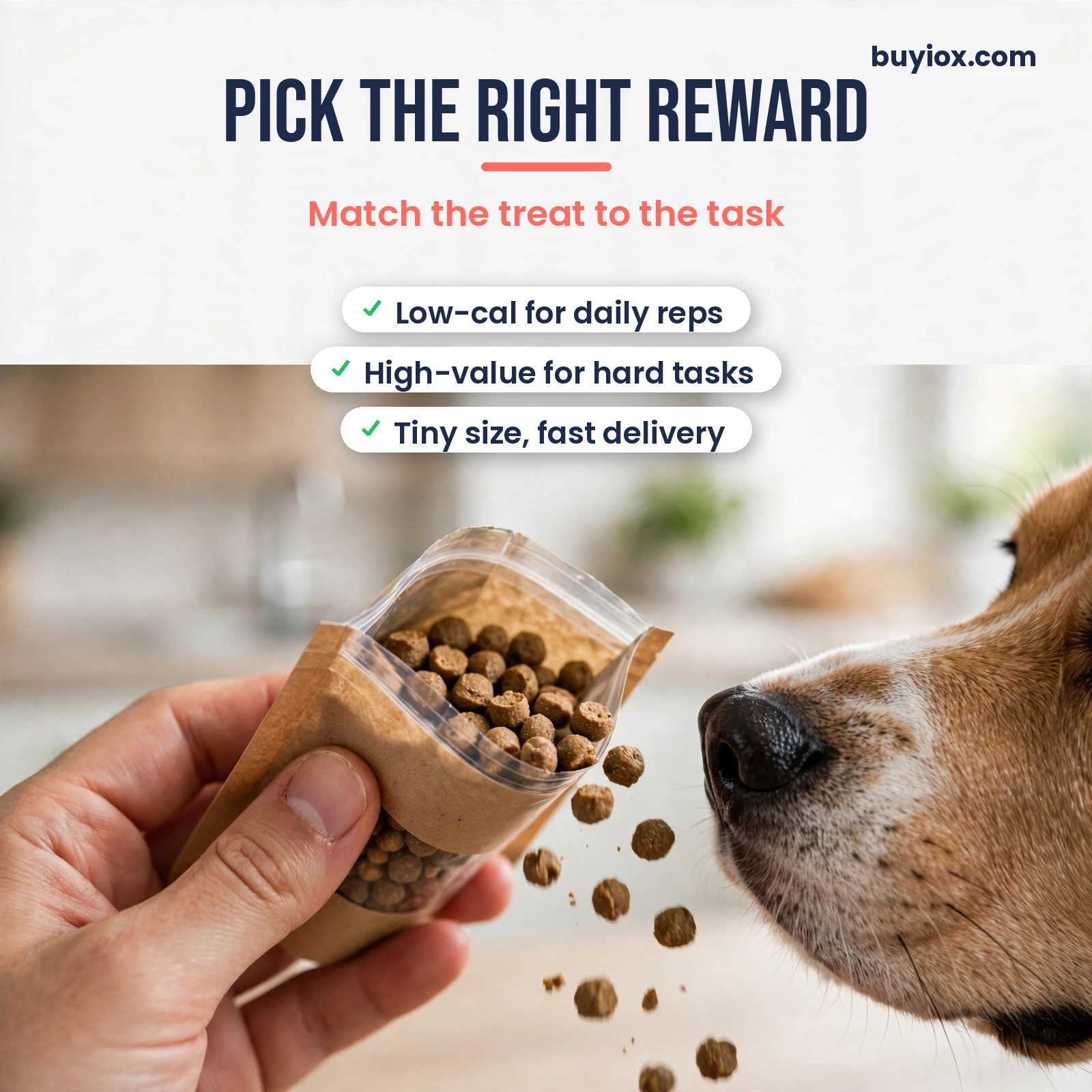
Match the treat to the task for faster results.
Buying Guide: How to Pick the Right Training Treat
The bag matters less than the match. Here is how to choose like a trainer.
Size first: the treat must disappear in one second
The golden rule of training treats is speed. If your dog needs five seconds to chew, your timing is gone and the next rep starts late. Pick treats no bigger than a pea, or treats you can break into pea-sized pieces. Soft treats win here because they vanish fast. Hard biscuits slow everything down and scatter crumbs that distract your dog from the next cue.
Calories second: count the session, not the treat
One treat is nothing. Fifty treats is a meal. Before a session, do the quick math: multiply the calories per treat by the number of reps you plan, and keep the total inside that 10% daily budget. PetMD notes that training treats are typically small, similar in size to a pencil eraser, precisely because owners use so many at once. On heavy training days, reach for the Pupford or Zuke’s end of the list, and trim a little kibble from dinner to balance the books.
Value third: rank your dog’s rewards like a trainer does
Professional trainers rank treats from low value to high value and match them to the difficulty of the task. Kibble or a plain biscuit for easy living-room reps. A soft, smelly commercial treat for normal outdoor work. Freeze-dried liver or real meat for recall, reactivity work, and anything with serious distractions. Using your highest-value treat for everything is like paying a bonus for showing up on time: it stops working as a bonus. Save the liver for the moments that actually need it.
Match the treat to the dog in front of you
Puppies need tiny, soft, gentle treats and lots of them, which is why Blue Bits and Little Jacs lead for young dogs. Small breeds need the same small size for a different reason: their calorie budgets are tiny. Dogs with allergies need single-ingredient options like Stewart or Pupford, and you should always check the ingredient panel, not just the front of the bag. And if your dog is a picky eater, rotate two flavors: boredom kills motivation faster than anything else.
Storage and handling: the boring part that actually matters
Training treats live in pockets, pouches, and cars. Soft treats dry out, freeze-dried treats crumble, and open bags go stale. Reseal every bag, decant a day’s worth into a small pouch, and keep the main bag cool and dry. A stale treat is a low-value treat, no matter what the label promised. And if you train outdoors in summer, skip chocolate-style or greasy treats that melt into your pocket.
Pair treats with the rest of your training kit
Treats do not train a dog alone. For leash work, pair your rewards with one of the best no-pull dog harnesses so pulling does not undo your progress. For grooming-related training, like getting your dog comfortable with brushing, reward calm behavior during sessions with our guide to the best dog deshedding brushes. And if bath time is part of your puppy’s training plan, the best dog shampoos for sensitive skin make the whole routine less stressful for both of you.
Frequently Asked Questions
How many treats can I give my dog during training?
Keep all treats, including training rewards, within about 10% of your dog’s daily calories. That is the guideline the AKC gives, and it is why low-calorie treats matter so much for training. For a dog eating 400 calories a day, that means about 40 calories of treats total. With 2-calorie treats, that is 20 rewards; with sub-1-calorie treats, it is 40 or more. On heavy training days, trim a little from your dog’s meals to stay in balance.
What makes a good training treat?
A good training treat is small, soft, smelly, and fast to eat. The AKC advises using small, soft treats that a dog can quickly chew and swallow, and professional trainers add one more rule: the treat should be gone in about a second so the next rep starts cleanly. It should also be something your dog genuinely loves, not just tolerates, because motivation is the whole point of the reward.
Are freeze-dried treats better than soft treats?
Neither is better in general; they do different jobs. Freeze-dried liver treats like Stewart and Pupford are higher value because the smell is intense, which makes them ideal for distractions and recall work. Soft treats like Zuke’s and Pet Botanics are better for high-rep drilling because they are lower in calories and easier to eat quickly. Most experienced trainers keep both: soft treats for everyday reps, freeze-dried liver for the hard stuff.
Can puppies have training treats?
Yes, puppies can absolutely have training treats, and training is actually easier when you start early. Choose treats made for puppies or small dogs, like Blue Buffalo Blue Bits or Bil-Jac Little Jacs, which are tiny, soft, and gentle on young stomachs. Keep sessions short, just a few minutes at a time, and ask your vet how much food your puppy needs so you can keep treats inside the daily calorie budget.
What are high-value treats and when should I use them?
High-value treats are the rewards your dog finds irresistible: freeze-dried liver, real meat, or cheese. The AKC notes that high-value treats make difficult reinforcement easier to deliver, especially in distracting environments. Use them for recall, reactivity work, vet visits, and any new or hard behavior. For easy, well-known behaviors at home, save money and calories by using your dog’s regular low-value treats or even kibble.
Do training treats make dogs gain weight?
They can, but only if you ignore the calorie math. Training treats themselves are tiny; the problem is volume over weeks. A dog getting 50 extra treats a day without any adjustment to meals will gain weight. The fix is simple: count the session’s calories, choose low-calorie treats for heavy training days, and reduce meal portions slightly to compensate. Used this way, training treats are one of the healthiest ways to bond with your dog.
Can I use my dog’s regular kibble as a training treat?
Yes, and many trainers do exactly that, especially for easy behaviors at home. Kibble is already part of your dog’s daily calories, so using it as a reward adds nothing extra to the budget. The downside is motivation: most dogs find kibble far less exciting than a soft or liver treat, so it works poorly for distractions or hard behaviors. A good system is kibble for easy reps at home and real training treats for everything else.
Final Verdict
There is no single best training treat, only the right treat for the job in front of you. Start with Zuke’s Mini Naturals Chicken Recipe for everyday training: at 2 calories per treat and around $6 a pouch, it is the safest all-rounder here. Add Stewart Pro-Treat Beef Liver as your high-value secret weapon for recall and distractions, and keep Pupford Train on hand for heavy training days when calories matter most.
For puppies, Blue Buffalo Blue Bits are the gentle, DHA-boosted starter pick. For toy and small breeds, Bil-Jac Little Jacs get the size and calorie count exactly right. And if you train daily or run classes, Pet Botanics Training Reward at roughly 500 treats per bag is the value buy that keeps your pocket full without emptying your wallet.
Whichever you choose, remember the trainer’s rule the AKC repeats: be generous with rewards and fast with delivery. A dog who is paid well and paid quickly learns fast, and that is the whole point of the treat bag.