
Affiliate Disclosure: Buyiox is reader-supported. When you buy through links on this page, we may earn a small commission at no extra cost to you. We only recommend products we would use for our own dogs.
You leave the room for two minutes. You come back to find your dog on the kitchen counter, in the trash, or halfway up the stairs with a sock in its mouth. You close a door, and your puppy cries. You put up a flimsy barrier, and your dog walks straight through it like it is not even there. If any of that sounds familiar, you do not have a bad dog. You have a home with no boundaries, and a dog gate is the simplest way to fix it.
A good dog gate does three jobs at once. It keeps your dog away from hazards like stairs, hot stoves, cleaning products, and medications. It gives house training a real chance, because a puppy that can only reach one puppy-proofed room has far fewer places to have an accident. And it keeps the peace in a multi-pet or small-child home, where everyone needs a little space sometimes. The AKC guide to choosing a dog gate says a gate can help prevent falls, keep dogs away from household hazards, support house training, and manage interactions with other pets or young children, and that is exactly what the six best dog gates below are built to do.
But here is the part most roundups skip: a gate only works if it stays put. A pressure gate that pops out of the doorway the first time your Labrador leans on it is worse than no gate at all, because it teaches your dog that gates can be beaten. A gate that is too short is a hurdle, not a barrier. A gate that is too narrow for your hallway is a return label waiting to happen. This is a research-based roundup. We did not test these gates on our own dogs, so every claim below is framed the way it should be: what the manufacturer states, what owners report, and what the trade-offs are. Measure your opening first, match the gate to your dog, and pick the mounting type your location actually needs. Do that, and the gate you buy will still be standing a year from now.
Our Top 6 Dog Gates at a Glance
- Carlson Extra Wide Walk-Thru Gate with Pet Door – Best overall, the all-steel walk-through gate most homes should buy first
- Munchkin Easy Close Baby Gate – Best for stairs and wide openings, with hardware mounting for maximum stability
- Regalo Easy Step Extra Wide Walk Thru Gate – Best budget wide gate, the cheapest way to cover a big hallway
- North States MyPet Paws Portable Pet Gate – Best portable pick, the no-tools plastic gate you can move room to room
- Dreambaby Retractable Gate – Best retractable gate, the mesh gate that vanishes when you do not need it
- Summer Infant Metal Banister and Stair Safety Gate – Best for banisters and stairs, the no-drill answer for tricky stair tops
1. Carlson Extra Wide Walk-Thru Gate with Pet Door – Best Overall

Carlson Extra Wide Walk-Thru Gate with Pet Door (product-style image)
The Carlson Extra Wide Walk-Thru Gate with Pet Door is the best dog gate for most homes, and the reason is simple: it is the safest first buy. It is an all-steel gate, which means a chewing puppy cannot gnaw through it the way it can chew through plastic or wood. It stands 30 inches tall, which is high enough for most small and medium dogs and for many larger ones that are not dedicated jumpers. It fits openings from 29 to 38.5 inches with the included extension, so it covers most standard doorways and hallways without extra parts. And it has a walk-through door with a one-touch release handle, so you step through it like a normal doorway instead of climbing over it every time you carry laundry.
What makes this gate lead the list is the small pet door built into the bottom. The 10 by 7 inch door lets a cat or a very small pet pass through while keeping a larger dog contained, which is a genuine daily win in a multi-pet home. The gate mounts by pressure, so there is no drilling and no holes in your walls, but a wall-mount kit is included if you want extra security. The lever-style handle is easy for adults to open one-handed, even with an armful of groceries, and the gate is lead-free steel, so it is safe for a dog that mouths everything it meets. At around $45 on Petco, it costs less than a single vet visit for a swallowed sock, and for a first dog gate, for a standard doorway, and for an owner who wants a normal gate that simply works, this is the honest best overall pick.
The honest trade-off is height. At 30 inches tall, this gate will not stop a big jumper, a determined athletic dog, or a breed that treats every barrier as a challenge. The AKC notes that bigger breeds or jumpers probably need a gate at least 30 inches high, and this gate sits exactly on that line, which means a tall, springy dog may clear it. The pressure mounts can also mark painted walls, and very small dogs may fit through the pet door that was meant for the cat, so measure your smallest pet before you buy. Some owners also report that the gate is not wide enough for very wide doorways, and wider openings need extra extension kits sold separately. But for its job, which is a sturdy, chew-proof, everyday gate for a normal doorway, the Carlson is the most trustworthy gate on this list.
Why we like it
- All-steel construction is chew-proof and built to last for years
- Small 10 by 7 inch pet door lets cats pass while larger dogs stay put
- Walk-through door with a one-touch release handle for easy adult access
- Fits openings from 29 to 38.5 inches with the included extension
- Pressure mount with a wall-mount kit included, so no drilling is required
Pros
- Best dog gate for most homes, with the safest all-steel design here
- Best pick for a first dog gate, and cheap enough to buy a second for another doorway
- Widely sold with thousands of owner reviews behind it
Cons
- 30-inch height will not stop big jumpers or very athletic dogs
- Pressure mounts can mark painted walls
- Very small dogs may fit through the cat door
- Very wide doorways need extra extension kits sold separately
Price: around $45 on Petco
Best for: first-time gate buyers, standard doorways and hallways, multi-pet homes with a cat, and owners who want a sturdy steel gate without drilling.
Who should skip it: owners of big jumpers or very athletic dogs, where a taller gate is the better buy, and owners with very wide openings, where the Regalo below covers more width for a similar price.
2. Munchkin Easy Close Baby Gate – Best for Stairs and Wide Openings
Munchkin Easy Close Baby Gate (product-style image)
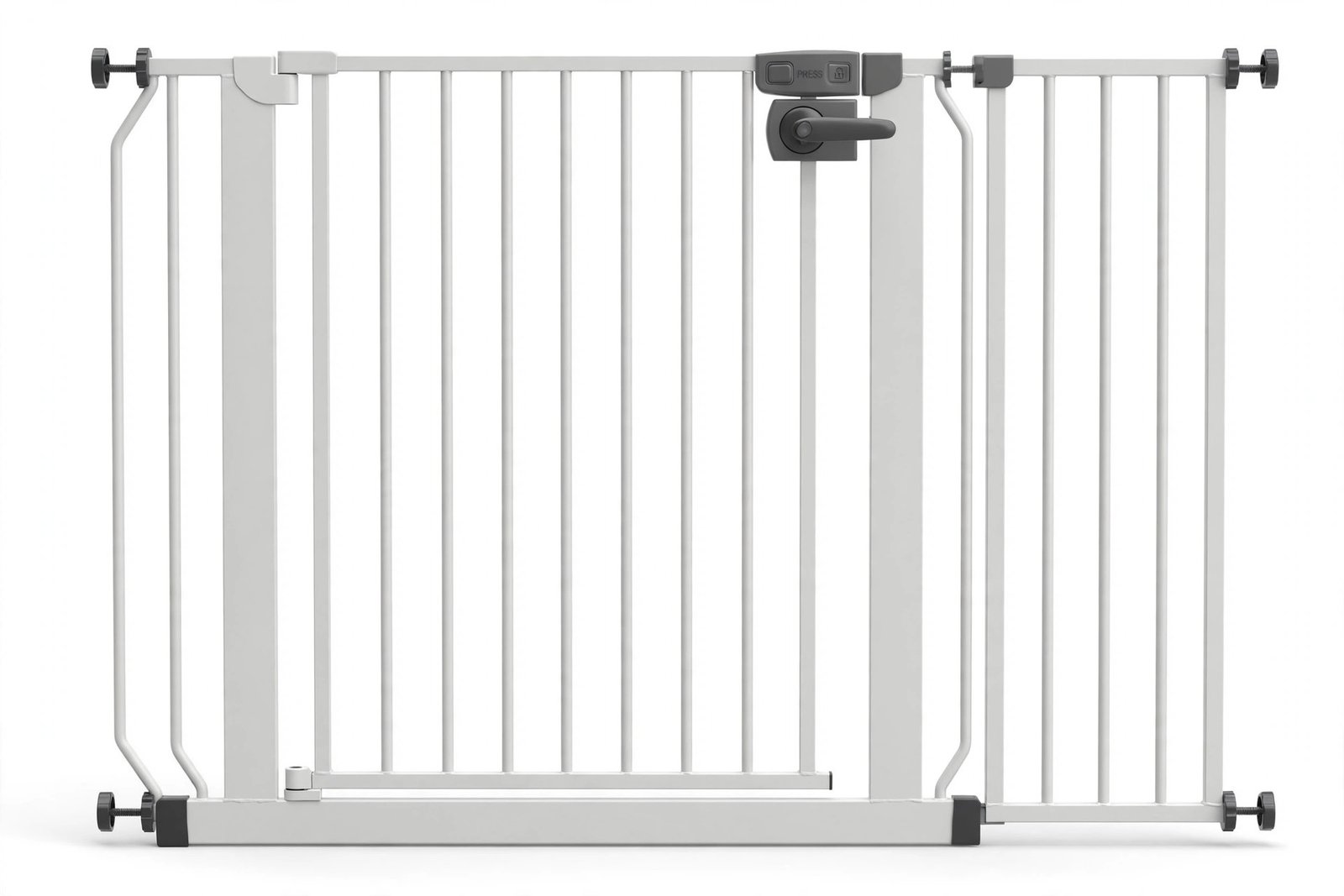
The Munchkin Easy Close Baby Gate is the best baby gate for dogs when the job is stairs or a wide opening, and the reason is the mounting. The standard model is a steel pressure gate that stands 29.5 inches tall and fits openings from 29.5 to 35 inches with the included 2.75-inch extension, and it comes with hardware for a screwed-in install when you need extra security. The XL model goes further: it stands 36 inches tall and fits openings from 29.5 to 51.6 inches with three included extensions, which covers hallways and open-plan gaps that most gates cannot touch. That range is the whole point. Most gates fit one doorway. This one fits the awkward spaces in a real house.
What makes this gate special is the latch. The dual-locking mechanism is easy for an adult to open one-handed with a simple push to close, but it is designed to be tricky for little hands and paws. The door swings in both directions, so you can walk through from either side without thinking about it, and the gravity-fed double lock clicks shut with a reassuring feel every time. The steel frame feels sturdier than the budget price suggests, and the gate can lift off its frame when you want full open access for moving furniture. At around $45 for the standard model on Amazon, it costs about the same as the Carlson above, but it brings a better latch and a hardware option to the same doorway. For the busiest doorway in the house, that latch is worth the money.
Be honest about the limits. First, the bottom step-over rail is a trip hazard, especially at night or for an older person in the house, so watch your step every time you pass through. Second, the standard model is not a wide gate on its own: beyond 35 inches you need extra extensions, and the XL model costs roughly twice as much, at around $90. Third, and most important, a pressure mount alone is not for the top of stairs. The gate includes hardware for a screwed-in install, and you should use it there, because a pressure gate at the top of a staircase can be knocked loose with serious consequences. Buy the standard model for a busy doorway, buy the XL for a wide hall, and always use the hardware mounts at the top of stairs.
Why we like it
- Dual-locking mechanism is easy for adults and hard for toddlers and paws
- Door swings both ways and closes with a simple push
- Pressure mount with hardware included for a screwed-in install
- XL model fits openings up to 51.6 inches and stands 36 inches tall
- Steel frame feels sturdier than the price suggests
Pros
- Best dog gate for stairs and wide openings, with the best latch here
- Best pick for the busiest doorway in the house
- Hardware mounting option makes it the most secure pick for stair use
Cons
- Bottom step-over rail is a trip hazard
- Standard model only covers up to 35 inches without extra extensions
- XL model costs around twice as much as the standard model
- Pressure mount alone must never be used at the top of stairs
Price: around $45 for the standard model on Amazon
Best for: the busiest doorway in the house, stair bottoms with hardware mounting, wide hallways (XL model), and owners who want the most secure latch in this price range.
Who should skip it: owners on a tight budget covering a very wide opening, where the Regalo below is cheaper, and anyone who wants a gate with no bottom bar to step over, where the Dreambaby retractable gate below is the better buy.
3. Regalo Easy Step Extra Wide Walk Thru Gate – Best Budget Wide Gate
Regalo Easy Step Extra Wide Walk Thru Gate (product-style image)
The Regalo Easy Step Extra Wide Walk Thru Gate is the best budget wide gate, and the reason is the math. It stands 30 inches tall and fits openings from 29 to 49 inches wide, with a 4-inch and a 12-inch extension included in the box. That means one gate covers a standard doorway, a wide hallway, and most open-plan gaps, without buying extra parts. The 16-inch-wide walk-through door has a lever handle with a one-touch release safety lock, so adults pass through easily while the gate stays shut for the dog. The frame is all metal, the pressure-mount design needs no tools, and wall cups and mounting hardware are included.
What makes this gate worth its price is how much width you get for the money. At around $50, it costs about the same as the Carlson above, but it covers openings up to 49 inches wide, which is more than ten inches wider. The extension system is simple to understand: 29 to 32 inches with no extension, 34 to 36.5 inches with the 4-inch extension, 41.5 to 44.5 inches with the 12-inch extension, and 46.5 to 49 inches with both. For a wide hallway between the kitchen and the living room, for the bottom of the stairs in an open-plan home, or for a rental where you need one gate that fits the widest opening you own, this is the cheapest honest answer. The gate is also rated for children 6 to 24 months and for medium to large pets, which tells you the frame is built for real daily use, not just light duty.
Now the honest problems. First, the fit has gaps: the standard 29 to 38.5 inch model does not fit openings between 32 and 35.5 inches without an additional 4-inch extension, so measure your opening before you order and check the range, not just the headline number. Second, the latch is simpler than the Munchkin double lock above, and owners report that a clever dog or a determined toddler can work it out faster. Third, like every 30-inch gate here, it will not stop a big jumper, and the bottom bar is a trip hazard in a dark hallway. Buy it when width per dollar is the deciding factor, and when your opening is genuinely wide. Buy it for a standard 30-inch doorway, and you are paying for width you will never use.
Why we like it
- Fits openings from 29 to 49 inches wide with two extensions included
- 16-inch-wide walk-through door with a lever handle and one-touch release
- All-metal frame with pressure mounting and wall cups included
- Cheapest way to cover a wide hallway or open-plan gap
- Rated for medium to large pets as well as children
Pros
- Best budget wide gate, with the most width per dollar here
- Best pick for wide hallways and open-plan homes
- Best pick for renters who need one gate for a big opening
Cons
- Some opening widths need an extra extension the box does not include
- Latch is simpler than the Munchkin double lock
- 30-inch height will not stop big jumpers
- Bottom bar is a trip hazard in a dark hallway
Price: around $50
Best for: wide hallways, open-plan homes, bottom-of-stairs placement, and budget buyers who need maximum width for minimum money.
Who should skip it: owners of big jumpers, where a taller gate is the better buy, and owners with a standard narrow doorway, where the Carlson above fits better and brings a pet door.
4. North States MyPet Paws Portable Pet Gate – Best Portable Pick

North States MyPet Paws Portable Pet Gate (product-style image)
The North States MyPet Paws Portable Pet Gate is the best portable dog gate, and the reason is that it asks nothing of you. It comes fully assembled, it needs no screws and no tools, and you install it by expanding it in the opening and locking it in place with one hand. It stands 23 inches tall and expands from 26 to 40 inches to fit most standard doorways. The latticework has cute paw prints built into the plastic, the ergonomic handle gives you a firm grip, and the rubber bumpers protect your walls and accommodate base moldings up to 4 inches high. At around $25 on Chewy, it is the cheapest gate on this list by a clear margin, and it is made in the USA.
What makes this gate special is how easy it is to move. Most gates are installed once and left there, because taking them down is a chore. This one is built to be picked up and moved: from the kitchen doorway in the morning to the bedroom doorway at night, from your house to a holiday rental, from one room to another as the puppy grows. The EZ-track system locks firmly into place with one hand, which matters when the other hand is holding a puppy, a leash, or a coffee. For a small dog, for a puppy that is still learning boundaries, for a calm older dog that respects a barrier, and for an owner who needs a gate in three different rooms but only wants to buy one, this is the honest best portable pick.
Be very clear about the limits. First, height: at 23 inches tall, this gate will not stop a medium or large dog that can jump, and even some athletic small dogs can clear it. The AKC notes that a gate 20 inches high may work for puppies or small breeds, and this gate sits just above that line, which means it is a puppy and small-dog gate, not a general-purpose gate. Second, it is pressure mounted plastic, so a determined pet can knock it over, and a persistent chewer can damage it. Third, there is no walk-through door, so you either step over it or lift it out of the doorway every time you pass, which gets old fast in a high-traffic doorway. Buy it as a portable, temporary, small-dog barrier, and it is excellent. Buy it as the only gate for a strong 60-pound dog, and it will be on the floor by lunchtime.
Why we like it
- No tools, no screws, no assembly: expand it, lock it, done
- Lightweight and portable, so one gate can serve several rooms
- Rubber bumpers protect walls and fit over base moldings up to 4 inches high
- EZ-track locking system works with one hand
- Made in the USA and ready to use out of the box
Pros
- Best portable dog gate, the easiest gate here to move and reinstall
- Best pick for puppies, small dogs, and calm older dogs
- Cheapest gate on this list at around $25
Cons
- Only 23 inches tall, so medium and large dogs can jump it
- A determined pet can knock a pressure-mounted plastic gate over
- No walk-through door, so you step over it or lift it out
- Plastic can be chewed by a persistent chewer
Price: around $25 on Chewy
Best for: puppies, small dogs, calm older dogs, renters, and owners who need one gate that moves between rooms.
Who should skip it: owners of medium or large dogs, owners of jumpers or pushers, and anyone who needs a gate in a high-traffic doorway, where a walk-through steel gate is the better buy.
5. Dreambaby Retractable Gate – Best Retractable Gate

Dreambaby Retractable Gate (product-style image)
The Dreambaby Retractable Gate is the best retractable dog gate, and the reason is that it disappears. Most gates are a permanent piece of furniture in your doorway: a steel frame you walk around, a bottom bar you step over, a door you open and close a dozen times a day. This gate is a mesh panel that rolls out from a wall-mounted housing when you need it and retracts completely out of the walkway when you do not. The extra-tall model stands 35 inches tall and spans openings up to 55 inches wide, which covers wide hallways and open-plan gaps that a standard steel gate cannot reach. There is no base bar to step over, which removes the trip hazard that every other gate on this list has.
What makes this gate special is the hardware. It is hardware mounted, which means it screws into the wall or door frame, and that is the most secure mounting type there is. Two sets of mounting brackets are included, so one gate can serve two openings: mount a bracket set in the kitchen doorway and another at the stairs, and move the gate between them. The EZY-Check indicators use red and green visuals to confirm at a glance that the gate is installed correctly and locked shut. The manufacturer states that the gate is tested to ASTM F1004 and the European gate standard, and the extra-tall model is rated for use at the top or bottom of stairs when it is mounted exactly as the instructions direct. At around $60, it costs about the same as the Carlson above, but it brings a 55-inch span and a vanishing act that no steel gate can match.
Now the honest problems. First, mesh is not steel: the fabric can show claw damage faster than a metal gate, and a dog that scratches or paws at the mesh will wear it out sooner. Second, the latch feels less robust than premium retractable gates, and independent roundups note that the gate is not rated for dogs over about 50 pounds leaning or pushing on it, so a strong large dog is the wrong match. Third, hardware mounting means drilling holes in your walls, which renters may not be allowed to do, and the gate is only as safe as its install, so follow the mounting instructions exactly. Buy it when you need a wide span, when you hate tripping over a bottom bar, or when you want the walkway clear when the gate is open. Buy it for a strong 70-pound dog that leans on barriers, and you will be disappointed.
Why we like it
- Retracts fully out of the walkway when not in use, with no bottom bar to step over
- Extra-tall model stands 35 inches tall and spans openings up to 55 inches wide
- Hardware mounted for maximum security, with two bracket sets included
- One-hand operation, so you can open it while carrying a child or a bag
- EZY-Check red and green indicators confirm correct installation and locking
Pros
- Best retractable dog gate, with the widest span here
- Best pick for wide hallways and open-plan homes
- Best pick for owners who hate tripping over a bottom bar
Cons
- Mesh can show claw damage faster than steel
- Not rated for dogs over about 50 pounds leaning or pushing on it
- Hardware mounting means drilling holes in your walls
- Latch feels less robust than premium retractable gates
Price: around $60
Best for: small to medium dogs, wide hallways and open-plan gaps, homes where the walkway must stay clear, and owners who want no bottom bar to step over.
Who should skip it: owners of large or strong dogs that lean on barriers, renters who cannot drill, and owners of dogs that scratch or paw at mesh.
6. Summer Infant Metal Banister and Stair Safety Gate – Best for Banisters and Stairs

Summer Infant Metal Banister and Stair Safety Gate (product-style image)
The Summer Infant Metal Banister and Stair Safety Gate is the best dog gate for banisters and stairs, and the reason is that it solves the hardest install in the house. Most gates need two flat walls or a door frame to press against. A staircase with a banister on one or both sides gives you neither. This gate comes with a dual installation kit that fastens to your banister without drilling into the wood, so you get a secure gate at the top or bottom of the stairs without damaging the banister. It stands 32.5 inches tall, fits openings from 31 to 46 inches wide, and works banister to banister, banister to wall, wall to wall, in a doorway, or at a stairway.
What makes this gate special is the door. The extra-wide door opens the full width of your stairway, so you walk through it like a normal doorway instead of squeezing past a narrow gate at the top of the stairs. The no-threshold design means there is no bottom bar to trip over right at the edge of a staircase, which is exactly where a trip is most dangerous. A locking indicator gives you a visual confirmation that the gate is shut, a support foot adds extra stability, and the gate is third-party tested. For a home with a banister staircase, for a dog that must never reach the stairs unsupervised, and for an owner who refuses to drill into a wooden banister, this is the honest best pick, and there is no cheaper gate that does this job.
Be very clear about the limits. First, the gate is made for square-top banisters only, according to the manufacturer guidance on retailer listings, and it is not offered for rounded-top banisters, so check the shape of your banister before you order. Second, at around $80 on Chewy, it costs more than any other gate on this list, and installation takes longer than a pressure gate because the banister mounts need careful fitting. Third, at 32.5 inches tall it is taller than most gates here, but it will still not stop a very strong jumper, and a gate at the top of stairs is only safe when it is installed exactly as the instructions direct. Buy it when you have a banister staircase and a dog that must stay off the stairs. Buy it for a flat doorway, and you are paying for a banister kit you will never use.
Why we like it
- Dual installation kit fastens to banisters without drilling into the wood
- Extra-wide door opens the full width of the stairway
- No-threshold design removes the trip hazard at the top of the stairs
- Locking indicator confirms at a glance that the gate is shut
- Support foot adds extra stability on stairs
Pros
- Best dog gate for banisters and stairs, with no other gate doing this job as well
- Best pick for homes with a banister staircase
- Best pick for owners who refuse to drill into a wooden banister
Cons
- Made for square-top banisters only, not rounded-top banisters
- Around $80, the most expensive gate on this list
- Installation takes longer than a pressure gate
- 32.5-inch height will not stop very strong jumpers
Price: around $80 on Chewy
Best for: homes with a banister staircase, top-of-stairs and bottom-of-stairs placement, and owners who want a secure stair gate without drilling into wood.
Who should skip it: owners with rounded-top banisters, owners with flat doorways and no stairs, and budget buyers, where the Carlson or Regalo above is the better buy.
Dog Gate Comparison Table
| Dog Gate | Best For | Width Range | Mounting | Around Price |
|---|---|---|---|---|
| Carlson Extra Wide Walk-Thru Gate with Pet Door | Most homes, best overall | 29-38.5 in | Pressure, wall kit included | ~$45 |
| Munchkin Easy Close Baby Gate | Stairs and wide openings | 29.5-35 in (XL to 51.6 in) | Pressure, hardware included | ~$45 |
| Regalo Easy Step Extra Wide Walk Thru Gate | Best budget wide gate | 29-49 in | Pressure | ~$50 |
| North States MyPet Paws Portable Pet Gate | Best portable pick | 26-40 in | Pressure, no tools | ~$25 |
| Dreambaby Retractable Gate | Best retractable gate | Up to 55 in | Hardware | ~$60 |
| Summer Infant Metal Banister and Stair Safety Gate | Best for banisters and stairs | 31-46 in | Hardware, banister kit | ~$80 |

Buying Guide: How to Choose the Right Dog Gate
A dog gate looks simple on the shelf, but the wrong one is too short to stop your dog, too narrow for your hallway, or the wrong mounting type for your stairs. Match the gate to the location first, then to your dog, then to your opening, because those three answers decide everything else.
1. Pressure-mounted vs hardware-mounted: the decision that matters most
There are three mounting types, and the location decides which one you need. A pressure-mounted gate stays in place by pushing outward against both sides of the opening, using tension knobs and an adjustable frame. It needs no tools, leaves no holes, and moves easily from room to room, which makes it popular with renters. The AKC notes that pressure-mounted gates are a good option if you are renting or are not looking to make permanent changes. A hardware-mounted gate is screwed into the wall or door frame. It leaves small holes, but it is the most secure kind. The AKC says hardware-mounted gates are better for the top of stairs and for large or energetic dogs, because they are less likely to give way when a dog pushes or jumps against them. A freestanding gate is not attached to anything at all. It stands on its own feet, often as a zigzag of hinged panels, and the AKC describes these as handy for temporary barriers and oddly shaped spaces, but less secure than mounted gates.
The one rule you must never bend is the stair rule. Never put a pressure-mounted gate at the top of stairs. Child-safety guidance is clear on this point, and the same logic applies to dogs: a dog that leans or jumps on a pressure gate at the top of a staircase can push it out and fall with it. At the bottom of the stairs or in a level doorway, a failed pressure gate just means the dog walks through. At the top of the stairs, it means a fall. Use a hardware-mounted gate at the top of stairs, every time, with no exceptions. If your staircase has banisters, the Summer Infant gate above is built for exactly that install.
2. Measure the opening before you buy anything
Most gate returns trace back to a bad measurement, and the fix takes two minutes with a tape measure. Measure the width at the floor, at mid-height, and near the top of the opening, because walls are rarely perfectly straight and the width at the top can differ from the width at the bottom. Keep the smallest reading, and buy a gate whose listed range covers that number with a little room to spare. A pressure gate needs that figure to sit inside its listed range, or the tension mechanism cannot clamp hard enough to hold against a determined dog. Measure where the gate will actually sit, because baseboards and trim take up space at the bottom. Check what the gate will mount to: solid wood, a door frame, or wall studs. Drywall with nothing behind it will not hold screws or steady pressure well. And if the gate has a door, note which way it can swing and whether anything blocks it.
3. Pick the right height for your dog, not for your doorway
Height is about your dog’s jumping ability as much as its size. The AKC, quoting veterinary expert Dr. Kelly Hood, says a gate 20 inches high may work for puppies or small breeds, and for bigger breeds or jumpers you will probably need a gate at least 30 inches high. That is the honest starting point, but watch your own dog before you trust it. A dog that can get its front paws over the top rail can usually haul itself over. A dog that scales furniture will treat a low rail as a step. A calm older dog may respect a 23-inch gate like the North States above for years, while an athletic young Border Collie may clear a 30-inch gate on the first day. When in doubt, buy taller. A gate that is too tall is a minor annoyance. A gate that is too short is useless.
4. Check bar spacing before you buy for a small dog
Bar spacing matters as much as height for a small dog or a puppy. If the gap between the bars is wide enough for a head to pass through, the dog can get stuck, and if the whole body fits, the gate is not a gate at all. Safety guidance widely applies a 2 and 3/8 inch threshold for openings, borrowed from crib-slat rules, and small-dog guides recommend bar gaps of 2 inches or less. Check the gap under the bottom rail too, because a puppy can slip underneath a gate that looks solid from the front. And check the pet door: the Carlson gate above has a 10 by 7 inch pet door meant for a cat, and a very small dog may fit through it. Measure your smallest pet, not just your largest one.
5. Stairs safety: top, bottom, and banisters
Stairs need two gates, not one, once your puppy starts moving around the house. Put a hardware-mounted gate at the top of the stairs and a gate at the bottom, so a puppy cannot climb up and then fall down. VetStreet puppy-proofing guidance says to block off access to stairs with baby gates until your puppy masters stair climbing, because puppies have limited experience with heights and can be injured on stairs. Teach your puppy to walk up and down the stairs using treats to lure it, and keep the gates up until it can do so calmly. If your staircase has banisters, use a banister kit like the Summer Infant gate above, never a pressure gate wedged between two spindles. And never use a freestanding gate near stairs: it is not attached to anything, and a dog can push it over at the worst possible moment.
6. Materials: steel, wood, plastic, and mesh
Dog gates are commonly made from metal, wood, plastic, or mesh, and each material has a real trade-off. Metal gates are usually the most durable and chew-resistant, so they are great for dogs who are persistent chewers, according to the AKC. That is why four of the six gates on this list are steel. Wood looks better in a living room, but a chewing puppy can damage it, and it is heavier to move. Plastic is light and cheap, which is why the North States gate is so portable, but it is the easiest material for a determined dog to chew or knock over. Mesh is the lightest of all and it retracts, which is why the Dreambaby gate vanishes when you do not need it, but it shows claw damage faster than steel. Match the material to your dog: a chewer needs steel, a calm small dog can live with plastic, and a dog that scratches needs steel, not mesh.
7. Walk-through doors, latches, and daily life
You will open your dog gate a dozen times a day, so the door and the latch matter more than they look. A walk-through door with a one-hand latch, like the Carlson, Munchkin, and Regalo gates above, turns the gate into a normal doorway. A gate with no door, like the North States portable gate, means stepping over it or lifting it out every time you pass, which gets old fast in a high-traffic doorway. A retractable gate like the Dreambaby removes the bottom bar entirely, so there is nothing to trip over. Test the latch in your head before you buy: can you open it with one hand while holding a laundry basket? Does it click shut on its own, or do you have to remember to close it? A gate that does not close itself will be left open, and a gate left open is not a gate.
8. Using a gate for house training
A gate is one of the best house training tools you own, because it turns a whole house into one small, manageable room. During house training, gates can limit a puppy’s access to areas where accidents are more likely, which is exactly what the AKC recommends. Set up the gate so the puppy’s safe room has a bed, water, and a few toys, and keep the puppy there whenever you cannot watch it directly. Pair the gate with reward-based training: every time the puppy settles calmly behind the gate, reward it. Our guide to the best dog training treats covers the small, quick rewards that work best for this kind of training, because a puppy that is rewarded for calm behavior behind a gate learns to love the gate instead of fighting it. Never use a gate as punishment. A gate is a boundary, not a prison, and a puppy that is shut behind a gate and ignored will bark, chew, and hate the gate. A puppy that is gated with a chew toy and a reward learns that the gate means rest time.
9. When a gate is not enough
A gate is the right tool for a doorway, a hallway, and the bottom of the stairs. It is the wrong tool for a dog that needs full containment when you leave the house, for a dog with severe separation anxiety that will injure itself trying to get through, and for a very large open-plan space with no walls to mount to. For those jobs, pair the gate with a crate or a playpen. Our guide to the best dog crates covers the crates that pair well with a gate, because a crate inside a gated room is the safest setup for a puppy when you are out. Our guide to the best dog playpens covers the larger safe spaces for open-plan homes, where a single gate cannot cover the gap. And if your gated dog gets bored, our guide to the best dog chew toys covers the toys that keep a confined dog busy instead of chewing the gate. A gate plus a crate plus a chew toy is a system, and a system is what actually keeps a dog safe.

Frequently Asked Questions
Can you use a baby gate for a dog?
Yes, and most of the gates on this list are sold as baby gates first. The AKC notes that many baby gates are made from the same materials as dog gates, but they are not always built to withstand canine behavior, because baby gates are often lighter, shorter, and less chew-resistant than a dedicated dog gate. A baby gate works well for a small or calm dog, for a puppy, and for a doorway where the dog respects the barrier. It works badly for a large dog that leans on it, for a chewer that will gnaw through plastic or wood, and for a jumper that clears a 30-inch rail. Check the height, the material, and the mounting type against your dog, not just the label on the box.
Are pressure-mounted gates safe at the top of stairs?
No, never. A pressure-mounted gate stays in place by pushing outward against both sides of the opening, and a dog that leans or jumps on it can push it out. At the top of a staircase, that means the gate and the dog can fall together. Child-safety guidance from the CPSC is clear that only gates screwed into the wall belong at the top of stairs, and the AKC says the same for dogs: hardware-mounted gates are better for the top of stairs and for large or energetic dogs. Use a hardware-mounted gate at the top of stairs, and use a pressure gate only in level doorways and at the bottom of stairs.
How tall should a dog gate be?
It depends on your dog. The AKC, quoting veterinary expert Dr. Kelly Hood, says a gate 20 inches high may work for puppies or small breeds, and for bigger breeds or jumpers you will probably need a gate at least 30 inches high. Watch your own dog before you trust that number: a dog that can get its front paws over the top rail can usually haul itself over, and a dog that climbs furniture will treat a low rail as a step. Most gates on this list stand 30 to 35 inches tall, which covers most dogs. If your dog is a known jumper, look for a taller gate, and never trust a 23-inch gate for a medium or large dog.
How do I measure for a dog gate?
Measure the width of the opening at the floor, at mid-height, and near the top, because walls are rarely perfectly straight. Keep the smallest reading, and buy a gate whose listed range covers that number with a little room to spare. Measure where the gate will actually sit, because baseboards and trim take up space at the bottom. Check what the gate will mount to: solid wood, a door frame, or wall studs. Drywall with nothing behind it will not hold screws or steady pressure well. The AKC advises measuring the width of the doorway or opening before you buy and checking that your number falls inside the gate’s range, and that single step prevents most returns.
What bar spacing is safe for a small dog?
Small enough that your dog’s head cannot pass through. Safety guidance widely applies a 2 and 3/8 inch threshold for openings, borrowed from crib-slat rules, and small-dog guides recommend bar gaps of 2 inches or less. Check the gap under the bottom rail too, because a puppy can slip underneath a gate that looks solid from the front. And check any pet door in the gate: the Carlson gate above has a 10 by 7 inch pet door meant for a cat, and a very small dog may fit through it. Measure your smallest pet, not just your largest one, and if the bars are too wide for your puppy, pick a gate with tighter spacing or a mesh panel.
What is the difference between pressure-mounted, hardware-mounted, and freestanding gates?
A pressure-mounted gate stays in place by pushing outward against both sides of the opening. It needs no tools and leaves no holes, which makes it popular with renters, but it can be pushed out by a strong dog and must never be used at the top of stairs. A hardware-mounted gate is screwed into the wall or door frame. It leaves small holes, but it is the most secure kind, and it is the only safe choice at the top of stairs and for large or energetic dogs. A freestanding gate is not attached to anything. It stands on its own feet, often as a zigzag of hinged panels, and it is handy for temporary barriers and oddly shaped spaces, but it is less secure than mounted gates and must never be used near stairs.
Can a dog gate help with house training?
Yes, and it is one of the best house training tools you own. During house training, gates can limit a puppy’s access to areas where accidents are more likely, which is exactly what the AKC recommends. A puppy that can only reach one puppy-proofed room has far fewer places to have an accident, and you can watch it properly. Set up the gated room with a bed, water, and a few toys, keep the puppy there whenever you cannot watch it directly, and reward calm behavior behind the gate. Pair the gate with a crate for times when you leave the house, and with regular outdoor breaks, and house training gets faster, calmer, and a lot less messy.
Our Verdict: Which Dog Gate Should You Buy?
If you only buy one gate, buy the Carlson Extra Wide Walk-Thru Gate with Pet Door. It is the best dog gate for most homes because it gets the basics right: all-steel construction that a chewer cannot beat, a walk-through door you can open one-handed, a small pet door for the cat, and a price around $45 that makes a second gate affordable. It fits most standard doorways, it needs no drilling, and it has the longest owner track record on this list. For a first gate, for a standard doorway, and for a small or medium dog, it is the honest best overall pick.
But the right gate depends on your house, not on a ranking. If your problem is a staircase with banisters, buy the Summer Infant gate, because no other gate on this list mounts to a banister without drilling. If your problem is a wide hallway or an open-plan gap, buy the Regalo for the best width per dollar, or the Dreambaby retractable gate if you want the walkway clear when the gate is open. If your problem is the busiest doorway in the house, buy the Munchkin, because its double-lock latch is the best latch here. And if your problem is a puppy that needs a barrier in three different rooms, buy the North States portable gate, because one gate that moves is worth more than three gates you cannot afford.
Whatever you buy, measure first, mount it correctly, and never put a pressure gate at the top of stairs. A gate that stays put is a gate that works, and a gate that works is the difference between a calm house and a dog on the kitchen counter. Pick the gate that fits your doorway, your dog, and your stairs, and buy it once, properly, instead of buying the wrong gate twice.
Ready to set up your dog’s safe space? Start with the gate that fits your doorway, add a crate for nights and absences, and stock up on chew toys to keep your gated dog busy. The gate is the boundary. The training is what makes the boundary stick.