
Affiliate Disclosure: Buyiox is reader-supported. When you buy through links on this page, we may earn a small commission at no extra cost to you. We only recommend products we would recommend to our own families.
You are halfway through a recipe, the onion is making your eyes water, the cheese still needs grating, and the dough is waiting for hands that are already tired. A good food processor ends that moment. It chops a pile of vegetables in seconds, shreds a block of cheese before you can find the grater, slices a cucumber into even rounds, and kneads pizza dough while you wash your hands. The six best food processors below are the ones that actually earn their counter space, and we state the limits of each one plainly, including the budget pick that cannot knead stiff dough and the premium pick that costs as much as a weekend away.
Here is the honest truth most roundups will not tell you: most people do not need the most powerful food processor, and most people do need a bigger bowl than they think. A small bowl forces you to work in batches, which wipes out the time you were trying to save, while a huge bowl leaves a small amount of pesto smeared around the sides where the blade cannot reach it. The right machine matches the way you actually cook, not the way a cooking show cooks. A family that batch-cooks on Sunday needs a 13 or 14-cup bowl and a motor that will not stall on dough. A cook who lives alone and mostly makes salsa and dips needs a smaller, lighter machine that is easy to wash and put away.
Before you buy, know the one rule that matters more than any brand name: a food processor is not a blender, and a blender is not a food processor. A blender is built for liquids, soups, and smoothies, with a tall narrow jar and a blade that pulls food down into a vortex. A food processor is built for solid food, with a wide flat bowl and interchangeable blades and discs that chop, slice, shred, and knead. You can make hummus in both, but only a food processor will slice a potato into even rounds or shred a block of cheddar in ten seconds. If you already own a good blender and you mostly make smoothies, our guide to the best blenders for smoothies is the better next read. If your prep work is chopping, slicing, shredding, and dough, keep reading, because that is exactly what this guide covers.
Our Top 6 Food Processors at a Glance
- Cuisinart Custom 14-Cup DFP-14BCNY – Best overall, the proven workhorse most kitchens should buy first
- Breville Sous Chef 16 Pro – Best premium, the most capable machine here, for cooks who prep in volume
- KitchenAid 13-Cup KFP1318 – Best value full-size, the smartest storage and the lightest big bowl
- Ninja Professional Plus BN601 – Best for beginners, one-touch presets that remove the guesswork
- Hamilton Beach 10-Cup 70730 – Best budget, a full-size bowl and a built-in scraper for around $50
- BLACK+DECKER 8-Cup FP1600B – Best compact, the cheapest honest way into a real food processor
1. Cuisinart Custom 14-Cup Food Processor DFP-14BCNY – Best Overall
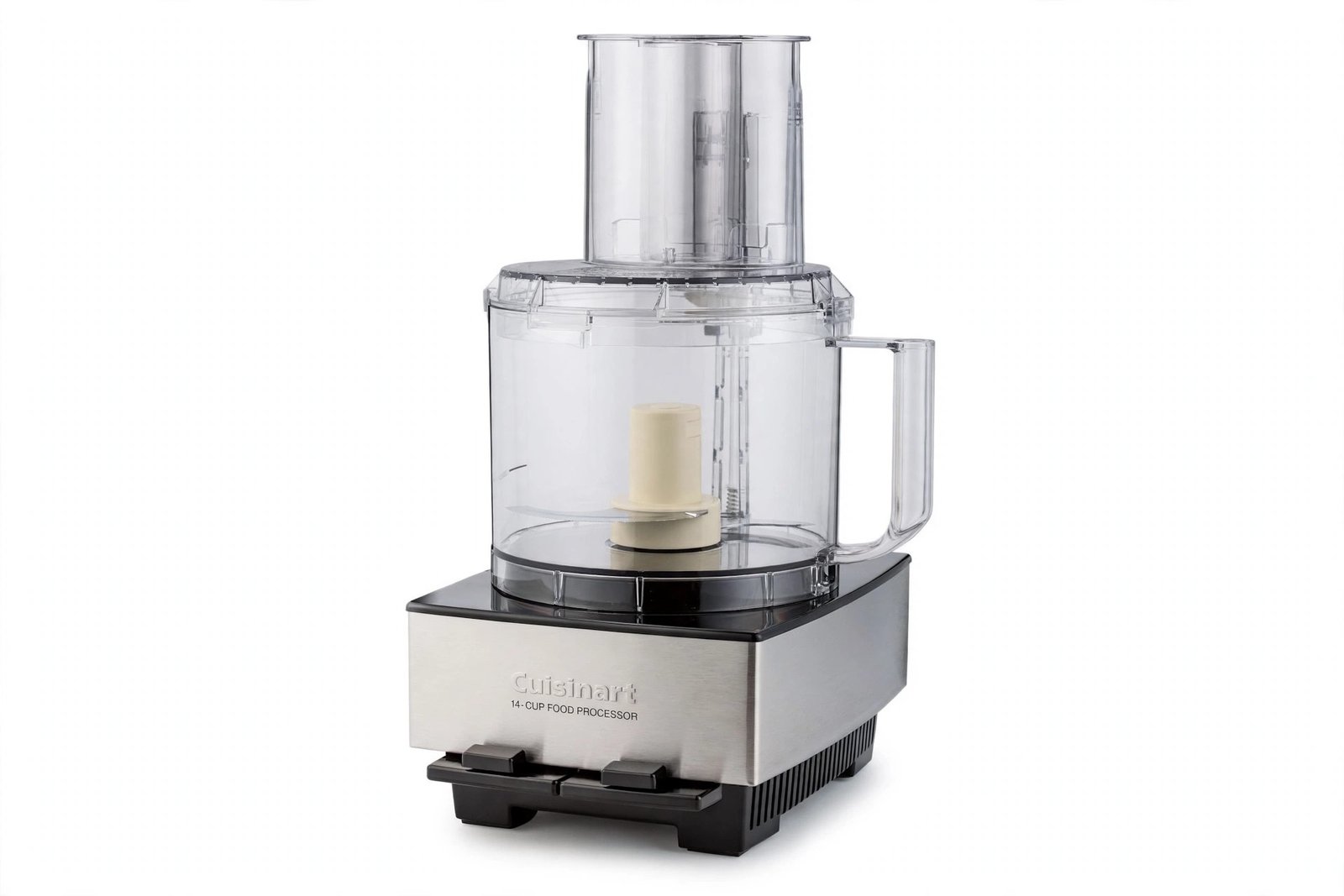
Cuisinart Custom 14-Cup Food Processor DFP-14BCNY (product-style image)
The Cuisinart Custom 14 is the best food processor for most home cooks, and the reason is simple: it is the machine every other machine is measured against. America’s Test Kitchen names it the winner in its food processor tests, Wirecutter has recommended it as its top pick since 2013, and Consumer Reports gives it the top shredding rating among the models it tested. That is not a one-year wonder. That is a machine that has beaten every newcomer for more than a decade, and it does it with the simplest controls on this list: two levers, on and off/pulse, and nothing to learn.
What makes this machine lead the list is the combination of capacity and honest power. The 720-watt motor is a continuous rated figure, not an inflated peak number, and it drives a 14-cup work bowl that handles a full batch of pie dough, a whole cabbage for slaw, or a double batch of salsa in one pass. The extra-large feed tube swallows whole potatoes and cucumbers, so you spend less time pre-cutting, and the box includes a 4mm slicing disc, a shredding disc, and a chopping and mixing blade. The base is heavy, around 18 pounds, which sounds like a drawback until the motor is running at full speed and the machine stays planted on the counter instead of walking across it. At around $250 it is not cheap, but it is half the price of the Breville below, and it comes with a limited 3-year warranty on the whole unit and a full 5-year motor warranty.
The honest trade-offs are real. First, the slicing disc is fixed at one thickness, so if you want paper-thin slices one day and thick-cut the next, you need to buy extra discs or buy the Breville. Second, the bowl holds 14 cups of dry food but only around 3 cups of liquid, so it is not the machine for large batches of soup, and the minimum-fill problem applies too: a tiny amount of pesto in a 14-cup bowl will smear around the sides instead of processing evenly. Third, it is big and heavy, so if you plan to lift it in and out of a cabinet every time you cook, you will stop using it. But for its job, which is everyday family cooking in volume, the Cuisinart is the most trustworthy machine on this list.
Why we like it
- 720-watt continuous motor powers through dense vegetables, cheese, and dough without straining
- 14-cup bowl handles family-size batches in one pass
- Extra-large feed tube takes whole fruits and vegetables with less pre-cutting
- America’s Test Kitchen winner and Wirecutter top pick since 2013, the strongest expert record here
- Simple two-lever controls, nothing to learn, and a 5-year motor warranty
Pros
- Best food processor for most home cooks, with the most proven record here
- Best pick for batch cooking, dough, and large families
- Heavy base stays planted during hard jobs like kneading
Cons
- Fixed slicing disc, only one thickness unless you buy extra discs
- Only around 3 cups of liquid capacity despite the 14-cup bowl
- Big and heavy at around 18 pounds, so it needs a permanent counter spot
Price: around $250 on Amazon
Best for: families, batch cooks, bakers who make dough, and anyone who wants one machine to last for years.
Who should skip it: cooks in small kitchens who need a lighter machine they can lift in and out of a cabinet, where the Ninja or the BLACK+DECKER below fits better, and cooks who want adjustable slicing thickness, where the Breville or the KitchenAid is the better buy.
2. Breville Sous Chef 16 Pro – Best Premium
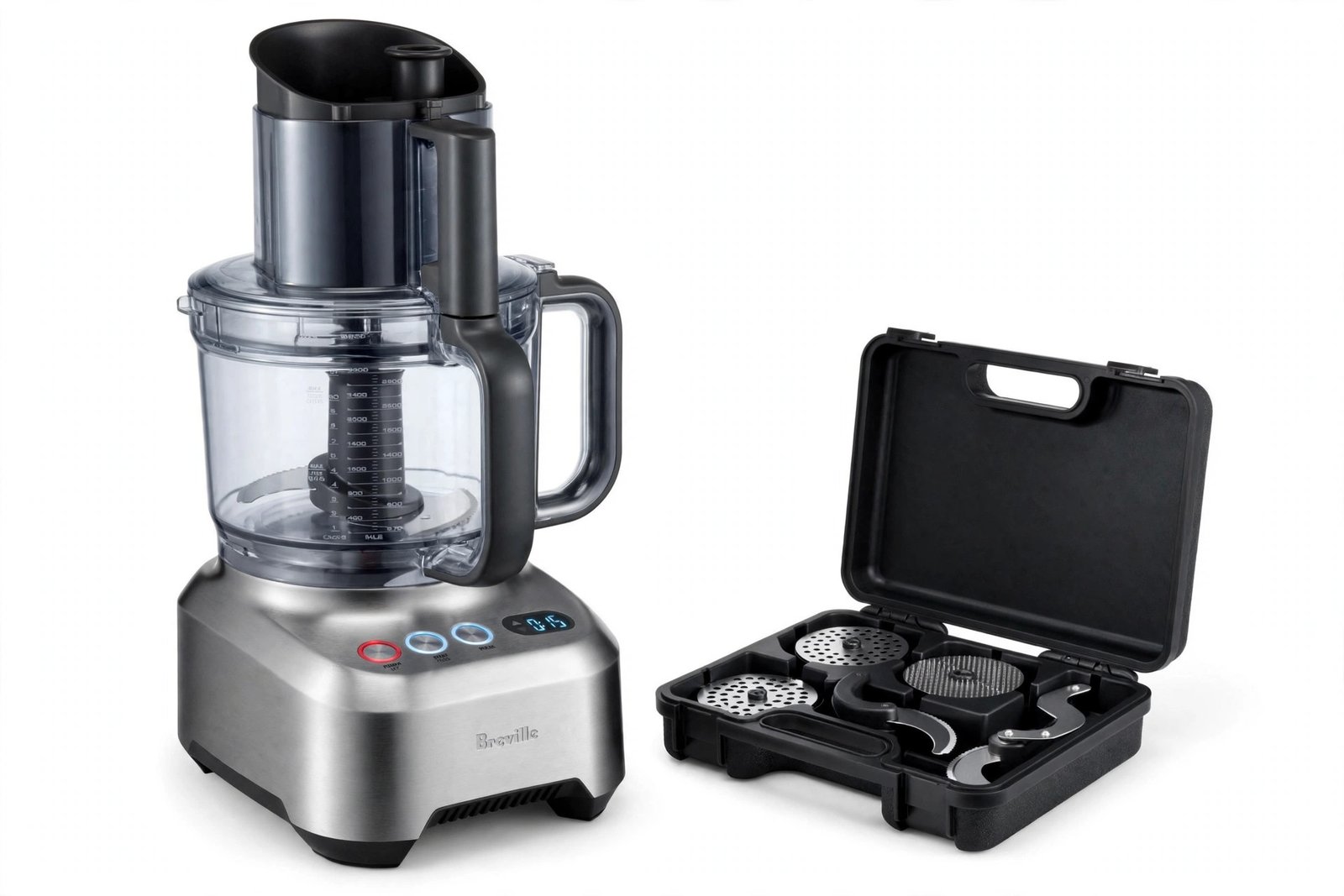
Breville Sous Chef 16 Pro Food Processor (product-style image)
The Breville Sous Chef 16 Pro is the most capable food processor you can buy for a home kitchen, and independent lab testing backs that up. TechGearLab scored it 83 out of 100 overall in its tests, the highest score in its lineup, with top marks for chopping and mixing, and the Good Housekeeping Institute gave it near-perfect scores across its tests, from evenly diced onions to uniformly sliced tomatoes. The 1200-watt direct-drive motor is the strongest here, the 16-cup bowl is the largest here, and the accessory box is the deepest here: five discs and three blades, including a julienne disc, a French fry disc, a whisking disc, and a reversible shredding disc.
What makes the Breville special is control. The slicing disc adjusts from 0.3mm to 8mm across 24 settings, so you can cut paper-thin potato chips one day and thick-cut vegetables the next without swapping a single part. The 5.5-inch feed chute takes whole carrots and cucumbers, the machine ships with both a 16-cup bowl and a 2.5-cup mini bowl for small jobs, and a digital timer counts down while you work. The direct-drive motor runs quietly for its power, around 67.5 decibels at three feet in TechGearLab testing, which is quieter than the budget machines here. It also comes with a 25-year motor guarantee, which tells you how long Breville expects this machine to last.
Now the honest problems, and there are three. First, the price: at around $400 it costs more than the Cuisinart and the KitchenAid combined, and for a cook who chops vegetables twice a week, that extra money buys capability you will never use. Second, the size and weight: it is around 18 inches tall and over 20 pounds with the bowl on, so it needs a permanent home on the counter and a cabinet that can actually hold the accessory box. Third, Breville has replaced this exact model with the newer Sous Chef 16 (BFP810), which has a 1450-watt motor and a new button interface at around the same price, so check which model you are buying before you pay. The Pro is still widely sold and still excellent, but the successor is the current model. Buy the Breville if you prep in volume every day and you will use the adjustable slicing and the mini bowl. Buy the Cuisinart if you will not.
Why we like it
- 1200-watt direct-drive motor, the strongest motor on this list
- 16-cup bowl plus a 2.5-cup mini bowl, so small jobs work as well as big ones
- Adjustable slicing disc with 24 thickness settings, from 0.3mm to 8mm
- Five discs and three blades in a dedicated storage case, including julienne and French fry discs
- 25-year motor guarantee, the longest motor cover here
Pros
- Best premium food processor, the most capable machine here
- Best pick for serious cooks, large families, and batch prep in volume
- Quietest powerful machine here, and the easiest to clean among the big bowls
Cons
- Around $400, more than the Cuisinart and KitchenAid combined
- Very large and heavy, needs a permanent counter spot and storage for the accessory case
- This exact Pro model is being replaced by the newer Sous Chef 16, so check the model number before buying
Price: around $400 on Amazon
Best for: serious home cooks, large families, and anyone who preps in volume and wants adjustable slicing and a mini bowl.
Who should skip it: casual cooks who chop a few vegetables a week, where the Cuisinart does the same core jobs for much less, and small kitchens where a 16-cup machine will not fit under the cabinets.
3. KitchenAid 13-Cup Food Processor KFP1318 – Best Value Full-Size
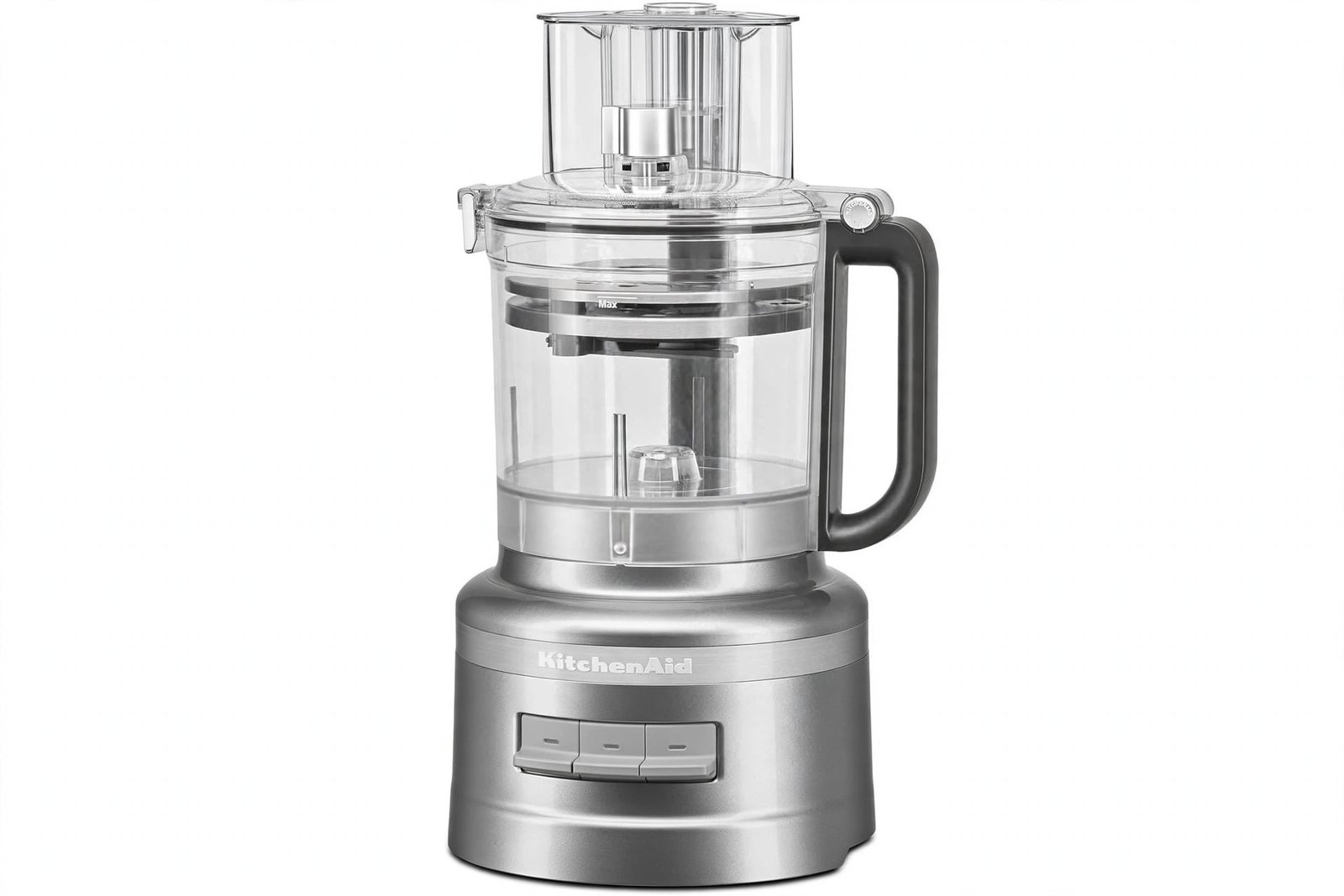
KitchenAid 13-Cup Food Processor KFP1318 (product-style image)
The KitchenAid 13-Cup is the smartest full-size food processor for the money, and it wins on the details that make a machine pleasant to live with rather than on raw power. It is the lightest full-size processor on this list at around 8.3 pounds, which matters more than it sounds like: a machine you can lift with one hand is a machine you will actually take out of the cabinet. It also has the best storage solution here. Every blade and disc nests into a storage caddy that sits inside the bowl, so the whole kit stores as one piece instead of a drawer full of sharp discs you can never find.
What makes the KitchenAid special is the ExactSlice system. A lever on the outside of the machine adjusts the slicing thickness without removing the lid or swapping discs, which is the kind of small convenience that saves real time when you are halfway through a recipe. The 3-in-1 feed tube takes whole vegetables without pre-cutting, the box includes a multipurpose blade, a dough blade, an adjustable slicing disc, and a reversible shredding disc, and the twist-free one-click bowl assembly snaps into place instead of needing the usual twist-and-lock wrestling match. Independent testing keeps surprising reviewers with this machine: its chopping and shredding scores in Consumer Reports testing rank among the top machines tested regardless of price, even though its motor is only around 500 watts. At around $180 it sits between the budget machines and the Cuisinart, and it comes in KitchenAid’s full range of colors, so it can match your stand mixer. If baking is your thing, our guide to the best stand mixers covers the machine that pairs with this one for serious baking days.
Now the honest limits. First, the motor: around 500 watts is the weakest full-size motor on this list, and while it handles vegetables, cheese, and light dough well, it will work harder and slower on stiff bread dough and big batches of nut butter than the Cuisinart or the Breville. Second, the bowl is 13 cups, which is generous, but the dough capacity is smaller than the bowl suggests: reviewers note it does not have the capacity to mix enough dough for a standard loaf in one go. Third, the fixed handle position can be awkward in tight cabinets, and the KFP1319 version with the dicing kit costs more, at around $240, so check which version you are buying. Buy the KitchenAid if you want a full-size machine that is light, tidy, and easy to store. Buy the Cuisinart if dough and heavy batches are your main jobs.
Why we like it
- In-bowl storage caddy keeps every blade and disc in one tidy place
- Externally adjustable ExactSlice lever changes slice thickness without swapping discs
- 3-in-1 feed tube takes whole vegetables with less pre-cutting
- Lightest full-size processor here at around 8.3 pounds, easy to lift and store
- Strong Consumer Reports chopping and shredding scores despite the smaller motor
Pros
- Best value full-size food processor, the smartest storage on this list
- Best pick for small kitchens and cooks who store the machine in a cabinet
- Available in KitchenAid colors to match your stand mixer
Cons
- Around 500 watts, the weakest full-size motor here, so stiff dough is slower work
- Dough capacity is smaller than the bowl size suggests, not enough for a standard loaf in one batch
- The dicing-kit version costs around $240, so the base model is the value pick, not the full kit
Price: around $180 on Amazon
Best for: cooks who want a full-size bowl without the weight, small kitchens, and anyone tired of losing discs in a drawer.
Who should skip it: bakers who knead stiff bread dough every week, where the Cuisinart or Breville is stronger, and cooks who want the biggest possible bowl, where the 14-cup Cuisinart or 16-cup Breville wins.
4. Ninja Professional Plus Food Processor BN601 – Best for Beginners
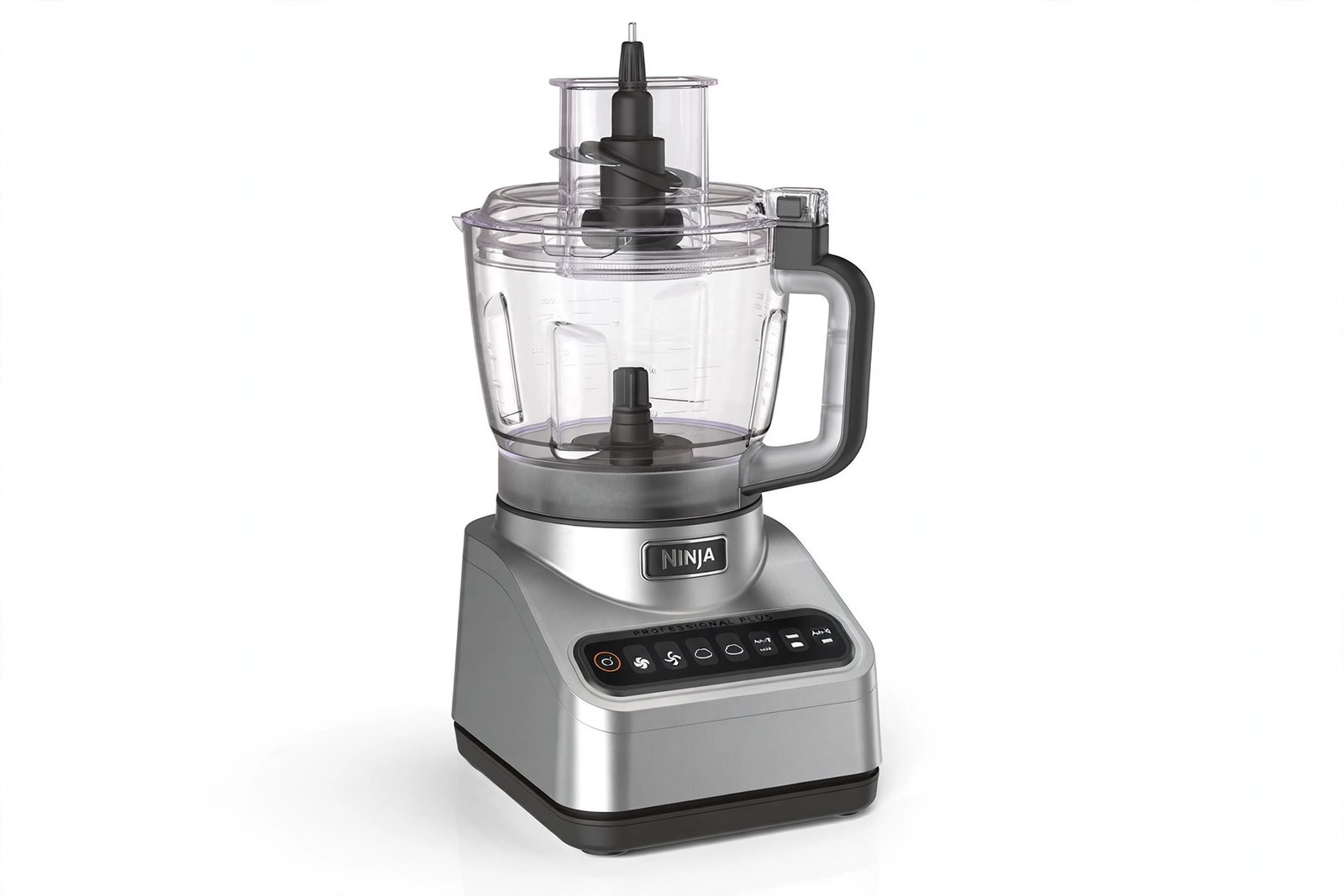
Ninja Professional Plus Food Processor BN601 (product-style image)
The Ninja Professional Plus is the best food processor for anyone who has never owned one, and the reason is the four buttons on the front. Auto-iQ gives you four preset programs, Chop, Slice, Puree, and Dough, and each one runs a timed pattern of pulsing and speed changes so you do not have to guess how long to hold the button or when to stop. Press Dough and the machine mixes up to 2 pounds of dough in 30 seconds. Press Chop and it stops before your onions turn to mush. For a first-time buyer, that is the difference between a machine you use every week and a machine that sits in a cabinet because you are never quite sure you are using it right.
What makes the Ninja a strong pick beyond the presets is the value. The 1000 peak watt motor (850 watts rated) is more powerful than the Hamilton Beach and the BLACK+DECKER below, the 9-cup bowl is big enough for family dinners and weekly meal prep, and the box includes a reversible slicing and shredding disc, a dough blade, and a 20-recipe guide to get you started. At around $129.99 it costs half the Cuisinart and a third of the Breville, yet it handles the same everyday jobs: chopping vegetables, shredding cheese, making salsa, pureeing sauces, and kneading pizza dough. All removable parts are BPA-free and dishwasher safe, and the machine only runs when it is fully assembled, which is a useful safety net in a busy kitchen. If your kitchen runs on quick weeknight meals, our guide to the best slow cookers covers the other set-and-forget machine that pairs well with a food processor.
Be honest about what it is not. First, the 9-cup bowl is a real step down from the 13 and 14-cup bowls above, so a full batch of coleslaw for a party or a double batch of dough will need two rounds. Second, the wattage number needs reading carefully: 1000 watts is the peak figure, and the rated power is 850 watts, which is still strong, but it is not the same as the Breville’s 1200-watt continuous motor. Third, the Ninja is a dedicated food processor only, with no blender jug or extra bowls in the box, so if you want a machine that also blends smoothies, the Ninja kitchen systems cost more and do more. Buy it if you want the easiest first food processor with real power. Buy the Cuisinart if you regularly cook for a crowd.
Why we like it
- 4 Auto-iQ preset programs (Chop, Slice, Puree, Dough) remove the guesswork for beginners
- 1000 peak watts with a dough blade that mixes up to 2 pounds of dough in 30 seconds
- 9-cup bowl is big enough for family meals and weekly meal prep
- Reversible slicing and shredding disc included, plus a 20-recipe guide
- Around $129.99, half the price of the Cuisinart for the same everyday jobs
Pros
- Best food processor for beginners, the easiest machine here to use well on day one
- Best pick for first-time buyers and weeknight cooks
- Strong power for the price, with dishwasher-safe parts
Cons
- 9-cup bowl is smaller than the full-size machines above, so big batches need two rounds
- 1000 watts is a peak figure, with 850 watts rated, so it is not as strong as the headline number suggests
- Food processor only, with no blender jug or extra bowls in the box
Price: around $129.99 on Amazon
Best for: first-time food processor buyers, beginners who want presets, and weeknight cooks who want power without a premium price.
Who should skip it: cooks who regularly prep for a crowd, where the 14-cup Cuisinart is the better buy, and bakers who knead large batches of stiff dough, where the Breville is stronger.
5. Hamilton Beach 10-Cup Food Processor 70730 – Best Budget
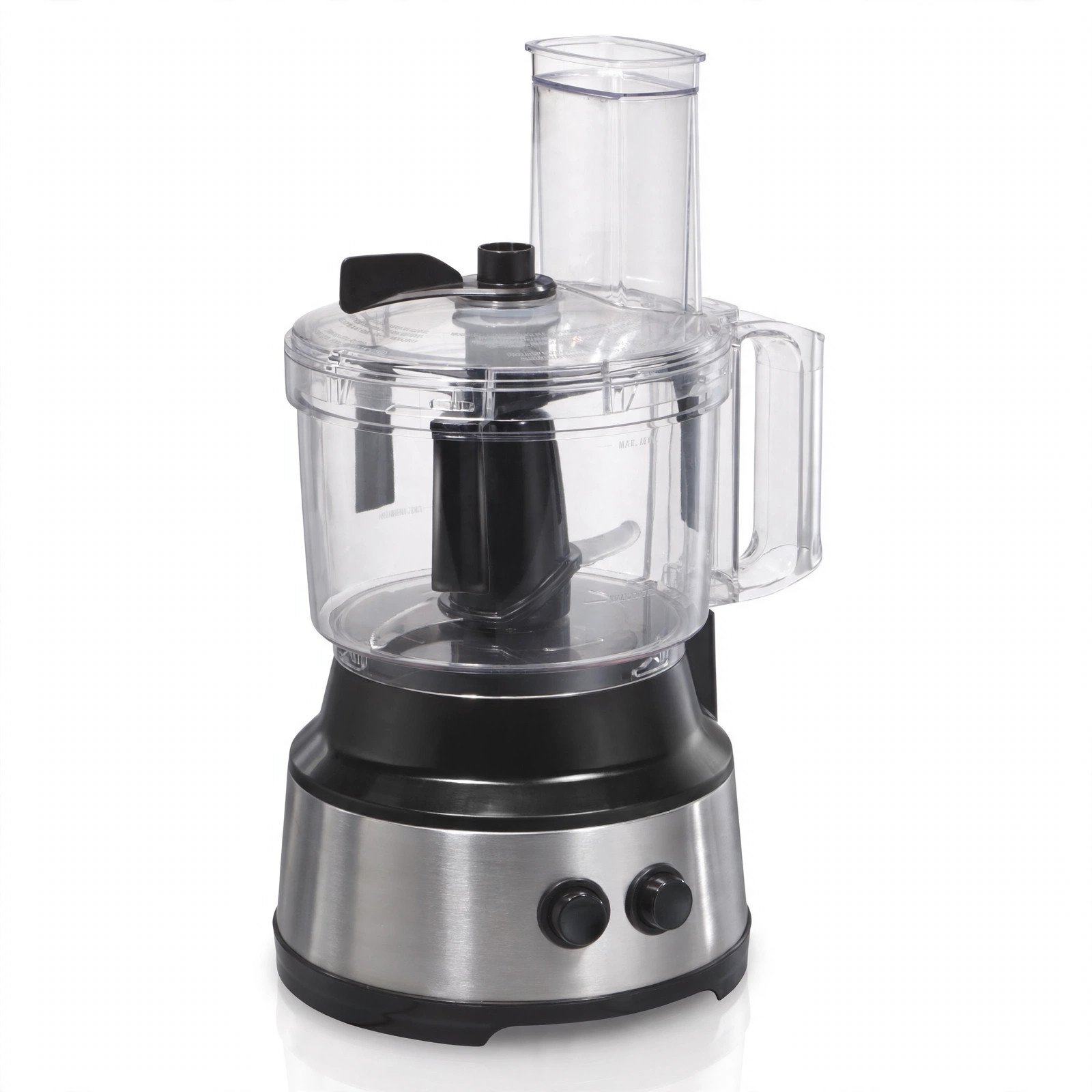
Hamilton Beach 10-Cup Food Processor 70730 (product-style image)
The Hamilton Beach 10-Cup is the best budget food processor, and it is the proof that you do not need to spend $200 to get a real machine. At around $50 it costs a fifth of the Cuisinart, yet it gives you a full-size 10-cup bowl, a reversible stainless slicing and shredding disc, a chopping blade, two speeds plus pulse, and a large feed chute. It also has the one feature no other machine on this list has: a built-in bowl scraper. A lever on the lid sweeps the bowl wall while the motor runs, so you never have to stop the machine, open the lid, and scrape the sides down with a spatula. Anyone who has made hummus in a processor without a scraper knows how much time that saves.
What makes the Hamilton Beach a genuine recommendation rather than a cheap compromise is the owner record. It has more than 41,000 owner reviews on Amazon, the deepest review record of any machine in this guide, and TechGearLab named it the best food processor on a tight budget after testing it against machines costing five times as much. The 450-watt motor handles vegetables, hard cheese, and salsa without complaint, the suction-cup feet keep it steady on the counter, and all removable parts are dishwasher safe. For a cook who wants to chop, slice, shred, and puree on a budget, this is the machine that does the job for the least money. If you are building out a budget kitchen, our guide to the best air fryers covers another appliance that earns its counter space without a premium price.
Now the honest limits, and they matter. First, the motor: 450 watts is the joint-weakest here, and it is not built for stiff bread dough or long runs of nut butter, and there is no dough blade in the box, so do not buy this machine for baking. Second, it is loud: TechGearLab measured it at 96 decibels at three feet, the loudest machine in its tests, so early-morning prep will wake the house. Third, the bowl is 10 cups, which is generous for the price, but the machine is light, so it can shift on the counter during hard jobs despite the suction feet. Buy it for everyday chopping, slicing, and shredding on a budget, and it is the best $50 you will spend in the kitchen. Buy it for dough, and you will be disappointed.
Why we like it
- Built-in bowl scraper works while the motor runs, so no stopping to scrape the sides
- 10-cup bowl, a full-size capacity at a budget price
- More than 41,000 owner reviews on Amazon, the deepest review record here
- Reversible stainless slicing and shredding disc included
- Around $50, a fifth of the price of the Cuisinart
Pros
- Best budget food processor, the cheapest full-size machine worth buying
- Best pick for students, first apartments, and anyone testing whether they will use a food processor
- Bowl scraper is genuinely useful and unique on this list
Cons
- 450 watts and no dough blade, so it is not built for stiff bread dough or nut butter
- Loudest machine here at 96 decibels in lab testing
- Light base can shift on the counter during hard jobs
Price: around $50 on Amazon
Best for: budget buyers, first apartments, and cooks who mostly chop, slice, shred, and make salsa and dips.
Who should skip it: bakers who knead dough, where the Ninja or Cuisinart is the better buy, and light sleepers, where the quieter Cuisinart or Breville is worth the extra money.
6. BLACK+DECKER 8-Cup Food Processor FP1600B – Best Compact
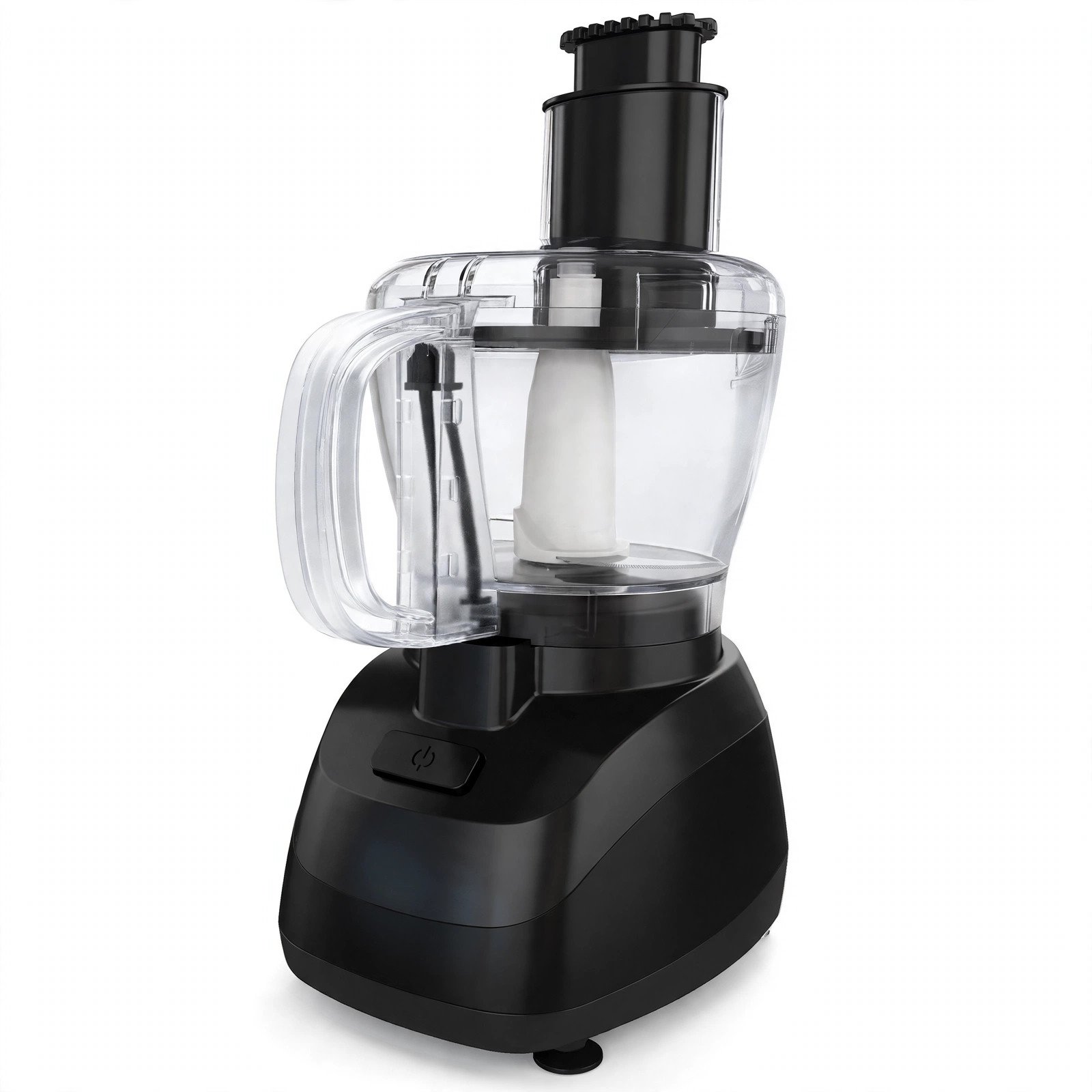
BLACK+DECKER 8-Cup Food Processor FP1600B (product-style image)
The BLACK+DECKER 8-Cup is the cheapest honest way into a real food processor, and for a small kitchen it is the most sensible pick on this list. At around $47 it gives you an 8-cup bowl, a 450-watt motor, a stainless steel chopping blade, and a reversible slicing and shredding disc, which is the same core toolkit as machines costing twice as much. It weighs only around 5.3 pounds, so it lifts in and out of a cabinet with one hand, and the controls could not be simpler: on, off, and pulse. There is nothing to learn, nothing to set up, and nothing to go wrong.
What makes this machine worth recommending is that it does the everyday jobs well. Independent testing found it slices carrots and potatoes cleanly, grates a block of cheddar in seconds, and mixes cookie dough with the chopping blade, and owners consistently praise it for chopping vegetables, shredding cheese, slicing onions, and making salsa and chunkier dips. The safety interlock stops the motor unless the bowl and lid are properly locked, all removable parts go in the dishwasher, and the 2-year limited warranty is decent for the price. For a cook who lives alone or cooks for two, an 8-cup bowl holds a full dinner’s worth of ingredients without working in batches, and the machine takes up less counter space than any other full-size processor here. If fresh juice is part of your morning routine, our guide to the best juicers covers the machine that pairs with this one for a complete prep setup.
Be very clear about the limits. First, the motor: 450 watts struggles with very hard items like whole nuts, and the purees come out coarser than the premium machines here, with unprocessed pieces left in hummus and smooth dips. Second, there is only one speed, so you cannot dial the power down for delicate jobs, and the feed chute is small, which means quartering a potato before it will fit. Third, the plastic housing feels less durable than the Hamilton Beach or the Ninja, and the suction-cup feet did not hold well in testing, so the machine can move on the counter. Buy it for light chopping in a small kitchen on a tight budget, and it is excellent value. Buy it for heavy daily prep, and spend the extra $3 on the Hamilton Beach instead.
Why we like it
- 8-cup bowl is big enough for one or two cooks, small enough to store easily
- Lightest machine here at around 5.3 pounds, easy to lift in and out of a cabinet
- Simplest controls on this list: on, off, and pulse, nothing to learn
- Stainless steel chopping blade and reversible slicing and shredding disc included
- Around $47, the cheapest full-size food processor worth buying
Pros
- Best compact food processor, the smallest footprint here
- Best pick for small kitchens, single cooks, and couples
- Cheapest machine on this list, with dishwasher-safe parts and a 2-year warranty
Cons
- Coarsest purees here, with unprocessed pieces left in hummus and smooth dips
- Only one speed and a small feed chute, so large items need pre-cutting
- Light plastic housing and suction feet that do not always hold
Price: around $47 on Amazon
Best for: small kitchens, single cooks and couples, and anyone who wants the cheapest real food processor that still does the job.
Who should skip it: cooks who make smooth hummus and dips every week, where the Ninja or Cuisinart is smoother, and families, where the 10-cup Hamilton Beach or the 14-cup Cuisinart is the better buy.
Food Processor Comparison Table
| Food Processor | Best For | Bowl and Motor | Key Feature | Around Price |
|---|---|---|---|---|
| Cuisinart Custom 14-Cup DFP-14BCNY | Most cooks, best overall | 14 cups, 720W | ATK winner, 5-year motor warranty | ~$250 |
| Breville Sous Chef 16 Pro | Premium, large batches | 16 cups plus 2.5-cup mini, 1200W | Adjustable slicing, 24 settings | ~$400 |
| KitchenAid 13-Cup KFP1318 | Best value full-size | 13 cups, around 500W | In-bowl storage caddy, ExactSlice lever | ~$180 |
| Ninja Professional Plus BN601 | Beginners, presets | 9 cups, 1000W peak | 4 Auto-iQ presets including dough | ~$129.99 |
| Hamilton Beach 10-Cup 70730 | Best budget | 10 cups, 450W | Built-in bowl scraper | ~$50 |
| BLACK+DECKER 8-Cup FP1600B | Best compact | 8 cups, 450W | Lightest machine here, 5.3 lb | ~$47 |
Is a Food Processor Actually Worth It? The Honest Answer
Yes, but only if you cook with fresh ingredients more than twice a week. A food processor earns its keep by turning the boring, repetitive part of cooking into a ten-second job: chopping onions, shredding cheese, slicing vegetables, making dough. If you cook most nights and you chop vegetables most nights, it will save you hours every month, and it will make you more likely to cook at home instead of ordering in. If you mostly reheat ready meals and chop an onion once a fortnight, it will sit in a cabinet, and a sharp knife and a cutting board are the better buy.
The second honest point is that a food processor does not replace your knife, your blender, or your mixer. It replaces the repetitive prep work in between. You will still need a knife for trimming meat and cutting a tomato for a sandwich. You will still need a blender for smoothies and soups, because a food processor bowl only holds around 3 cups of liquid even when the bowl is rated at 14 cups. And you will still need a stand mixer if you bake bread every week, because even the best food processor kneads a smaller batch than a mixer. The Spruce Eats tested food processors and blenders side by side and found the same split: a processor wins at chopping, slicing, and shredding, while a blender wins at liquids and smooth textures. Buy the machine for the job it is built for, and it will never disappoint you.
The third point is size, and it is the mistake most buyers make. A bowl that is too small forces you into batches, which kills the time saving. A bowl that is too big leaves small amounts smeared around the sides where the blade cannot reach them. The rule that works for most kitchens is simple: one or two cooks, 7 to 9 cups; a family of three or four, 11 to 13 cups; batch cooking and entertaining, 14 to 16 cups. The Breville solves the small-batch problem with its 2.5-cup mini bowl, which is one reason it costs what it does, and the other machines solve it by being honest about their size: the Ninja at 9 cups is right for a couple, and the Cuisinart at 14 cups is right for a family.
One warning that cannot be repeated often enough: never put hot liquid in a food processor, and never fill the bowl past the liquid line. Hot soup in a sealed processor bowl builds pressure, and a bowl filled to the rim will leak from the lid and the center column. Let soup cool first, work in batches, and keep the bowl below the liquid mark. And never run the machine with the lid off or reach into the bowl while the blade is moving, because the blade is sharp enough to cut through a carrot in a second, and it will not stop for a finger.
Buying Guide: How to Choose the Right Food Processor
A food processor looks simple on the shelf, but the wrong one is too small for your family, too weak for dough, or too loud for your mornings. Match the bowl to your household first, then the motor to your hardest job, then think about storage and cleanup, because those three answers decide everything else.
1. Start with the bowl size, not the brand
Bowl size is the first decision because it decides whether the machine saves you time or wastes it. A 7 to 9-cup bowl suits one or two cooks and handles salsa, dips, pesto, and a week of hummus in one go. An 11 to 13-cup bowl suits a family of three or four and handles pastry, slaw, and a double batch of biscuit crumbs. A 14 to 16-cup bowl suits batch cooking and entertaining, and it kneads dough and slices for freezing without splitting batches. Remember that the cup rating is measured to the rim, so the usable capacity is roughly 80 percent of the listed figure, and the liquid capacity is far smaller, usually around 3 cups even in a 14-cup bowl. If you cook for two most nights and freeze occasionally, an 11-cup machine and a second batch will serve you better than a 16-cup machine that dwarfs your counter.
2. Match the motor to your hardest job
Watts are the most misunderstood number on the box, because some brands quote peak watts and others quote continuous watts, and the two are not the same. As a rough guide, 450 to 500 watts handles vegetables, cheese, and light chopping. Around 700 watts handles dough and continuous shredding without stalling. Around 1000 watts and above handles stiff bread dough, hard cheese, and long runs of nut butter. The Cuisinart’s 720 watts is a continuous rating, which is more honest than the Ninja’s 1000 peak watts, and the Breville’s 1200 watts is a continuous direct-drive rating, which is why it costs what it does. If dough is your main job, buy 700 watts or more and check that a dough blade is in the box. If you only chop vegetables and make salsa, 450 watts is plenty, and the Hamilton Beach proves it.
3. Check the feed tube before you buy
The feed tube decides how much pre-cutting you have to do, and pre-cutting is the hidden time cost of a food processor. A wide tube, around 5.5 inches on the Breville, takes whole carrots, cucumbers, and potatoes. A 3-in-1 tube, like the KitchenAid’s, takes different sizes without forcing you to cut everything to the same shape. A narrow tube, like the BLACK+DECKER’s, means quartering a potato before it fits, which eats into the time you were trying to save. Check the tube width in the specifications before you buy, because it matters more than a third extra disc you will never use.
4. Count the discs, then count the storage
Every machine here comes with a chopping blade and at least one slicing and shredding disc, and that covers 90 percent of everyday cooking. Extra discs only help if you will actually use them: an adjustable slicing disc is worth paying for, because it replaces a whole set of fixed discs, while a julienne disc is only worth it if you make julienne vegetables more than once a month. The harder question is where the discs live. The KitchenAid wins here, because every accessory nests into a caddy inside the bowl. The Breville wins second, because it ships with a dedicated storage case. The Cuisinart loses here, because its discs live wherever you put them, which usually means a drawer you will not open. Buy the machine whose accessories you can actually find when you need them.
5. Think about cleanup before you fall in love
A food processor you dread cleaning is a food processor you will stop using. Check three things: are the bowl, lid, and blades dishwasher safe, does the bowl have a smooth interior with no corners that trap food, and does the base wipe clean without food getting into the buttons. All six machines here have dishwasher-safe removable parts, but the Ninja’s simple button layout and the Breville’s smooth base wipe cleaner than the Hamilton Beach’s lever and seams. The bowl scraper on the Hamilton Beach also saves cleanup time, because it keeps food in the blade’s path instead of smeared up the sides. If you hate washing up, pick the machine with the fewest parts and the smoothest bowl.
6. Measure your counter and your cabinets
Large food processors are typically 15 to 17 inches tall with the feed tube attached, so a cabinet gap of 15 inches will not fit a 16-cup Breville, and a 14-cup Cuisinart at around 18 pounds is not a machine you will lift in and out of a cabinet every day. Measure the height under your cabinets, the depth of your counter, and the shelf where you plan to store the accessory box before you order. The lightest machine here, the BLACK+DECKER at 5.3 pounds, is the one you can lift with one hand. The heaviest, the Breville at over 20 pounds, is the one that needs a permanent home. A machine that lives on the counter gets used. A machine that lives in a high cabinet gets forgotten.
7. Check the warranty, because it tells you what the maker believes
Warranties are the most honest signal in the whole category. Breville guarantees the Sous Chef motor for 25 years, which is a maker betting its reputation that the motor will last. Cuisinart gives 5 years on the motor and 3 years on the whole unit, which is a solid, serious promise. BLACK+DECKER gives 2 years, and Hamilton Beach gives 1 year, which is honest for the price but tells you these are machines built to a budget, not machines built to be inherited. A long warranty does not make a machine better, but a maker that guarantees a motor for 25 years is telling you something about how that motor is built.

Frequently Asked Questions
What size food processor do I need?
It depends on how many people you cook for. One or two cooks can manage with a 7 to 9-cup bowl, which handles salsa, dips, pesto, and a week of hummus in one go. A family of three or four should look at 11 to 13 cups, which handles pastry, slaw, and a double batch of crumbs. Batch cooks and entertainers need 14 to 16 cups, which kneads dough and slices for freezing without splitting batches. Remember that the cup rating is measured to the rim, so the usable capacity is roughly 80 percent of the listed figure, and the liquid capacity is far smaller, usually around 3 cups even in a 14-cup bowl.
How many watts should a food processor have?
Match the watts to your hardest job. Around 450 to 500 watts is enough for vegetables, cheese, and light chopping, which is why the Hamilton Beach and the BLACK+DECKER work fine for everyday prep. Around 700 watts is the level where dough and continuous shredding stop stalling the motor. Around 1000 watts and above is for stiff bread dough, hard cheese, and long runs of nut butter. Read the number carefully, because some brands quote peak watts and others quote continuous watts: the Ninja’s 1000 watts is a peak figure with 850 watts rated, while the Breville’s 1200 watts is a continuous direct-drive rating. TechGearLab’s lab testing of the Breville Sous Chef 16 Pro shows what that continuous power buys you: top scores for chopping and mixing, and a motor that never bogged down in its tests.
Can a food processor make dough?
Yes, if it has a dough blade and a strong enough motor. The Cuisinart, Breville, KitchenAid, and Ninja on this list all include a dough blade, and they knead pizza dough, pie dough, and bread dough in a minute or two. The Hamilton Beach and the BLACK+DECKER do not include a dough blade, and their 450-watt motors are not built for stiff bread dough, so do not buy them for baking. Two tips: use the dough blade, not the sharp chopping blade, because the chopping blade cuts the gluten strands instead of stretching them, and do not overfill the bowl, because dough needs room to turn. A 14-cup bowl kneads a bigger batch than a 9-cup bowl, so match the bowl to the size of the batch you bake.
What is the difference between a food processor and a blender?
A food processor is built for solid food and a blender is built for liquids. A processor has a wide flat bowl and interchangeable blades and discs that chop, slice, shred, and knead, while a blender has a tall narrow jar and a blade that pulls food down into a vortex for soups, smoothies, and sauces. A processor slices a potato into even rounds and shreds a block of cheddar in ten seconds. A blender makes a smoother smoothie and a smoother soup. You can make hummus in both, but the processor gives you a chunkier, more textured result and the blender gives you a silkier one. Most kitchens that cook from scratch end up owning both, and each one earns its keep at a different job.
Can you put food processor parts in the dishwasher?
Yes, for all six machines on this list: the bowl, lid, blades, and discs are dishwasher safe, usually on the top rack. The motor base must never go in water, so wipe it with a damp cloth instead. Two practical tips: rinse the blade straight after use, because dried-on food is far harder to clean than fresh food, and be careful handling the blade when you load the dishwasher, because it is sharp enough to cut through a carrot in a second. If your machine has a bowl scraper, like the Hamilton Beach, rinse it too, because food collects under the scraper arm.
What can you not put in a food processor?
Do not put hot liquid in a food processor, because hot soup in a sealed bowl builds pressure and can force the lid off. Do not put bones, frozen meat, whole ice cubes, or very hard items like whole nutmeg in a home processor, because they can chip the blade or stall the motor. Do not put coffee beans in it if you want a decent grind, because a processor chops unevenly and a grinder does the job properly. Do not overfill the bowl past the liquid line, and do not process very small amounts in a very large bowl, because the blade cannot reach a thin smear of food. And never put your fingers in the bowl while the blade is moving, even to push food down: use the pusher that comes with the machine.
Is an expensive food processor worth it?
It depends on how often you cook and what you cook. If you prep vegetables, make dough, and shred cheese most days, a $250 Cuisinart or a $400 Breville pays for itself in time saved and in years of service, and the long warranties tell you the makers expect them to last. If you chop an onion twice a week and make salsa at the weekend, a $50 Hamilton Beach does the same core jobs and leaves $200 in your pocket. TechGearLab tested the Hamilton Beach 10-Cup against machines costing five times as much and named it the best food processor on a tight budget, which shows how close the budget machines have come. The honest rule is simple: buy the cheapest machine that does your hardest job well, and spend more only when the extra capacity, power, or slicing control matches a job you actually do.
Our Verdict: Which Food Processor Should You Buy?
If you want one food processor that does the most for the most cooks, get the Cuisinart Custom 14-Cup DFP-14BCNY. It is the most proven machine here, with a decade of expert wins behind it, a 720-watt motor that handles dough and big batches, and a 14-cup bowl that cooks for a family in one pass. At around $250 it costs less than a month of takeaways, and it will still be on your counter in ten years.
If you want the best machine money can buy, get the Breville Sous Chef 16 Pro, because its 1200-watt motor, adjustable slicing disc, and mini bowl make it the most capable processor here, and the 25-year motor guarantee tells you Breville expects it to last. If you want the smartest storage and the lightest big bowl, get the KitchenAid 13-Cup KFP1318, with its in-bowl caddy and ExactSlice lever, for around $180. If you are buying your first food processor and you want it to be easy, get the Ninja Professional Plus BN601, because its four Auto-iQ presets take the guesswork out of every job for around $129.99. If you want the best budget machine, get the Hamilton Beach 10-Cup 70730, the only processor here with a built-in bowl scraper, for around $50. And if you want the cheapest honest machine for a small kitchen, get the BLACK+DECKER 8-Cup FP1600B for around $47.
Whatever you choose, remember the simple rule: match the bowl to your household, match the motor to your hardest job, and measure your counter before you order. A food processor that fits your kitchen and your cooking will save you hours every month. Start today, and your next dinner prep might take ten minutes instead of forty.
Was this guide helpful? Share it with a fellow home cook who is still chopping everything by hand. And if you try one of these food processors, come back and tell us how it handled your cooking – your experience helps other cooks choose with confidence.