
Affiliate Disclosure: Buyiox is reader-supported. When you buy through links on this page, we may earn a small commission at no extra cost to you. We only recommend products we would buy for our own kitchens.
You bought the juicer with the best intentions. Fresh orange juice every morning, green juice after the gym, a glass of carrot and ginger before work. Then reality arrived. The machine clogged on the second carrot, the pulp came out soaking wet, the cleanup took longer than the juicing, and the whole thing ended up at the back of a cupboard. If that sounds familiar, the juicer was not the problem. The choice was.
A good juicer is the one you will actually use on a Tuesday morning, and that comes down to three things: it squeezes real juice out of the produce you buy, it does not clog or jam, and it cleans up in minutes. The six best juicers below cover every kind of buyer, from a first-timer who wants fast juice for under $100 to a daily juicer who wants a hands-free cold press machine that pays for itself in produce. Every price and spec here comes from the maker’s own listing or a current retailer page, and every weakness is stated plainly, including the premium pick that costs four times the budget pick and the cheap pick that cannot handle leafy greens.
One honest note before you buy: juice is not a replacement for eating whole fruit and vegetables. Juicing strips out most of the fiber, so a glass of juice should sit on top of a healthy diet, not replace it. Harvard Health recommends aiming for a glass that is about 80 percent vegetables and 20 percent fruit, which keeps the sugar down and the nutrients up. With that rule in mind, a good juicer is one of the easiest ways to get more vegetables into your day, and the right machine makes it a habit instead of a chore.
Our Top 6 Juicers at a Glance
- Breville Juice Fountain Plus JE98XL – Best overall centrifugal, fast and simple for beginners
- Ninja NeverClog Cold Press Juicer JC151 – Best budget cold press, real slow juicing for around $120
- Hurom H320 Slow Juicer – Best premium, hands-free batch juicing for families
- Omega NC900HDC Juicer – Best for leafy greens and wheatgrass, plus nut butter and pasta
- Hamilton Beach Big Mouth Juice Extractor 67601A – Best cheap centrifugal, whole fruit in seconds for around $75
- Cuisinart Juice Extractor CJE-1000 – Best 5-speed centrifugal, the most control for big batches
Best Juicer Comparison Table
| Juicer | Type | Best For | Key Specs | Around Price |
|---|---|---|---|---|
| Breville Juice Fountain Plus JE98XL | Centrifugal | Beginners, fast morning juice | 850W, 2 speeds, 3-inch chute | ~$150 |
| Ninja NeverClog JC151 | Cold press | Budget cold press, celery and greens | 150W, 2 pulp filters, 24 oz jug | ~$120-130 |
| Hurom H320 | Cold press | Families, hands-free batch juicing | 150W, 50 RPM, 2L self-feeding hopper | ~$479-599 |
| Omega NC900HDC | Masticating | Leafy greens, wheatgrass, versatility | 80 RPM, 150W, 15-year warranty | ~$300-380 |
| Hamilton Beach Big Mouth 67601A | Centrifugal | Cheapest way to start juicing | 800W, 3-inch chute, 80 oz pulp bin | ~$75 |
| Cuisinart CJE-1000 | Centrifugal | Big batches, speed control | 1000W, 5 speeds, 3-inch feed tube | ~$180-230 |
1. Breville Juice Fountain Plus JE98XL – Best Overall Centrifugal
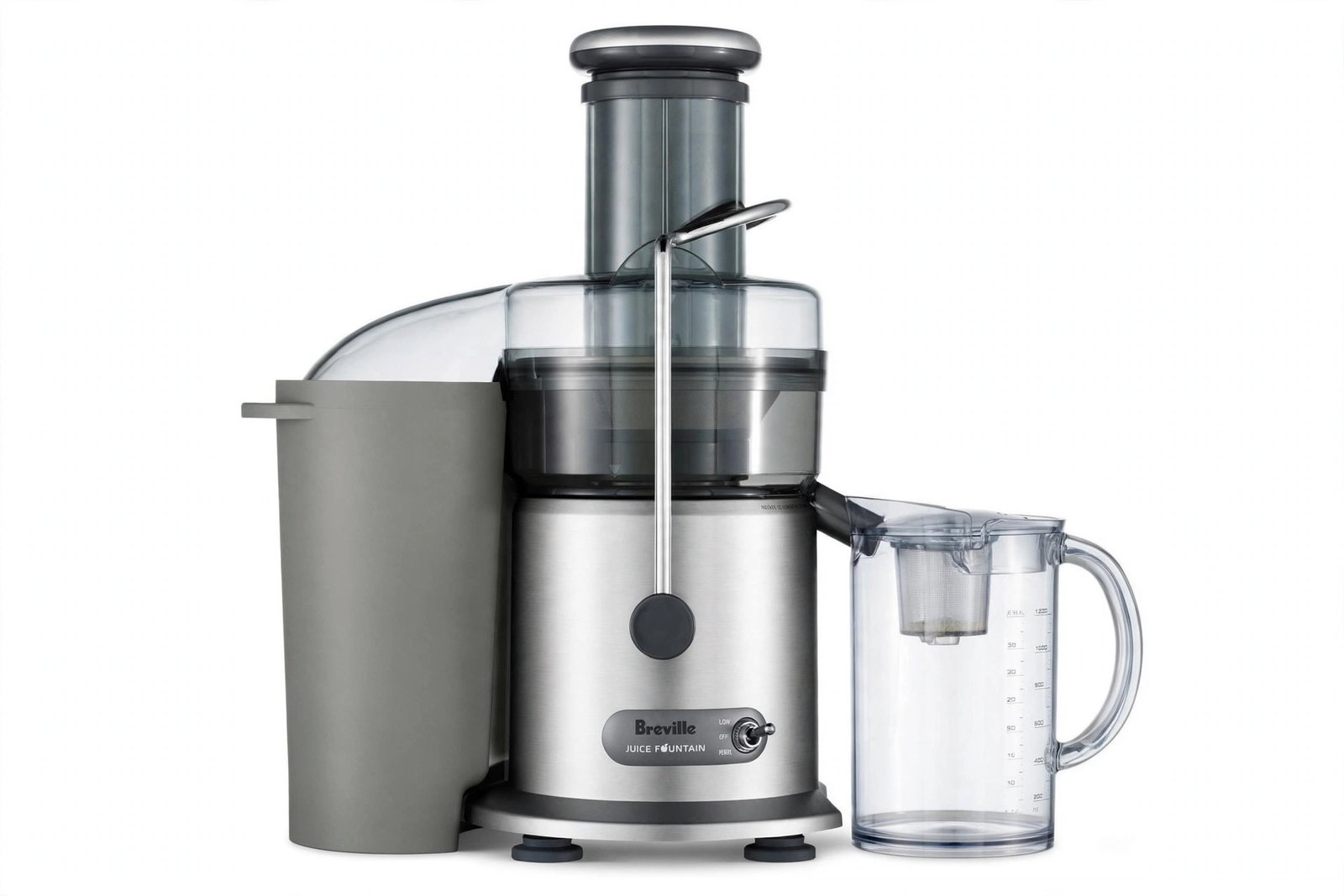
Breville Juice Fountain Plus JE98XL (product-style image)
If you want fresh juice in under a minute with almost no learning curve, this is the machine to buy. The Breville Juice Fountain Plus JE98XL is a centrifugal juicer, which means a fast-spinning steel basket shreds the produce and flings the juice out through a fine mesh. Its 850-watt motor runs at two speeds, 6,500 RPM for soft fruit like melon and berries, and 12,000 RPM for hard produce like apples, carrots, and beets. Breville says it can make an 8-ounce glass of juice in about 5 seconds, and while your morning will not be quite that fast once you count the washing and chopping, it is still the quickest juicer on this list by a wide margin.
The feature that matters most is the 3-inch extra-wide feed chute. A whole apple, a peeled orange, or a small handful of carrots goes straight in with little or no cutting, which is where most of the time saving comes from. The juice jug holds 35.2 fl oz and has a froth separator, so you can pour a smooth glass without the foam, and the pulp container holds 2.6 quarts, so you can juice for the whole family before emptying it. The parts that touch food are dishwasher-safe, the cord wraps under the base for storage, and the whole machine weighs about 10 pounds, which is heavy enough to stay put on the counter but light enough to lift into a cupboard.
The honest trade-offs are the ones every centrifugal juicer shares. It is loud, much louder than any cold press machine here, so early-morning juicing will wake the house. It is weaker on leafy greens than the slow juicers: kale and spinach give up far less juice in a centrifugal basket, and the pulp comes out wetter, which means you are throwing away juice you paid for. And the warranty is only 1 year, which is short next to the 15-year warranty on the Omega and the long warranties on the premium cold press machines. But for apples, carrots, oranges, and beets a few times a week, the Breville is fast, simple, and fairly priced at around $150, and it is the juicer most first-time buyers should start with.
Why we like it
- 850-watt dual-speed motor, 6,500 RPM for soft fruit and 12,000 RPM for hard produce
- 3-inch extra-wide chute takes whole apples with little or no cutting
- 35.2 fl oz jug with froth separator and a large 2.6-quart pulp container
- An 8-ounce glass in about 5 seconds, the fastest juicer on this list
- Around $150, the cheapest Breville juicer and a fair price for the speed
Pros
- Best centrifugal juicer for beginners, fast and almost no learning curve
- Whole fruit goes straight in, so prep time is close to zero
- Dishwasher-safe parts and a jug that pours without the foam
Cons
- Loud, much noisier than any cold press juicer here
- Weak on leafy greens, with wetter pulp and lower yield from kale and spinach
- Only a 1-year limited warranty, short next to the slow juicers
Price: around $150 on Amazon
Best for: first-time juicers, busy mornings, and anyone who mostly juices apples, carrots, oranges, and beets.
Who should skip it: daily green juice drinkers and celery juicers, where the Ninja or the Omega will squeeze far more from every bunch.
2. Ninja NeverClog Cold Press Juicer JC151 – Best Budget Cold Press

Ninja NeverClog Cold Press Juicer JC151 (product-style image)
The Ninja NeverClog JC151 is the most important juicer on this list, because it does something that used to cost twice as much: real cold press juicing for around $120. A slow auger crushes the produce at low speed and presses it through a strainer, which squeezes more juice out of celery, kale, and ginger than any centrifugal machine can, and leaves the pulp noticeably drier. The 150-watt high-torque motor is built to power through tough, fibrous produce without clogging, and a one-touch reverse button clears stubborn fibers the moment they jam. It is the cheapest way to find out whether cold press juicing is for you, and for many buyers it is the only juicer they will ever need.
The feature that gives it its name is Total Pulp Control. Two interchangeable pulp filters let you choose less pulp or lots of pulp, so the same machine makes a smooth glass for one person and a thick, fiber-rich glass for another. The juice jug holds 24 ounces and the pulp container holds 36 ounces, which is enough for a couple of large glasses before you need to empty it. At 4.4 stars from thousands of ratings on Amazon, it is also one of the best-reviewed juicers at this price, and independent test labs have rated it highly for leafy greens in particular. The parts are dishwasher-safe, the machine weighs under 8 pounds, and it runs far quieter than any centrifugal juicer.
Be honest about what you give up at this price. The feed chute is narrow, at around 1.75 inches, so you will cut apples and carrots into pieces before they go in, which adds a few minutes to every batch. It is slower than a centrifugal machine by nature, and owners report that hard produce like beets can make it squeal and slow down. The warranty is only 1 year, and the 24-ounce jug is small for a family, so batch juicing for four people means emptying and refilling. But none of that changes the value: for around $120 to $130, the Ninja gives you genuine cold press quality, dry pulp, and quiet mornings, and that is a combination no other juicer near this price offers.
Why we like it
- Real cold press juicing for around $120, half the price of most slow juicers
- Total Pulp Control with two interchangeable filters, less pulp or lots of pulp
- 150-watt high-torque motor with a reverse button to clear jams
- 24 oz juice jug and 36 oz pulp container, dishwasher-safe parts
- 4.4 stars from thousands of Amazon ratings, strong on leafy greens
Pros
- Best budget cold press juicer, the cheapest real slow juicer here
- Dry pulp and high yield from celery, kale, and ginger
- Quiet, compact, and easy to store at under 8 pounds
Cons
- Narrow feed chute, so you must cut produce into pieces first
- Can squeal and slow down on hard produce like beets
- Only a 1-year limited warranty and a small 24-ounce jug for families
Price: around $120 to $130 on Amazon
Best for: first-time cold press buyers, celery and green juice drinkers, and anyone who wants slow juicing without the premium price.
Who should skip it: families juicing for four or more, where the Hurom’s big hopper saves far more time, and anyone who hates chopping produce first.
3. Hurom H320 Slow Juicer – Best Premium, Best for Families

Hurom H320 Slow Juicer (product-style image)
The Hurom H320 is the juicer you buy when juicing has already become a daily habit and you are tired of standing at the machine feeding it one piece at a time. Its 2-liter self-feeding hopper is the largest Hurom has made, with a 136 mm opening that takes whole apples, peeled oranges, and cucumber halves. You load the whole recipe, close the lid, and an internal cutting system feeds the produce to the auger by itself. A slow 50 RPM squeeze presses the juice out with almost no heat and almost no oxidation, and Hurom says the juice stays fresh in the fridge for up to three days, so you can batch a weekend’s worth of juice in one session.
The numbers explain the price. The hopper holds 2 liters of produce, the chamber holds 500 ml, and the machine runs at 150 watts for up to 30 minutes continuously. A control lever and a choice of fine and coarse strainers let you set the pulp level to your taste, from crystal-clear juice to a thicker glass with more body. The pulp comes out bone dry, which is the sign of a machine that is extracting everything the produce has to give, and the slow squeeze keeps the color rich and the flavor bright. Hurom lists the H320 at $599 on its own site, with sale prices around $479, which makes it the most expensive juicer on this list by a wide margin.
That price is the honest problem, and it is a real one. At around $479 to $599, the H320 costs four times the Ninja and three times the Breville, and no amount of dry pulp changes the fact that it is a serious purchase. It is also tall, at over 18 inches, so check the space under your kitchen cupboards before you order, and like every slow juicer it is slower per glass than a centrifugal machine, even if the hands-free hopper saves your time overall. But if you juice every day, if you batch for a family, or if you are tired of chopping and feeding, the H320 is the machine that turns juicing from a chore into a routine you can start and walk away from. That is what the money buys.
Why we like it
- 2-liter self-feeding hopper with a 136 mm opening, load whole fruit and walk away
- Slow 50 RPM squeeze with almost no heat, juice keeps up to 3 days in the fridge
- Fine and coarse strainers plus a pulp control lever for any texture you like
- Bone-dry pulp, the sign of maximum extraction from every piece of produce
- Quiet motor and a 500 ml chamber built for family-size batches
Pros
- Best premium juicer for daily juicers and families who batch juice
- Hands-free juicing, no standing and feeding one piece at a time
- Clearest, freshest-tasting juice on this list, with the longest fridge life
Cons
- Around $479 to $599, four times the price of the Ninja
- Tall at over 18 inches, so check your cupboard clearance first
- Slower per glass than a centrifugal juicer, even if the hopper saves your time
Price: around $479 to $599 direct from Hurom
Best for: daily juicers, families, and anyone who wants to load a whole recipe and walk away.
Who should skip it: occasional juicers and anyone on a budget, where the Ninja gives you real cold press quality for a quarter of the price.
4. Omega NC900HDC Juicer – Best for Leafy Greens and Wheatgrass

Omega NC900HDC Juicer (product-style image)
The Omega NC900HDC is built differently from every other juicer on this list, and that difference is the whole point. It is a horizontal masticating juicer, which means the auger lies flat and presses the produce in two stages: first it crushes, then it presses, squeezing out every last drop. It runs at just 80 RPM on a 150-watt motor with gear reduction equivalent to a 2-horsepower motor, so it has the torque to chew through wheatgrass, kale, and celery without stalling. Independent comparisons put its leafy green yield at roughly 65 to 75 percent, well above most vertical juicers, and it is the machine that serious celery juicers keep coming back to.
Versatility is the second reason to buy it. The NC900HDC is a nutrition center, not just a juicer: it comes with six nozzles and attachments that turn nuts into nut butter, extrude pasta, grind coffee and spices, mince herbs and garlic, make baby food, and whip up frozen desserts and soy milk. Five adjustable pressure settings on the end cap let you tune the extraction for soft fruit or hard roots, and an automatic pulp ejection system keeps the juice flowing so you can juice continuously without stopping to clear the machine. The juice it makes keeps in the fridge for up to 72 hours, and the whole machine carries a 15-year warranty on the motor and parts, which is the longest warranty on this list by far.
The honest limits are worth knowing before you order. The feed chute is narrow, at about 1.5 inches, so you will cut everything into small pieces, and the horizontal design means it takes up more counter space sideways than a tall vertical juicer. It has more parts to clean and reassemble than a simple centrifugal machine, so cleanup takes a few minutes longer, and at around $300 to $380 it is a mid-premium purchase, not a casual one. But if your juice is mostly greens, celery, and wheatgrass, or if you want one machine that also makes nut butter and pasta, no other juicer on this list does as much, and none of them is backed for 15 years.
Why we like it
- Dual-stage horizontal auger at 80 RPM, the best leafy green and wheatgrass yield here
- Gear reduction equivalent to a 2HP motor, with torque to handle tough produce
- Six nozzles and attachments for nut butter, pasta, baby food, and frozen desserts
- Five adjustable pressure settings and automatic pulp ejection for continuous juicing
- 15-year warranty on motor and parts, the longest on this list
Pros
- Best juicer for leafy greens, celery, and wheatgrass
- Most versatile machine here, a juicer and a food processor in one
- Juice keeps up to 72 hours, and the warranty outlasts every rival
Cons
- Narrow 1.5-inch feed chute, so you must prep and cut everything small
- More parts to clean and reassemble than a centrifugal juicer
- Around $300 to $380, a serious purchase for a first juicer
Price: around $300 to $380 on Amazon
Best for: green juice and celery juice drinkers, wheatgrass fans, and anyone who wants a juicer that also makes nut butter and pasta.
Who should skip it: buyers who want fast, no-prep juicing, where the Breville’s 3-inch chute and 5-second glass win easily.
5. Hamilton Beach Big Mouth Juice Extractor 67601A – Best Cheap Centrifugal

Hamilton Beach Big Mouth Juice Extractor 67601A (product-style image)
Sometimes the right juicer is simply the cheapest one that works, and that is the Hamilton Beach Big Mouth. For around $75, you get an 800-watt centrifugal juicer with a 3-inch feed chute that takes a whole apple, a peeled orange, or a handful of kale with no cutting at all. The stainless steel micro-mesh cutter turns a dense beet into smooth juice in seconds, the pulp bin holds a generous 80 ounces, and the removable parts are dishwasher-safe. Independent test labs have called it their top budget pick, with consistently strong yields for a machine under $100, and it ranks among the best-selling centrifugal juicers on Amazon.
What makes it a genuine bargain rather than a false economy is that Hamilton Beach did not cut the parts that matter. The 3-inch chute matches the Breville’s, the 800-watt motor is close to the Breville’s 850 watts, and the 3-year limited warranty is actually longer than the Breville’s 1-year warranty. The machine is simple to use, with one speed and a straightforward on-off control, so there is nothing to learn and nothing to set wrong. For a household that wants fresh orange and carrot juice a few times a week without spending $150 or more, the Big Mouth does the job honestly and well.
Two honest points before you buy. First, it has one speed only, so you cannot slow it down for soft fruit the way you can with the Breville or the Cuisinart, and soft berries will come out foamier and wetter. Second, check the model number when you order: Hamilton Beach lists the original 67601 as no longer available, and the 67601A is the version still sold on Amazon, at around $75, though some listings show higher prices, so compare before you buy. And like every centrifugal juicer, it is loud and weak on leafy greens next to a slow juicer. But if your budget is $75 and your juice is mostly fruit and carrots, this is the best juicer you can buy for the money.
Why we like it
- Around $75, the cheapest juicer on this list by a wide margin
- 800-watt motor with a 3-inch chute, whole fruit goes straight in
- Extra-large 80-ounce pulp bin, so you juice longer before emptying
- 3-year limited warranty, longer than the Breville’s 1-year term
- Dishwasher-safe removable parts and a simple one-speed control
Pros
- Best cheap juicer, the lowest price for real whole-fruit juicing
- Fast and simple, nothing to learn and nothing to set wrong
- Strong yields for under $100, a proven budget pick in independent tests
Cons
- One speed only, so soft fruit comes out foamier and wetter
- Loud, and weak on leafy greens like every centrifugal juicer
- Original 67601 is discontinued, so check you are buying the 67601A
Price: around $75 on Amazon
Best for: budget buyers, first-time juicers, and households that mostly juice fruit and carrots a few times a week.
Who should skip it: green juice drinkers and anyone who wants speed control, where the Ninja or the Cuisinart is the better buy.
6. Cuisinart Juice Extractor CJE-1000 – Best 5-Speed Centrifugal
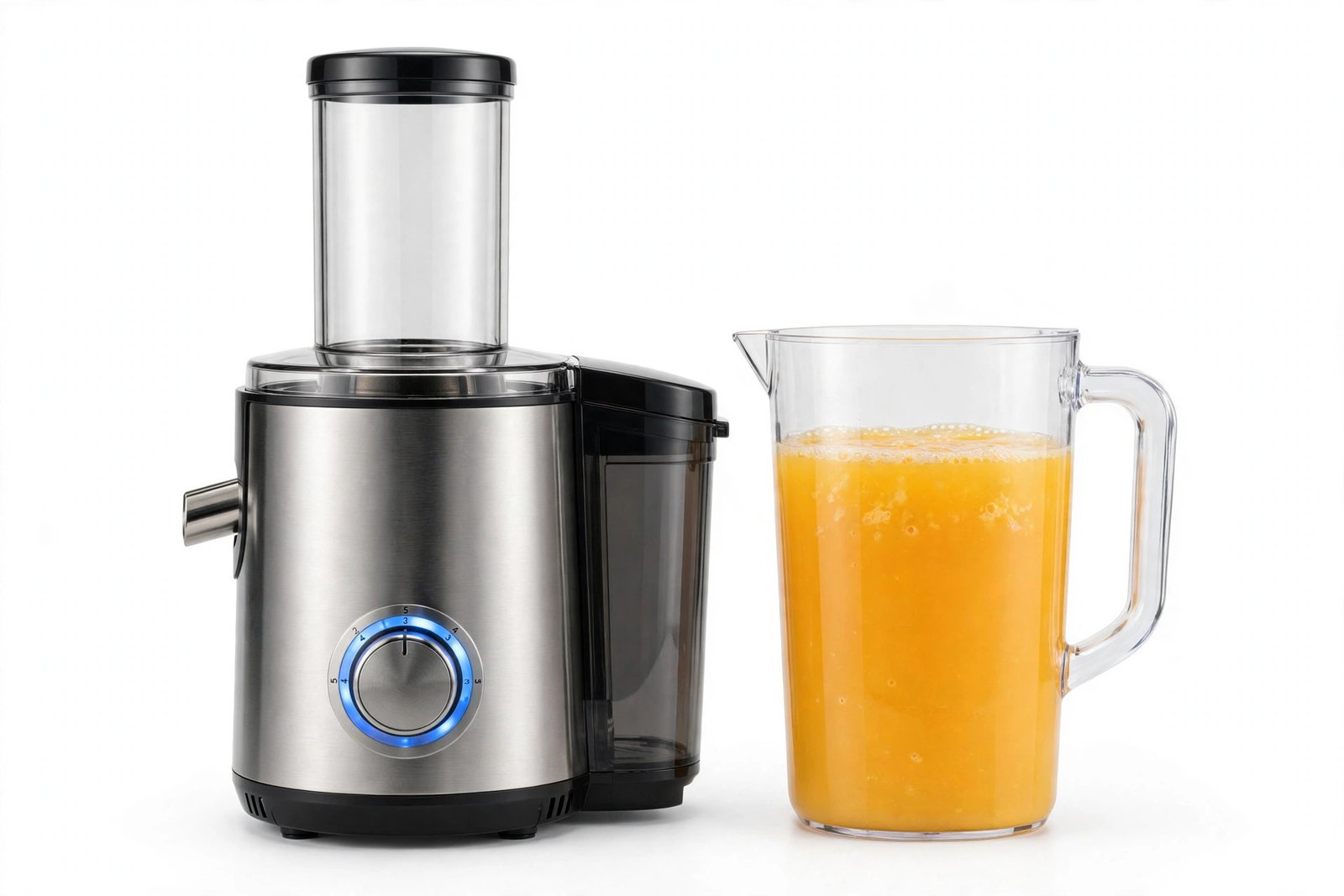
Cuisinart Juice Extractor CJE-1000 (product-style image)
The Cuisinart CJE-1000 is the centrifugal juicer for people who want control. Its 1000-watt motor is the most powerful on this list, and a 5-speed dial with a blue LED light ring lets you pick the right speed for what is going in: low speeds for soft berries and leafy greens, high speeds for carrots, beets, and apples. The speeds run from about 5,000 RPM at the lowest setting to about 10,200 RPM at the highest, which is a wider range than any other centrifugal juicer here. A 3-inch feed tube takes whole fruit, the 1-liter juice pitcher pours easily and stores in the fridge, and the 2-liter pulp container means long juicing sessions without stopping to empty it.
The build matches the price. The housing is die-cast metal and stainless steel, which looks and feels a step above the plastic bodies of the cheaper centrifugals, and the machine comes with Cuisinart’s foam management filter disk, which cuts the foam that centrifugal juicers are known for, and an anti-drip adjustable flow spout, so the counter stays clean between glasses. The easy unlock and lift system makes the parts simple to take apart, every removable part is dishwasher-safe, and the machine carries a 3-year limited warranty. At around $180 to $230, it sits between the Breville and the premium cold press machines, and it looks the part on the counter.
The honest trade-offs are size and price. At roughly 16 inches tall with a wide base, the CJE-1000 takes up more counter space than the Breville or the Hamilton Beach, and it is heavy enough that you will want to leave it out rather than lift it in and out of a cupboard. The price is also worth a careful look: retailer listings range from around $180 to $230, and one retailer’s spec table even shows a conflicting wattage figure, though the instruction manual and the Amazon listing both confirm 1,000 watts, so check the box when it arrives. And for all its power, it is still a centrifugal juicer, so it will never match a slow juicer on kale and celery. But if you want the fastest, most powerful centrifugal with real speed control, this is the one to buy.
Why we like it
- 1000-watt motor, the most powerful centrifugal juicer on this list
- 5-speed dial with blue LED ring, from about 5,000 to 10,200 RPM
- 3-inch feed tube, 1-liter pitcher, and a large 2-liter pulp container
- Foam management disk and anti-drip spout for a cleaner counter
- Die-cast and stainless steel housing with a 3-year limited warranty
Pros
- Best 5-speed centrifugal juicer, the most control over any produce
- Best for big batches, with the largest pulp container here
- Premium build that looks good left out on the counter
Cons
- Large and heavy, so it needs a permanent spot on the counter
- Around $180 to $230, the priciest centrifugal on this list
- Still a centrifugal, so it cannot match a slow juicer on leafy greens
Price: around $180 to $230 on Amazon
Best for: big-batch juicers, families, and anyone who wants five speeds to match every kind of produce.
Who should skip it: small kitchens and green juice drinkers, where the Ninja is smaller, cheaper, and far better on greens.
Cold Press vs Centrifugal: Which Type of Juicer Is Better?
The first decision is not which brand to buy, it is which type of juicer to buy, because the two types behave like different machines. A centrifugal juicer spins a steel basket at thousands of RPM and flings the juice out through a mesh. It is fast, loud, and cheap, and it is excellent on hard fruit and root vegetables. A cold press juicer, also called a masticating or slow juicer, crushes the produce with an auger turning at 40 to 80 RPM and presses it through a strainer. It is slow, quiet, and more expensive, and it squeezes far more juice out of leafy greens, celery, and wheatgrass.
The difference is not small. In side-by-side testing, America’s Test Kitchen found that slow juicers pulled about twice as much juice from a pound of kale as fast ones, roughly 5.6 ounces against 2.8 ounces, while the fast machines were quicker on carrots and finished a pound in about 39 seconds against roughly 1 minute 47 seconds for the slow group. That is the trade-off in one sentence: slow juicers win on greens, fast juicers win on speed. The pulp tells the same story. Cold press pulp comes out dry and crumbly, which means the juice stayed in your glass instead of going in the bin, while centrifugal pulp comes out wet, which means you are throwing away juice you paid for.
There is also a nutrition question, and the honest answer is more modest than the marketing. Cold press juice keeps a little better because the slow squeeze creates less heat and less oxidation, which is why makers say it stays fresh for up to 72 hours in the fridge. But no juicer adds nutrients that were not in the produce, and every juicer removes most of the fiber, which is why Harvard Health is clear that eating whole fruit and vegetables is better than drinking their juice, and that juice works best as an addition to a healthy diet, not a replacement for it. If you mostly juice fruit and carrots, a centrifugal machine is the sensible buy. If your glass is mostly celery, kale, and spinach, a cold press machine will pay for itself in produce within months.
The rest of your kitchen matters too. Fresh juice pairs naturally with a good smoothie routine, and our guide to the best blenders for smoothies covers the machines that handle the fruit a juicer cannot, like bananas, mango, and avocado, which have almost no free liquid and belong in a blender, not a juicer. And if your morning routine is built around the kitchen, our guides to the best toaster ovens and the best air fryers cover the other appliances that make breakfast faster.
Buying Guide: How to Choose the Right Juicer
A juicer looks simple on the shelf, but the wrong one is too slow for your mornings, too weak for your greens, or too hard to clean to use twice. Match the machine to what you actually juice, how often you juice, and how much cleanup you will put up with, because those three answers decide everything else.
1. Start with what you juice, not what the box promises
The produce decides the machine. If your glass is mostly oranges, apples, carrots, and beets, a centrifugal juicer like the Breville or the Hamilton Beach is fast, cheap, and perfectly good. If your glass is mostly celery, kale, spinach, and wheatgrass, you need a cold press juicer like the Ninja or the Omega, because a centrifugal basket simply cannot squeeze greens. If you juice a bit of everything, the Ninja is the best compromise, because it handles greens well and costs little more than a good centrifugal. Buying a centrifugal juicer for a daily green juice habit is the most common mistake in juicing, and it is the reason so many juicers end up in a cupboard.
2. Decide how much time you will really spend on it
Be honest about your mornings. A centrifugal juicer makes a glass in seconds but needs the produce cut to fit a 3-inch chute, and it is loud enough to wake the house. A slow juicer takes longer per glass but runs quietly, and a machine with a self-feeding hopper like the Hurom lets you load the whole recipe and walk away. If you juice once a week, speed barely matters. If you juice every morning before work, the machine that saves you five minutes a day is worth paying more for, because five minutes a day is the difference between a habit and a chore.
3. Check the feed chute before you buy
The feed chute decides how much chopping you do. A 3-inch chute, like the ones on the Breville, the Hamilton Beach, and the Cuisinart, takes a whole apple or a peeled orange with no cutting. A narrow chute, like the 1.5-inch opening on the Omega or the 1.75-inch chute on the Ninja, means cutting everything into pieces first, which adds minutes to every batch. The Hurom goes further still, with a 136 mm hopper that takes whole fruit by the handful. If you hate chopping, buy the widest chute you can afford, because the chopping is what kills the habit.
4. Count the parts you have to wash
Cleanup is where juicers live or die. Every juicer on this list has dishwasher-safe removable parts, but the number of parts still matters: a centrifugal juicer has a basket, a lid, a jug, and a pulp bin, while a slow juicer adds an auger, a strainer, and a hopper. Rinse the parts straight after juicing, before the pulp dries on, and cleanup takes two minutes. Leave them in the sink until evening and it takes ten. A cleaning brush is included with most machines, and it is worth using, because dried pulp in a mesh strainer is the hardest thing in a kitchen to clean.
5. Work out the real cost, including the produce
A juicer is cheap. The produce is not. A daily green juice can cost several dollars a day in celery, kale, apples, and ginger, which adds up to hundreds of dollars a year. That is why yield matters more than the price on the box: a cold press juicer that squeezes twice as much juice from a pound of kale pays for its higher price in produce savings, while a cheap centrifugal that leaves wet pulp wastes money every single morning. Buy seasonal produce, buy it in bulk, and freeze ginger and turmeric in small pieces so nothing goes to waste. The cheapest juicer is the one that wastes the least produce.
6. Check the warranty, because it tells you what the maker believes
Warranties on this list run from 1 year to 15 years, and the gap is not an accident. The Breville and the Ninja carry 1-year warranties, which is standard for machines at their price. The Hamilton Beach and the Cuisinart carry 3-year warranties, which is a fair middle ground. The Omega carries a 15-year warranty on its motor and parts, which is the maker telling you it expects the machine to last a decade or more. If you plan to juice every day for years, a long warranty is worth real money. If you are trying juicing for the first time, a 1-year warranty on a $120 machine is a fair risk.
7. Make sure it fits your kitchen before it arrives
Measure twice. The Hurom is over 18 inches tall and will not fit under low cupboards. The Cuisinart is wide and heavy and wants a permanent spot on the counter. The Omega is long because the auger lies flat, so it needs sideways space. The Ninja is the smallest machine here and the easiest to lift into a cupboard. A juicer that lives on the counter gets used. A juicer that lives in a cupboard gets forgotten. If you have the counter space, leave it out. If you do not, buy the smallest machine that does the job, because the best juicer is the one you can reach without a step stool.

Frequently Asked Questions
What is the difference between a cold press juicer and a centrifugal juicer?
A centrifugal juicer spins a steel basket at thousands of RPM and flings the juice out through a mesh. It is fast, loud, and cheap, and it works best on hard fruit and root vegetables. A cold press juicer, also called a masticating or slow juicer, crushes produce with an auger turning at 40 to 80 RPM and presses it through a strainer. It is slow, quiet, and more expensive, and it squeezes far more juice from leafy greens, celery, and wheatgrass, with drier pulp and juice that keeps longer in the fridge.
Is juicing healthy?
Juicing can help you eat more vegetables, but it is not a replacement for eating whole fruit and vegetables. Juicing removes most of the fiber, which is why Harvard Health recommends a glass that is about 80 percent vegetables and 20 percent fruit, to keep the sugar down and the nutrients up. Juice still contains vitamins, especially vitamin C, and a well-made vegetable juice is a good source of potassium, folate, and vitamins A and K. Think of juice as a bonus on top of a healthy diet, not a substitute for it, and be careful with fruit-heavy juice, because it concentrates sugar without the fiber that slows it down.
How long does fresh juice last in the fridge?
Fresh juice is best drunk straight away, but cold press juice keeps longer than centrifugal juice because the slow squeeze creates less heat and less oxidation. Makers of slow juicers say their juice stays fresh for up to 72 hours in the fridge, and that matches what most owners report. Centrifugal juice is best drunk within a day. Store any juice in a sealed glass jar filled to the top to keep the air out, keep it cold, and add a squeeze of lemon, which slows browning. If it smells off or tastes sour, throw it away.
Can you juice leafy greens in a centrifugal juicer?
You can, but you will not get much juice from them. A centrifugal basket spins leafy greens around without pressing them properly, so kale and spinach give up roughly half as much juice as they do in a slow juicer, and the pulp comes out wet. If you juice greens more than once a week, a cold press juicer like the Ninja or the Omega is the honest buy. If you only add a handful of spinach to an apple and carrot juice now and then, a centrifugal machine will cope, especially if you roll the leaves into a tight ball and sandwich them between hard pieces like apple or carrot.
What is the best juicer for beginners?
For most beginners, the Ninja NeverClog JC151 is the best first juicer, because it gives you real cold press quality for around $120 and handles everything from apples to celery. If you want the fastest possible start with no learning curve at all, the Breville Juice Fountain Plus is the simplest machine here: whole fruit goes in, juice comes out in seconds. If your budget is tight, the Hamilton Beach Big Mouth does the same job for around $75. Start with the machine that matches what you will actually juice, not the one with the longest feature list.
How do you clean a juicer?
Rinse every part straight after juicing, before the pulp dries, and cleanup takes about two minutes. Take the machine apart, rinse the basket or strainer under running water, and use the cleaning brush that comes with the machine to clear the mesh. Most removable parts on the juicers in this guide are dishwasher-safe, but hand-rinsing the strainer is usually faster and gentler. Never put the motor base in water, and never leave pulp to dry on a mesh strainer, because dried pulp is the hardest thing in a kitchen to clean.
Is a masticating juicer worth the extra money?
It is worth it if you juice greens, celery, or wheatgrass regularly, or if you juice every day. A slow juicer squeezes roughly twice as much juice from a pound of kale as a fast one, leaves drier pulp, runs quietly, and makes juice that keeps for up to three days. Over a year of daily juicing, the extra yield can save more in produce than the price gap between a $120 slow juicer and a $75 centrifugal. It is not worth it if you juice fruit and carrots once a week, where a centrifugal machine is faster, cheaper, and perfectly good.
Our Verdict: Which Juicer Should You Buy?
If you want one juicer that does the most for the most people, get the Ninja NeverClog Cold Press Juicer JC151. For around $120 to $130, it gives you real cold press quality, dry pulp, quiet mornings, and a choice of pulp levels, and it handles the celery and kale that defeat every centrifugal machine. It is the best value juicer on this list, and the one we would buy first.
If you want the fastest juice with the least effort, get the Breville Juice Fountain Plus JE98XL. Whole fruit goes in, a glass comes out in seconds, and at around $150 it is the simplest machine here. If you juice every day for a family and you are tired of feeding the machine one piece at a time, get the Hurom H320 Slow Juicer, because its 2-liter hopper lets you load a whole recipe and walk away. If your glass is mostly greens and wheatgrass, get the Omega NC900HDC Juicer, with the best leafy green yield here and a 15-year warranty. And if your budget is tight, get the Hamilton Beach Big Mouth Juice Extractor for around $75, or the Cuisinart Juice Extractor CJE-1000 if you want five speeds and the biggest pulp container for large batches.
Whatever you choose, remember the simple rule: juice mostly vegetables, drink it fresh, rinse the machine straight away, and keep eating whole fruit and vegetables too. A juicer does not make you healthy on its own. But the right juicer, used every morning, is one of the easiest ways to get more vegetables into your day, and that is a habit worth starting today.
Was this guide helpful? Share it with a friend who is thinking about buying a juicer. And if you try one of these juicers, come back and tell us what you made first – your experience helps other readers choose with confidence.