
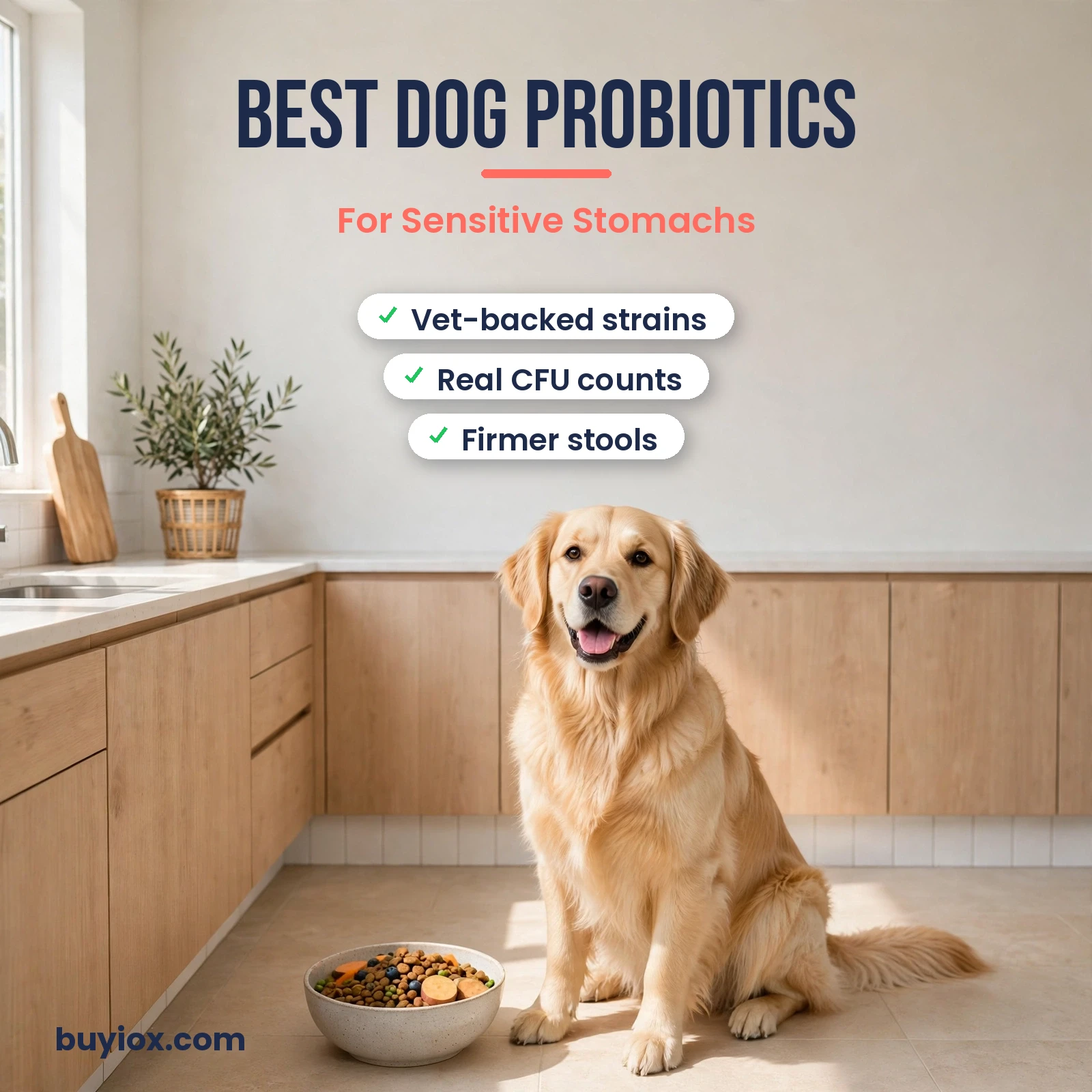
Affiliate Disclosure: Buyiox is reader-supported. When you buy through links on this page, we may earn a small commission at no extra cost to you. We only recommend products we would use for our own dogs.
It starts the same way every time. Your dog eats dinner, and a few hours later you are cleaning up a loose stool in the yard, or worse, on the living room rug. Or your dog wakes you at 3 a.m. to go out, again, for the third night in a row. Or every meal ends with loud gurgling, gas that clears the room, and a dog that looks uncomfortable for hours. If any of that sounds familiar, you are not alone, and your dog is not broken. Sensitive stomachs are one of the most common reasons owners visit the vet, and the gut is where most of it starts.
That is why dog probiotics have become the best-selling supplement category in the pet world. Probiotics are live bacteria meant to support a healthy balance of gut microbes, and the idea is simple: a healthier gut means firmer stools, less gas, and a calmer stomach. But here is the honest truth most roundups will not tell you: the science behind dog probiotics is thinner and more mixed than the marketing suggests. A 2019 systematic review of 17 studies found only a very limited and possibly clinically unimportant effect for preventing or treating sudden gut upsets, and a 2024 meta-analysis for the European ENOVAT guidelines found that probiotic products did not clearly shorten acute diarrhea in dogs. The AKC notes that probiotics can help during stress and antibiotic treatment, and that some studies found they work as well as antibiotics for shelter dogs with diarrhea, but the same guide is clear that the research is still early.
So why buy one at all? Because the evidence is strain-specific, not category-wide. A probiotic is only as good as its exact strain, and a few strains, most famously Enterococcus faecium SF68, do have real trial data behind them in dogs. The six best dog probiotics below are the ones with named strains, real CFU counts printed on the label, and the most consistent owner feedback. We state the limits of each one plainly, including the one with only 100 million CFU per dose and the one whose CFU count is the lowest on this list. Start with the one that fits your dog’s problem, give it four to six weeks, and judge it by your dog’s stools, not by what the jar promises.
Our Top 6 Dog Probiotics at a Glance
- Purina Pro Plan FortiFlora – Best overall, the vet-recommended benchmark
- Zesty Paws Probiotic Bites – Best popular chew, the tasty everyday pick
- Nutramax Proviable-DC – Best multi-strain vet formula, 7 named strains
- Pet Honesty Probiotics for Dogs – Best all-in-one chew, probiotics plus enzymes and pumpkin
- VetriScience Probiotic Everyday – Best simple daily chew, one stable strain plus prebiotic
- Honest Paws Pre + Probiotics – Best pre and probiotic powder, 6 strains plus inulin
1. Purina Pro Plan FortiFlora – Best Overall
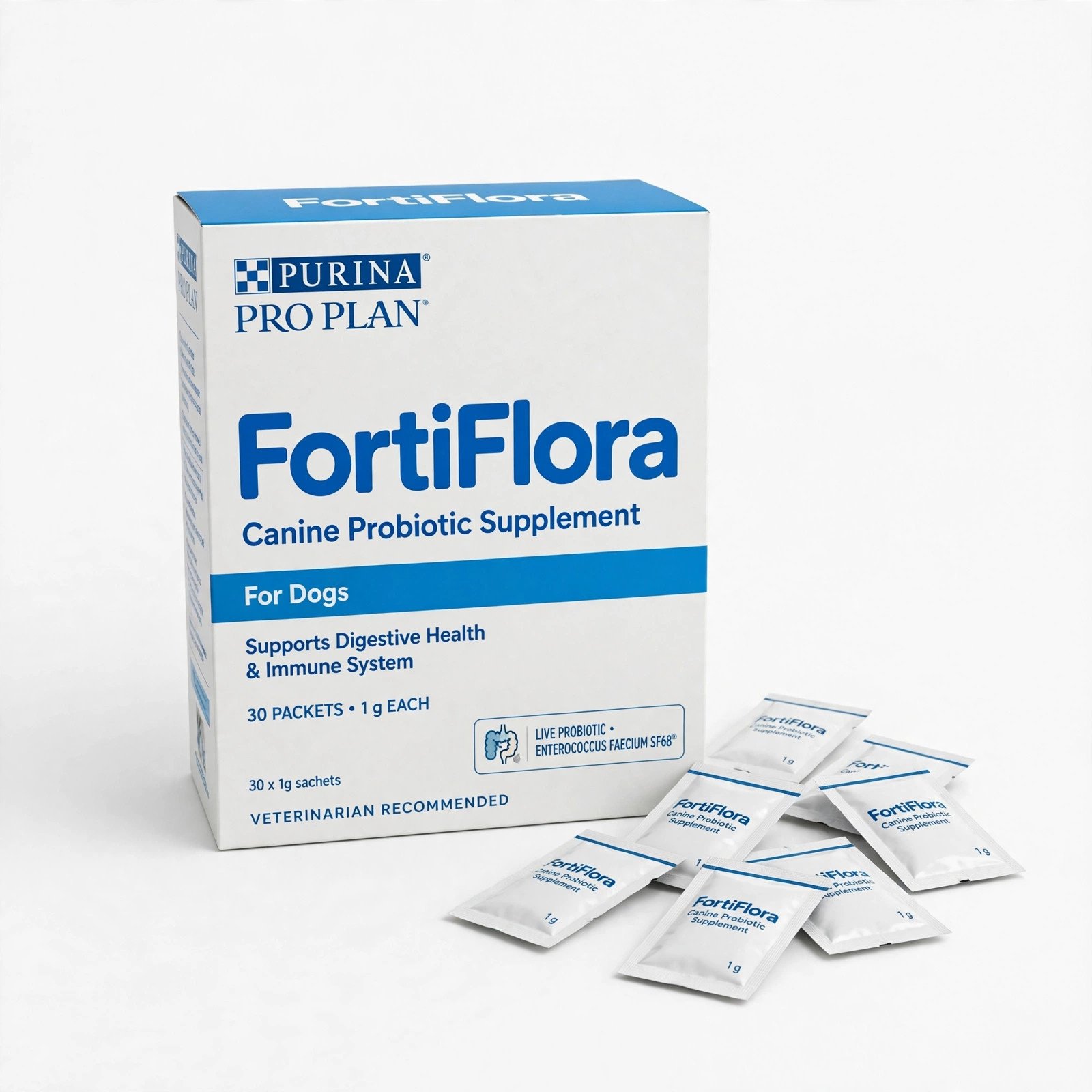
Purina Pro Plan FortiFlora (product-style image)
If you ask ten vets which dog probiotic they recommend first, most of them will say FortiFlora, and that is not an accident. FortiFlora is the number one veterinarian-recommended probiotic for dogs, it is sold through vet clinics as well as on Amazon, and it is the best-selling dog supplement on Amazon. Each single-serve sachet delivers a guaranteed live level of Enterococcus faecium SF68 at 100 million CFU, a strain with more than 20 years of peer-reviewed research behind it, including studies showing it can shorten diarrhea and help dogs recover after antibiotics. The powder is liver-flavored, you sprinkle one sachet over your dog’s food once a day, and the dose is the same for any size of dog, which makes dosing almost foolproof.
What makes FortiFlora the best overall pick is the combination of evidence, simplicity, and trust. It is a single-strain product, which sounds like a weakness until you understand that most multi-strain chews cannot point to a single dog trial for their exact blend. FortiFlora can. Owners report firmer stools within 48 to 72 hours in many cases, and the Amazon rating backs that up: around 4.7 stars from more than 50,000 ratings. The sachets are individually sealed, so the bacteria stay alive until you open them, and the powder mixes into any food, which matters for picky dogs that spit out chews. If your dog is on antibiotics, has just had a bout of diarrhea, or gets stressed by travel and boarding, this is the product your vet is most likely to hand you.
The honest trade-off is the price per day. At around $31 for a box of 30 sachets, FortiFlora costs about a dollar a day, which is roughly twice what some chews cost for a small dog, and it adds up fast in a multi-dog household. It also contains only one strain at 100 million CFU, which looks tiny next to chews that claim 6 billion CFU, though the CFU number alone does not tell you how much survives to the gut. And it is a powder, not a chew, so if your dog eats dry kibble and leaves the dust at the bottom of the bowl, some of the dose goes uneaten. But for a dog with a real stomach problem, and especially for a dog your vet has already seen, FortiFlora is the honest first buy, and it is the one we would buy first.
Why we like it
- Number one veterinarian-recommended probiotic for dogs, sold through vet clinics
- Enterococcus faecium SF68, a strain with 20+ years of published research in dogs
- Single sachet a day for any size dog, no weight-based counting
- Individually sealed sachets keep the bacteria alive until use
- Around 4.7 stars from more than 50,000 Amazon ratings
Pros
- Best dog probiotic for most dogs, with the strongest vet backing and the best evidence
- Best pick for diarrhea, stress-related upsets, and recovery after antibiotics
- Powder mixes into any food, ideal for picky dogs that refuse chews
Cons
- Around $31 for 30 sachets, about a dollar a day, which adds up in multi-dog homes
- Only one strain at 100 million CFU, which looks low next to multi-strain chews
- Powder can be left at the bottom of the bowl if your dog eats around it
Price: around $31 on Amazon for 30 sachets
Best for: dogs with diarrhea or loose stools, dogs on antibiotics, and any owner whose vet recommended a probiotic by name.
Who should skip it: owners on a tight budget with several dogs, where a chew like Zesty Paws costs far less per day for a small dog.
2. Zesty Paws Probiotic Bites – Best Popular Chew
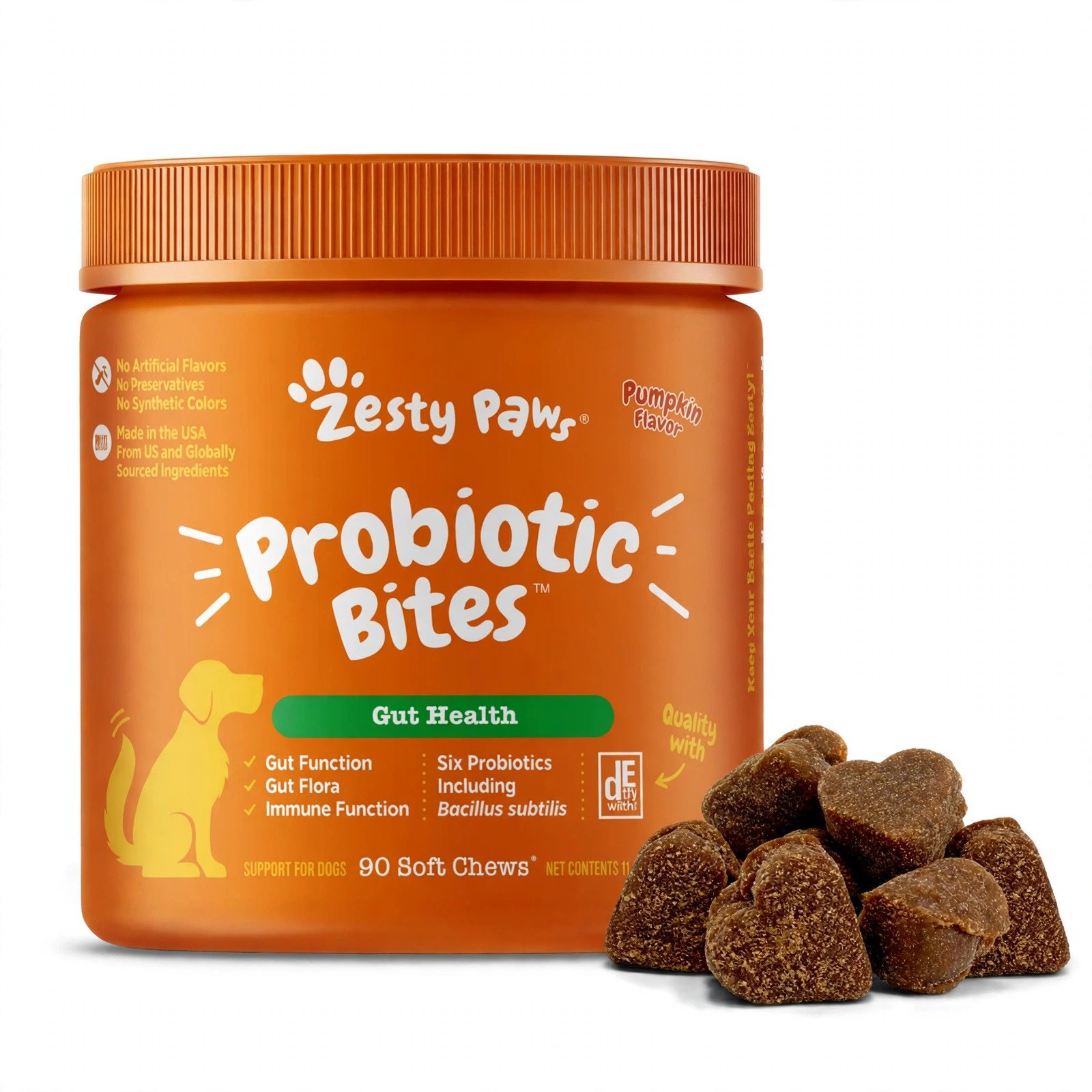
Zesty Paws Probiotic Bites (product-style image)
Zesty Paws is the best-selling probiotic chew most dog owners have actually heard of, and there is a reason it keeps showing up at the top of the bestseller lists. The Probiotic Bites are pumpkin-flavored soft chews built around the Gut First blend: three live strains, Bacillus coagulans, Bacillus subtilis, and Saccharomyces boulardii, delivering 6 billion CFU per two-chew serving, plus 50 mg of fructooligosaccharides (FOS), a prebiotic that feeds the good bacteria. The chews also contain pumpkin and papaya for extra digestive support, and they are soft, smelly in a good way to a dog, and genuinely tasty, which is why they work so well for fussy dogs that refuse powders and tablets.
The brand is NASC-certified, the chews are made in the USA with no artificial flavors or synthetic colors, and the review record is enormous, with thousands of owners reporting firmer stools and less gas. At around $33 for 90 chews, the cost is about 37 cents a chew, and for a small dog on one chew a day that is one of the cheapest options on this list. The chews suit dogs of all ages, they come in pumpkin and chicken flavors, and they pair well with our guide to the best dog calming chews if your anxious dog has a nervous stomach as well, since both are soft chews given the same way each day.
Be honest about the trade-off. The CFU count looks impressive, but the three strains in the Gut First blend do not have the same depth of dog-specific trial data as FortiFlora’s SF68, and the product leans on general probiotic research rather than trials of its exact formula. The dose is also weight-based, one to two chews a day depending on size, so a large dog can go through a jar in about six weeks. And like every chew on this list, it is a supplement, not a medicine: if your dog has bloody stools, vomiting, or diarrhea that lasts more than a day or two, see your vet before buying any probiotic. But for everyday digestive support and for a first-time buyer who wants a tasty, affordable chew, Zesty Paws is the easiest recommendation on this list.
Why we like it
- Gut First blend: 6 billion CFU per two chews from three live strains
- Pumpkin and papaya for extra digestive support, plus FOS prebiotic
- Pumpkin-flavored soft chews that even fussy dogs eat happily
- NASC-certified, made in the USA, no artificial flavors or synthetic colors
- Around $33 for 90 chews, about 37 cents a day for a small dog
Pros
- Best popular dog probiotic chew, the one most owners already trust
- Best tasting probiotic here, ideal for picky dogs that refuse powders
- Affordable daily cost, especially for small and medium dogs
Cons
- Its exact blend has less dog-specific trial data than FortiFlora’s single strain
- Weight-based dosing means a large dog goes through a jar faster
- Not a medicine, so it cannot fix diarrhea caused by infection, parasites, or food allergy
Price: around $33 on Amazon for 90 soft chews
Best for: first-time buyers, fussy dogs that refuse powders, and owners who want an affordable tasty everyday probiotic.
Who should skip it: owners of dogs with a diagnosed gut problem, where FortiFlora or Proviable-DC is the stronger vet-tier pick.
3. Nutramax Proviable-DC – Best Multi-Strain Vet Formula
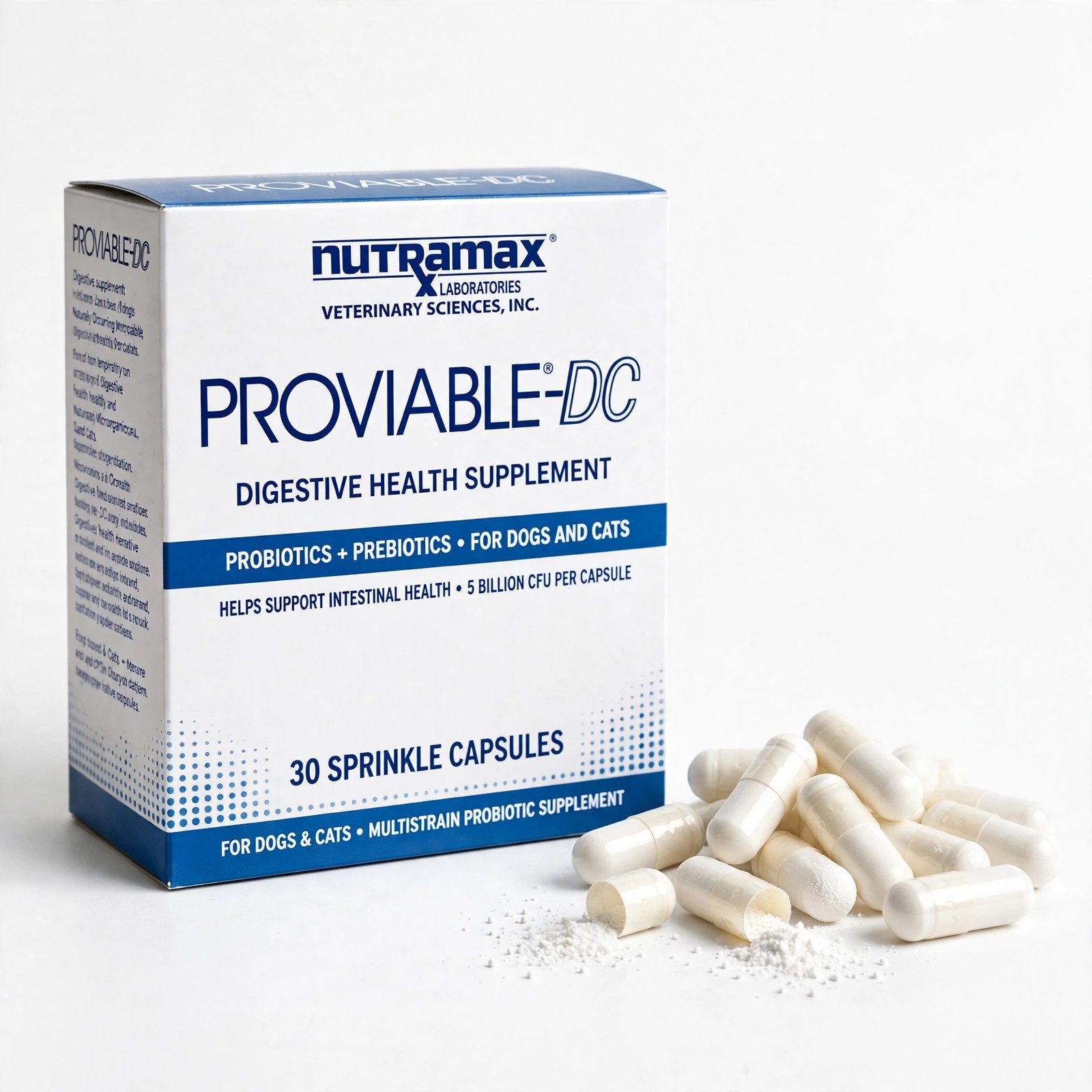
Nutramax Proviable-DC (product-style image)
Proviable-DC is the clinic-grade option on this list, and it comes from Nutramax, the same company behind Cosequin, the most vet-recommended joint supplement in the US. Each sprinkle capsule delivers a minimum of 5 billion CFU from seven named bacterial strains, each with its own NCIMB culture-collection code, including Lactobacillus acidophilus, Lactobacillus casei, Lactobacillus plantarum, Lactobacillus bulgaricus, and Enterococcus faecium, plus a prebiotic, fructooligosaccharide. You open the capsule and sprinkle the powder over food, one capsule a day for most dogs, and the 80-count box is sold through veterinarians as well as online.
What sets Proviable-DC apart is transparency. Every strain is named with a code you can look up, the CFU count is guaranteed at a minimum of 5 billion per capsule, and the formula is clinically researched as a multi-strain probiotic for intestinal balance. Vets reach for it for dogs recovering from antibiotics, dogs with recurring digestive upsets, and dogs that need a stronger, broader probiotic than a single-strain product. The same range includes Proviable-KP, a kaolin and pectin paste for short-term diarrhea support, which is a different product for a different job, so do not confuse the two. At around $34 to $45 for 80 capsules, it costs roughly 42 to 56 cents a day, which is excellent value for a vet-grade formula, and the smaller 30-count box runs around $18 to $23 if you want to trial it first.
Two honest points before you buy. First, the capsule format is less convenient than a chew: you have to open each capsule and sprinkle the contents, and if your dog eats dry kibble and leaves the powder behind, part of the dose is wasted, so mix it into wet food or a little yogurt. Second, despite the impressive strain list, direct trials of Proviable-DC itself are limited, which is true of almost every multi-strain product. What you are buying is a well-made, transparent, vet-trusted formula, not a guaranteed outcome. If your dog needs the most studied single strain, buy FortiFlora. If your dog needs the broadest, most transparent multi-strain formula, buy Proviable-DC.
Why we like it
- Seven named strains with NCIMB codes, 5 billion CFU minimum per capsule
- Plus a prebiotic (FOS) to feed the good bacteria
- Made by Nutramax, the company behind Cosequin, with rigorous batch testing
- Sprinkle capsule format, easy to mix into wet food
- Around $34 to $45 for 80 capsules, about 42 to 56 cents a day
Pros
- Best multi-strain dog probiotic, with the most transparent label on this list
- Best vet-grade pick for dogs recovering from antibiotics or recurring upsets
- Excellent value per day for a vet-quality formula
Cons
- Capsule must be opened and sprinkled, less convenient than a chew
- Powder can be left uneaten if sprinkled on dry kibble
- Direct trials of this exact formula are limited, like most multi-strain products
Price: around $34 to $45 on Amazon for 80 sprinkle capsules
Best for: dogs recovering from antibiotics, dogs with recurring digestive upsets, and owners who want every strain named on the label.
Who should skip it: owners who want a no-fuss chew their dog will eat as a treat, where Zesty Paws or Pet Honesty is the easier daily habit.
4. Pet Honesty Probiotics for Dogs – Best All-in-One Chew
Pet Honesty Probiotics for Dogs (product-style image)
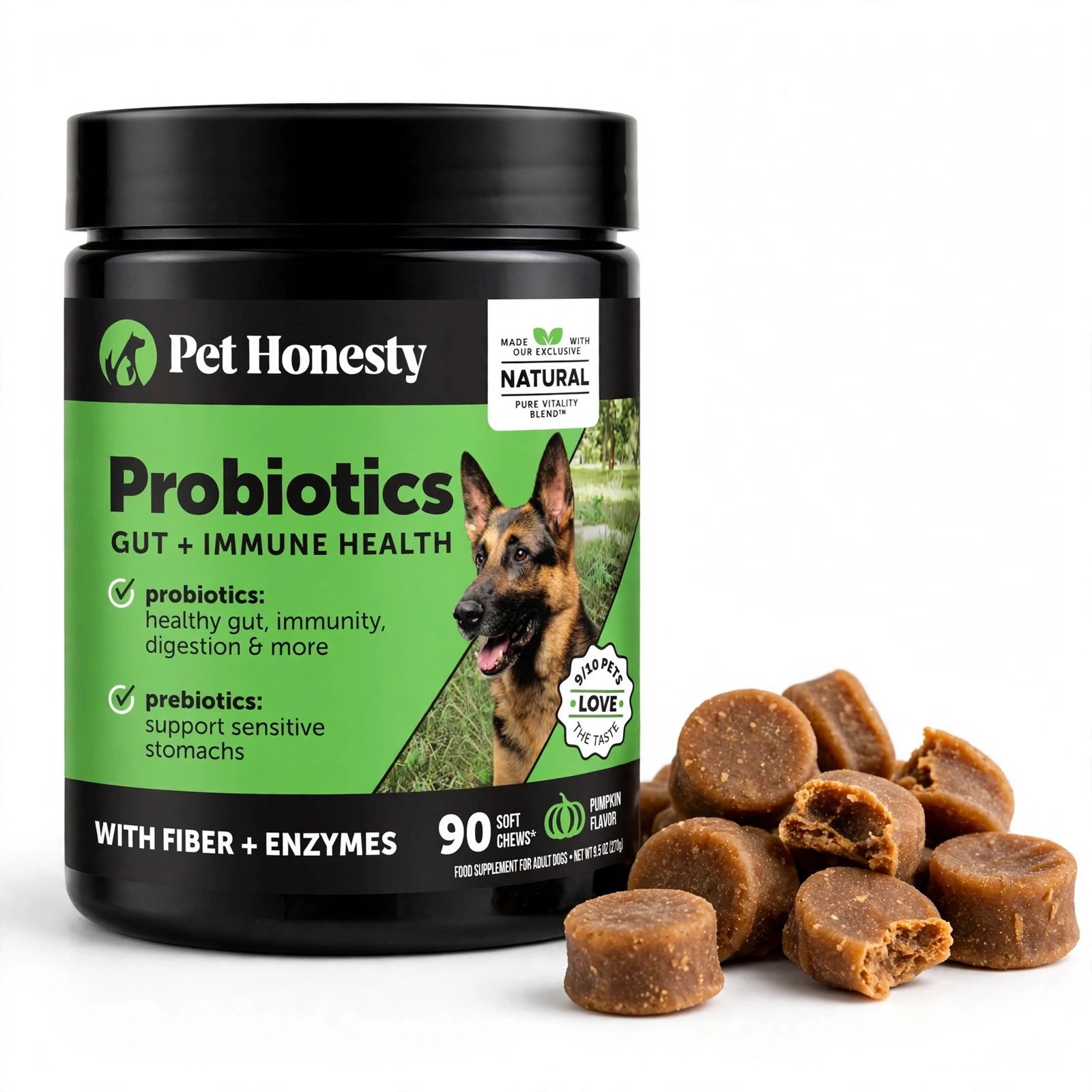
Pet Honesty takes the everything-in-one-chew approach. Each serving delivers 6 billion CFU from seven to eight probiotic strains, plus prebiotics, a digestive enzyme blend, and pumpkin for fiber, all in a pumpkin-flavored soft chew. The idea is to support digestion from three angles at once: live bacteria to balance gut flora, prebiotic fiber to feed those bacteria, and enzymes to help break food down. The chews are NASC-certified, made in the USA, and the brand reports that in an 8-week feeding study, 85 percent of dogs saw better digestion within 90 days, though that is a manufacturer study rather than an independent trial, so treat it as a signal, not a promise.
Dosing could not be simpler: one chew per 25 pounds of body weight, every day. The chews come in a 90-count jar for around $33, and for a 25-pound dog that works out to about 37 cents a day. Owners report that their dogs eat the chews willingly, the jar lasts a long time for a small dog, and the pumpkin flavor suits dogs with sensitive stomachs. The brand also sells a duck-flavored version for dogs that prefer it, and the chews are vet and nutritionist approved, with the NASC Quality Seal on the jar. If your dog has gas, occasional loose stools, and a sensitive stomach all at once, this is the most complete single chew on this list.
Now the honest problems, and they are real ones. First, the cost per day climbs fast for big dogs: a 60-pound dog needs three chews a day, which is about $1.10 a day, making it more expensive per day than FortiFlora for a large dog. Second, once the jar is opened it has a shelf life of 90 days, so a small dog on one chew a day will not finish a 90-count jar before it expires, which wastes money. And third, like the other multi-strain chews here, the individual strains are not all named with culture codes, so you cannot verify each one the way you can with Proviable-DC. Buy it for a small or medium dog, buy it for the all-in-one formula, but do not buy the big jar for a tiny dog and expect it to last.
Why we like it
- 6 billion CFU per serving from seven to eight probiotic strains
- Prebiotics, digestive enzymes, and pumpkin in the same chew
- Simplest dosing here: one chew per 25 pounds of body weight
- NASC-certified, made in the USA, vet and nutritionist approved
- Around $33 for 90 chews, about 37 cents a day for a small dog
Pros
- Best all-in-one dog probiotic chew, the most complete formula in one bite
- Best pick for dogs with gas, loose stools, and a sensitive stomach together
- Great value for small and medium dogs
Cons
- Cost per day climbs fast for large dogs, about $1.10 a day at 60 pounds
- 90-day shelf life after opening, so a small dog will not finish the jar in time
- Not all strains are named with culture codes, so the label is less transparent than Proviable-DC
Price: around $33 on Amazon for 90 soft chews
Best for: small and medium dogs, owners who want probiotics plus enzymes plus pumpkin in one chew, and dogs with gas as well as loose stools.
Who should skip it: owners of large dogs, where the per-day cost beats FortiFlora, and owners of very small dogs, where the 90-day shelf life wastes half the jar.
5. VetriScience Probiotic Everyday – Best Simple Daily Chew
VetriScience Probiotic Everyday (product-style image)
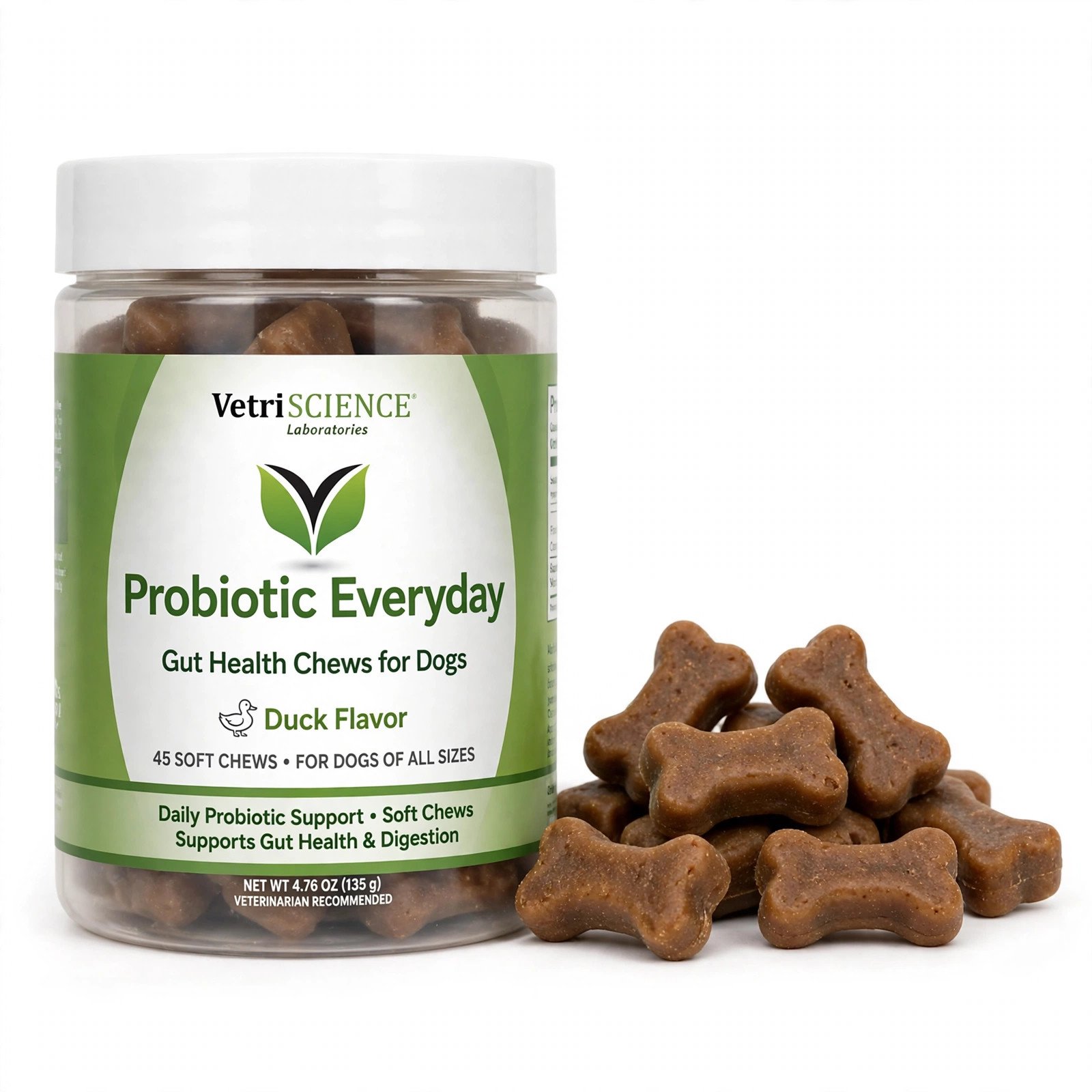
If you want the simplest probiotic on this list, this is it. VetriScience Probiotic Everyday is built on one patented strain, GanedenBC30, which is Bacillus coagulans, delivered at 1 billion CFU per chew, plus prebiotic fiber in the form of FOS (fructooligosaccharides). The strain is spore-forming, which means it is unusually stable: it survives heat, stomach acid, and storage far better than most probiotic bacteria, so more of it actually reaches the gut alive. The chews are duck-flavored, soft, and small, and they are made by VetriScience, a vet-formulated brand trusted by more than 12,000 veterinary clinics for its other products, including the GlycoFlex joint range we covered in our guide to the best dog joint supplements.
The dosing is one chew a day for most dogs, and the jar holds 45 chews for around $26, which works out to about 58 cents a day. A 120-count jar is also available for around $45, which brings the daily cost down further for multi-dog homes. The chews may also help with gas, bloating, and even bad breath, according to the maker, because the gut and the mouth are connected through the same bacterial balance. Owners report that even fussy dogs eat the duck-flavored chews happily, and the small chew size suits small breeds and puppies as well as large dogs.
Be honest about the limit: 1 billion CFU per chew is the lowest count on this list, and if you judge products by the CFU number alone, this one looks weak. But the CFU number is not the whole story, because a spore-forming strain like GanedenBC30 survives the journey to the gut far better than a fragile strain that dies in stomach acid. What matters is how many live bacteria arrive, not how many were in the jar at the factory. Even so, if your dog has a serious, recurring gut problem, the stronger, multi-strain formulas above give you more firepower. VetriScience Probiotic Everyday is the best pick for everyday maintenance, for a healthy dog that just needs a little gut support, and for owners who want the simplest possible routine.
Why we like it
- GanedenBC30, a patented spore-forming strain that survives stomach acid well
- 1 billion CFU per chew plus prebiotic FOS fiber
- One chew a day, duck flavor, small size suits all breeds
- Vet-formulated brand trusted by 12,000+ vet clinics
- Around $26 for 45 chews, about 58 cents a day
Pros
- Best simple daily dog probiotic, the easiest routine on this list
- Best strain stability, spore-forming bacteria survive better to the gut
- Small tasty chews that even fussy dogs and small breeds eat happily
Cons
- Lowest CFU count here at 1 billion per chew, so it is not the strongest pick
- Single strain, so it is less broad than the multi-strain formulas
- Not the best choice for a dog with a serious, recurring gut problem
Price: around $26 on Amazon for 45 soft chews
Best for: healthy dogs that need everyday gut maintenance, owners who want the simplest one-chew routine, and small breeds that need a small chew.
Who should skip it: owners of dogs with serious or recurring digestive problems, where FortiFlora or Proviable-DC gives you more firepower.
6. Honest Paws Pre + Probiotics – Best Pre and Probiotic Powder
Honest Paws Pre + Probiotics (product-style image)
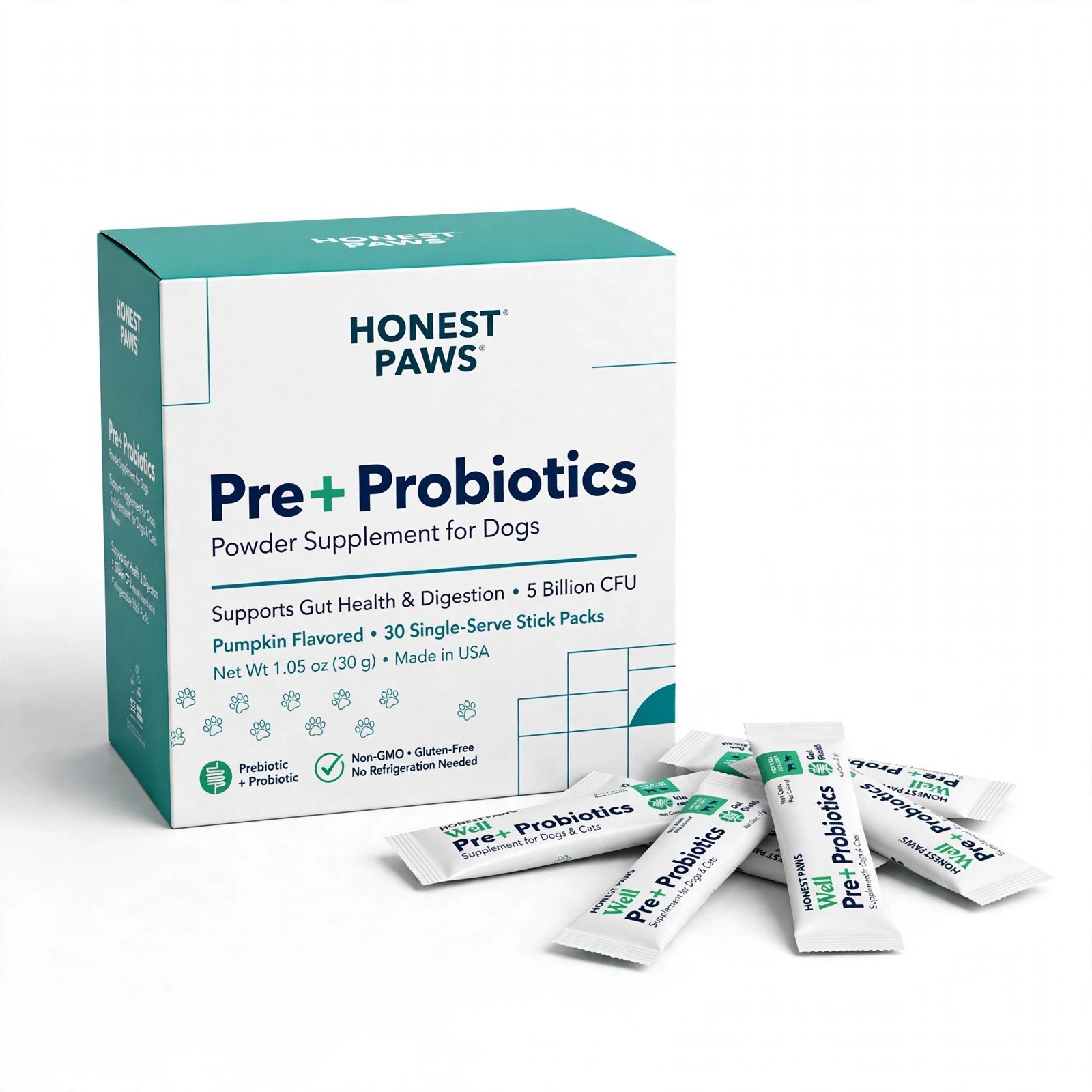
Honest Paws takes a different route from the rest of this list, and it is the only product here that gives the prebiotic equal billing with the probiotic. Each single-serve stick pack delivers 5 billion CFU from six probiotic strains, including Bacillus subtilis DE111, Lactobacillus acidophilus, Bacillus coagulans, and Bifidobacterium longum, plus 500 mg of inulin, a prebiotic fiber that feeds the good bacteria, and 50 mg of spinach leaf extract, an antioxidant. The powder comes in chicken and pumpkin flavors, you sprinkle one stick pack over food once a day, and it suits dogs and cats of all sizes and ages, from puppies to seniors.
The formula won the NASC Visibility Award in 2022, it is GMO-free, third-party lab tested, and made in the USA, and the brand is transparent about every active ingredient and its amount, which is more than most chew brands offer. At around $30 for 30 stick packs, it costs about a dollar a day, the same as FortiFlora, but you get six strains and a real prebiotic dose for that money. Owners also report that it helps with itchy skin and allergy symptoms, which makes sense: the gut and the immune system are closely linked, and around 70 percent of the immune system lives in the gut. If your dog has both a sensitive stomach and itchy skin, this is the most interesting pick on the list.
Two honest points before you buy. First, it is a powder in stick packs, not a chew, so if your dog eats dry kibble and leaves the dust behind, some of the dose goes uneaten, and you will need to mix it into wet food. Second, like most multi-strain products, the exact blend has not been tested in a published dog trial of its own, so you are buying a well-made formula with good ingredients rather than a proven outcome. And a dollar a day is real money for a maintenance product, especially in a multi-dog home. But if you want a prebiotic and a probiotic in one product, with a transparent label and a real prebiotic dose, Honest Paws is the best version of that idea you can buy.
Why we like it
- Six probiotic strains at 5 billion CFU per stick pack, including DE111
- 500 mg of inulin prebiotic per serving, a real dose, not a token amount
- Spinach leaf extract for antioxidant support
- NASC Visibility Award winner, GMO-free, third-party lab tested, made in the USA
- One stick pack a day for any size dog, chicken or pumpkin flavor
Pros
- Best pre and probiotic powder for dogs, the only true synbiotic here
- Best pick for dogs with both a sensitive stomach and itchy skin
- Fully transparent label with every active ingredient and amount printed
Cons
- Around $30 for 30 stick packs, about a dollar a day, which adds up in multi-dog homes
- Powder can be left at the bottom of the bowl on dry kibble
- No published dog trial of this exact blend, like most multi-strain products
Price: around $30 on Amazon for 30 stick packs
Best for: dogs with a sensitive stomach and itchy skin together, owners who want a real prebiotic dose, and anyone who prefers a powder over a chew.
Who should skip it: owners on a tight budget, where Zesty Paws costs a third as much per day for a small dog, and owners whose dogs eat only dry kibble.
Dog Probiotic Comparison Table
| Probiotic | Best For | Strains and CFU per Dose | Form | Around Price |
|---|---|---|---|---|
| FortiFlora | Most dogs, best overall | 1 strain, E. faecium SF68, 100 million CFU | Powder sachet | ~$31 / 30 |
| Zesty Paws Probiotic Bites | Popular tasty chew | 3 strains, 6 billion CFU per 2 chews | Soft chew | ~$33 / 90 |
| Proviable-DC | Multi-strain vet formula | 7 named strains, 5 billion CFU per capsule | Sprinkle capsule | ~$34-45 / 80 |
| Pet Honesty Probiotics | All-in-one chew | 7-8 strains, 6 billion CFU, plus enzymes and pumpkin | Soft chew | ~$33 / 90 |
| VetriScience Probiotic Everyday | Simple daily chew | 1 strain, GanedenBC30, 1 billion CFU per chew | Soft chew | ~$26 / 45 |
| Honest Paws Pre + Probiotics | Pre and probiotic powder | 6 strains, 5 billion CFU, plus 500 mg inulin | Powder stick pack | ~$30 / 30 |
Do Dog Probiotics Actually Work? The Honest Evidence
Before you spend a dollar, you deserve the honest answer, and it is more complicated than the jars admit. Probiotics for dogs are sold as animal food supplements in the United States, not as approved drugs, which means brands do not have to prove their claims before they hit the shelf. That is why the evidence matters more than the marketing, and the evidence is genuinely mixed. A 2019 systematic review in the Journal of Veterinary Internal Medicine looked at 17 studies and found a very limited and possibly clinically unimportant effect for preventing or treating sudden gut upsets in dogs. A 2024 meta-analysis for the European ENOVAT antimicrobial guidelines came to a similar view: probiotic, prebiotic, and synbiotic products did not clearly shorten acute diarrhea in dogs, and no side effects were reported.
What does that mean in practice? It means a probiotic is not a cure for diarrhea, and it is not a substitute for a vet visit when a dog is genuinely ill. It also means the effect is strain-specific: a strain that worked in a trial is not the same as a different strain in a different product, and you cannot borrow the evidence from one to sell the other. The PetMD guide to probiotics for dogs explains that probiotics can help maintain a healthy gut, but that side effects can include gas, bloating, and soft stools that briefly get worse before they improve, which is why you should start a new probiotic slowly and watch your dog for the first week.
None of that means probiotics are useless. The same reviews found the strongest signal in a few specific situations: dogs given a probiotic alongside antibiotics had fewer digestive issues, including diarrhea, vomiting, and loss of appetite, in a 2019 study cited by the AKC, and some studies found probiotics worked as well as antibiotics for shelter dogs with diarrhea. FortiFlora’s strain, Enterococcus faecium SF68, has the most dog-specific data of any strain on this list, with trials showing it can shorten diarrhea and help dogs recover after antibiotics. And spore-forming strains like GanedenBC30 have a real advantage in surviving stomach acid, which is why a lower CFU count can still be effective.
The bigger plan matters more than any jar. Diet is the single most powerful gut treatment there is: in the long-term gut disease studies, diet did the heavy lifting and a probiotic did not seem to add much on top. A bland diet of boiled chicken and rice settles most mild upsets within a day or two, and a slow, careful food change prevents most stomach trouble in the first place, which is why a slow feeder bowl helps dogs that gulp their food and swallow air. Fresh water matters too, and our guide to the best dog water fountains covers the fountains that keep water clean and appealing. And if your dog’s stomach trouble comes with bad breath or dental problems, our guide to the best dog dental chews and our guide to the best dog toothbrushes cover the daily care that keeps the mouth and the gut healthy together.
One warning that cannot be repeated often enough: never give your dog a human probiotic without asking your vet first. Human products may contain extra ingredients that are unsafe for dogs, including xylitol, which is toxic to dogs, and the doses and strains are made for humans, not for a 20-pound dog. The same rule applies to human medicines: if your dog has bloody stools, vomiting, lethargy, or diarrhea that lasts more than a day or two, see your vet first, get a diagnosis, and use the probiotic alongside proper treatment, not instead of it. A probiotic supports a gut. It does not fix parasites, food allergy, pancreatitis, or an infection, and pretending otherwise is how dogs suffer longer than they need to.

Buying Guide: How to Choose the Right Dog Probiotic
A dog probiotic looks simple on the shelf, but the wrong one is under-dosed for your dog, built on a strain with no dog data, or in a form your dog will not eat. Match the product to your dog’s actual problem first, then check the label, then think about the price per day, because those three answers decide everything else.
1. Start with your dog’s real problem, not the jar’s promise
A healthy dog that just needs a little gut support, a dog recovering from antibiotics, and a dog with chronic loose stools need three different products. For a healthy dog, a simple daily chew like VetriScience Probiotic Everyday is the sensible start, because you are maintaining a healthy gut rather than treating a problem. For a dog recovering from antibiotics or a bout of diarrhea, a vet-backed product like FortiFlora or Proviable-DC fits better, because those are the formulas vets actually reach for in that situation. For a dog with gas, loose stools, and a sensitive stomach all at once, an all-in-one chew like Pet Honesty covers more ground. Buying the strongest product for a healthy dog wastes money, and buying the weakest product for a sick dog wastes time.
2. Read the label like a vet: strain names matter more than CFU counts
Every jar boasts a big CFU number, but the strain name is what separates a real probiotic from a flavored chew. Look for the full strain name, ideally with a culture code you can look up, like Enterococcus faecium SF68 or Bacillus subtilis DE111. Proviable-DC and Honest Paws print their strains in full, which is why they lead this list on transparency. Be wary of products that list only a genus, like Lactobacillus, with no species or strain, and be wary of huge CFU numbers with no strain names at all. A hundred million of a studied strain that survives to the gut beats ten billion of an unnamed strain that dies in stomach acid. If a brand will not tell you the strain, you cannot know whether the product works.
3. Pick the form your dog will actually eat every day
A probiotic only works if your dog eats it, every day, for weeks. Soft chews are the easiest form for most dogs, because they taste like treats and need no preparation. Powders suit dogs that eat wet food, because you can mix them in invisibly, but they are wasted on dry kibble if your dog leaves the dust behind. Sprinkle capsules like Proviable-DC suit dogs that eat wet food and owners who do not mind opening a capsule each day. If your dog has refused supplements before, start with a tasty soft chew like Zesty Paws or Pet Honesty, and give it at the same time every day, with a meal, so it becomes part of the routine rather than a daily negotiation.
4. Give it four to six weeks before you judge it
Probiotics do not work overnight, and most of them do not work in a week either. The bacteria need time to colonize the gut and change the balance of microbes, and most brands and vets say to allow four to six weeks of daily use before deciding whether a product helps. Some dogs improve in a few days, especially after antibiotics, but most take longer. Keep a simple diary during that time: how firm are the stools, how often does your dog go, how much gas is there, and how settled does your dog seem after meals? Small, steady improvements in those answers are what a working probiotic looks like. If nothing has changed after six weeks, try a different strain or a different form, like switching from a chew to a powder, rather than buying the same thing again.
5. Work out the real price per day, not the price on the jar
A $26 jar is not always cheaper than a $45 jar. What matters is the price per day at your dog’s dose, and that depends on the count, the serving size, and your dog’s weight. FortiFlora at around $31 for 30 sachets is about a dollar a day for any size dog. Zesty Paws at around $33 for 90 chews is about 37 cents a day for a small dog on one chew, but a 60-pound dog on two chews a day pays about 73 cents a day. Pet Honesty looks cheap at $33 for 90 chews, but a 60-pound dog needs three chews a day, which is $1.10 a day, more than FortiFlora. Always divide the jar price by the number of days it lasts for your dog’s weight before you compare.
6. Check for allergies and ask your vet about interactions
Most dog probiotics are very safe, but they are not risk-free. Some chews contain chicken, beef, or pumpkin flavoring, which matters for dogs with food allergies. Some dogs get mild gas, bloating, or looser stools for the first few days on a new probiotic, which usually settles within a week, and PetMD notes that symptoms can briefly get worse before they improve. Dogs with a severely weakened immune system, for example during cancer treatment or on strong immune-suppressing drugs, should only take a probiotic under veterinary supervision. Always tell your vet what you are giving, especially if your dog takes other medication, because your vet needs the full picture to treat your dog properly. Probiotics are not regulated like medicines, so your vet is the safety net the label cannot be.
7. Support the gut from every angle, not just the jar
The probiotic is one piece of a bigger plan, and the other pieces are often more powerful. Feed a consistent, high-quality diet and change foods slowly over a week, because a sudden food change is the most common cause of loose stools. Keep fresh water available at all times, because dehydration makes gut problems worse. Keep your dog at a healthy weight and give gentle daily exercise, because a stressed, inactive dog has a worse gut than a relaxed, active one. Store probiotics properly, in a cool, dry place, and respect the shelf life, because live bacteria die in heat and after the expiry date. A probiotic plus a steady diet plus fresh water plus a calm routine will always beat a probiotic alone.
Frequently Asked Questions
Do probiotics for dogs actually work?
Sometimes, and it depends on the strain and the dog. The evidence is mixed: a 2019 systematic review of 17 studies found only a very limited and possibly clinically unimportant effect for preventing or treating sudden gut upsets, and a 2024 meta-analysis found probiotics did not clearly shorten acute diarrhea. But the same research found the strongest signal in specific situations: dogs given a probiotic alongside antibiotics had fewer digestive issues, and some studies found probiotics worked as well as antibiotics for shelter dogs with diarrhea. The strain Enterococcus faecium SF68 has the most dog-specific data. No probiotic cures gut disease, and none replaces vet treatment, but many owners and vets see real improvement in some dogs, especially when the probiotic is part of a plan that includes a steady diet and proper hydration.
How long does it take for dog probiotics to work?
Allow four to six weeks of daily use before judging a dog probiotic, though some dogs improve in a few days, especially after antibiotics. The bacteria need time to colonize the gut and change the balance of microbes, and most brands and vets say to allow at least a month of daily use. Keep a simple diary of stool firmness, frequency, and gas, so you can spot small, steady improvements rather than relying on memory. If nothing has changed after six weeks, try a different strain or form rather than buying the same product again.
What is the best probiotic for dogs with diarrhea?
For dogs with diarrhea, the strongest pick on this list is Purina Pro Plan FortiFlora, because its strain, Enterococcus faecium SF68, has the most published dog-specific research, including trials showing it can shorten diarrhea and help dogs recover after antibiotics. Nutramax Proviable-DC is the other strong option, with seven named strains and 5 billion CFU per capsule. But diarrhea that lasts more than a day or two, or diarrhea with blood, vomiting, or lethargy, needs a vet visit first: a probiotic supports a gut, it does not treat parasites, infection, or food allergy.
Can I give my dog human probiotics?
Do not give your dog human probiotics without asking your vet first. Human products may contain extra ingredients that are unsafe for dogs, including xylitol, which is toxic to dogs, and the doses and strains are made for humans, not for a 20-pound dog. Dog-specific products like FortiFlora and Proviable-DC are formulated and dosed for dogs, and many are made in NASC-certified facilities with dog-safe ingredients. The same rule applies to medicines: never give your dog human medication without veterinary advice. When in doubt, buy the dog product and ask your vet.
Are probiotics safe for puppies?
Most dog probiotics are safe for adult and senior dogs, and some, like Honest Paws Pre + Probiotics and Zesty Paws Probiotic Bites, are labeled for dogs of all ages, including puppies over eight weeks old. But healthy puppies on a complete diet do not usually need a probiotic unless a vet recommends one, for example after antibiotics or for a puppy with recurring loose stools. Always follow the label’s age guidance, and ask your vet before giving any supplement to a puppy, a pregnant dog, or a dog with a weakened immune system.
Probiotic chews or powder: which is better for dogs?
Neither is better in general, it depends on your dog. Chews are easier to give, because most dogs eat them like treats, and they suit dogs that refuse powders. Powders suit dogs that eat wet food, because you can mix them in invisibly, and they are the form vets most often recommend, since FortiFlora and Proviable-DC are both powders. The real question is whether your dog will eat the dose every day: a chew your dog eats beats a powder your dog leaves at the bottom of the bowl. If your dog eats only dry kibble, choose a chew. If your dog eats wet food, either form works.
Do dog probiotics help with itchy skin and allergies?
Possibly, but the evidence is thin. Around 70 percent of the immune system lives in the gut, so a healthier gut can in theory support a healthier immune response, and some owners report less itching after starting a probiotic. Honest Paws Pre + Probiotics is the most interesting pick for this, because it combines probiotics with a prebiotic and is marketed for skin and allergy support. But there is no strong dog trial proving a probiotic fixes itchy skin, and itching is far more often caused by food allergy, environmental allergy, or fleas. If your dog is itchy, see your vet for a proper diagnosis before buying a probiotic for the skin.
Our Verdict: Which Dog Probiotic Should You Buy?
If you want one probiotic that does the most for the most dogs, get the Purina Pro Plan FortiFlora. It is the number one veterinarian-recommended probiotic for dogs, it has the most published research behind its strain, its dosing is the simplest on this list, and at around $31 for 30 sachets it costs about a dollar a day. For a dog with diarrhea, a dog recovering from antibiotics, or any dog your vet has already seen, FortiFlora is the honest first buy.
If you want a tasty, affordable everyday chew, get the Zesty Paws Probiotic Bites, because they cost about 37 cents a day for a small dog and even fussy dogs eat them happily. If you want the broadest, most transparent multi-strain formula, get the Nutramax Proviable-DC, with seven named strains and 5 billion CFU per capsule. If you want everything in one chew, get the Pet Honesty Probiotics for Dogs, with probiotics, prebiotics, enzymes, and pumpkin together. If you want the simplest daily routine, get the VetriScience Probiotic Everyday, one small duck-flavored chew a day. And if you want a real prebiotic dose alongside your probiotic, get the Honest Paws Pre + Probiotics powder.
Whatever you choose, remember the simple rule: give it four to six weeks, judge it by your dog’s stools, keep the diet steady, and see your vet if your dog is in real distress. A probiotic supports a gut. The diet, the water, the routine, and the vet do the rest. Start today, and your dog’s next meal might sit a little easier than the last one.
Was this guide helpful? Share it with a fellow dog owner whose dog has a sensitive stomach. And if you try one of these probiotics, come back and tell us how your dog liked it – your experience helps other owners choose with confidence.