
As an Amazon Associate I earn from qualifying purchases. This costs you nothing extra and helps us keep Buyiox free.
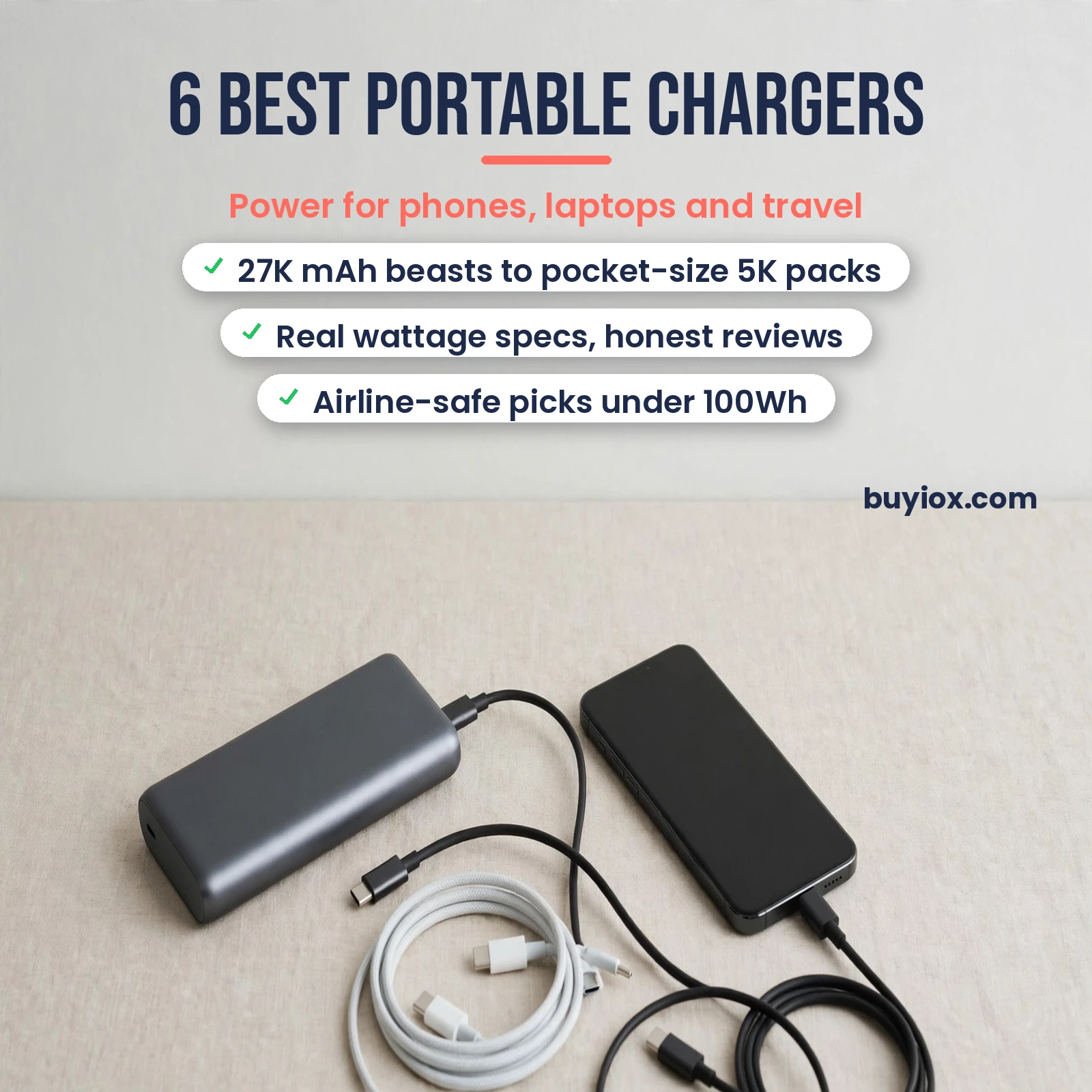
Your Phone Always Dies at the Worst Possible Moment
You know the feeling. The battery icon turns red at the airport gate, halfway through a travel day, or right when you need maps to find your hotel. Your phone is your camera, your wallet, your boarding pass and your lifeline – and a dead phone in an unfamiliar place is a genuine problem, not an inconvenience.
The market makes this harder than it should be. Thousands of portable chargers crowd Amazon, from suspiciously cheap $8 bricks to $180 power stations with spec sheets that read like riddles. The two numbers that matter most – capacity (mAh) and output speed (watts) – are printed in tiny text, and most listings do not tell you the things you actually need: can it fast-charge a laptop, will it survive a TSA check, and how much of that big mAh number actually reaches your phone.
This guide fixes that. We researched six real, currently available portable chargers – verified capacity, wattage and port specs from official brand pages – covering every real use case: the big laptop-charging beast, the slim everyday carry, the pocket mini, the MagSafe magnetic pack, and the travel pick with a built-in cable. Real pros, real cons, and the airline rules explained in plain English.
A note on prices: they shift constantly on Amazon, so every price below is approximate. The buttons take you to live Amazon search results where you can check the current price before buying.
Quick Comparison: The 6 Best Portable Chargers
| Product | Best For | Approx. Price |
| — | — | — |
|---|---|---|
| Anker Prime 27,650mAh 250W Power Bank | Best overall | Around $179 |
| UGREEN Nexode 25,000mAh 200W Power Bank | Best for laptops | Around $100 |
| INIU Carry P50-E1 10,000mAh 45W | Best budget pick | Around $30 |
| Baseus Blade 2 12,000mAh 65W | Best slim pick | Around $50 |
| Anker MagGo 5,000mAh Qi2 Slim | Best magnetic/MagSafe | Around $50 |
| Anker Nano 10,000mAh 45W with Built-in Cable | Best travel mini | Around $40 |
Prices change often on Amazon, so treat these as rough guides. All six sit under the airline limit, which we explain in the buying guide below.
1. Anker Prime 27,650mAh 250W Power Bank – Best Overall
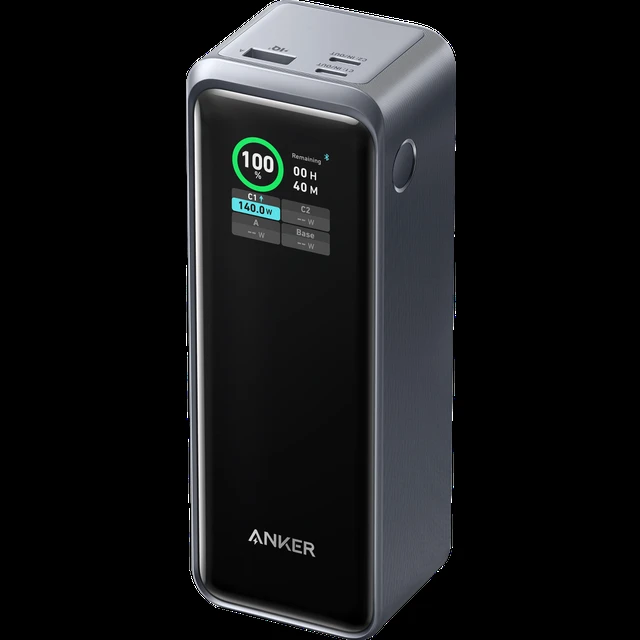
The Anker Prime 27,650mAh: 250W total output, smart display, and airline-safe 99.54Wh rating.
The Anker Prime 27,650mAh is the portable charger everything else gets measured against. If you want one power bank that can charge a laptop, a tablet and a phone at the same time – and actually do it fast – this is the one.
The headline numbers are serious: up to 250W of total output through two USB-C ports and one USB-A port, powered by the latest USB Power Delivery 3.1 standard (the USB-IF maintains the official specification at https://www.usb.org/). Each USB-C port can deliver up to 140W on its own. In practical terms, that means boosting a 16-inch MacBook Pro to 50% in about 28 minutes – the kind of charging speed you normally only get from a wall adapter. The smart display shows real-time wattage per port, remaining time and battery percentage, which stops the guessing game entirely.
The clever part is the capacity math: 27,650mAh works out to 99.54Wh – deliberately engineered to sit just under the 100Wh limit the FAA sets for carry-on lithium batteries without airline approval (the official rules are at https://www.faa.gov/hazmat/packsafe/lithium-batteries). It is the biggest battery you can legally carry on without asking the airline first. It charges a 13-inch MacBook Air roughly 1.28 times or an iPhone 14 nearly five times per brand figures.
Recharging the beast itself is fast too: up to 170W input refills it in about 37 minutes with the right charger. The Anker app adds sound-alert location finding and battery health optimization. In the box you get a 140W USB-C cable, a travel pouch and a 24-month warranty.
The honest downsides: it is heavy at 665g (about 1.5 lbs) – this is a bag charger, not a pocket charger. The price sits in the premium tier at around $179. And you need a high-wattage wall charger to get that 37-minute refill; with a normal 20W phone charger it takes much longer. It is also overkill if you only charge a phone – the 250W muscle goes unused.
Pros:
- 250W total output with PD 3.1 – the fastest multi-device charging on this list
- 140W per USB-C port – genuine laptop fast charging
- Smart display shows per-port wattage, time remaining and battery health
- 99.54Wh – the maximum battery you can fly with without airline approval
- 170W input refills the bank in about 37 minutes
- Anker app with find-my-powerbank sound alerts
- Charges a MacBook Air 1.28x or an iPhone 14 nearly 5x per brand figures
Cons:
- Heavy at 665g – a bag charger, not a pocket charger
- Premium price at around $179
- Needs a 100W+ wall charger to achieve the 37-minute refill
- Overkill if you only ever charge a phone
Best for: Laptop owners, digital nomads and anyone who wants the single most capable portable charger. The best portable charger overall.
Skip if: You only charge a phone and carry light – the INIU P50 below gives you what you need at a sixth of the price.
2. UGREEN Nexode 25,000mAh 200W Power Bank – Best for Laptops
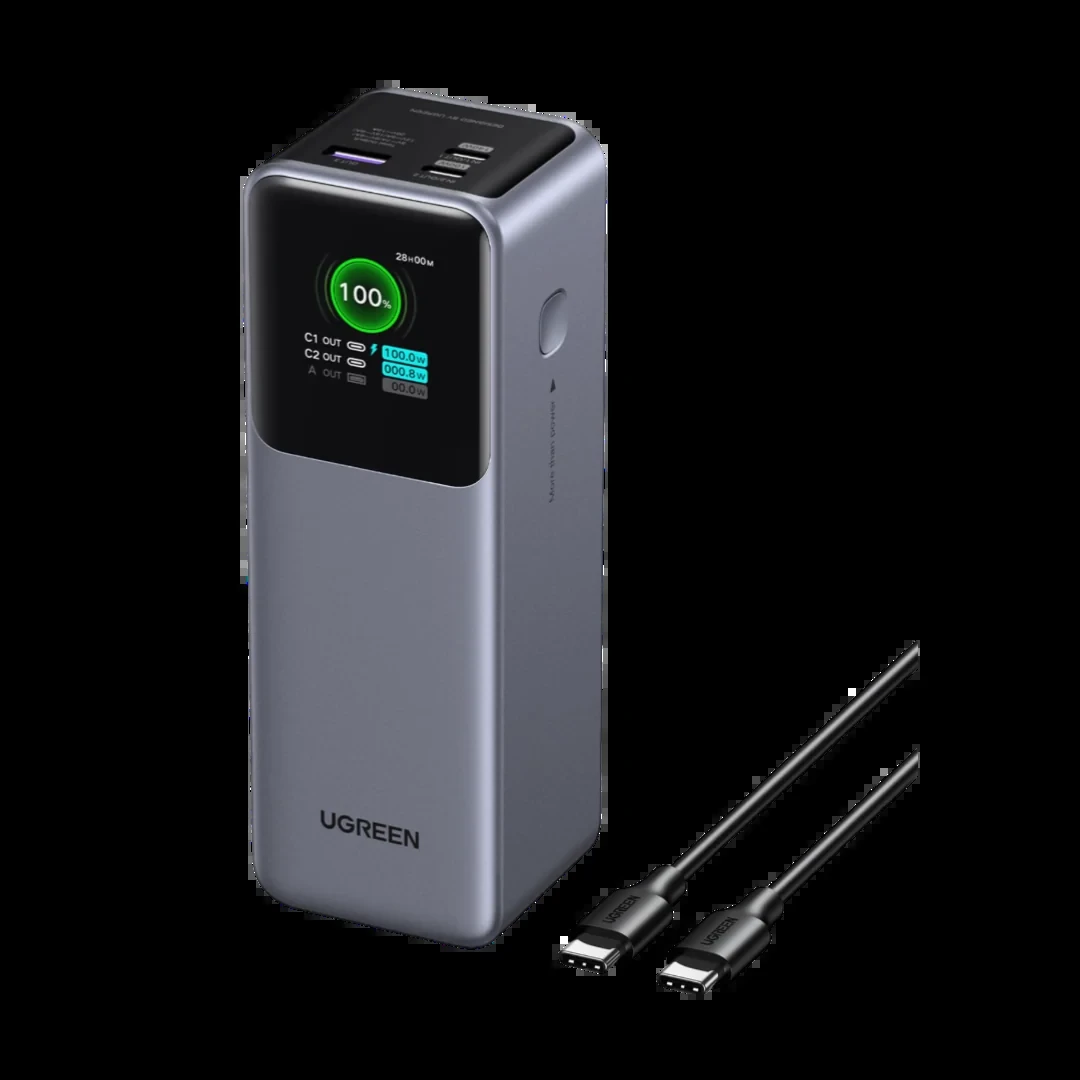
The UGREEN Nexode 25,000mAh: 200W total output, TFT smart display, and 90Wh airline-safe capacity.
If the Anker Prime is the flagship, the UGREEN Nexode 25,000mAh is the value flagship – most of the laptop-charging power at a noticeably lower price. This is the pick for anyone who needs to keep a MacBook or Windows laptop alive away from outlets.
The specs stack up well against chargers costing much more: 200W total output across two USB-C ports and one USB-A port. USB-C1 delivers up to 140W (PD 3.1), USB-C2 up to 100W, and the USB-A port up to 22.5W. That is enough to charge two laptops at once, or one laptop at full speed while topping up a phone and earbuds on the side. UGREEN’s own figures say it charges a 13-inch MacBook Air around 1.3 times or a modern iPhone nearly five times.
The TFT smart display is genuinely useful – it shows remaining capacity, live output wattage and battery health, not just a row of blinking dots. The bank itself is 25,000mAh rated at 90Wh, comfortably under the 100Wh airline threshold, and it weighs 592g – lighter than the Anker Prime while still carrying laptop-class power. Recharge input runs up to 65W per port, which refills the bank in roughly 2 hours with a decent wall charger.
Protocol support is broad: PD 3.0, PPS, QC 4+, SCP and more, so Samsung Super Fast Charging and other brand-specific fast charging modes work too. The dimensions (131 x 54 x 51mm) fit easily in a laptop bag side pocket.
The trade-offs: 65W input is slower than the Anker Prime’s 170W, so refilling takes longer. At 592g it is still not pocketable. And while UGREEN’s pricing is attractive (often around $100 on sale from a $150 list), it still costs three times the budget picks – worth it only if you actually charge laptops.
Pros:
- 200W total output – charges two laptops or laptop plus phone plus earbuds
- USB-C1 up to 140W with PD 3.1 support
- TFT smart display shows live wattage, capacity and battery health
- 90Wh capacity – safely under the 100Wh airline limit
- Lighter than the Anker Prime at 592g
- Broad protocol support: PD 3.0, PPS, QC 4+, SCP
- Strong value – laptop-class power often around $100 on sale
Cons:
- 65W recharge input is slower than the Anker Prime’s 170W
- Still too heavy for pockets – laptop bag territory
- Overkill price if you never charge a laptop
- Display adds cost and a (small) power drain
Best for: Laptop owners who want serious charging power without the Anker Prime price. The best power bank for laptops on value.
Skip if: Your heaviest device is a phone – you are paying for watts you will never use. Look at the INIU or Anker Nano instead.
3. INIU Carry P50-E1 10,000mAh 45W – Best Budget Pick
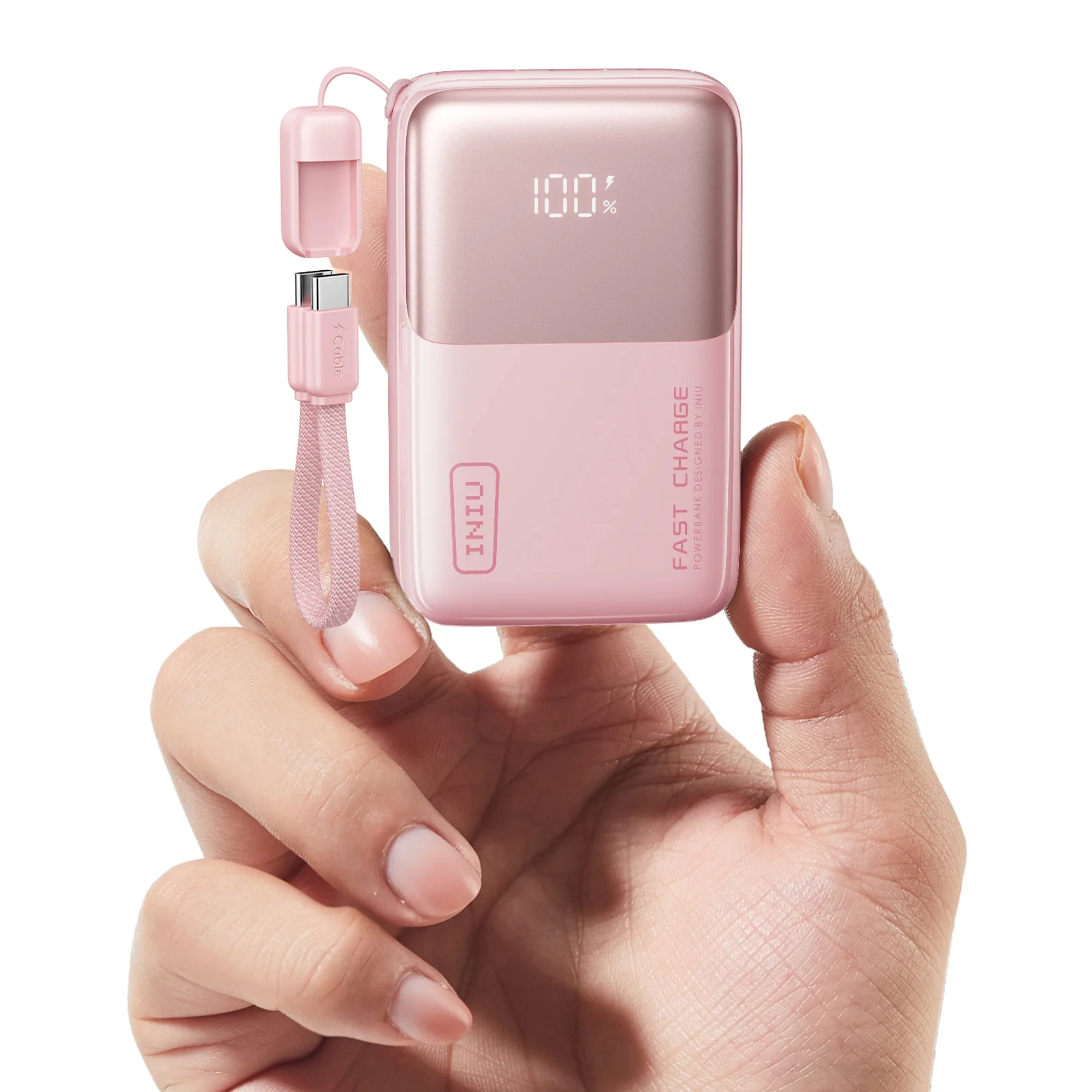
The INIU Carry P50-E1: 10,000mAh and 45W fast charging in a pocket-size body with a cable lanyard.
Here is the truth about portable chargers: most people do not need 200W. They need a pocket-size brick that fast-charges their phone twice and costs less than dinner. The INIU Carry P50-E1 is that brick, and it is the best value on this list by a wide margin.
The numbers: 10,000mAh capacity, 45W max output – enough to fast-charge any current phone (PD 3.0, QC 3.0, PPS and Samsung Super Fast Charging are all supported). INIU claims it can take a phone from empty to around 73% in 25 minutes, and it charges most phones 1.5 to 2 times on a single fill. Two USB-C ports plus one USB-A port handle a phone, earbuds and a watch at once.
The design is where it wins. It weighs just 160g (5.6 oz) and measures about 3.3 x 2.0 x 1.0 inches – genuinely pocketable. The detachable USB-C cable doubles as a lanyard, so you always have a cable and you will not forget to pack one. A small digital display shows the exact battery percentage. INIU backs it with a 3-year warranty, which is unusually generous at this price.
At around $30 (often less on sale), the value is remarkable. Independent roundups keep naming it their overall pick for most people, and the review consensus is strong.
The honest limits: 10,000mAh gives you roughly two phone charges, not five – this is a daily-carry top-up device, not a multi-day backup. 45W will not fast-charge a laptop (it will trickle-charge one slowly, at best). And 45W is shared across ports, so charging three devices at once slows each down. But for the phone-in-pocket use case, none of that matters.
Pros:
- Outstanding value – 45W fast charging at around $30
- Genuinely pocketable at 160g and 3.3 inches tall
- Detachable USB-C cable doubles as a lanyard – no forgotten cables
- Digital display shows exact battery percentage
- 3-year warranty – generous for the price
- Charges most phones 1.5 to 2 times, 0-73% in about 25 min per INIU labs
Cons:
- 10,000mAh is about two phone charges – not a multi-day backup
- 45W will not fast-charge laptops
- Output is shared across ports when charging multiple devices
- Compact size means it is easy to misplace
Best for: Everyday carry – commuters, students and anyone who wants fast phone charging in a pocket at a low price. The best budget portable charger.
Skip if: You need laptop charging or multi-day capacity – step up to the UGREEN or Anker Prime.
4. Baseus Blade 2 12,000mAh 65W – Best Slim Pick
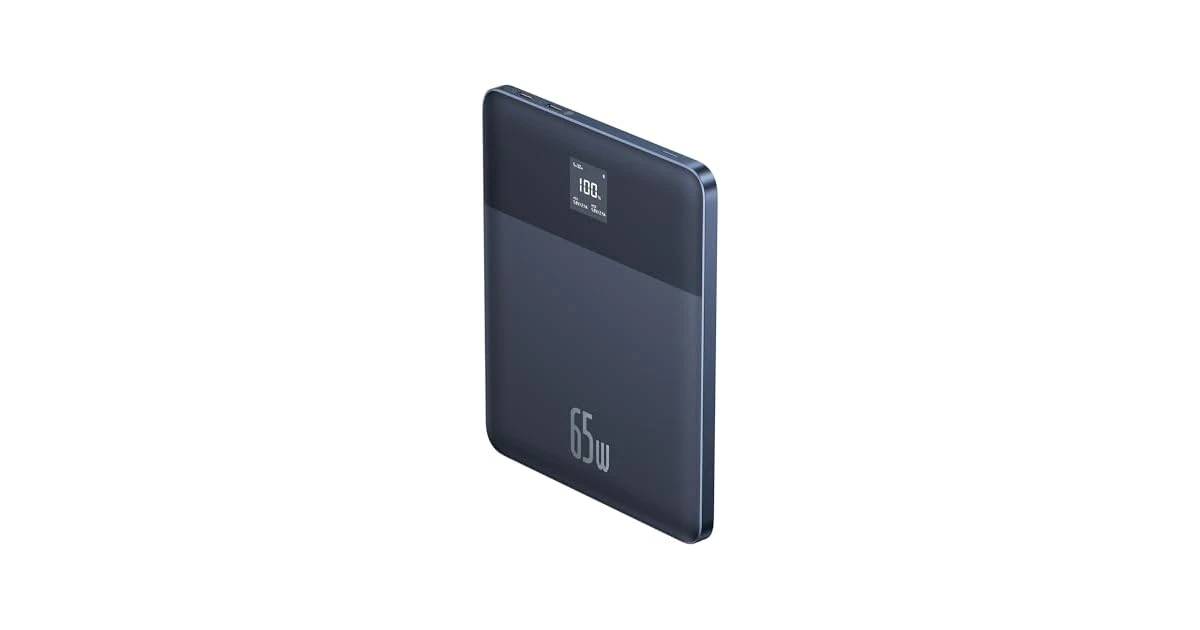
The Baseus Blade 2: 12,000mAh and 65W output in a 7.3mm-thin body that slips into a laptop sleeve.
The Baseus Blade 2 solves a specific problem: you want laptop-capable charging, but you refuse to carry a brick. At roughly 7.3mm at its thinnest section – thinner than most phones – it slides into a laptop sleeve or a jacket pocket like a second phone.
Despite the thin profile, it delivers: 12,000mAh capacity with 65W max output through two USB-C ports. 65W is the sweet spot for ultrabooks – it fast-charges a 13-inch MacBook Air, a tablet or any phone at full speed. The two USB-C ports can charge two devices at once. A built-in digital display shows battery percentage, and the Baseus app adds low-power mode, timer charging and even a customizable screensaver on the display – fun extras you do not get elsewhere at this price.
The rated energy is 46.44Wh (well under airline limits), and it weighs around 339g. Baseus claims roughly 2.2 full charges for an iPhone 15 or 1.8 for a Galaxy S23 class phone. A 100W USB-C cable is included in the box, which is a nice touch. At around $50 list – and it has been spotted on sale near $32 – it is excellent value for a 65W charger.
The honest downsides: 12,000mAh will not fully charge most laptops – one review measured about 46% of a 13-inch MacBook Air from empty. It is an emergency laptop top-up, not a full laptop refill. The ultra-slim body means the capacity is modest for its price, and thin batteries can run warmer under sustained 65W load. The app features are fun but not essential – do not buy it for the screensaver.
Pros:
- Ultra-slim at about 7.3mm – fits in a laptop sleeve or jacket pocket
- 65W output fast-charges ultrabooks, tablets and phones
- Two USB-C ports for simultaneous charging
- Digital display plus app with low-power mode and timers
- 100W USB-C cable included in the box
- 46.44Wh – comfortably airline-safe
- Strong value, often discounted well below $50
Cons:
- 12,000mAh gives roughly 46% of a MacBook Air – a top-up, not a full refill
- Slim batteries can run warm under sustained 65W load
- App extras are fun, not essential
- Less capacity per dollar than the chunkier picks
Best for: Ultrabook owners and minimalists who want 65W laptop charging in a pocketable form. The best slim portable charger.
Skip if: You need multiple full laptop charges – the UGREEN Nexode gives you double the capacity for about double the price.
Buying Guide: How to Choose a Portable Charger
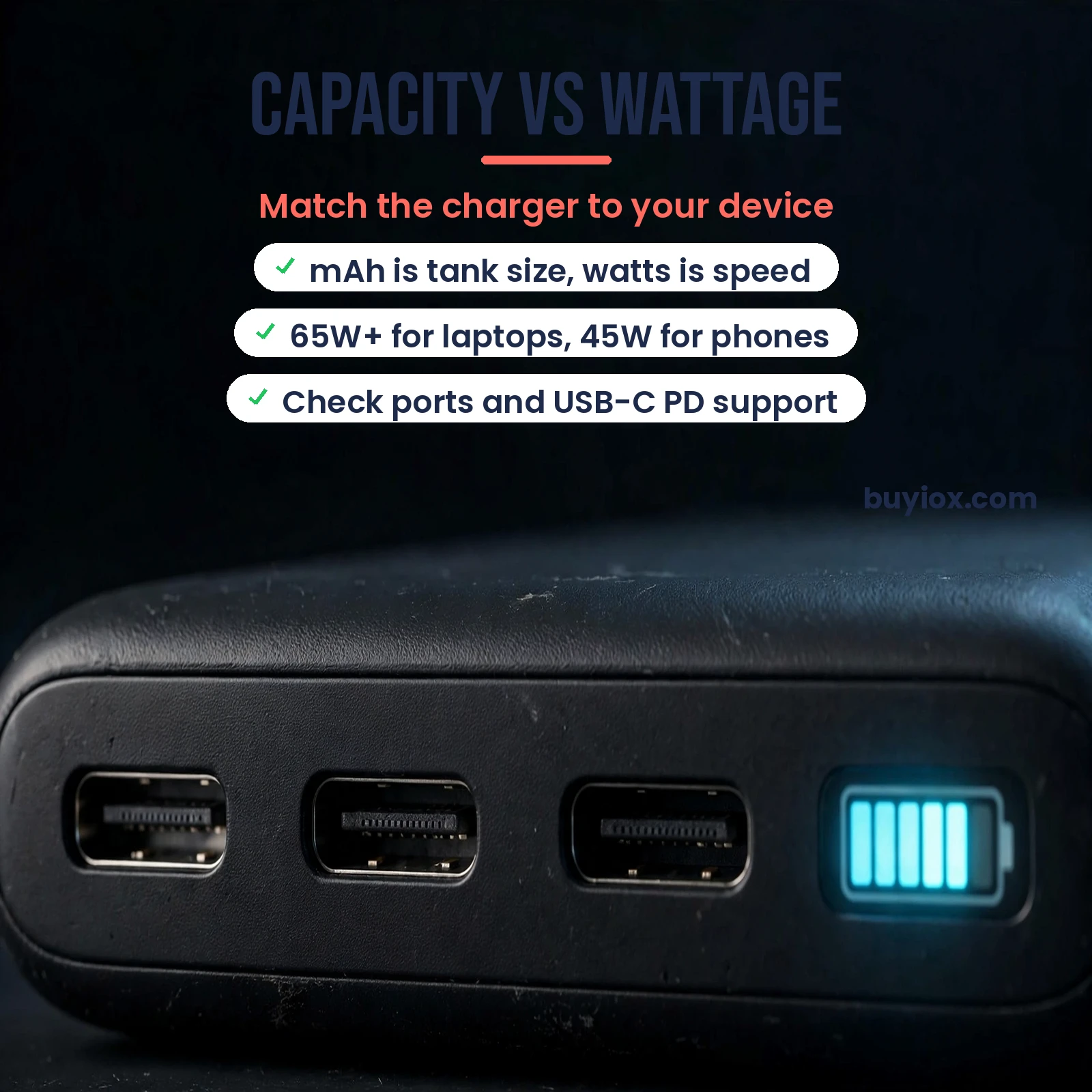
Buying a power bank on mAh alone is the classic mistake. A 30,000mAh brick with 10W output will charge your phone slowly all day. A 5,000mAh pack with 15W wireless might be exactly right for your commute. Five things to match to your actual life:
Capacity (mAh) vs. energy (Wh) – and the airline rule
mAh tells you the tank size. Roughly: 5,000mAh is one phone charge, 10,000mAh is about two, 20,000-27,000mAh is four to five phone charges or one laptop charge. But airlines do not care about mAh – they care about watt-hours (Wh). The FAA rule is simple: batteries under 100Wh can fly in carry-on with no airline approval, 100-160Wh needs airline approval, and anything over 160Wh cannot fly at all (https://www.faa.gov/hazmat/packsafe/lithium-batteries). The TSA follows the same framework for carry-on screening (https://www.tsa.gov/travel/security-screening/whatcanibring/items/portable-chargers). Every charger on this list sits under 100Wh – that is deliberate. Also: power banks always go in carry-on, never in checked baggage. Spare lithium batteries are banned from checked bags.
Wattage and USB-C Power Delivery
Watts are speed. A phone fast-charges at 20-45W, a tablet at 30-45W, and a laptop needs 45-100W depending on size. USB-C Power Delivery (PD) is the universal fast-charging standard – the USB Implementers Forum maintains the specification (https://www.usb.org/) – and PD 3.1 added the high-voltage modes that make 140W+ charging possible. Match the charger’s single-port output to your hungriest device: 65W or more for laptops, 45W for phones and tablets. Multi-port totals (200W, 250W) only matter if you charge several devices at once.
Ports: how many, and which type
Count your devices, then add one. Two USB-C plus one USB-A covers a laptop, phone and earbuds for most people. USB-C is the future – it handles both input and output at high wattage – while USB-A is legacy convenience for older cables and accessories. Built-in or retractable cables (like the Anker Nano’s) eliminate the forgotten-cable problem entirely, which matters more than it sounds.
MagSafe and Qi2 wireless
If you use an iPhone 12 or newer, a magnetic pack snaps onto the back and charges with no cable at all. Qi2 is the newer standard that brings MagSafe-style magnets to Android phones too, at up to 15W wireless. Wireless is slower and less efficient than wired – expect roughly 60-75% of the energy to reach the phone versus nearly all of it over cable – but for top-ups on the move, the convenience is real. The Anker MagGo below is the pick for this.
Weight and size – be honest about your bag
The best charger is the one you actually carry. A 665g flagship does nothing sitting on your desk. If you commute with a small bag, a 160g pocket bank beats a 600g brick every time – even with a quarter of the capacity. Laptop-bag commuters can carry the big ones; jeans-pocket people should stay under 200g.
5. Anker MagGo 5,000mAh Qi2 Slim – Best Magnetic / MagSafe Pick
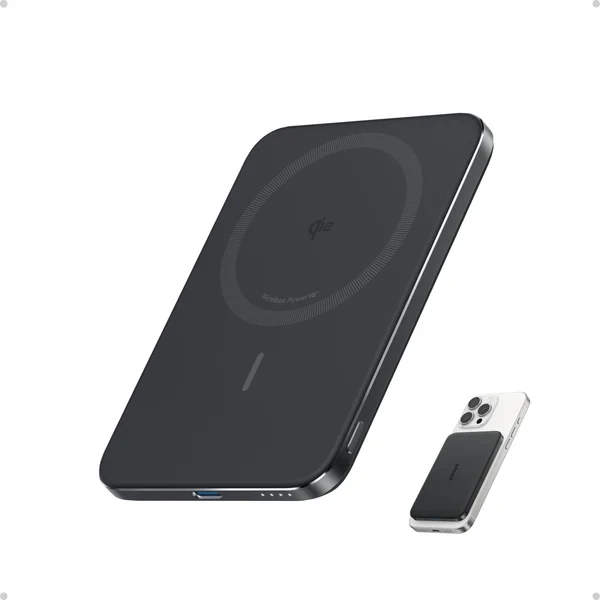
The Anker MagGo 5,000mAh: ultra-slim Qi2 magnetic charging at up to 15W, plus 20W wired USB-C.
Some days you do not want a cable at all. The Anker MagGo 5,000mAh slim snaps magnetically onto the back of your phone and tops it up while you keep using it – no cable, no pocket bulk, no fumbling. For iPhone 12 through 17 with MagSafe, and Qi2-compatible Android phones, it is the most convenient charger on this list.
The specs: 5,000mAh capacity with up to 15W Qi2 magnetic wireless charging – the fastest wireless speed the standard allows. A USB-C port adds 20W wired charging for when you want speed, and the port works both ways (the bank refills in under two hours). The whole thing is just 8.6mm thick and weighs 122g – half the weight of a big iPhone, thin enough to forget it is attached.
Anker rates it to bring an iPhone 16 Pro to about 25% in roughly 42 minutes wirelessly. The aluminum alloy frame and dual temperature sensors keep it cooler than typical magnetic packs during wireless charging.
The honest limits: 5,000mAh is roughly one phone charge – this is a top-up device, not a backup battery. Wireless charging wastes energy as heat, so you get fewer effective charges than the same capacity wired. It only works properly with magnetic phones or magnetic cases – thick non-magnetic cases (over about 2.5mm) interfere with charging. And at around $50, you are paying a premium per mAh for the magnetic convenience.
Pros:
- Magnetic snap-on charging – no cables needed
- Up to 15W Qi2 wireless – the fastest the standard allows
- Ultra-slim at 8.6mm and just 122g
- 20W USB-C port for faster wired charging when needed
- Refills in under two hours via USB-C
- Cooler-running aluminum frame with temperature sensors
Cons:
- 5,000mAh is roughly one phone charge – a top-up device only
- Wireless charging is less efficient than wired
- Needs a magnetic phone or magnetic case – thick cases interfere
- Premium price per mAh for the magnetic convenience
Best for: iPhone (MagSafe) and Qi2 Android users who want cable-free top-ups during the day. The best magnetic portable charger.
Skip if: You need multiple charges or do not have a magnetic phone – the INIU P50 gives you double the capacity for less money.
6. Anker Nano 10,000mAh 45W with Built-in Cable – Best Travel Mini
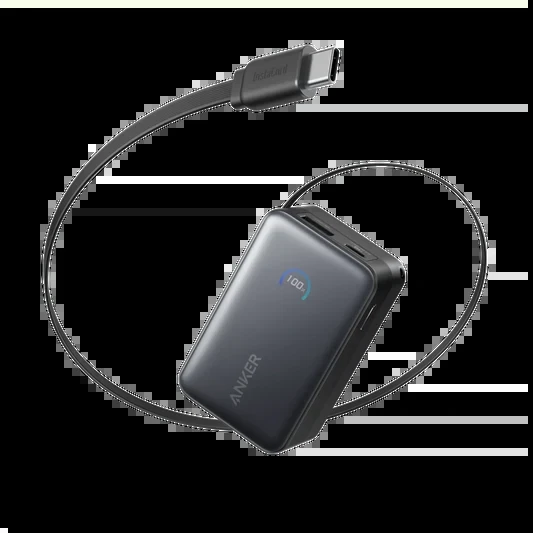
The Anker Nano 10,000mAh: 45W fast charging with a built-in retractable USB-C cable – nothing to forget.
The Anker Nano 10,000mAh exists for travelers who have learned the hard way: the cable is always the thing you forget. This one has a built-in retractable USB-C cable (about 2.3 feet) that pulls out when you need it and disappears when you do not – plus the USB-C port itself for a second device.
The specs hit the sweet spot for a travel mini: 10,000mAh (about two to three phone charges), 45W max output – enough to fast-charge an iPhone 16 Pro to 50% in under half an hour per brand figures – and 30W input so the bank itself refills in roughly two hours. Pass-through charging lets it charge your phone while the bank refills from the wall, which is genuinely handy in hotel rooms with one free outlet. A smart display shows real-time charging status.
It measures about 3.2 x 2.0 x 1.4 inches and weighs 8.2 oz (232g) – compact enough for a jacket pocket or a carry-on side pouch, and fully flight-approved well under the 100Wh limit. Anker’s 24-month warranty and huge service network add peace of mind for a travel device.
The honest downsides: a single built-in cable means if it ever wears out, you lose the headline feature – though the USB-C port still works with any cable. 10,000mAh will not cover a multi-day trip without a wall recharge. And at around $40 it costs more than the INIU P50 – you are paying for the retractable cable and the Anker brand.
Pros:
- Built-in retractable USB-C cable – nothing to forget or pack
- 45W fast charging for phones and tablets
- Pass-through charging – charge phone and bank at once
- Smart display shows real-time charging status
- 30W input refills the bank in about two hours
- Flight-approved, compact at 8.2 oz
Cons:
- Built-in cable is a single point of failure if it wears out
- 10,000mAh needs a wall recharge on multi-day trips
- Costs more than the INIU P50 for similar capacity
- Only one built-in cable – second device needs its own cord
Best for: Travelers and commuters who always forget cables. The best travel mini portable charger.
Skip if: You never forget cables and want the lowest price – the INIU P50-E1 does the same job cheaper.
Frequently Asked Questions
Can I take a portable charger on a plane?
Yes, in your carry-on – never in checked baggage. The FAA allows lithium batteries under 100Wh in carry-on without airline approval, batteries between 100Wh and 160Wh need airline approval, and anything over 160Wh is banned from flights (https://www.faa.gov/hazmat/packsafe/lithium-batteries). The TSA applies the same rules at screening (https://www.tsa.gov/travel/security-screening/whatcanibring/items/portable-chargers). Every charger in this guide is under 100Wh, so all six fly with no paperwork. Spare batteries are prohibited in checked luggage because a damaged battery in the hold cannot be reached in an emergency.
What does mAh actually mean on a power bank?
Milliamp-hours (mAh) measure the battery’s charge capacity – think of it as the size of the fuel tank. A 10,000mAh bank holds roughly enough energy to charge a modern phone about twice. But not all of it reaches your phone: voltage conversion and heat losses mean real-world output is typically 60-80% of the rated number, which is why a “10,000mAh” bank gives you about two charges rather than three. Bigger mAh is not automatically better – a 30,000mAh bank with slow 10W output charges your phone more slowly than a 10,000mAh bank with 45W output.
How many watts do I need to charge a laptop?
It depends on the laptop. Ultrabooks like the MacBook Air charge happily at 45-65W, which is why the Baseus Blade 2 (65W) works for them. Larger laptops like the 16-inch MacBook Pro want 96W or more for full-speed charging – that is where the Anker Prime (140W per port) and UGREEN Nexode (140W on USB-C1) earn their keep. Check your laptop’s original wall adapter wattage: matching or exceeding it gives you full-speed charging. A 45W bank will still charge most laptops slowly or hold their charge steady while you work, but it will not fast-charge a power-hungry machine.
Is wireless magnetic charging worse than wired?
It is slower and less efficient, but not worse for every situation. Qi2 magnetic charging tops out at 15W versus 45W+ for wired, and wireless transfer loses roughly 25-40% of energy as heat – so a 5,000mAh magnetic bank delivers fewer effective charges than a 5,000mAh wired bank. The trade is convenience: a magnetic pack like the Anker MagGo snaps on with no cable and charges while you use the phone one-handed. For overnight or full-speed charging, wired wins. For daytime top-ups on the move, magnetic is the more pleasant experience.
Why does my power bank charge slower with two devices plugged in?
Because the total wattage is shared. A 65W bank with two devices connected splits its output between the ports – often unevenly, with one port getting priority. This is normal and safe; the bank’s internal circuitry divides power to stay within its rated total. If you need full speed on two devices at once, buy a bank whose total wattage covers both: for example, a laptop (65W) plus a phone (25W) wants at least 90W total. The Anker Prime’s 250W and UGREEN’s 200W exist precisely for this scenario.
How long do portable chargers last before they wear out?
A quality lithium power bank lasts roughly 300-500 full charge cycles before its capacity noticeably drops – for most people, that is 2-4 years of regular use. Heat is the main killer: avoid leaving banks in hot cars or charging them under pillows. Storing a bank at 100% for months also ages it faster; if you will not use it for a while, store it around 50-60% charge. When a bank that used to give two phone charges only manages one, the battery is worn out – recycle it properly rather than binning it, since lithium batteries do not belong in household trash.
Is a bigger mAh number always better?
No – it is a trade-off against weight, size and recharge time. A 27,650mAh bank weighs over 600g and takes over half an hour to refill even with a 170W charger; a 10,000mAh bank weighs 160g and refills in under two hours with a normal charger. Bigger also means longer to recharge and more bulk to carry every day. The right size is the smallest bank that covers your longest day away from outlets: 5,000-10,000mAh for daily phone use, 20,000mAh+ for laptops and travel. Carrying capacity you never use just means carrying weight you never needed.
Final Verdict: Which Portable Charger Should You Buy?
If you want our single top recommendation, it is the Anker Prime 27,650mAh 250W. It is the most capable portable charger you can buy: 250W of PD 3.1 output, 140W per USB-C port, a smart display that tells you exactly what is happening, and a 99.54Wh rating that squeezes the maximum legal battery under the airline limit. At around $179 it is expensive, but nothing else charges a laptop, tablet and phone this fast from one brick.
For laptop owners who want most of that power for less money, the UGREEN Nexode 25,000mAh 200W is the value play: 200W total, 140W on the first USB-C port, and a genuinely useful TFT display, often around $100 on sale. For everyone else – the phone-in-pocket majority – the INIU Carry P50-E1 at around $30 is the honest answer: 10,000mAh, 45W fast charging, a cable you cannot forget, and a 3-year warranty. The Baseus Blade 2 is the pick if slim matters more than anything, the Anker MagGo 5,000mAh if you live the cable-free magnetic life, and the Anker Nano 10,000mAh if you travel and always forget cables.
Two numbers decide everything: the watts your hungriest device needs, and the mAh your longest day demands. Get those two right and any of the six above will serve you well for years. For more travel-ready tech, check our picks for the best bluetooth key finder so you never lose your gear, and the best mini projector for movie nights anywhere.