Affiliate Disclosure: This article contains affiliate links. If you buy through them, we may earn a commission at no extra cost to you. It helps us keep testing and publishing honest reviews.
https://buyiox.com/wp-content/uploads/2026/11/dl-featured.webp
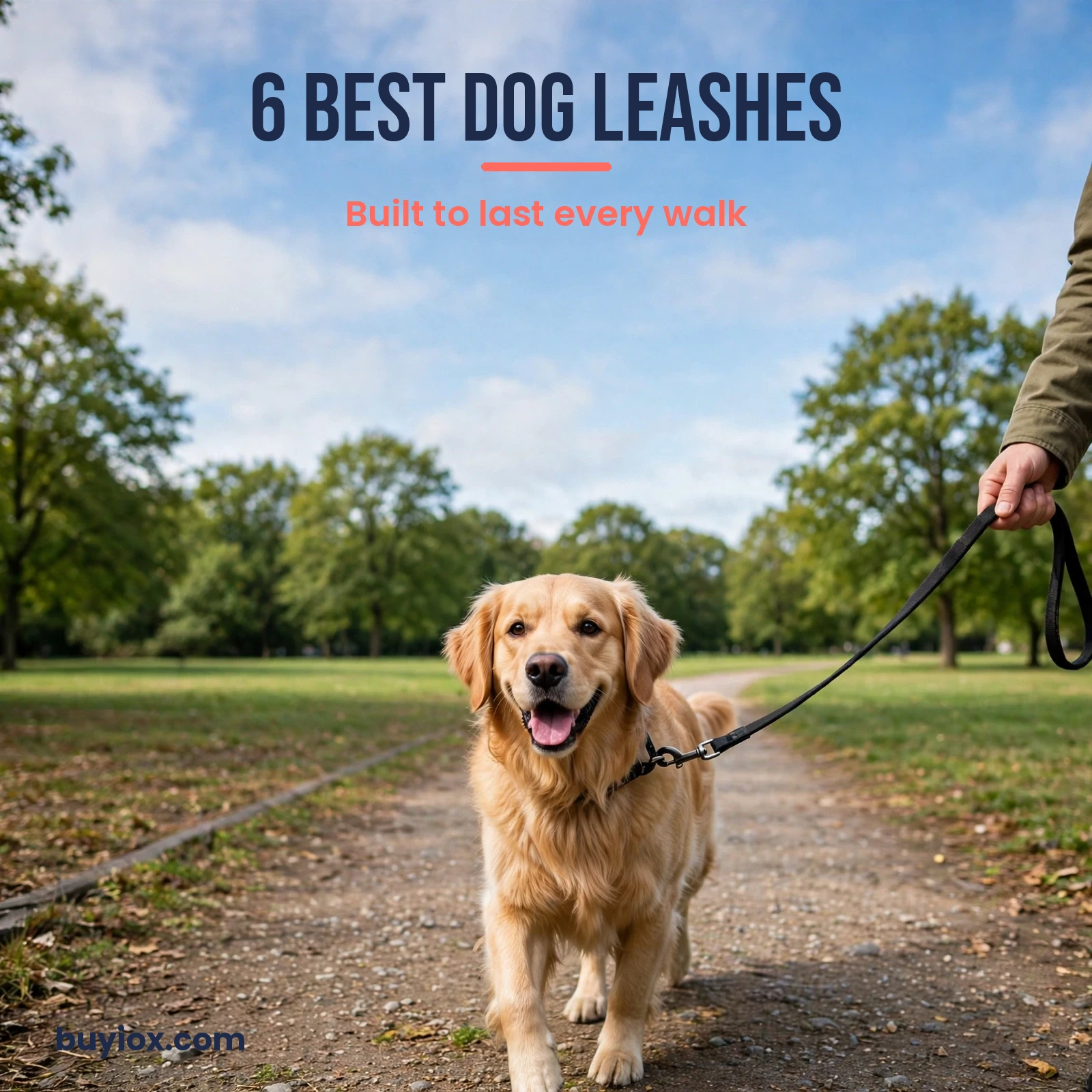
6 Best Dog Leashes for Everyday Walks That Actually Last
The leash snapped on a Tuesday. Not during a hike, not at the dog park, just an ordinary walk around the block. One second my dog was trotting beside me, the next he was sprinting toward a squirrel while I stood there holding a frayed handle and a very expensive lesson. A leash is the one piece of dog gear you use every single day, twice a day, in rain, mud, and summer heat. It is also the piece most people buy as an afterthought, grabbing whatever is cheapest at the checkout counter.
That is a mistake. A bad leash does more than annoy you. A thin cord burns your palm when your dog lunges. A weak clasp can pop open at a busy intersection. A stiff handle turns a relaxing walk into a wrestling match. The best dog leash is the one you forget you are holding: comfortable in your hand, strong enough for your dog, and still in one piece after hundreds of walks.
We researched the most recommended leashes across trainer roundups, gear-lab tests, and thousands of owner reviews to find six that genuinely last. Every leash below comes from a brand with a real track record, and every one has been recommended by independent reviewers, not just its own marketing team. We cover fixed leashes, a rope leash, a retractable, and a slip lead, so whatever your dog’s size and walking style, there is a pick here for you.
If your dog pulls hard enough that a leash alone is not solving it, pair your new leash with one of our best no-pull dog harnesses – the right harness and leash combination changes walks completely.
Our Top Picks at a Glance
- Best overall: Ruffwear Front Range Leash – light, tough, and comfortable for almost any dog
- Best for pulling dogs: Max and Neo Double Handle Traffic Leash – two padded handles give you control when it counts
- Best budget for large dogs: BAAPET Strong Dog Leash – climbing-rope strength for around $8
- Best retractable: TUG 360 Tangle-Free Retractable Leash – 16 feet of freedom for calm, trained dogs
- Best simple everyday leash: PetSafe Nylon Leash – the no-nonsense classic that just works
- Best slip leash: Mendota Pet Slip Leash – a trainer favorite, made in the USA
Comparison Table
| Dog Leash | Best For | Length | Material | Around Price |
|---|---|---|---|---|
| Ruffwear Front Range | Most dogs, everyday walks | 5 ft | Nylon webbing | Around $20 |
| Max and Neo Double Handle | Pulling dogs, traffic control | 6 ft | Reflective nylon | Around $17 |
| BAAPET Strong | Large dogs on a budget | 5 ft | Climbing rope | Around $8 |
| TUG 360 Retractable | Calm dogs, open spaces | 16 ft | Nylon tape | Around $22 |
| PetSafe Nylon | Training, simple daily use | 6 ft | Nylon webbing | Around $10 |
| Mendota Pet Slip Leash | Training, quick walks | 6 ft | Braided rope | Around $20 |
https://buyiox.com/wp-content/uploads/2026/11/dl-in1.webp
The 6 Best Dog Leashes for Everyday Walks
1. Ruffwear Front Range Leash – Best Overall Dog Leash
If you only buy one leash, make it this one. The Ruffwear Front Range Leash is the closest thing to a universal everyday leash: light enough for small dogs, strong enough for medium and large ones, and comfortable enough that your hand will not ache after a long walk. It is the pick that independent roundups keep coming back to, and Ruffwear’s reputation in outdoor dog gear is hard to beat.
https://buyiox.com/wp-content/uploads/2026/11/dl-prod-1.jpg
The Ruffwear Front Range Leash (5 ft) – our best overall dog leash for everyday walks.
What makes it stand out is how thoughtfully it is built for daily use. The Tubelok jacquard webbing resists fraying and fading, so the leash still looks and feels good after months of mud, rain, and sun. The padded handle is genuinely comfortable, not a thin strip of foam that flattens in a week. A locking clasp keeps the connection secure, and a short traffic handle near the clasp lets you pull your dog close in seconds at a crosswalk or when another dog approaches. At 5 feet long and just 3/4 of an inch wide, it hits the sweet spot between control and freedom, and it comes in seven colors.
- Length: 5 feet, 3/4 inch wide
- Material: Tubelok nylon webbing with padded handle
- Hardware: Locking clasp plus traffic handle
- Colors: 7 color options
- Price: Around $20
Pros:
- Lightweight and comfortable for long daily walks
- Padded handle and locking clasp are genuinely useful, not gimmicks
- Traffic handle gives instant close control in busy spots
- Tubelok webbing resists fraying and fading far better than basic nylon
- Trusted outdoor brand with a strong warranty reputation
Cons:
- Only 5 feet long – some owners prefer a full 6 feet
- Thin webbing is not ideal for heavy chewers or very strong pullers
- The clasp is on the small side for giant breeds
- Costs more than a basic nylon leash
Best for: Most dogs and most owners – small to large breeds with decent leash manners who need one reliable everyday leash.
Skip it if: Your dog is a powerful puller or a leash chewer, or you want a full 6-foot length for training work.
2. Max and Neo Double Handle Traffic Leash – Best Leash for Pulling Dogs
When your dog pulls, the problem is rarely just strength – it is leverage. The Max and Neo Double Handle Traffic Leash solves that with a second padded handle positioned close to the clasp. Grab the traffic handle and your 70-pound puller is suddenly walking at your side, not three feet ahead of you. For owners of strong dogs, that second handle is worth more than any fancy material.
https://buyiox.com/wp-content/uploads/2026/11/dl-prod-2.jpg
The Max and Neo Double Handle Traffic Leash (6 ft, red) – the best leash for pulling dogs.
The leash is made from 2mm thick nylon webbing with reflective stitching woven through it, so it stays visible on evening walks. Both handles are padded with soft neoprene, which matters more than it sounds: a bare nylon handle digs into your palm the moment a strong dog lunges, and neoprene spreads that force out. A D-ring near the main handle lets you clip on poop bags or a small pouch. The 6-foot length is the standard trainers recommend, and the metal clasp is sturdy enough for large breeds. Max and Neo also donates one leash to a dog rescue for every leash sold, which is a nice reason to feel good about the purchase. Independent reviewers have called it one of the best budget traffic-handle leashes you can buy, and at around $17 it is hard to argue with.
- Length: 6 feet, 1 inch wide
- Material: 2mm thick reflective nylon webbing
- Handles: Two padded neoprene handles (main + traffic)
- Extras: D-ring near handle for bags and accessories
- Price: Around $17
Pros:
- Traffic handle gives real control over strong pullers
- Two padded neoprene handles protect your hands
- Reflective stitching keeps you visible at night
- Excellent value – premium features at a budget price
- Buy-one-donate-one rescue program
Cons:
- 1-inch width feels bulky for toy breeds and small dogs
- No locking clasp – the standard clasp is strong but basic
- The second handle can dangle and snag if you never use it
- Heavier than a single-handle leash
Best for: Medium and large dogs that pull, owners who walk near traffic or in crowded areas, and anyone who wants maximum control without paying premium prices.
Skip it if: You have a small dog under 20 pounds, or your dog already walks politely on a loose leash and does not need a traffic handle.
3. BAAPET Strong Dog Leash – Best Budget Leash for Large Dogs
Here is the truth about leash prices: you do not need to spend $40 to get a leash that survives a large dog. The BAAPET Strong Dog Leash costs around $8 and is made from the same kind of 1/2-inch diameter nylon rope used in rock climbing. That is the whole secret. Thick rope, a strong metal clasp, and a padded handle, with nothing extra to break.
https://buyiox.com/wp-content/uploads/2026/11/dl-prod-3.jpg
The BAAPET Strong Dog Leash (5 ft, black) – the best budget leash for large dogs.
The 13-inch foam padded handle is the feature owners mention most. A bare rope handle burns your hand when a big dog pulls, but the thick foam grip on this leash spreads the pressure and protects your palm, even on long walks. Reflective threads are woven through the rope for nighttime visibility, and the 360-degree rotating zinc-alloy clasp keeps the leash from twisting as your dog circles. It comes in lengths of 2, 4, 5, and 6 feet and a wide range of colors, and the 5-foot version reviewed here is rated for dogs from 18 to 120 pounds. Reviewers at Rover named it the most comfortable leash for pet parents, and it shows up in nearly every “best leashes for big dogs” roundup published in the last few years.
- Length: 5 feet (2, 4, and 6-foot versions available), 1/2 inch diameter rope
- Material: Rock climbing nylon rope with reflective threads
- Handle: 13-inch foam padded handle
- Hardware: 360-degree rotating zinc-alloy clasp
- Weight rating: Dogs from 18 to 120 pounds
- Price: Around $8
Pros:
- Outstanding strength for the price – climbing rope does not fray easily
- The padded handle genuinely prevents rope burn on strong pulls
- Reflective threads add real nighttime safety
- Multiple lengths and colors to match your dog and your style
- Rated up to 120 pounds, so it covers most large breeds
Cons:
- The rope is thick and heavy for small dogs
- No traffic handle for close control
- The foam handle can absorb water and take time to dry
- Budget hardware – check the clasp regularly for wear
Best for: Large and strong dogs, budget-conscious owners, and anyone who wants maximum durability per dollar spent.
Skip it if: You have a small or toy breed, or you want a lightweight leash that packs down small for travel.
4. TUG 360 Tangle-Free Retractable Leash – Best Retractable Dog Leash
Retractable leashes are controversial, and honestly, some of that criticism is fair. PetMD warns that retractable leashes can cause injuries when dogs bolt to the end of the line, and they can reinforce pulling because dogs learn that pulling earns more freedom. But for a calm, well-trained dog in an open space, a good retractable leash is genuinely useful – it lets your dog sniff and explore while you keep walking at your own pace. The TUG 360 is the retractable we would buy.
https://buyiox.com/wp-content/uploads/2026/11/dl-prod-4.jpg
The TUG 360 Tangle-Free Retractable Leash (16 ft) – the best retractable leash for calm dogs.
The TUG 360 uses a 16-foot strong nylon tape instead of a thin cord. Tape is wider, easier to see, and less likely to cause the kind of friction burns that thin retractable cords are known for. The one-handed brake, pause, and lock system works with a thumb, so you can stop the line instantly without fumbling. The 360-degree tangle-free swivel means the leash does not twist into knots when your dog circles you, which is the most annoying failure of cheaper retractables. The housing is a comfortable ergonomic shape with an anti-slip grip, and it comes in small, medium, and large sizes for dogs up to 110 pounds. The medium size reviewed here suits dogs up to 55 pounds.
- Length: 16 feet of nylon tape
- Control: One-handed brake, pause, and lock
- Design: 360-degree tangle-free swivel, anti-slip ergonomic handle
- Sizes: Small, medium, and large – up to 110 pounds
- Price: Around $22
Pros:
- Nylon tape is safer and more visible than thin retractable cords
- 16 feet of range for sniffing and exploring in open areas
- One-handed brake is fast and intuitive
- Tangle-free design actually works – no more twisted lines
- Comfortable grip for long walks
Cons:
- Not suitable for pullers, reactive dogs, or puppies still learning leash manners
- Should never be used near roads or in crowded areas
- The plastic housing can crack if dropped on concrete
- Retractable leashes teach pulling if used with untrained dogs
Best for: Calm, well-trained dogs with good recall, and owners who walk in parks, fields, and other open spaces where extra range is safe.
Skip it if: Your dog pulls, lunges, or bolts, if you walk near traffic, or if your dog is still learning loose-leash walking. A fixed leash is the safer choice.
5. PetSafe Nylon Leash – Best Simple Everyday Dog Leash
Some products do not need reinventing. The PetSafe Nylon Leash is a flat nylon leash with a loop handle at one end and a bolt snap at the other. No padding, no second handle, no retractable mechanism, no gimmicks. It is the leash trainers reach for when they are teaching a puppy to walk nicely, and it is the leash that shows up in gear-lab durability tests year after year because it simply refuses to break.
https://buyiox.com/wp-content/uploads/2026/11/dl-prod-5.jpg
The PetSafe Nylon Leash (6 ft, black) – the best simple everyday leash for training and daily walks.
The soft, durable nylon has heavy-duty stitching throughout, and the bolt snap is a secure, simple design that clips on and off easily even with cold hands. It comes in 4-foot and 6-foot lengths and three widths (3/8 inch, 3/4 inch, and 1 inch), so you can match the leash to your dog’s size properly – narrow for small dogs, wide for large ones. The 3/4-inch by 6-foot version reviewed here is the most versatile size for everyday use. TechGearLab named it the best bang for your buck in its leash testing, praising its durability and low price, and it pairs perfectly with PetSafe’s own Easy Walk harness if your dog needs extra help with pulling. It is also one of the best leashes for puppy training, because a plain 6-foot leash is exactly what trainers recommend for teaching loose-leash walking.
- Length: 6 feet (4-foot version available)
- Width: 3/4 inch (3/8 inch and 1 inch available)
- Material: Soft, durable nylon with heavy-duty stitching
- Hardware: Secure bolt snap
- Price: Around $10
Pros:
- Simple, proven design with nothing to break
- Excellent durability for the price – gear labs rate it highly
- Multiple lengths and widths for a proper fit
- Light and easy to carry, great for training sessions
- Pairs perfectly with no-pull harnesses
Cons:
- No padded handle – long walks with a puller can hurt your hand
- Basic look, no reflective stitching or premium touches
- No traffic handle for close control
- Thin nylon can feel flimsy compared to rope leashes
Best for: Puppies in training, owners who want a reliable spare leash, and anyone who prefers a simple, lightweight leash for daily walks.
Skip it if: Your dog is a strong puller and you need a padded handle, or you want reflective material for night walks.
6. Mendota Pet Slip Leash – Best Slip Leash for Training
A slip leash is a leash and collar in one piece: a loop of rope that slides over your dog’s head and tightens gently when they pull, then loosens when they relax. Trainers love them because there is nothing to fumble with – no clasp, no buckle, just slip it on and walk. The Mendota Pet Slip Leash is the one trainers and reviewers keep recommending, and it has been made the same way in the USA for years.
https://buyiox.com/wp-content/uploads/2026/11/dl-prod-6.jpg
The Mendota Pet Slip Leash (6 ft) – the best slip leash for training and quick walks.
The leash is made from soft, pliable braided multifilament polypropylene rope that is UV-coated to resist fading and decay. An oil-tanned leather slide lets you adjust the loop, and a leather stop keeps the loop from tightening too far. It comes in 3/8-inch and 1/2-inch widths and 4-foot and 6-foot lengths, in dozens of colors, so you can match it to your dog’s size and your taste. The 3/8-inch by 6-foot version reviewed here suits small and medium breeds. Professional trainers use Mendota slip leads for quick on-and-off work, vet visits, and training sessions, and one independent gear review named the Mendota leash family the best overall dog leash of all, praising its durability, craftsmanship, and the way it scrunches into a pocket when you are done.
- Length: 6 feet (4-foot version available)
- Width: 3/8 inch (1/2 inch for large breeds)
- Material: Braided polypropylene rope, UV-coated
- Hardware: Oil-tanned leather slide and stop, brass ring
- Made in: USA
- Price: Around $20
Pros:
- Leash and collar in one – fastest on and off of any leash type
- Soft rope is comfortable in the hand and gentle on the dog
- Extremely durable – UV-coated braid resists weather and wear
- Packs down small enough to fit in a pocket
- Made in the USA with quality materials
Cons:
- Not suitable for dogs that pull hard – the loop tightens around the neck
- No handle – you hold the rope loop itself
- Can slip off a dog that backs out of it if not fitted correctly
- Needs to be used correctly – never leave a slip lead on an unsupervised dog
Best for: Trained dogs with good leash manners, quick walks and vet visits, trainers, and owners who want the fastest on-and-off leash available.
Skip it if: Your dog pulls hard or is still learning leash manners, or you want a leash with a proper handle and clasp for maximum security.
Dog Leash Buying Guide: How to Choose the Right One
Buying a leash looks simple until you are staring at fifty options that all claim to be the strongest, most comfortable, and most durable. Here is what actually matters, and what you can safely ignore.
Length: 4 to 6 feet is the sweet spot
For everyday walks, a fixed leash of 4 to 6 feet is the right starting point for most dogs. The American Kennel Club recommends starting leash training with a 4 to 6-foot nylon leash, and the same length works for daily walks: long enough for your dog to sniff and explore, short enough to keep them out of traffic and away from other dogs. A 5-foot leash like the Ruffwear Front Range is a good middle ground. Shorter leashes (3 to 4 feet) give more control in crowded city streets. Longer lines (15 to 30 feet) are training tools for recall work in open fields, not everyday walking leashes. Retractable leashes extend to 16 feet, but that freedom comes with real trade-offs we cover below.
Material: nylon, rope, or leather
Nylon webbing is the most common leash material for good reason: it is light, strong, weather-resistant, and cheap. The PetSafe and Max and Neo leashes in this guide are both nylon, and both will survive years of daily use. Rope leashes like the BAAPET and the Mendota slip lead are thicker, softer in the hand, and very hard to break – the best choice for strong dogs. Leather is the classic premium option: comfortable, durable, and it ages beautifully, but it needs care and it costs more. Avoid thin cord leashes for anything but tiny dogs – they cut into hands and can snap under a sudden lunge.
Handle comfort: the part you actually feel
You hold the handle for every minute of every walk, so it matters more than most buyers expect. A padded handle (Ruffwear, BAAPET, Max and Neo) spreads the force of a pull across your palm instead of concentrating it in one burning line. If your dog pulls at all, padded is worth paying for. A second traffic handle, like the one on the Max and Neo, is the single most useful feature for strong dogs – it lets you shorten the leash instantly without wrapping it around your hand, which is a habit that causes rope burn and, in bad cases, broken fingers.
Hardware: the clasp is the weak point
Most leash failures happen at the clasp, not in the webbing. Look for a sturdy metal bolt snap or a locking clasp, and check it every month for wear, rust, or a loose spring. The Ruffwear Front Range has a locking clasp, which is the most secure option in this guide. A clasp that is too small for your dog’s size is a real risk – match the hardware to your dog’s weight, and replace the leash the moment the clasp starts sticking or feeling loose.
https://buyiox.com/wp-content/uploads/2026/11/dl-in2.webp
Retractable vs standard leash: which is right for you?
A standard fixed leash gives you predictable control, teaches loose-leash walking, and works in every situation – streets, crowds, trails, and training. A retractable leash gives your dog more freedom in open spaces but hands control to the dog: when they pull, the line extends, which teaches them that pulling works. PetMD’s veterinary-reviewed guide to retractable leashes documents the real risks: thin cords can cause burns and cuts, a locked line can jerk a bolting dog hard enough to injure the neck, and the mechanism can jam or break. Our rule is simple: if your dog is calm, trained, and has good recall, and you are walking in an open park or field, a retractable like the TUG 360 is fine. For everything else – streets, crowds, puppies, pullers, reactive dogs – use a fixed 4 to 6-foot leash.
Hands-free leashes: worth it for runners
Hands-free leashes clip to a waist belt so you can run, hike, or push a stroller with both hands free. They work best with a bungee section that absorbs sudden lunges, and they are a great option for runners with well-trained dogs. They are not a shortcut for training, though – if your dog pulls hard on a standard leash, a hands-free setup will pull you off balance. Train loose-leash walking first, then go hands-free. If you run with your dog in cold weather, pair the leash with one of our best dog boots to protect their paws from ice and road salt, and a dog raincoat for wet days.
Matching the leash to your dog
Small dogs (under 20 pounds): a light, narrow leash like the Ruffwear Front Range or the PetSafe in 3/8-inch width. Heavy hardware will drag on a small dog’s neck. Medium dogs (20 to 50 pounds): any leash in this guide works – pick based on your walking style. Large dogs (50 to 90 pounds): the BAAPET rope leash or the Max and Neo double-handle leash, both built for real pulling force. Giant breeds (over 90 pounds): the BAAPET in 6 feet, and consider pairing it with a no-pull harness for control. Puppies: a plain 6-foot nylon leash like the PetSafe – cheap, light, and exactly what trainers recommend for teaching loose-leash walking.
How to Use a Dog Leash Safely
A good leash only helps if you use it right. These habits keep walks safe and pleasant for both of you:
- Keep it loose: a loose leash is the goal, not a tight one. When your dog pulls, stop walking instead of pulling back. Reward the slack with a treat from your dog treat pouch and your dog will learn that a loose leash earns forward motion.
- Never wrap the leash around your hand: a sudden lunge can tighten the wrap and break a finger or drag you over. Use a traffic handle instead.
- Clip to a harness, not a collar, for pullers: pressure on the neck can injure the trachea. A front-clip harness spreads the force across the chest.
- Lock retractables in busy areas: if you use a retractable leash, lock it short near roads, other dogs, and crowds – or switch to a fixed leash for those stretches.
- Check the leash monthly: look for frayed webbing, worn rope, rust on the clasp, and a loose spring in the bolt snap. Replace at the first sign of real wear – a leash is cheap, a vet bill is not.
- Wash it regularly: the AKC recommends washing nylon leashes in a bowl of hot water with a little dog shampoo. Mud, sweat, and bacteria build up fast on a leash you handle every day.
Frequently Asked Questions
What length leash is best for everyday walking?
A 4 to 6-foot fixed leash is best for most dogs and most walks. The AKC recommends starting leash training with a 4 to 6-foot nylon leash, and that length gives your dog room to sniff while keeping them close enough to control in traffic. Shorter leashes suit crowded city streets, while longer lines are for recall training in open fields, not daily walks.
Are retractable leashes safe?
They can be safe for calm, well-trained dogs in open spaces, but they carry real risks. PetMD notes that retractable leashes can cause rope burns and cuts, neck injuries when a bolting dog hits the end of the line, and tangles that trip people. They also teach pulling, because dogs learn that pulling extends their range. Never use a retractable leash near roads, with puppies, or with reactive or untrained dogs. For most daily walks, a fixed 6-foot leash is the safer choice.
What is the best leash for a dog that pulls?
A fixed leash with a traffic handle, like the Max and Neo Double Handle, gives you the most control, because you can shorten your grip instantly without wrapping the leash around your hand. Pair it with a front-clip no-pull harness for the best results. Avoid retractable leashes for pullers – they reward pulling with more freedom. And remember, the leash manages the pulling, but training fixes it: stop walking every time the leash goes tight, and reward your dog for walking on a loose leash.
How often should you replace a dog leash?
Inspect your leash monthly and replace it at the first sign of fraying, a worn clasp, or a loose bolt snap spring. A well-made leash used daily typically lasts one to two years, though rope and heavy-duty nylon leashes can last much longer. Replace immediately if the webbing is cut or the clasp sticks – a leash failure at a busy intersection is not worth the risk. Keep a spare leash at home so you are never caught without one.
Can you use a retractable leash with a puppy?
No, trainers recommend against it. Puppies are still learning leash manners, and a retractable leash teaches them that pulling earns more freedom – the exact opposite of what you want to train. Start with a plain 4 to 6-foot nylon leash, like the PetSafe, and teach loose-leash walking first. Once your puppy is an adult with reliable recall and calm leash manners, you can consider a retractable for open spaces.
Is a harness or a collar better with a leash?
It depends on your dog. A collar is fine for calm dogs with good leash manners. A harness is better for pullers, small dogs, and breeds prone to neck problems, because it spreads pressure across the chest instead of the throat. Front-clip harnesses give you steering control and actively discourage pulling. See our best no-pull dog harnesses guide for the best options to pair with your new leash.
How do I stop my dog from pulling on the leash?
Use the stop-and-wait method: the moment the leash goes tight, stop walking completely. Wait until your dog turns back or the leash slackens, then walk on and reward the loose leash with a treat. Never pull back on the leash yourself – that turns the walk into a tug-of-war your dog will win. Short, consistent training sessions beat long frustrated ones, and a front-clip harness plus a traffic-handle leash makes the whole process easier while your dog learns.
Final Verdict: Which Dog Leash Should You Buy?
For most people, the Ruffwear Front Range Leash is the right answer. It is light, comfortable, well built, and it covers the widest range of dogs and walks. The padded handle and traffic handle are genuinely useful features, and Ruffwear’s build quality means it will still be going strong after hundreds of walks.
If your dog pulls, get the Max and Neo Double Handle – the traffic handle alone is worth the price, and the neoprene padding saves your hands. On a tight budget, or if you have a big strong dog, the BAAPET Strong Dog Leash delivers climbing-rope durability for around $8, which is remarkable value. For calm dogs in open spaces, the TUG 360 retractable adds freedom without the usual tangle problems. And if you want the simplest possible leash that just works, the PetSafe Nylon Leash is the classic for a reason.
Whatever you choose, remember that the best dog leash is the one you will actually enjoy holding twice a day, every day. Pick the length and material honestly for your dog’s size and behavior, check the clasp every month, and replace it at the first sign of wear. Your walks – and your hands – will thank you.