
Affiliate Disclosure: Buyiox is reader-supported. When you buy through links on this page, we may earn a small commission at no extra cost to you. We only recommend products we would use in our own kitchens.
Fill a glass from the tap, take a sip, and taste swimming pool water. That chlorine taste is the first thing most people notice, and it is the reason millions of households buy a water filter pitcher. But taste is only the start. Under that chlorine smell sit the things you cannot taste: lead from old pipes, PFAS “forever chemicals” that made national news, and the trace of everything else that rides along in the pipes between the treatment plant and your glass.
A good water filter pitcher fixes the taste and cuts the contaminants that matter, for the price of a few takeout coffees. A bad one only fixes the taste and leaves you thinking the rest is handled. The difference between the two is not the brand name on the lid. It is the certification on the box and the filter inside. NSF explains that residential water filters are not federally regulated, so voluntary standards are what prove a filter actually removes what it claims to remove. And the stakes are real: the EPA set legally enforceable limits of 4.0 parts per trillion for PFOA and PFOS in drinking water, the first national limits for PFAS, because these chemicals do not break down in the body or the environment.
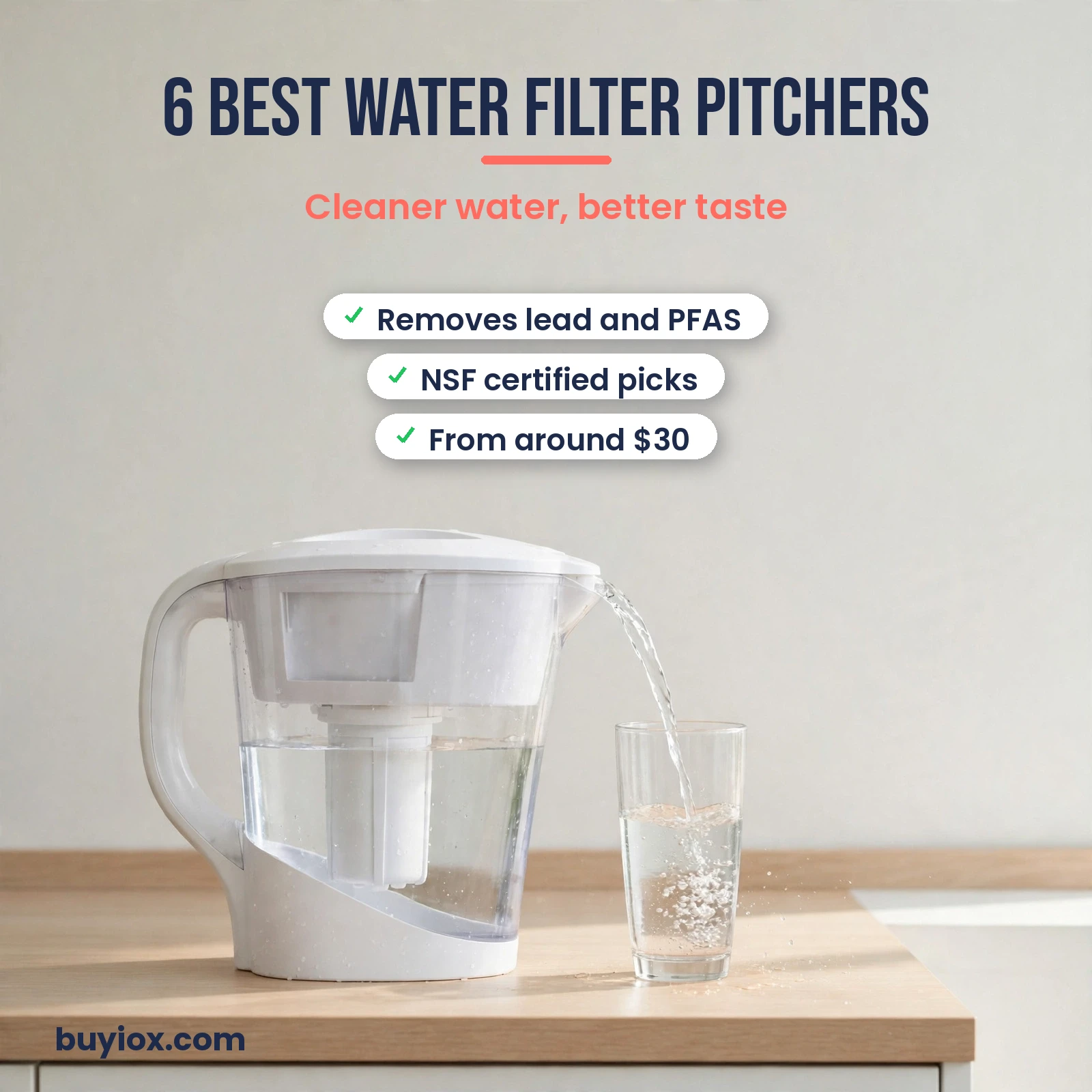
We researched the six best water filter pitchers on the market right now, from the $30 everyday classic to the premium pitcher that targets hundreds of contaminants. Every pick below was checked against its certification claims, its filter life, and what it actually costs to run for a year. Here is the honest breakdown, including who each pitcher suits and who should skip it.
https://buyiox.com/wp-content/uploads/2026/11/wfp-featured.webp
Our Top 6 Water Filter Pitchers at a Glance
- Brita Elite Everyday Water Filter Pitcher – Best overall, the safe default pick
- PUR Plus Water Filter Pitcher 11-Cup – Best value, cheapest way to cut lead
- ZeroWater 10-Cup Ready-Pour Water Filter Pitcher – Best for TDS and PFAS, with a meter to prove it
- Clearly Filtered Water Filter Pitcher – Best for PFAS and lead, premium protection
- Aquagear Water Filter Pitcher – Best filter life, fewest replacements
- LifeStraw Home Water Filter Pitcher – Best for bacteria and parasites
1. Brita Elite Everyday Water Filter Pitcher – Best Overall
https://buyiox.com/wp-content/uploads/2026/11/wfp-prod-1.jpg
Brita Elite Everyday Water Filter Pitcher (product-style image)
Brita is the name most people think of first, and the Elite Everyday is the reason why. This is the 10-cup pitcher with the Elite filter, and it is the one Brita pitch to buyers who care about more than taste. The Elite filter is WQA certified to NSF/ANSI standards, and the listing claims it reduces 99 percent of lead plus 30 contaminants including chlorine taste and odor and microplastics. That lead claim is the big one. A standard Brita filter only handles taste and chlorine. The Elite filter is the version that goes after health contaminants too.
Day to day, it is also the easiest pitcher on this list to live with. The 10-cup capacity fills about three reusable bottles, it fits in most fridge doors, and the SmartLight indicator on the lid tells you when the filter needs changing instead of leaving you to guess. The Elite filter lasts about six months or 120 gallons, which is three times longer than a standard Brita filter. That long life is what keeps the yearly running cost low, even though the pitcher itself costs more than the basic Brita models.
Why we like it
- Reduces 99 percent of lead, plus chlorine taste and microplastics, per the listing
- Elite filter lasts about 6 months or 120 gallons, so replacements are rare
- SmartLight indicator removes the guesswork on filter changes
- 10-cup capacity suits most households and fits in most fridges
- BPA-free, and the most widely available pitcher here, with filters sold everywhere
Pros
- The safest default pick: strong certification, strong lead reduction, easy to find
- Lowest yearly filter cost of any pitcher on this list
- Simple flip-top lid makes refilling under the tap quick
Cons
- Costs more up front than the basic Brita or the PUR Plus
- Does not remove fluoride, bacteria or viruses
- Filtration is slower than a basic carbon pitcher, so refills take a little patience
Price: around $45 on Amazon
Best for: almost every household, especially anyone who wants solid lead reduction without thinking hard about certifications.
Who should skip it: buyers who specifically need fluoride removal or bacteria protection, where the Clearly Filtered or LifeStraw Home pitchers are the better tools.
2. PUR Plus Water Filter Pitcher 11-Cup – Best Value
https://buyiox.com/wp-content/uploads/2026/11/wfp-prod-2.jpg
PUR Plus Water Filter Pitcher 11-Cup (product-style image)
If the Brita Elite is the safe default, the PUR Plus 11-Cup is the smart budget buy. At around $30 it is the cheapest pitcher on this list, and it still does the job that matters most: its lead-reducing PUR Plus filter is NSF and WQA certified, and it cuts lead, chlorine taste and odor. The 11-cup capacity is the largest here, which matters for families who refill the pitcher several times a day and do not want to stand at the tap every hour.
The design is practical rather than pretty. The LockFit cap clicks shut so the lid does not fall off when you pour, the filter change light on the lid reminds you when to swap the cartridge, and the whole pitcher is dishwasher safe, which is a small thing until you try to clean a pitcher that is not. The trade-off is filter life. A PUR Plus filter lasts about 2 months or 40 gallons, so you will buy roughly six filters a year. That is still cheap in total, but it is more hands-on than the Brita Elite’s twice-a-year rhythm.
Why we like it
- Cheapest pitcher here at around $30, with real lead reduction, not just taste
- 11-cup capacity, the largest on this list, suits families
- LockFit cap stays on while pouring, and the pitcher is dishwasher safe
- Filter change light tells you when to swap the cartridge
- NSF and WQA certified lead-reducing filter
Pros
- Best value pick by a clear margin
- Big capacity means fewer refills per day
- Easy to clean and easy to find replacement filters
Cons
- Short filter life: about 2 months or 40 gallons, so six filters a year
- Less PFAS coverage than the premium pitchers here
- Plainer design and slower pour than the Brita Elite
Price: around $30 on Amazon
Best for: families and budget buyers who want lead reduction at the lowest up-front price, and anyone with a big household that refills often.
Who should skip it: buyers who hate changing filters often, or who want the strongest PFAS protection, where the ZeroWater or Clearly Filtered pitchers are better.
3. ZeroWater 10-Cup Ready-Pour Water Filter Pitcher – Best for TDS and PFAS
https://buyiox.com/wp-content/uploads/2026/11/wfp-prod-3.jpg
ZeroWater 10-Cup Ready-Pour Water Filter Pitcher (product-style image)
ZeroWater is the only pitcher on this list that shows you its work. Every 10-Cup Ready-Pour pitcher ships with a TDS meter, a small device that measures total dissolved solids in your water. Test the tap, test the filtered water, and the meter reads 000 on fresh filtered water. That visible proof is why this pitcher has such a loyal following, and it is also the honest way to know when the filter is spent: when the reading climbs, it is time to change it.
The filtration is a 5-stage ion-exchange system, and the listing says it is IAPMO certified to reduce lead, chromium and PFOA/PFOS. That PFAS claim is the one that sets it apart from the budget pitchers. The trade-off is filter life and running cost. Each filter is rated for about 15 gallons, and far less in hard water with high dissolved solids. In a hard-water home you can burn through a filter in two to three weeks, and at around $15 per cartridge that adds up fast. ZeroWater is the best pitcher here for what it removes, and the most expensive to run.
Why we like it
- Included TDS meter proves the filter is working, and tells you exactly when to change it
- IAPMO certified to reduce lead, chromium and PFOA/PFOS
- Produces a genuine 0 TDS reading on fresh filtered water
- Ready-Pour spout lets you pour while the top reservoir is still filtering
- Great for coffee and tea, where dissolved solids change the taste
Pros
- Strongest visible proof of filtration on this list
- Best PFAS claim at this price point
- Excellent taste, especially for hard or heavily mineralized tap water
Cons
- Highest running cost here: filters last about 15 gallons, much less in hard water
- Strips out minerals too, so the water can taste flat to some people
- Slow to filter, and the pitcher is bulky in a small fridge
Price: around $35 on Amazon
Best for: homes with hard water or high dissolved solids, PFAS-conscious buyers on a budget, and coffee lovers who want the cleanest possible water for brewing. If you make coffee daily, pair it with a good coffee maker and the difference is easy to taste.
Who should skip it: anyone with very hard water who does not want to buy filters every few weeks, or buyers who want the lowest yearly cost, where the Brita Elite wins.
4. Clearly Filtered Water Filter Pitcher – Best for PFAS and Lead
https://buyiox.com/wp-content/uploads/2026/11/wfp-prod-4.jpg
Clearly Filtered Water Filter Pitcher (product-style image)
Clearly Filtered is the premium pick, and it is priced like one at around $110. What you get for that money is the widest contaminant coverage on this list. The company says its Affinity filtration targets 386+ contaminants, and the pitcher is independently tested to NSF/ANSI standards 42, 53, 401 and 473, covering taste, lead, emerging contaminants and PFAS. The headline numbers are lead reduction of 99.5 percent, fluoride reduction of around 98 percent, and PFAS reduction of around 99.7 percent, all from the maker’s published lab testing.
The filter lasts about 100 gallons, or around four months for a typical household, and replacement filters run around $50 to $60 each. That makes the yearly cost the highest here after ZeroWater, but the per-gallon cost is far lower than ZeroWater’s because the filter lasts so much longer. The other trade-off is speed. This is the slowest pitcher on the list to filter a full reservoir, so you fill it and wait rather than expecting instant water. For buyers whose main worry is what is actually in their water, that wait is a fair price.
Why we like it
- Widest contaminant coverage here: 386+ targets including lead, fluoride, PFAS, arsenic and microplastics
- Independently tested to NSF/ANSI 42, 53, 401 and 473
- One of the only pitchers here that genuinely reduces fluoride, around 98 percent per the maker
- 100-gallon filter life keeps the yearly cost reasonable for a premium pitcher
- Clear body lets you see the water level and the filter at a glance
Pros
- Best PFAS and lead protection on this list
- Only premium pitcher here that also tackles fluoride
- Long filter life for its class
Cons
- Most expensive pitcher here at around $110, with $50 to $60 replacement filters
- Slowest filtration speed on this list
- Only sold direct from Clearly Filtered or Amazon, so fewer places to compare prices
Price: around $110 on Amazon
Best for: buyers who know their water has lead or PFAS concerns, families who want the most thorough filtration a pitcher can offer, and anyone who wants fluoride reduction without installing a whole system.
Who should skip it: budget buyers, and anyone who mainly wants better taste, where the Brita Elite or PUR Plus does the job for a third of the price.
5. Aquagear Water Filter Pitcher – Best Filter Life
https://buyiox.com/wp-content/uploads/2026/11/wfp-prod-5.jpg
Aquagear Water Filter Pitcher (product-style image)
Aquagear wins the long game. Each filter is rated for 120 gallons, about six months of normal use, which ties the Brita Elite for the longest filter life on this list. The filter is independently tested to NSF/ANSI 42 and 53 standards, and the company says it removes lead, chlorine, PFOA/PFOS and microplastics, plus about 90 percent of fluoride. That fluoride claim is unusual for a pitcher at this price, and it is the reason many buyers choose Aquagear over the bigger brands.
The pitcher itself is a straightforward 10-cup design with a white filter cartridge you can see through the clear body, and the filter media is made in the USA. Aquagear also runs a filter recycling program: they send a postage-paid label so you can return spent filters instead of throwing them away, which is a real plus if you dislike the waste of disposable cartridges. The downsides are price and pace. At around $70 the pitcher costs more than the Brita or PUR, replacement filters run around $50 each, and filtration is slower than the budget pitchers. But because each filter lasts six months, the yearly cost stays in the middle of the pack.
Why we like it
- 120-gallon filter life, about 6 months, tied for the longest here
- Company says it removes about 90 percent of fluoride, rare at this price
- Tested to NSF/ANSI 42 and 53 standards, with lead, chlorine, PFOA/PFOS and microplastic reduction
- Filter media made in the USA, and spent filters can be returned for recycling
- BPA-free pitcher with a clear body and visible filter
Pros
- Fewest filter changes of any pitcher here, so the lowest hassle
- Strong all-round contaminant coverage for the price
- Recycling program cuts the waste of disposable filters
Cons
- Replacement filters cost around $50 each, so each change stings
- Slower filtration than the budget pitchers
- Less widely stocked than Brita or PUR, so filters are harder to find locally
Price: around $70 on Amazon
Best for: buyers who want long filter life and fluoride reduction without paying Clearly Filtered prices, and anyone who hates changing filters every two months.
Who should skip it: buyers on a tight budget, where the PUR Plus costs less than half up front, and anyone who needs the fastest possible refill.
6. LifeStraw Home Water Filter Pitcher – Best for Bacteria and Parasites
https://buyiox.com/wp-content/uploads/2026/11/wfp-prod-6.jpg
LifeStraw Home Water Filter Pitcher (product-style image)
LifeStraw Home is the only pitcher on this list built for a different job. The other five pitchers are chemical filters: they catch lead, chlorine, PFAS and taste. LifeStraw Home adds a 0.2 micron membrane microfilter, and the maker says that membrane blocks bacteria, parasites and microplastics, while its carbon and ion-exchange filter reduces lead, mercury, PFAS and other chemicals. No other pitcher here makes a bacteria claim at all, which makes this the pick for well water, rural water, or anyone who simply wants that extra layer.
There are two filters to maintain, and that is the honest catch. The carbon filter lasts about 40 gallons, or around two months, and costs around $17 to replace. The membrane filter lasts about 264 gallons, or around a year, and costs around $25. Together that works out to roughly $127 a year in filters for a household drinking about 240 gallons, the highest running cost here alongside ZeroWater. Also worth knowing: a search of the NSF database found no NSF listing for this model, so the bacteria and parasite claims are maker-stated and tested to the NSF P231 protocol rather than NSF certified. That does not make them false, but it means you are trusting the maker’s own testing rather than an independent certification listing.
Why we like it
- Only pitcher here with a membrane filter that the maker says blocks bacteria, parasites and microplastics
- Also reduces lead, mercury and PFAS through its carbon and ion-exchange filter
- Membrane filter lasts about a year, so only the cheap carbon filter needs frequent changes
- 10-cup capacity, BPA-free, and available in several colours
- Good pick for well water or rural supplies where bacteria is a real concern
Pros
- Unique protection no other pitcher here offers
- Two-stage design separates chemical filtering from microbe filtering
- Attractive design that looks good on a kitchen counter
Cons
- Two filters to track and replace, with a high yearly running cost
- No NSF listing found for this model, so the bacteria claims rest on maker testing
- Does not remove fluoride, and the carbon filter needs changing every two months
Price: around $50 on Amazon
Best for: well-water households, rural homes, and anyone whose main worry is bacteria and parasites rather than just taste.
Who should skip it: city-water households with treated municipal water, where the membrane adds cost without adding much, and buyers who want a single-filter pitcher.
Water Filter Pitcher Comparison Table
| Pitcher | Best For | Capacity | Filter Life | Certifications | Around Price |
|---|---|---|---|---|---|
| Brita Elite Everyday | Most households, lead reduction | 10 cups | 6 months / 120 gallons | WQA certified to NSF/ANSI standards, 99% lead | ~$45 |
| PUR Plus 11-Cup | Budget, families | 11 cups | 2 months / 40 gallons | NSF and WQA certified, lead reducing | ~$30 |
| ZeroWater 10-Cup | TDS and PFAS, proof by meter | 10 cups | About 15 gallons | IAPMO certified, lead, chromium, PFOA/PFOS | ~$35 |
| Clearly Filtered | PFAS, lead and fluoride | 10 cups | About 100 gallons | Tested to NSF/ANSI 42, 53, 401, 473 | ~$110 |
| Aquagear | Long filter life, fluoride | 10 cups | 6 months / 120 gallons | Tested to NSF/ANSI 42 and 53 | ~$70 |
| LifeStraw Home | Bacteria and parasites | 10 cups | Carbon 40 gal, membrane 264 gal | Maker-tested to NSF P231 protocol | ~$50 |
Buying Guide: How to Choose the Right Water Filter Pitcher
A water filter pitcher looks simple, but the wrong pick wastes money twice: once on the pitcher, and again on filters that do not fix your actual problem. Match the pitcher to your water, not to the prettiest listing.
1. Start with what is actually in your water
Every public water system in the US must send customers a Consumer Confidence Report each year, usually by July 1, and most post it online. Read yours before you buy. It lists what was detected in your water and at what levels. If lead shows up, you need a pitcher certified for lead. If PFAS shows up, you need one tested for PFOA and PFOS. If everything is within limits and you just hate the taste, any good carbon pitcher will do. Guessing wastes money; a free report tells you the answer.
2. Learn the three NSF numbers that matter
NSF certification is not one thing. It is a set of standards, and the number tells you what the filter was actually tested for. NSF explains that the most common certifications for filtration systems are NSF/ANSI 42, 53 and 401, and each one covers a different category.
NSF/ANSI 42 covers aesthetic effects: chlorine, taste and odor. It says nothing about health contaminants. A pitcher certified only to 42 will make your water taste better and nothing more. NSF/ANSI 53 covers health effects: lead, mercury, volatile organic compounds, cysts and PFAS. This is the standard that matters if you have a health concern. NSF/ANSI 401 covers emerging contaminants: trace pharmaceuticals, pesticides and herbicides that are not yet federally regulated. A good rule of thumb is simple: if the box only says “NSF certified” without a number, ask which standard. If it says 42 only, it is a taste filter. If it says 53, it is a health filter.
https://buyiox.com/wp-content/uploads/2026/11/wfp-in1.webp
3. Count the real cost: filter life beats sticker price
The cheapest pitcher is rarely the cheapest to own. The PUR Plus costs around $30, but its filter lasts 40 gallons, so a household drinking 240 gallons a year buys six filters. The Brita Elite costs around $45, but its filter lasts 120 gallons, so the same household buys two. ZeroWater looks cheap at around $35, but at 15 gallons per filter in hard water, it can cost more per year than the Clearly Filtered pitcher that costs $110 up front. Before you buy, multiply the replacement filter price by how many you will need in a year. That number is the real price of the pitcher.
4. Check capacity and fridge fit
Most pitchers here hold 10 cups, which is about 2.4 litres, but remember that only part of that is filtered water ready to pour. The top reservoir holds unfiltered water waiting to drip through, so the usable amount is smaller than the headline number. The PUR Plus holds 11 cups, the most here, and suits families. Before you buy, measure your fridge shelf height and door space. A tall pitcher that does not fit in the fridge ends up living on the counter, where warm water and sunlight are a bad combination for a filter.
5. Think about flow speed and taste
Premium filters are slower. The Clearly Filtered and Aquagear pitchers take noticeably longer to filter a full reservoir than the Brita or PUR, because their denser filter media catches more. That is a fair trade if you need the extra filtration, but it is annoying if you only want better taste. Also know that the most aggressive filters, like ZeroWater, strip out minerals along with contaminants, and some people find the resulting water tastes flat. If you love the taste of mineral water, a standard carbon pitcher may suit you better than a zero-TDS pitcher.
6. Pair the pitcher with the rest of your kitchen
Filtered water improves everything you make with water, not just the glass you drink. It makes a real difference in tea and coffee, so if you brew daily, filtered water plus a good electric kettle gives you a noticeably cleaner cup. It also travels well: fill a insulated water bottle from the pitcher in the morning and you carry clean water all day instead of buying bottled water. Small habits like these are where a pitcher pays for itself fastest.
https://buyiox.com/wp-content/uploads/2026/11/wfp-in2.webp
What Water Filter Pitchers Cannot Do: An Honest Answer
A pitcher is a good tool with clear limits, and honest sellers say so. No pitcher on this list removes bacteria or viruses from unsafe water, except for the LifeStraw Home, whose membrane is made for that job. No pitcher softens hard water or removes dissolved minerals in general, except ZeroWater, which strips nearly everything. No pitcher removes fluoride unless it is specifically designed to, and only the Clearly Filtered and Aquagear pitchers here make that claim.
Three honest rules:
- Never use a pitcher on water that is not already treated or known to be microbiologically safe, unless the pitcher is specifically made for that, like the LifeStraw Home. A pitcher is a polisher, not a purifier for unsafe water.
- Change the filter on schedule. An old filter does not just stop working, it can become a home for bacteria and start releasing trapped contaminants back into the water.
- Keep the pitcher in the fridge and wash it regularly. Warm, damp filters grow things, and a pitcher left on a sunny counter is the worst place for one.
If your water has a serious problem, like a boil-water notice, a failed well test, or very high lead levels, a pitcher is not the answer. Talk to your water provider or a local water treatment professional about a certified point-of-entry system or a reverse osmosis unit. A pitcher is for making good water taste better and safer, not for fixing bad water.
Frequently Asked Questions
Do water filter pitchers remove lead?
Some do, and some do not. It depends on the filter, not the pitcher shape. Pitchers with filters certified or tested to NSF/ANSI 53 for lead, like the Brita Elite, PUR Plus and Clearly Filtered models here, are designed to reduce lead. A basic carbon pitcher certified only to NSF/ANSI 42 for taste will not reliably remove lead. Always check the certification number and the specific lead claim before you buy, and if your water test shows high lead, confirm the claim in the NSF or WQA certification database.
Do water filter pitchers remove PFAS?
The better ones do, but not all of them. PFAS reduction sits under NSF/ANSI 53, so look for a pitcher tested to that standard with a named PFOA/PFOS claim. The Clearly Filtered pitcher is tested to NSF/ANSI 53 and 473 for PFAS, and ZeroWater is IAPMO certified to reduce PFOA/PFOS. Budget pitchers with only NSF 42 certification do not make a PFAS claim. The EPA set enforceable limits of 4.0 parts per trillion for PFOA and PFOS, so if PFAS is your main worry, buy a pitcher with a named PFAS claim, not just a general “reduces contaminants” label.
How often should I change a pitcher filter?
Follow the maker’s rated life, and change it sooner if the water starts tasting off or the flow slows down. As a guide: Brita Elite and Aquagear filters last about 6 months or 120 gallons, Clearly Filtered lasts about 100 gallons, PUR Plus lasts about 2 months or 40 gallons, and ZeroWater lasts about 15 gallons, much less in hard water. LifeStraw Home has two filters: carbon about 40 gallons, membrane about 264 gallons. Never stretch a filter far past its rated life, because an exhausted filter can release trapped contaminants back into the water.
Do water filter pitchers remove fluoride?
Most do not. Fluoride is very hard to remove with a standard carbon filter, and most pitcher makers do not even try. The exceptions on this list are Clearly Filtered, which the maker says removes around 98 percent of fluoride, and Aquagear, which the company says removes about 90 percent. If fluoride removal is your main goal, check the specific claim and the test data, and be ready to pay more, because fluoride-capable filters cost more to make and to replace.
Is filtered pitcher water as good as bottled water?
For taste and for the contaminants a good pitcher is certified to remove, yes, and often better. Bottled water is also regulated, but it is not automatically cleaner than tap water, and it costs far more per gallon and creates plastic waste. A pitcher with a certified filter gives you similar or better water for pennies per gallon. The one thing bottled water does that a pitcher does not is travel well, so fill a reusable bottle from the pitcher instead of buying single-use bottles.
Why does my filtered water still taste funny?
Three common causes. First, the filter may be exhausted: change it and the taste usually clears up. Second, the pitcher itself may need a wash: residue builds up in the reservoir and lid, so wash it with warm soapy water every week or two. Third, the problem may be something the filter is not designed to remove, like sulfur, iron or very high mineral content. If a fresh filter and a clean pitcher do not fix the taste, check your water report and consider a filter rated for the specific contaminant.
Do I need to refrigerate a water filter pitcher?
Yes, keep it in the fridge. Cold water slows bacterial growth in the filter, and cold filtered water tastes better anyway. A pitcher left on a warm counter, especially in sunlight, is the worst place for a damp filter. Wash the pitcher regularly, change the filter on schedule, and do not let filtered water sit in the pitcher for days without use.
Our Verdict: Which Water Filter Pitcher Should You Buy?
If you want one pitcher that does the most for the most households, get the Brita Elite Everyday. It cuts lead by 99 percent, its filter lasts six months, and at around $45 it is the safest default pick on this list. If you want the lowest up-front price, the PUR Plus 11-Cup at around $30 gives you real lead reduction and the biggest capacity for families.
For the cleanest possible water with proof, the ZeroWater 10-Cup and its TDS meter show you exactly what the filter removed, though you will pay for it in replacement filters. For the strongest overall protection, the Clearly Filtered pitcher is the premium pick, with the widest contaminant coverage and real fluoride reduction. For the longest filter life, the Aquagear pitcher ties Brita at 120 gallons and adds fluoride removal. And for well water or bacteria worries, the LifeStraw Home is the only pitcher here with a membrane filter made for that job.
Whatever you choose, remember the two rules that matter most: buy the certification that matches your water, and change the filter on schedule. A good pitcher is one of the cheapest upgrades in any kitchen, and the glass of water you drink tomorrow will taste the difference.
Was this guide helpful? Share it with someone who still buys bottled water by the case. And if you try one of these pitchers, come back and tell us how your tap water tastes now – your experience helps other readers choose with confidence.